
Fake Crypto Payments: What to Check Before Handing Over Goods

 Prefer us on Google


If a buyer says the crypto is in your wallet, do not accept it as payment until you have checked the token contract, the network and whether it can be sold; if deceived, keep the evidence and report it. WEEX does not offer services to residents of Iran. Clause 1.1(d)(ii) of the WEEX Terms of Use (updated 7 July 2026) says residents of Iran may not open accounts or access WEEX services. A wallet entry proves neither value nor saleability.
From a wallet notification to a real payment: four checks, in this order
Four checks separate "a token showed up in my wallet" from "a payment was made". The order matters, because each step is meaningless without the one before it.
- Identify the token precisely. Ask the buyer for the full name, the symbol and the network the transfer was sent on. Names and symbols are shared across different tokens; a familiar-looking symbol in your wallet does not mean it is the asset you recognise.
- Match the contract address against the project's own source. A contract address is the string that uniquely identifies one token on one network. Take it from the project's official site or documentation and compare it character by character with the address recorded in your wallet. A direct message, a Telegram channel or an image the buyer sends is not an official source.
- Look at the transaction on a block explorer. A block explorer is a public site that shows the transactions and contracts on a network. Using the transaction hash — its unique identifier — check which token, at which contract address, reached your address and when. A recorded transaction only says a transfer happened; it says nothing about value.
- Check liquidity. Find out whether the same token, at the same contract address, trades anywhere with real buyers for your amount. Look at order-book depth and the gap between the buy and sell price. A number shown by a wallet or in a screenshot from the buyer is not a substitute for this check.
If the fourth check has no clear answer, what you received is not a payment; it is an entry in a wallet. The agreed price also has to be measured in the same token on the same network: market value moves during the day, and a single moment's figure is not the measure of your deal.
The 25 Mehr 1405 report: what was said, and what was not
On 25 Mehr 1405 (17 October 2026), Tasnim news agency, quoting Brigadier General Davoud Moazami Goudarzi, chief of Tehran's FATA police, reported that a number of citizens were defrauded after listing cars for sale on Divar and Sheypur: the other party won the seller's trust by offering to pay for the car in crypto, then took delivery after sending fake, worthless assets to the seller's wallet. The same report says two suspects were arrested in a southern district of Tehran after judicial procedures, and that there were 15 victims.
IRIB News published the same account with the same advice on the same date (25 Mehr 1405 / 17 October 2026). These statements reached the public through those two news reports and are attributed to the chief of Tehran's FATA police.
The reports name no token, symbol, network or contract address. Nothing can therefore be said about which token was used in this case or what its characteristics were; what a reader can act on is the method of checking, not a particular name. The police chief's advice in those same reports is clear: do not hand over a car or other property before confirming the validity and value of the asset received (Tasnim, 25 Mehr 1405 / 17 October 2026).
What to ask the buyer before handing over a car or any goods
- Get the token details in writing. Ask for the full name, contract address and network in a message, and compare that address with the project's official source. If the buyer sends only a symbol, or avoids giving a contract address, hold the handover.
- Fix the unit of payment. Agree on one specific token, one specific network, and an amount expressed in that same unit. "An amount equivalent to X" is not "a set number of tokens"; price movement and network fees can open a meaningful gap.
- Look at the market yourself. Test the buyer's claim about a market or a price against an independent source. A screenshot or a wallet notification is not evidence; a transaction hash and a contract address are what can be checked on a block explorer.
- A wallet notification is not a transaction hash. A notification that arrives on your phone displays a state; the only thing tied to the network, and checkable, is the transaction hash. If the buyer will not give a hash, there is no transfer to check.
- Treat pressure for immediate handover as a signal. When you are given no time to check, that hurry is itself a reason to wait.
If any part of these checks cannot be done, do not hand over the goods. That is what the chief of Tehran's FATA police said in the 25 Mehr 1405 (17 October 2026) report: delivery of a car or other property should wait until the validity and value of the asset received is confirmed (Tasnim).
-- Price
How is a worthless asset different from a fabricated transaction?
Two failure shapes are possible in a case like this, and the reports do not say which occurred. In the first, the transfer really is recorded on the network but the asset is a token with no market and no real buyers; the wallet shows a number and selling is impossible. In the second, the notification or the transaction image was fabricated and no transfer took place on the network. Both are cleared up the same way: look up the transaction hash and the contract address on a block explorer, then check the market independently.
Keep one sentence beside all of this: a confirmed transaction is not a confirmed payment. Confirmation only says a network recorded a string; it does not say that string has value, has a buyer, or equals the agreed price.
If you were deceived: preserve the evidence and report it
In the 25 Mehr 1405 (17 October 2026) report, the chief of Tehran's FATA police asked citizens to report suspicious cases on 096380 or through the official FATA portal (Tasnim; IRIB News).
Before you call, gather the evidence; this list is practical guidance on what to keep:
- your own wallet address and the network the transfer was sent on;
- the transaction hash and the contract address of the token you received;
- the full conversation with the buyer, including the payment offer and the handover time;
- the listing text and images, the date and place of handover, and any document or receipt exchanged.
Do not send more assets to the same destination, and never give a wallet recovery phrase or private key to anyone — not to someone offering to "return" your assets, and not in a form or site set up for that purpose. Enter an account password or one-time code only on the official page of the service it belongs to.
This article is general fraud-prevention guidance and does not replace a police investigation or a court process.
Published 19 October 2026 · Published by WEEX · WEEX Learn
This content is provided for general informational purposes only and doesn't constitute financial, investment, legal, or tax advice. Any events, rewards, online promotions, or related information mentioned herein should not be considered a recommendation, solicitation, or invitation to purchase, sell, trade, or otherwise deal in any crypto assets. Crypto assets are highly volatile and may result in loss. The availability of WEEX services, products, and related events may vary by region. You are responsible for ensuring that your participation is in accordance with applicable local laws and regulations.
You may also like
What Is Blockchain Interoperability? How Cross-Chain Bridges and Messaging Work
Best Crypto Trading Strategies for Beginners: What to Know Before You Trade
WEEX Broker Models: Strategy Bots, Copy Trading and Sub-Exchanges
What Is Orca (ORCA) Crypto? The Solana DEX, USDY Liquidity, and the ORCA Name Confusion
What Is a Decentralized Crypto Exchange (DEX)? How It Works, Costs, Risks, and When to Use One
How to Day Trade Crypto for Beginners: Fees, Hours, Risk Math
Self-Custody Wallets: When a Crypto Transfer Must Be Reported to Brazil's Coaf
WEEX Grid Trading: When a Grid Strategy Works and When It Fails
Ethereum Futures Trading: How to Size ETH Positions and Read PnL
What Is a White Label Crypto Exchange? A Complete Beginner's Guide
Is Hyperliquid Safe? Risks You Should Know Before You Trade

What a Blockchain Explorer Can and Cannot Tell You
How to Look Up a Wallet Address and Transaction History
How to Verify a Crypto Transaction With a Blockchain Explorer?
BTC Futures Trading on WEEX: Claim BTC Rewards Before Sep 25
What Is a Funding Rate? How Perpetual Futures Charge Longs and Shorts
Perpetual Futures for Beginners: Margin, Funding and Liquidation Explained
What the LUSD Attack Shows About DeFi Risk
What Is BONK? WEEX Spot and 1000BONK Futures Status and Risk Checks
What Is BRETT? WEEX Spot and Futures Status and Risk Checks
What Is FLOKI? WEEX Spot and 1000FLOKI Futures Status and Risk Checks
What Is WIF (dogwifhat)? WEEX Spot and Futures Status and Risk Checks

Who Is Attending TOKEN2049 Singapore 2026? Top Speakers, Exchanges and Exhibitors to Watch
USDC on Arc: What Circle's Mainnet Launch Changes for Holders
SpaceX Stock Futures: Where to Put Stops on a 115% Range
How to Trade Microsoft (MSFT) Stock Token with USDT on WEEX
How to Trade Apple (AAPL) Stock Token with USDT on WEEX
Crypto Futures Trading Explained: Leverage, Funding, Liquidation
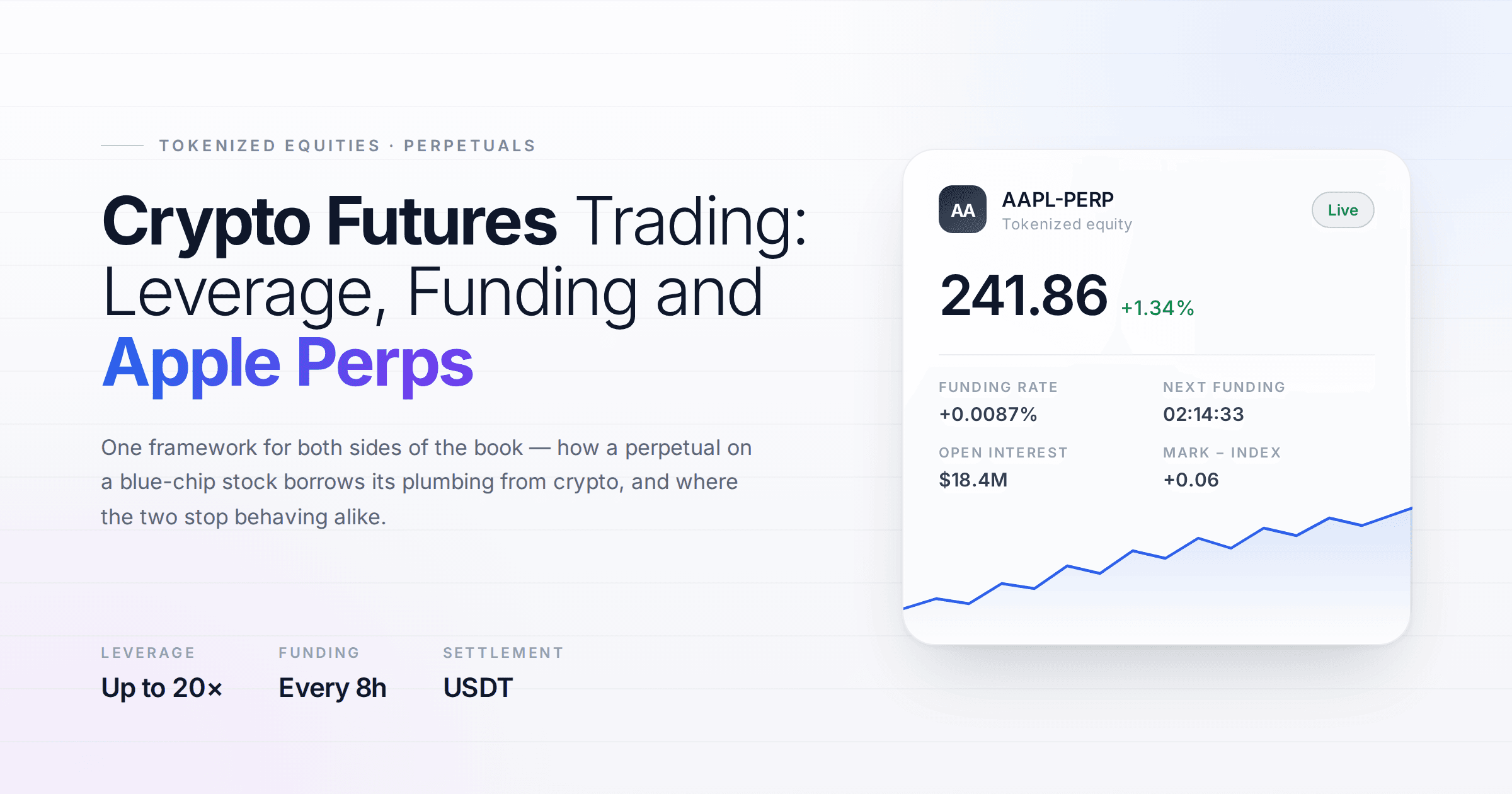
Crypto Futures Trading: Leverage, Funding and Apple Perps
How to Trade Tesla (TSLA) Stock Token with USDT on WEEX: A Trading Guide for Beginers in 2026
What Is Blockchain Interoperability? How Cross-Chain Bridges and Messaging Work
Best Crypto Trading Strategies for Beginners: What to Know Before You Trade
WEEX Broker Models: Strategy Bots, Copy Trading and Sub-Exchanges
What Is Orca (ORCA) Crypto? The Solana DEX, USDY Liquidity, and the ORCA Name Confusion
What Is a Decentralized Crypto Exchange (DEX)? How It Works, Costs, Risks, and When to Use One
How to Day Trade Crypto for Beginners: Fees, Hours, Risk Math


