How to Earn Passive Income with USDC: WEEX Launches Flexible USDC Staking

By: WEEX|2026-03-03 10:45:00
0
Share
copy

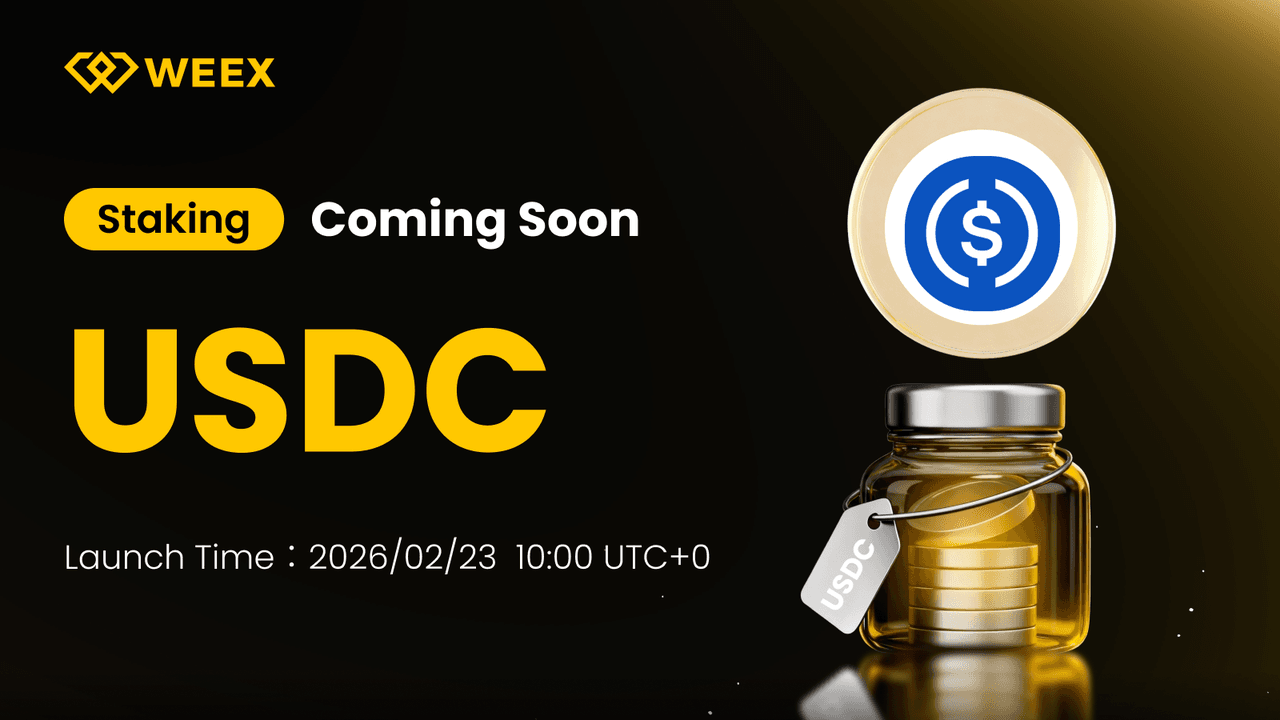
WEEX officially introduces USDC Staking, a flexible and stable earning product designed for users who want to grow their digital assets efficiently while maintaining liquidity. With competitive APR, low entry threshold, and flexible redemption, USDC Staking provides a simple and secure way to generate passive income directly within the WEEX ecosystem.

Whether you are an active trader optimizing idle capital or a long-term holder seeking steady returns, WEEX USDC Staking is built to enhance capital efficiency in all market conditions.

How to Earn Passive Income with USDC: WEEX Launches Flexible USDC Staking

What Is USDC Staking and How Does It Work on WEEX?

WEEX USDC Staking is a flexible earning product that enables users to generate passive income by staking their USDC directly on the WEEX platform. By participating, users receive a competitive annual percentage rate (APR) while maintaining convenient access to their funds.

Designed for simplicity and efficiency, WEEX USDC Staking allows seamless subscription and redemption within the WEEX App and Web. There is no need for on-chain transfers, external wallets, or complex DeFi operations — users can start earning with just a few clicks from their WEEX account.

Why Stake USDC? Benefits of Earning Yield on Stablecoins

Stablecoins play a crucial role in digital asset portfolios. USDC, as one of the most widely adopted stable assets, is widely used as trading collateral, a hedging tool during volatile market conditions, and a core asset for capital allocation across different strategies. Its price stability makes it an essential component for both active traders and long-term investors managing risk exposure.

However, idle USDC often generates no return. WEEX USDC Staking addresses this inefficiency by allowing users to earn yield on their stable assets without sacrificing liquidity or flexibility. By transforming dormant capital into productive assets, it enhances overall capital efficiency — delivering value in both bullish and bearish market cycles.

USDC Staking APR, Flexibility, and Key Advantages on WEEX

WEEX USDC Staking offers a competitive and stable 3.5% APR, allowing users to earn consistent returns on their USDC holdings without exposure to significant market volatility. Compared with major platforms such as Coinbase, WEEX provides a market-competitive yield designed to enhance capital efficiency while maintaining stability. This makes it an efficient solution for generating predictable returns with a conservative risk profile.

The product is designed with flexibility at its core. Users can subscribe and redeem funds based on their liquidity needs, without being restricted by long lock-up periods. This ensures greater control over capital allocation, whether for active trading or strategic portfolio management.

In addition, WEEX USDC Staking is fully integrated within the WEEX ecosystem. All operations are completed directly through the WEEX App or Web, eliminating the need for external wallets or complex DeFi interactions. By transforming idle USDC into yield-generating assets, the product enhances overall capital efficiency while preserving accessibility.

-- Price

--

Who Should Stake USDC? Benefits for Crypto Traders and Long-Term Investors

For active traders on WEEX, USDC Staking provides a way to put idle funds to work. Instead of leaving unused USDC sitting in an account between trades, users can generate yield while maintaining the flexibility to reallocate capital when new market opportunities arise.

For long-term holders and risk-conscious investors, USDC Staking offers a relatively stable income option within the platform. By earning yield on stable assets, users can enhance portfolio performance without taking on additional exposure to price volatility.

Overall, WEEX USDC Staking improves capital efficiency across different user profiles. Whether optimizing short-term liquidity or seeking steady passive returns, users can manage, grow, and access their assets seamlessly within the WEEX ecosystem.

About WEEX

Founded in 2018, WEEX has developed into a global crypto exchange with over 6.2 million users across more than 150 countries. The platform emphasizes security, liquidity, and usability, providing over 1,200 spot trading pairs and offering up to 400x leverage in crypto futures trading. In addition to the traditional spot and derivatives markets, WEEX is expanding rapidly in the AI era — delivering real-time AI news, empowering users with AI trading tools, and exploring innovative trade-to-earn models that make intelligent trading more accessible to everyone. Its 1,000 BTC Protection Fund further strengthens asset safety and transparency, while features such as copy trading and advanced trading tools allow users to follow professional traders and experience a more efficient, intelligent trading journey.

Follow WEEX on social media:

X: @WEEX_Official
Instagram: @WEEX Exchange 
Tiktok: @weex_global 
Youtube: @WEEX_Official 
Discord: WEEX Community
Telegram: WeexGlobal Group

You may also like

WEEX TradFi 2026 Guide: Trade Gold, Oil, and Stocks with Zero Fees

Key TakeawaysWEEX TradFi is a USDT-margined way to trade traditional market price movements inside a crypto-native account, without opening a separate brokerage account or making bank deposits. WEEX’s latest official event page highlights zero fees on gold, stocks, and oil, while other current WEEX TradFi materials also mention zero-fee access across gold, silver, crude oil, and tokenized stock futures. The product supports 24/7 trading, but liquidity can be thinner during weekends and holidays because traditional markets are still the reference point. WEEX TradFi uses USDT only as margin, and the latest event page shows different leverage caps by asset, including up to 400× for XAUT and XAG, 100× for PAXG, and 50× for tokenized stocks. The real value for crypto users is the simplified workflow: one WEEX account, one USDT balance, and access to global markets without switching systems. 

WEEX TradFi is designed for crypto users who want exposure to gold, oil, stocks, indices, and related global markets without leaving a USDT-based workflow. The latest official pages frame it as a crypto-native way to access traditional assets with 24/7 trading, no separate brokerage account, and no bank-funding friction, while the current event page adds a limited zero-fee promotion and a stock bonus offer. That combination makes WEEX TradFi a useful product to understand even if you are not ready to trade today, because it shows how crypto and traditional markets are being brought into one account experience.

Wanna Trade Safe & Fast? Join WEEX and Earn!

What Is WEEX TradFi?

WEEX TradFi is a USDT-margined derivatives product that lets users trade the price movement of traditional assets inside the WEEX platform. WEEX’s current official materials say the product includes gold, silver, crude oil, tokenized stocks, and global indices, and that users do not need a separate brokerage account or bank deposit setup to participate. In other words, the account structure is built to feel familiar to crypto traders while opening the door to traditional market exposure.

That is the core reason WEEX TradFi matters. Instead of forcing a crypto user to learn a separate brokerage interface, switch between platforms, or fund another account through fiat rails, WEEX keeps everything in USDT. The official TradFi pages also describe a no-expiry perpetual structure, which means positions can stay open as long as margin requirements are met. For readers who already understand crypto perpetuals, that structure is much easier to recognize than a traditional brokerage workflow.

Why WEEX TradFi Exists

WEEX TradFi exists because many crypto traders want more than Bitcoin and altcoins. They also want access to macro themes like gold, oil, stocks, and indices, but they want that access inside the same account they already use every day. WEEX’s own explanation is direct: TradFi is meant to remove friction, unify capital flow, and make global markets feel native to crypto users. That is why the platform emphasizes one account, USDT margin, and no need to open a separate brokerage relationship.

The user benefit is not just convenience. It is also workflow consistency. If someone already knows how to place futures orders, set stops, and manage margin in crypto, WEEX TradFi lowers the learning curve for trading non-crypto markets. That is a useful bridge for users who want diversification without leaving a familiar interface.

What the Latest WEEX Event Page Says

The latest official WEEX TradFi event page says the campaign runs under the headline “Trade gold, stocks, and oil with zero fees.” The page also lists a limited event window of May 21, 2026 to May 31, 2026 UTC+8, and it highlights a stock bonus offer of up to $100 futures bonus. Even though that window is time-limited, the page is important because it shows the current positioning of the product: zero fees, one platform, and a USDT-based entry point.

A second current WEEX article is even broader. It says WEEX is running a zero-fee promotion across all TradFi products, including crude oil perpetuals, gold, silver, and tokenized stock futures, and it describes the promotion as a trade-more-earn-more model. That means the current WEEX messaging is not limited to one asset; it is building a wider TradFi story around multiple traditional market categories.

Latest official WEEX TradFi snapshotWhat the page saysWhy it mattersMain campaign themeTrade gold, stocks, and oil with zero feesThe promotion is built around cost reduction.Event timingMay 21, 2026 to May 31, 2026 UTC+8The latest event page is time-bound, so users should always check the current page.Bonus offerUp to $100 futures bonus for stock tradingThe promotion adds reward value beyond fee savings.Margin currencyUSDT onlyUsers do not need fiat margin or a separate banking setup.Account setupNo separate TradFi accountThe workflow stays inside existing WEEX access.Trading rhythm24/7 accessUsers can trade any time, though liquidity may vary around market closures.

For readers interested in the live campaign hub, the event page is here: WEEX TradFi: One-Stop USDT Trading for Gold, Stocks, and Oil. The link is especially useful if you want to verify the latest asset list, fee banner, and event timing before acting.

How WEEX TradFi Works

The official process is simple. You create or log into a WEEX account, deposit USDT, move it into TradFi if needed, and then open a position on the asset you want to trade. WEEX says deposits can be made through on-chain transfers, OTC purchases, or internal transfers, and that you can trade directly from your existing spot or futures balance. That means the platform is not asking you to learn a totally new infrastructure before you start.

WEEX also says TradFi futures support 24/7 trading, which is a major psychological advantage for crypto-native users. A traditional market may reference a closing session, but the WEEX interface remains available all the time. The official FAQ adds one important nuance: liquidity may be lower during weekends and holidays because the underlying traditional markets are closed, so users should expect different market behavior depending on time of day and global market conditions.

What You Can Trade on WEEX TradFi

WEEX TradFi is not just one market. The official pages describe access to gold, silver, crude oil, tokenized stocks, commodities, and global indices. The page also makes clear that the product is built around price movement, not physical ownership. So when you trade gold or oil on WEEX TradFi, you are trading the contract exposure, not taking delivery of metal barrels or stock certificates.

Asset categoryExample products mentioned by WEEXPractical use casePrecious metalsGold, silver, XAUT, XAG, PAXGTrack inflation, macro uncertainty, and safe-haven flows.EnergyCrude oilTrade supply shocks, geopolitics, and inventory-driven moves.StocksTokenized stock futuresFollow earnings, product launches, and equity momentum.Broader macro assetsGlobal indices and commoditiesDiversify beyond pure crypto price exposure.

That asset mix matters because it gives crypto users a way to respond to real-world macro themes without stepping out of the crypto environment. Gold reacts to inflation and uncertainty. Oil reacts to supply, demand, and geopolitics. Stocks react to earnings and risk sentiment. In TradFi, those themes become tradable through a familiar USDT framework.

Fees and Costs: The Part Most Traders Ignore

The current promotion is attractive because it temporarily removes one of the biggest pain points: fees. But even if a user enters through a zero-fee promotion, understanding the normal fee structure is still important. WEEX’s TradFi help center says the product uses two major cost components: trading fees when you open or close positions, and funding fees when you hold positions over time. Trading fees are calculated as position value multiplied by the applicable fee rate.

Funding fees are different. WEEX explains that they are periodic payments between longs and shorts based on market conditions rather than a platform profit line item. WEEX’s newer TradFi education materials also say funding settlements occur every eight hours, typically around 07:00, 15:00, and 23:00 UTC+8, which is especially relevant for anyone holding positions overnight or for several days. That detail matters because a trade can look cheap on entry and still become expensive if funding accumulates.

Cost typeWhen it appliesWhy it mattersTrading feeWhen you open or close a positionAffects the cost of entry and exit.Funding feeWhen positions are held through settlement windowsCan raise or reduce total holding cost depending on market direction.Zero-fee promotionDuring the TradFi promotional periodCan temporarily reduce transaction friction on selected products.

For short-term users, fees mostly matter at entry and exit. For swing traders, the bigger issue is the funding side, because holding through multiple windows can quietly change the return profile. WEEX explicitly warns users to understand fees, trading hours, and risk controls before trading, which is exactly the right mindset for any TradFi product.

Why the Crypto-Native Workflow Is the Main Selling Point

WEEX is not positioning TradFi as a traditional brokerage clone. Its own materials repeatedly say the value lies in the unified crypto-native experience. That means users can trade global markets while staying in a familiar account structure, with familiar margin logic, and without switching to a separate platform or terminal. For crypto users who already understand perpetuals, that feels much more natural than the usual brokerage onboarding flow.

The platform also emphasizes no bank deposits and no separate TradFi account. Those two points are not marketing fluff. They remove two of the biggest barriers that keep many users away from traditional markets in the first place: banking friction and account fragmentation. That is why WEEX TradFi is often described as a bridge between crypto and global markets rather than just another derivatives product.

Leverage, Liquidity, and Risk

Leverage is one of the fastest ways to make TradFi exciting and dangerous at the same time. The current WEEX event page says XAUT and XAG support up to 400× leverage, PAXG supports up to 100×, and tokenized stocks support up to 50×. Those numbers are powerful, but they should be read as maximums, not recommendations. In real trading, position size and risk control matter more than the biggest available multiplier.

WEEX’s own risk language is consistent on this point. The platform warns that TradFi products carry risks such as price volatility, leverage, and liquidity changes, and it says users should understand product rules, fees, trading hours, and risk controls before trading. That warning is especially relevant for lower-liquidity periods, such as weekends and holidays, when the event page says market depth may be thinner.

Risk factorWhat happensPractical takeawayHigh leverageSmall moves can become large gains or lossesUse smaller size than the maximum allows.Lower liquiditySpreads can widen when traditional markets are closedAvoid assuming the same execution quality at all hours.Funding costsHolding positions through settlement windows can add costCheck settlement timing before leaving trades open.Promotion dependenceZero-fee campaigns are temporaryAlways verify current terms on the live event page.Who WEEX TradFi Is Best For

WEEX TradFi is best for users who already think in USDT, futures, and market direction rather than in bank wires and stock certificates. A crypto trader who wants to diversify into gold or crude oil will probably find the workflow familiar. A macro watcher who follows inflation, interest rates, and geopolitics may also appreciate being able to trade those themes from one account. And a user who simply wants more than crypto can get an easier entry point than a traditional brokerage account often provides.

User typeWhy it fitsCrypto-native futures traderSame mental model, same USDT margin, lower learning curve.Macro traderAccess to gold, oil, indices, and stocks in one place.Diversification seekerA way to trade traditional market exposure without opening a brokerage account.Fee-sensitive traderZero-fee TradFi promotion reduces execution friction during the campaign window.

For these users, the real value is not just “more assets.” It is unified capital flow. A single account, a single margin currency, and a single trading interface make it easier to move from a crypto idea to a global-market idea without rebuilding the whole workflow. That is a meaningful product design decision, not just a headline.

How the Product Compares With Traditional Brokerage Thinking

WEEX itself frames TradFi as a simpler alternative to the friction of traditional finance. The company’s materials say users can trade global assets without opening a separate brokerage account, without fiat transfers, and without changing the core crypto-native workflow. That is very different from the usual stock or CFD journey, where account opening, funding, and terminal setup can slow people down before they even place a trade.

WEEX also contrasts its approach with CFD-style products in its own educational content, saying the platform is designed to align more closely with how crypto traders already operate. That matters because a product can be technically powerful and still feel clunky if it makes users relearn the entire trading process. WEEX is clearly trying to avoid that problem.

How to Use the Event Smartly

A smart TradFi user does not start by asking only “What is the zero-fee offer?” The better question is “Which market theme fits my view, and how long do I expect to hold?” If the answer is a short-term trade, trading fees matter most. If the answer is a swing position, funding and liquidity matter more. That is why WEEX’s own fee documentation repeatedly reminds users to review fee rates and settlement rules before holding positions overnight.

The current event page makes the first step straightforward: log in, deposit USDT, transfer into TradFi, and start trading. That simplicity is part of the campaign’s appeal, but it is also the point where users should slow down and read the current rules. Promotions are useful, but execution quality and risk control are what determine whether the trade makes sense.

A Practical Way to Read WEEX TradFi in 2026

The easiest way to understand WEEX TradFi is to treat it as a bridge product. It connects crypto habits to traditional market opportunities, and it does so using USDT, perpetual-style contracts, and a single account. The latest official materials show that the platform is still actively promoting the product, still offering 24/7 access, and still using campaign pricing to reduce friction for selected markets. That combination is exactly why it is relevant now.

For searchers and traders alike, the main takeaway is simple. WEEX TradFi is not just about gold, oil, or stocks. It is about turning those markets into something a crypto user can access without leaving the crypto environment. That is the real product story behind the promotion, and it is the reason this campaign has SEO value beyond a temporary fee event.

Conclusion

WEEX TradFi is a strong example of how crypto platforms are expanding into global market access without abandoning the USDT-native experience. The latest official pages show zero-fee promotion messaging, one-account access, no separate brokerage setup, 24/7 trading, and a broad asset list that includes gold, silver, crude oil, stocks, and indices. For crypto users who want diversification, that is a compelling combination of utility and simplicity.

If you are evaluating the campaign, the next step is to review the live event terms, compare the assets you care about, and decide whether the current fee and bonus structure matches your trading style. The product is designed to be easy to enter, but the best results still come from understanding the market, the costs, and the risk before you click trade.

1. What is WEEX TradFi?

WEEX TradFi is a USDT-margined product that lets users trade the price movement of traditional assets such as gold, silver, crude oil, stocks, and indices inside the WEEX platform. WEEX says users can do this without opening a separate brokerage account.

2. What assets are supported on WEEX TradFi?

The latest official WEEX materials mention gold, silver, crude oil, tokenized stocks, commodities, and global indices. The event page also highlights gold, stocks, and oil as the main campaign focus.

3. Does WEEX TradFi really have zero fees?

The latest official event page says gold, stocks, and oil are offered with zero fees during the campaign window, and another WEEX article says zero-fee promotion also covers gold, silver, crude oil, and tokenized stock futures. Always check the live page because promotions are time-limited.

4. Do I need a separate account or bank deposit to use WEEX TradFi?

No. WEEX says TradFi uses USDT only as margin, no separate TradFi account is required, and users can trade directly from their existing WEEX balance.

5. Is WEEX TradFi suitable for beginners?

It can be, especially for crypto users who already understand futures-style trading and want global market exposure inside a familiar interface. That said, leverage, funding fees, and liquidity changes still create real risk, so beginners should start with small size and read the current rules carefully.

Disclaimer: Trading digital assets and derivatives involves significant risk. WEEX TradFi products also carry risks such as price volatility, leverage, funding costs, and liquidity changes. Promotions, supported assets, leverage caps, and fee terms can change at any time and may vary by region or account status. Always review the latest official WEEX TradFi page and trading rules before trading.

How to Trade Space Stocks on WEEX in 2026: SpaceX IPO & SPCX Guide

You are not here for a 2% dividend yield. You are here because the SpaceX IPO is about to print millionaires. And you are asking yourself: am I early, or did I already miss the rocket?

Since its private funding rounds, SpaceX has done what no aerospace company has ever done. It slashed launch costs by 90%, built Starlink into an $11 billion revenue machine, and now is going public on Nasdaq under the ticker SPCX at a $1.75 trillion valuation.

But here is what most traders miss. While traditional investors fight over IPO allocations, the smart crowd trades space stock futures 24/7 on crypto platforms like WEEX TradFi.

In this guide, we are ditching the Wall Street jargon. You will learn exactly how to trade SpaceX pre-IPO, which space stocks actually matter, and—most importantly—how to get exposure without a US brokerage account.

Why Space Stocks Are Trending in June 2026

Here is a stat that should wake you up. The global space economy is projected to hit 1.8trillionto1.8trillionto2 trillion by 2035–2040. That is not science fiction. That is McKinsey and PwC data.

But the real catalyst? SpaceX just filed its S-1 for a historic June 12 Nasdaq listing. The company aims to raise 75 billion at 135 per share. That is the largest IPO in history.

Space Stocks vs. Space Futures

If you have traded space stocks on traditional brokers like Fidelity or Schwab, you know the pain. The market closes at 4 PM ET. If Elon tweets something at 10 PM on a Sunday, you sit on your hands until Monday morning.

This is where space futures on WEEX TradFi change the game.

td {white-space:nowrap;border:0.5pt solid #dee0e3;font-size:10pt;font-style:normal;font-weight:normal;vertical-align:middle;word-break:normal;word-wrap:normal;}FeatureTraditional Stock BrokerWEEX TradFi FuturesTrading hours9:30 AM – 4:00 PM ET7月24日Short sellingComplex (borrow shares)One clickLeverageNone or limitedUp to 100xMinimum trade~$100 (full share)~$2 (fractional)FundingUSD bank accountUSDT onlyGlobal accessRestricted by regionOpen worldwide

You are not buying the company. You are trading the volatility. And in 2026, space stocks are among the most volatile assets on any exchange.

Best Space Stocks to Watch Before the SpaceX IPO1. SpaceX (SPCX)

Target Valuation: $1.75 trillion – $2 trillion IPO Price: $135 per share Starlink generated $11.4 billion of SpaceX’s $18.67 billion revenue in 2025. The company is also building orbital data centers for AI compute. This is not just a rocket company — it is a communications and AI infrastructure monopoly.

2. Rocket Lab (RKLB)

Recent Move: Up 365% over 52 weeks Backlog: $2.2 billion Rocket Lab is the most immediate public proxy for SpaceX exposure. The company posted $642 million in revenue and recently won a $190 million hypersonic test flight contract with the Department of Defense.

3. AST SpaceMobile (ASTS)

Recent Close: $118.12 (up 337%) Cash Reserves: $3.9 billion ASTS is building the first space-based cellular broadband network that connects directly to unmodified smartphones. Partnerships with AT&T, Verizon, and Vodafone make this a high-conviction long-term hold.

4. Intuitive Machines (LUNR)

Q1 2026 Revenue Growth: Tripled YoY to $186.7 million Backlog Expansion: +$842 million Intuitive Machines made history with the first commercial US moon landing. It was also selected for the US Space Force's Andromeda program for space domain awareness.

5. Firefly Aerospace (FLY)

Recent Raise: $576 million follow-on offering at $48 per share Firefly carved out a niche in medium-lift launches and lunar lander services. Its robust government backlog positions it as a potential acquisition target as capital consolidates.

How to Trade Space Stocks on WEEX: Step-by-Step Tutorial

Ready to stop watching and start trading? Here is exactly how to trade SpaceX pre-IPO, Rocket Lab futures, and other space stocks on WEEX.

Step 1: Deposit your funds

Deposit USDT using your preferred network (TRC20, ERC20, etc.).

Step 2: Search for SPACEXPRE

Head to the Spot page. Type SPACEXPREUSDT. You will see the trading pair.

Step 3: Enter the amount and Buy

Enter the amount you want to buy and then click on BUY to purchase.

Final Thoughts

The space infrastructure market offers a clear split: giants like SpaceX dominate connectivity and deep-space rockets, while specialized players like Rocket Lab, AST SpaceMobile, and Intuitive Machines capture high-margin defense, lunar logistics, and telecom niches.

Spreading capital across both layers—pairing ASTS's cash reserves and carrier deals with RKLB's defense contracts—offers a solid framework to ride this tech cycle. Using high-liquidity stock futures helps execute these trades efficiently. Still, success demands strict risk control and a solid grasp of launch schedules.

Ready to trade? WEEX offers zero fees, instant execution, and the security you need. Sign up on WEEX Now and Start Trading!

Serenity & Leopold & Nvidia & Trump — Who Is the “Shill King”?

The AI boom in the U.S. stock market continues to run hot, with supply chain bottlenecks, foreign investment, and policy catalysts weaving together to form the most compelling narrative. Against this backdrop, a select few highly influential “Shill Kings” have begun to steer market capital flows with their precise stock-picking success rates.From Reddit retail trading gurus to top-tier AI think tanks, from tech giant CEOs to high-profile political figures, whose market influence and stock-picking success rate comes out on top? WEEX Labs provides an in-depth analysis of the performance and strategic logic behind these four key “Shill Kings.” Serenity (@aleabitoreddit): The “Microscopic Shovel” Hunter of WSBAs a highly influential veteran trader on the WallStreetBets (WSB) subreddit, Serenity is a quintessential hardcore technical analyst and grassroots leader, known for his anime avatar and freely shared research.Serenity focuses intently on critical supporting segments within the NVIDIA AI chip supply chain. His core methodology centers on identifying key chokepoints in this ecosystem—specifically, the indispensable “screw-like” components essential to chip manufacturing and packaging. He targets irreplaceable small-cap upstream stocks in sectors such as photonics (CPO), optical interconnects, and HBM, which possess scarcity and pricing power.The performance of three core picks speaks for itself:SIVE (Sivers Semiconductors): Recommended 190 times; since the first public recommendation on March 16, 2026, the stock price has surged 19.6-fold. The company specializes in CPO lasers, which are indispensable core components in the AI optical interconnect sector.AAOI (Applied Optoelectronics): Recommended 123 times; the stock price has risen 5.10-fold since the first recommendation on January 26, 2026. It is a key supplier of high-speed optical modules for AI data centers.AXTI (AXT Inc.): Recommended 70 times, the stock has surged 9.02-fold since its first public recommendation on December 26, 2025. The company specializes in InP substrate materials, which feature extremely high technical barriers. Leopold Aschenbrenner: The 25-Year-Old Wall Street Stock Guru with an Institutional-Grade, Full-Chain AI StrategyAt just 25 years old, Leopold is arguably the current “chosen one” of the U.S. stock market. With a legendary track record at OpenAI and the FTX Future Fund, he has transformed the bold predictions from his forward-looking AGI (Artificial General Intelligence) paper, *Situational Awareness*, into a highly profitable investment portfolio with devastating precision.Not only are the holdings of his Situational Awareness LP fund wildly sought after on Wall Street, but his investment logic also targets the entire AI infrastructure chain. He believes the ultimate outcome of AI development is not just about algorithms, but a showdown between energy and computing power. Consequently, his portfolio is highly concentrated on companies transitioning from Bitcoin mining to data center computing power (such as Core Scientific and Riot Platforms) as well as upstream nuclear energy and electricity suppliers, creating a perfect closed-loop integration of cutting-edge technology and traditional infrastructure.Based on this grand framework, Leopold has executed an extremely clear “barbell strategy”:Long side (AI infrastructure): Betting on Bitcoin mining companies as the “precursors to AI data centers,” he heavily invested in Core Scientific (CORZ), Riot Platforms (RIOT), IREN, CleanSpark (CLSK), and others. These mining firms possess a vast number of high-density power sites and grid access rights, which can be directly converted into AI computing centers.Short side (traditional chip stocks): Simultaneously deployed put options with a notional value of approximately $7.46 billion to target NVIDIA ($1.57 billion), Broadcom ($1.01 billion), AMD, and the VanEck Semiconductor ETF ($2.04 billion).In terms of performance, the fund has delivered a total return of 267.46% since inception, with a Sharpe ratio of 3.58. Its average return over the past 12 months is approximately 265.37%, ranking 82nd among 488 hedge funds. NVDA (Nvidia) — A $18 Billion Investment in the Industry EcosystemAs the world’s largest AI computing leader by market capitalization, Nvidia Corp. does more than just sell GPUs; it binds the entire ecosystem through NVentures and direct equity investments. Its strategic investment portfolio—or every mention by CEO Jensen Huang in public—is interpreted by the market as an investment signal.According to Q1 2026 13F filings, the portfolio is valued at approximately $18.4 billion. So far this year, the company has publicly invested over $15 billion in AI infrastructure, with some companies mentioned by Huang in public standing out particularly:INTC (Intel) — 177.63% gain — A global leader in semiconductorsCRWV (CoreWeave) up 57.36% — AI cloud infrastructure providerCOHR (Coherent) up 86.74% — manufacturer of optical materials, lasers, and optoelectronic devicesNOK (Nokia) up 149.62% — telecommunications equipment giantLITE (Lumentum) Up 134.39% — Manufacturer of optical and photonic productsMRVL (Marvell) Up 145.47% — Semiconductor solutions providerJensen Huang excels at identifying and driving industry trends, and his predictions of “the next trillion-dollar company” often become market hotspots. Just as this article was being written, his call for Marvell to reach a trillion-dollar market cap once again demonstrated his immense influence, with MRVL surging over 26% in pre-market trading and hitting a record market cap of $243.5 billion. Trump: The “High-Frequency Trading President” in the White HouseAs one of the most influential figures in both political and business circles, Trump not only frequently makes trading calls regarding the cryptocurrency market, but his calls on the U.S. stock market also have the power to create wealth.According to disclosures from the U.S. Office of Government Ethics, Trump executed a total of 3,642 securities transactions in Q1 2026, with a transaction value ranging from approximately $220 million to $750 million, averaging about 58 trades per trading day. What has drawn even more market attention is his precise “buy first, then promote” trading strategy:Dell: On February 10, Trump’s personal account purchased between $1 million and $5 million worth of Dell stock; three months later, on May 8, he publicly urged people at the White House to “go buy a Dell—they’re great,” causing Dell’s stock to surge by about 14% during trading and hit an all-time high. This came shortly after the Dell family had pledged $6.25 billion to the “Trump account.”Palantir (PLTR): On April 10, Trump directly mentioned the stock ticker symbol on Truth Social, stating that it had “proven to have strong combat capabilities and equipment.” The stock price surged 3.6% during trading, adding approximately $10.5 billion to its market capitalization.Intel (INTC): Since early March, he has been buying Intel in batches, creating a dual exposure through his personal account and government holdings (the U.S. government purchased a 9.9% stake in August 2025 at approximately $20.47 per share). Since then, Intel has risen by about 150%.Furthermore, Trump’s ability to influence macroeconomic narratives has translated into tangible market movements—he once posted announcing a “U.S.-Iran ceasefire,” which directly triggered a plunge in oil prices and a rebound in U.S. stocks; he also posted during a market panic stating “now is an excellent time to buy,” followed by an announcement suspending most tariffs, resulting in a 9.5% single-day surge in the S&P 500. This ability to issue trading signals with insider-level precision is something Wall Street cannot replicate. Conclusion: Is Serenity the ultimate trading signal king?Based on the data, all the top trading signal providers have deeply integrated AI infrastructure and each has its own strengths:In terms of post-recommendation gains: Serenity’s 19.6x return (SIVE) is unmatched; Trump’s 14% single-day surge shows strong explosive power but lacks sustainability.In terms of win rate: Serenity leads significantly with 88.6%, backed by a sufficient sample size (35 stocks), ensuring high statistical reliability.In terms of capital size and management capabilities: Leopold manages $13.67 billion, with a cumulative return of 247.81% and a Sharpe ratio of 3.32—performance on par with professional institutions; Nvidia has publicly invested over $15 billion in AI infrastructure, resulting in massive paper gains.Regarding the advantage of information asymmetry: Trump possesses policy-making authority and access to insider information, but retail investors cannot replicate this, and there are ethical and legal risks involved. td {white-space:nowrap;border:0.5pt solid #dee0e3;font-size:10pt;font-style:normal;font-weight:normal;vertical-align:middle;word-break:normal;word-wrap:normal;}SerenityLeopoldNvidiaTrumpRole Reddit WSB traderFormer OpenAI researcher/hedge fund manager Global chip giant Current U.S. PresidentReturns/GainsPersonal cumulative return: 38xFund total return: +267.46%Supply chain stocks up 57%–178% year-to-dateMany recommended stocks up 10%–150%Trade Accuracy31 out of 35, approx. 88.6% 14F holdings currently being verifiedNon-proactive trading callsAlmost every mention triggers immediate market movementAsset TypesNVIDIA upstream “screw” small-cap stocks Bitcoin mining firms/AI power stocks + chip put optionsAI industry chain partners U.S. manufacturing/tech giantsStyle TagsDeeply mining “bottlenecks”Macro “Barbell Strategy” for Computing PowerIndustrial EmpowermentSentiment and PowerTrading CharacteristicsEarly Positioning + Repeated Calls (SIVE made 190 calls) Hedge Fund 13F Quarterly Disclosures Passive Position MappingBuy First, Promote Later + Government Policy SynergyInfluence Mechanisms Community Consensus-Driven Institutional Capital Follow-ThroughIndustry Cycle Resonance Trinity of Policy + Capital + Presidential AuthorityFrom the perspective of ordinary investors seeking reliable, trackable, and consistently high-win-rate guidance, Serenity is currently the most noteworthy “signal provider” on the market—with a transparent research framework, high signal frequency, clear investment logic, and all information available to the public for free. WEEX Coming Soon: Direct Access to U.S. Stocks, One-Click Copy Trading of Top SignalsWhile you’re following these top signal providers, WEEX is set to launch a trading section offering direct access to U.S. stocks, allowing users to invest directly in thousands of U.S. stocks—from tech giants like NVIDIA and Tesla to small-cap “cogs in the supply chain” identified by Serenity—all in one place.Switch freely between your crypto holdings and the world’s highest-quality U.S. stock assets.⏳ Stay tuned for the WEEX U.S. Stock Trading Section, pumping soon. Risk DisclosureWEEX Labs would like to remind you: A high win rate does not equate to zero risk; Serenity’s four losing trades also experienced significant drawdowns. When following signals from top traders, investors should always DYOR (Do Your Own Research), combine fundamental analysis with position management, and participate rationally. Past performance is not indicative of future results. Market investments carry risks; proceed with caution.

Nasdaq Hits New High: How to Trade U.S. Stocks on WEEX TradFi

Key Takeaways:Nasdaq hit an all-time high of 30,170 on May 28, 2026Q1 earnings growth reached 25-28%, far above early-year expectationsYou don't need a traditional broker to trade U.S. stocks anymoreWEEX TradFi offers two ways to trade: stock tokens (spot) and USDT-margined perpetualsTrade 24/7, go long or short, use leverage, and settle everything in USDTNasdaq Hits New High on May 28

On May 28, 2026, U.S. stocks rebounded sharply after a period of geopolitical uncertainty. The Nasdaq Composite climbed to an intraday high of 30,170 points — a new all-time record.

What drove the rally? A strong Q1 earnings season. S&P 500 earnings growth is now expected to reach 25-28%, well above what analysts predicted at the start of the year. Tech and AI companies led the way. Profit margins hit multi-year highs.

For traders, this creates real opportunities. The question is: what's the fastest, most flexible way to trade U.S. stocks right now?

Traditional brokers come with baggage — FX fees, limited hours, slow settlement, and approval delays. That's where WEEX TradFi comes in.

How to Trade U.S. Stocks on WEEX TradFi: Best Way for Beginners

WEEX TradFi gives you the easiest way to trade U.S. Stocks. Here is how the pros are trading NVDAUSDT perpetual contracts on WEEX.

Step 1: Deposit your funds

You cannot trade stock futures with Bitcoin or Ethereum directly on most pairs. Deposit USDT using your preferred network (TRC20, ERC20, etc.).

Step 2: Search for NVDA Futures

Head to the Futures page. Type NVDAUSDT. You will see the perpetual contract.

Note: WEEX recently increased leverage limits here. As of early 2026, you can access up to 100x leverage on NVDA .

Step 3: Go Long or Go ShortGo Long (Buy): You think the AI hype continues and earnings will crush estimates.Go Short (Sell): You think the stock is overheated and due for a correction (remember, it dropped 30% earlier this year before rebounding ).

Always set your Stop Loss and Take Profit before you click buy. With 50x leverage, a 2% move against you can liquidate your position if you are not careful.

What are TradFi perpetuals?

They work exactly like crypto perpetual contracts — but the underlying asset is a traditional financial asset like a stock, commodity, or index.

Key features of TradFi perpetuals: td {white-space:nowrap;border:0.5pt solid #dee0e3;font-size:10pt;font-style:normal;font-weight:normal;vertical-align:middle;word-break:normal;word-wrap:normal;}FeatureHow It WorksSettlementUSDT-margined, just like BTC or ETH perpetualsExpiryNo expiration date — hold as long as you wantDirectionGo long OR shortLeverageAmplify your position sizeAsset typesStocks (NVDA, TSLA, AAPL), indices (NASDAQ, S&P 500), commodities (gold, oil)

Why traders prefer perpetuals over stock tokens:

Short selling — Stock tokens only go long. Perpetuals let you profit from down moves.Leverage — Control a larger position with less capital.Hedging — Short Nasdaq perpetuals to hedge a long crypto portfolio.Same UI — If you trade crypto perps, you already know how this works.

Best for: Active traders, hedgers, and anyone who wants leverage or short exposure.

Why Trade U.S. Stocks on WEEX TradFi?

Here's the hard truth about traditional brokers: FX conversion fees, limited hours, slow T+2 settlement, and account approval delays.

WEEX TradFi removes all of it.

td {white-space:nowrap;border:0.5pt solid #dee0e3;font-size:10pt;font-style:normal;font-weight:normal;vertical-align:middle;word-break:normal;word-wrap:normal;}AdvantageHow WEEX TradFi DeliversNo FX feesSettle everything in USDT. No USD bank account needed.24/7 tradingTrade when news breaks — not just 9:30 AM to 4:00 PM ET.No approval delaysGet started fast. No broker interviews or paperwork.One accountSwitch between crypto and stocks instantly. Use crypto profits to add stock positions.Short sellingProfit from down moves using perpetuals. Traditional stock shorting is complicated and expensive.LeverageAmplify returns (and risks) with controlled leverage.

Note: WEEX TradFi is built for crypto natives who want stock exposure without leaving the crypto ecosystem.

Conclusion: Trade U.S. stocks on WEEX TradFi

The Nasdaq's new high at 30,170 is not an endpoint. It's a new starting point for an AI-driven earnings cycle. Q1 earnings confirmed fundamental resilience, offering traders opportunities in trend following, breakout buying, and event-driven plays. The market has shifted from recovery to structural growth, and the data backs it up.

WEEX TradFi gives you best way to trade this market. Stock tokens provide simple, 24/7, fractional spot-only exposure. TradFi perpetuals offer leveraged, long/short, USDT-margined futures on stocks and indices. No FX fees. No broker approval. No limited hours. Just USDT, your strategy, and 24/7 access to the world's largest stock market.

Ready to trade? Sign up on WEEX Now and Start Trading!

FAQ

Q: How do I trade U.S. stocks on WEEX TradFi?

Two ways. Use stock tokens for spot, long-only exposure. Use TradFi perpetuals for leverage and short selling. Both settle in USDT. No traditional broker needed.

Q: Can I trade after hours on WEEX TradFi?

Yes. Stock tokens trade 24/7, including weekends. Perpetuals also trade continuously. Just expect wider spreads during off-hours.

Q: What assets are available on WEEX TradFi?

Stocks (NVDA, TSLA, AAPL, AMZN, MSFT, AMD, ORCL, SMCI), indices (Nasdaq, S&P 500), commodities (gold, oil), and more.

Best AI Stock to Buy in 2026: 6 Top Picks and How to Buy

Key Takeaways:AI has shifted from software to physical infrastructure — data centers, servers, power, and coolingSix stocks dominate the 2026 AI data center buildout: NVDA, AMZN, MSFT, AMD, ORCL, SMCIPower and cooling are now the binding constraints, not chips or capitalTrade these AI stocks on WEEX TradFi using USDT-margined perpetual contractsWhat Is the Best AI Stock to Buy in 2026?

If you're asking "what AI stock should I invest in" right now, you're not alone. The 2026 AI trade has moved away from pure software plays. The real money is flowing into physical infrastructure — data centers, AI servers, power systems, cooling, and networking.

Here's the reality: hyperscalers can't build capacity fast enough. Amazon, Microsoft, and Google are spending hundreds of billions on AI data centers. Cloud backlogs are larger than available compute. And the binding constraints are no longer GPUs — they're power, cooling, and land.

This article breaks down the 6 best AI data center stocks for 2026, their core roles in the buildout, and how you can trade them on WEEX TradFi smoothly.

Why AI Data Center Stocks Matter in 2026

Four structural forces are driving the AI data center cycle:

Hyperscaler capex has reached industrial scale. Amazon, Microsoft, and Alphabet are expected to spend hundreds of billions on AI infrastructure in 2026. This is no longer a cloud software story. It's a physical buildout that benefits the entire data center ecosystem.Cloud backlogs exceed available capacity. Microsoft has reported over $80 billion in unfulfilled Azure orders. Customers are committing to future AI capacity before it exists. The market's focus has shifted from near-term margins to capacity visibility.Power and cooling are the real bottlenecks. AI data centers consume massive electricity. In many regions, grid access and interconnection timelines are slowing expansion more than capital availability. Companies with secured power access now have a strategic advantage.AI servers are becoming highly specialized. High-density racks, liquid cooling, and faster networking are essential for training and inference. This benefits companies that supply or operate the physical infrastructure layer.The 6 Best AI Stocks to Watch in 2026

Here's the list. Each stock captures a different part of the AI infrastructure stack.

NVIDIA (NVDA)

Core role: GPU compute + CUDA software ecosystem

NVIDIA remains the central compute supplier for AI data centers. Its GPUs power most frontier training workloads. CUDA keeps developers, AI frameworks, and enterprise infrastructure tied to NVIDIA hardware.

Q1 FY2027 results: Revenue hit 81.6billion,adjustedEPS81.6billion,adjustedEPS1.87. Both beat consensus. The Vera Rubin platform launches in H2 2026 and is expected to remain supply-constrained throughout its lifecycle.

The moat: Developer ecosystem. Hyperscaler custom silicon may reduce GPU reliance for some inference workloads, but most AI frameworks optimize for CUDA first.

Risk: Custom chips from AWS, Google, and Microsoft could gain inference share over time, putting pressure on NVIDIA's pricing power.

2026 outlook: Still the most direct large-cap AI compute play. Market cap near $5.4 trillion. Rubin ramp is the next major catalyst.

Trade NVIDIA (NVDA) futures on WEEX TradFi

Amazon (AMZN)

Core role: AWS + custom silicon (Trainium, Inferentia)

Amazon is the largest hyperscale cloud platform by absolute scale. AWS is aggressively expanding AI capacity as enterprise demand accelerates.

The thesis: AWS reached an annualized revenue run rate of 142 billion. AWS AI revenue now runs a troughly 15 billion annually, up from about $5 billion entering 2025. Trainium 2 and Inferentia 3 give Amazon a vertically integrated custom silicon roadmap.

Risk: If AI revenue growth fails to keep pace with rising capex, free cash flow pressure could trigger multiple compression.

2026 outlook: Strongest monetization of AI infrastructure among hyperscalers.

Trade Amazon (AMZN) futures on WEEX TradFi

Microsoft (MSFT)

Core role: Azure cloud + OpenAI infrastructure

Microsoft sits directly behind much of the frontier AI workload growth. Its OpenAI partnership gives unique exposure to large-scale model training and inference demand.

The advantage: Breadth across the AI stack — Azure infrastructure, OpenAI model access, Copilot applications, developer tools, and custom silicon (Cobalt CPUs, Maia AI accelerators).

Risk: Investors are still digesting the scale of the capex commitment, even as demand remains supply-constrained.

2026 outlook: Azure growth remains capacity-constrained. The $80B backlog provides high revenue visibility.

Trade Microsoft (MSFT) futures on WEEX TradFi

Advanced Micro Devices (AMD)

Core role: AI accelerators + EPYC server CPUs

AMD is the primary commercial alternative to NVIDIA in AI accelerators. Its EPYC server CPU franchise gives it a strong position inside data center infrastructure.

Q1 2026 results: Revenue reached 10.3billion,up3810.3billion,up385.8 billion. Management guided Q2 revenue to roughly $11.2 billion, above consensus.

The underappreciated angle: Agentic AI workloads increase CPU requirements for every accelerator deployed. AMD expects server CPU revenue to grow more than 70% in 2026. The multi-year Meta agreement to deploy up to 6 gigawatts of AMD Instinct GPUs across its AI infrastructure is a major catalyst.

Risk: MI450 execution and continued EPYC share gains are the key focus areas.

2026 outlook: Shares up roughly 66% YTD. The main question is whether AMD can take meaningful inference share from NVIDIA.

Oracle (ORCL)

Core role: Oracle Cloud Infrastructure + Stargate AI partnership

Oracle has transformed from an enterprise database company into one of the fastest-growing AI cloud infrastructure names. The Stargate partnership with OpenAI is the main driver.

Q3 FY2026 results: Total revenue reached $8.9 billion. OCI revenue surged 84% to $553 billion.

The opportunity: Oracle is constructing AI data center capacity across Texas, New Mexico, Wisconsin, and Michigan as part of the Stargate buildout.

The risk: Fiscal 2026 capex is expected to reach roughly $50.6 billion, pushing free cash flow deeply negative as Oracle invests ahead of revenue conversion.

2026 outlook: High-growth, high-risk. The $553B RPO provides visibility, but backlog conversion depends on power and construction timelines.

Trade Oracle (ORCL) futures on WEEX TradFi

Super Micro Computer (SMCI)

Core role: AI server integration + liquid cooling systems

Super Micro builds complete rack-scale AI systems that integrate GPUs, CPUs, networking, memory, and liquid cooling. Its direct liquid cooling position is critical as high-density AI data centers require better thermal management.

The catch: Q3 FY2026 included a $2.25 billion revenue miss versus consensus, mainly due to timing delays in data center orders. Margins showed improvement, but the miss spooked the market.

The risk: SMCI has faced delayed filings, auditor changes, accounting concerns, and headline risk. Shares now trade around 35,farbelowtheMarch2024highof35,farbelowtheMarch2024highof118.81.

2026 outlook: High-beta AI server stock. Massive upside if rack-scale AI demand accelerates. Significant downside if execution problems continue.

Best AI Stocks Comparison td {white-space:nowrap;border:0.5pt solid #dee0e3;font-size:10pt;font-style:normal;font-weight:normal;vertical-align:middle;word-break:normal;word-wrap:normal;}TickerPrimary RoleCore Advantage2026 CatalystNVDAAI compute platformCUDA ecosystem + Vera Rubin GPURubin ramp H2 2026AMZNHyperscale cloudAWS scale + Trainium 2~$200B capex planMSFTAzure cloudOpenAI partnership + $80B backlog~$190B capex planAMDAlternative AI computeMI450 + EPYC CPUMeta 6GW GPU dealORCLOCI cloud infrastructureStargate partnership + $553B RPOOCI +84% growthSMCIRack-scale AI serversLiquid cooling + high-density integration$36-40B FY26 guidanceHow to Trade AI Stocks on WEEX TradFi

You don't need a traditional brokerage account to gain exposure to these AI data center stocks. WEEX TradFi offers USDT-margined perpetual contracts.

Step-by-step to start trading AI stocks on WEEX TradFi:

Sign up: Go to WEEX official website, create a WEEX account, complete KYC and enable 2FA.Deposit USDT: Transfer USDT to your account or buy via fiat or 'Quick Buy'.Navigate to TradFi markets: Search for trading pairsSet direction and leverage: Long if you expect the stock to rise, short if you expect a pullbackSet stop-loss and take-profit: Manage risk before submitting the tradeExecute: Your PnL settles dynamically in USDT

Ready to trade? Visit WEEX TradFi and start trading AI stock futures now.

Risks to Know Before Trading AI Stocks

These stocks offer exposure to a massive infrastructure cycle, but they carry real risks:

Hyperscaler capex execution risk — Amazon, Microsoft, and Oracle are spending record amounts. If AI revenue growth lags, free cash flow pressure could trigger sharp multiple compression.Custom silicon risk for NVIDIA — AWS Trainium, Google TPU, Microsoft Maia, and Meta MTIA are all designed to reduce reliance on NVIDIA GPUs. If custom chips gain inference share faster than expected, NVIDIA's margins could face pressure.Oracle backlog conversion risk — Oracle's $553B RPO is tied to AI infrastructure and Stargate. Any delay in data center construction or power availability could push out revenue recognition.SMCI execution and governance risk — Auditor scrutiny, compliance concerns, and order timing delays can create sharp earnings-related volatility.Power and grid bottlenecks — AI data center expansion is increasingly constrained by electricity access and interconnection timelines. Delays in power availability can push out capacity deployment for the entire sector.Leverage and liquidation risk — Data center stocks can move sharply on earnings and AI demand commentary. Traders using USDT-margined futures should manage position size carefully and always use stop-loss orders.Conclusion

The best AI stock to buy in 2026 depends on which part of the infrastructure stack you want exposure to. NVIDIA captures the GPU compute layer. AMD offers AI accelerators and server CPUs. Amazon and Microsoft anchor the hyperscale cloud thesis. Oracle provides high-growth cloud infrastructure through OCI and Stargate. Super Micro Computer offers direct exposure to rack-scale AI server deployment. Each stock carries a different risk profile.

For active traders, WEEX TradFi provides a crypto-native way to trade all six names using USDT-margined perpetual contracts. Conservative position sizing, leverage control, and stop-loss orders are essential before entering any trade. The AI infrastructure cycle is still early, but volatility remains high — manage your risk accordingly.

Ready to trade AI stocks? Sign up on WEEX Now and Start Trading!

FAQ

Q: What is the best AI stock to buy in 2026?

It depends on your risk tolerance. NVIDIA offers direct AI compute exposure. Amazon and Microsoft provide safer hyperscale cloud plays. Oracle is the fastest grower. SMCI is high-risk, high-reward.

Q: What AI stock should I invest in for long-term holding?

Amazon and Microsoft. AWS and Azure are essential infrastructure that benefits from AI demand regardless of which chip vendor wins.

Q: Can I trade AI stocks on WEEX TradFi?

Yes. WEEX TradFi offers USDT-margined perpetual contracts on NVDA, AMZN, MSFT, AMD and ORCL with 24/7 trading.

Q: Is SMCI a good AI stock to buy in 2026?

Only for high-risk traders. SMCI has strong revenue growth but faces governance concerns and extreme volatility.

Q: How do I start trading AI stocks on WEEX TradFi?

Sign up, complete KYC, deposit USDT, navigate to TradFi markets, select your contract, set leverage and stop-loss, then execute.

How to Buy Apple Stock on WEEX TradfFi in 2026: A Guide for TradFi and Crypto Investors

Apple remains a $4 trillion tech powerhouse — but traditional brokerages are no longer your only option. Here’s how to invest in 2026.

Key TakeawaysApple (AAPL) trades near its all-time highs, with analyst targets averaging $310 per share for 2026 — a potential 10%+ upside from current levelsYou can now gain exposure to Apple’s stock price 24/7 through WEEX TradFi perpetual futures — no brokerage account, no fiat deposit, no KYC hasslesUnlike traditional brokers, WEEX lets you trade Apple with USDT collateral, adjustable leverage (up to 100x), and the same interface crypto traders already use

Old Way: How to Buy Apple Stock Through a Brokerage

Before we explore better alternatives, here’s how traditional investors buy Apple shares:

Step 1: Choose a regulated brokerage (Fidelity, Schwab, Robinhood, etc.)Step 2: Complete identity verification and KYC (can take 2-5 business days)Step 3: Fund your account with USD via bank wire (another 1-3 days)Step 4: Buy AAPL shares during Nasdaq trading hours (9:30 AM – 4:00 PM ET)

The problem: This process assumes you have access to the U.S. banking system. For millions of global investors — particularly in Asia, Africa, and Latin America — opening a U.S. brokerage account ranges from difficult to impossible.

Even for those who can, you’re locked into fixed trading hours, minimum share purchases, and no leverage unless you apply for a margin account.

New Way: Trade Apple Perpetual Futures on WEEX TradFi in 2026

WEEX TradFi offers a fundamentally different approach. Instead of buying shares through a broker, you trade USDT-margined perpetual futures that track Apple’s real-time stock price — 7x24, with no brokerage account required.

What Are Apple Perpetual Futures?

A perpetual futures contract is a derivative that tracks the price of an underlying asset — in this case, Apple (AAPL) stock — but with no expiration date. You can hold a position for minutes, days, or months without worrying about contract rollovers.

Unlike traditional futures, perpetuals use a funding rate mechanism to keep the contract price anchored to Apple’s actual stock price on Nasdaq. Every 4 to 8 hours, longs pay shorts (or vice versa) depending on whether the perpetual is trading at a premium or discount to the spot price.

For crypto traders, this structure is already familiar — it’s exactly how BTC and ETH perpetuals work. WEEX applies the same logic to Apple, Microsoft, Nvidia, and other major stocks.

How WEEX TradFi Compares to Traditional Brokerages td {white-space:nowrap;border:0.5pt solid #dee0e3;font-size:10pt;font-style:normal;font-weight:normal;vertical-align:middle;word-break:normal;word-wrap:normal;}FeatureWEEX TradFiTraditional BrokerAccount setupMinutes, using existing crypto accountDays to weeks, plus bank verificationTrading hours7X24Nasdaq hours only (9:30 AM – 4:00 PM ET)Minimum tradeFractional (as little as $1 USDT)1 full share (~$270+)LeverageAdjustable up to 50xNone without margin accountCollateralUSDT (no fiat needed)USD via bank wireShort sellingBuilt-in (go long or short)Requires margin account approvalGlobal accessYes — any country where crypto trading is permittedRestricted by brokerage licensingWhy WEEX TradFi Works Better for Global Investors

WEEX solves three major friction points that traditional brokerages can’t:

No Banking Dependency

You don’t need a U.S. bank account, a local bank that supports international wires, or any fiat currency at all. Deposit USDT from any wallet, exchange, or OTC desk — on-chain transfers take minutes, not days.

Trade When News Breaks

Apple reports earnings, the Fed announces rate cuts, or a supply chain disruption hits China — these events don’t wait for the Nasdaq opening bell. With 24/7 trading on WEEX, you can enter or exit positions immediately when news breaks, not 12 hours later.

Unified Portfolio Management

Your Apple position sits alongside gold, oil, forex, and crypto — all in one USDT account. No separate logins, no capital transfers between platforms, no fragmented margin.

How to Trade Apple Futures on WEEX in 2026: Step-by-Step GuideStep 1: Create Your WEEX Account

Go to WEEX official website and register with your email or phone number. Complete basic KYC verification — this typically takes 5-10 minutes.

Step 2: Deposit USDT

Transfer USDT to your WEEX account or buy directly via fiat or quick buy. Choose any network — ERC-20, TRC-20, BEP-20 — all are supported.

Step 3: Search for Apple Perpetual Contracts

Go to the WEEX Futures page and search for AAPLUSDT.

Step 4: Set Your Leverage

Adjust leverage from 1x to 50x. Lower leverage (2-5x) mimics spot exposure with less risk. Higher leverage amplifies both gains and losses — use cautiously.

You can access up to 100x leverage on AAPL.

Step 5: Choose Long or ShortLong if you expect Apple’s stock price to riseShort if you expect Apple’s stock price to fall

Unlike traditional brokers, short selling on WEEX requires no margin account approval or share borrowing — just click “Sell” and you’re short.

Step 6: Place Your Order

Choose between:

Market order — executes immediately at current priceLimit order — executes only at your specified priceStop-loss / Take-profit — automatic exit levels for risk management

Note: Always set stop-loss and take-profit before clicking buy.

Step 7: Monitor Funding Rates

Every 8 hours, a funding fee is exchanged between longs and shorts. Check the current rate before holding positions overnight. In most market conditions, funding rates are minimal (0.01% or less).

How to Trade Apple Futures Safely: 4 Strategies for BeginnersStrategy 1: Earnings Season Directional Plays

Apple reports earnings four times per year. The stock typically moves 3-7% on the day of release. With WEEX perpetuals, you can:

Enter a position minutes before the report (no settlement delays)Use 3-5x leverage to amplify the moveSet tight stop-losses (2-3%) to cap downsideStrategy 2: Hedging a Crypto Portfolio

If you hold significant crypto, Apple often moves independently of Bitcoin. During crypto drawdowns, Apple may hold steady or rise — especially if macro fears (inflation, rates) are driving the selloff. A long Apple position can offset crypto losses.

Strategy 3: News-Based Scalping

Apple is constantly in the news — product launches (iPhone 18 expected September 2026), supply chain updates, antitrust rulings, China relations. Each event creates intraday volatility. With 24/7 access, you can trade these headlines immediately, not the next morning.

Strategy 4: Diversification Without Brokerage Overhead

For crypto-native investors who don’t want to open a traditional brokerage account, WEEX TradFi offers a single interface for Apple, gold, oil, forex, and crypto. Rebalance across asset classes without leaving the platform.

Final Thoughts: Buy Apple Stocks on WEEX TradFi

Apple remains one of the most important companies in the global economy — 4 trillion in market cap, 400 billion in annual revenue, and a device ecosystem that touches billions of users. Gaining exposure to Apple’s price movements is a core position for many investors.

Traditional brokerages served the 20th century well. In 2026, you have better options: 24/7 trading, no banking friction, fractional access, and unified portfolio management with crypto and commodities — all from a single USDT account.

WEEX TradFi isn’t just an alternative to Robinhood or Fidelity. It’s a fundamentally different paradigm: stock exposure designed for the crypto-native world.

Ready to trade APPLE futures? Sign up on WEEX Now and Start Trading!

FAQ

Q: What if I invested $10,000 in Apple 30 years ago?

If you had invested $10,000 in Apple 30 years ago (in 1996) and reinvested your dividends, that position would be worth roughly 6.9 million to 11 million today.

Q: What could Apple stock be worth in 2030?

Apple's share price will double to around $550

Q: Is Apple a long-term stock?

Apple Inc. continues to represent a high-quality compounder with durable earnings power and significant capital return support, making it a core long-term holding in global equity portfolios.

Q: Will Apple stock reach $500?

It is possible for Apple (AAPL) stock to reach $500, but analysts generally project this as a long-term milestone for 2030 or beyond.

iconiconiconiconiconiconicon
Customer Support:@weikecs
Business Cooperation:@weikecs
Quant Trading & MM:bd@weex.com
VIP Program:support@weex.com