
SPCX Stock Price Rebounds 16% From Its All Time Low: Is the Worst Finally Over for SpaceX

 Prefer us on Google


SPCX stock price bouncing 24% from its all time low of $104.83 is not a routine recovery.
The specific combination that makes the worst over question worth answering carefully is what happened simultaneously. Cathie Wood bought $36.9 million worth of SPCX stock during the decline. The August 6 lockup passed without catastrophic selling. And the stock held above the IPO price of $135 rather than testing new lows.
SPCX stock price at $134 after the rebound is not back to where the IPO enthusiasm placed it. It is back to the starting point. Whether the worst is finally over depends on whether the concerns that produced the 45% decline have exhausted themselves or merely paused. SPCX stock price recovering to $134 answers the price question. It does not answer the fundamental one.
What Produced the 45% Decline That the Rebound Is Recovering From
Before evaluating whether the worst is over, mapping what specifically produced the decline prevents the most common error in rebound analysis, which is treating a price recovery as evidence that the concerns driving the decline have resolved when they may simply have been priced in.
The decline accumulated across three distinct episodes rather than a single event. The first episode was the post-IPO peak enthusiasm unwinding as the stock moved from $135 at IPO to $225.64 and then began the mean reversion that overextended IPO rallies typically produce. The second episode was the lockup expiration anticipation as investors who understood the August 6 mechanics began reducing exposure before the 911.5 million shares became eligible for trading. The third and most consequential episode was the Q2 earnings reaction where the $18.4 billion quarterly capital expenditure, more than double the $7.81 billion quarterly revenue, produced the after-hours selloff that pushed the stock from $125 to $104.83.
SpaceX's stock price has been under pressure, primarily due to three major challenges: technical risks with Starship Flight 13, the impending expiration of the initial insider lock-up period, and deleveraging in global tech stocks.
The three episodes collectively produced a decline that was more than the sum of its parts because each episode created sellers for different reasons whose simultaneous presence overwhelmed the buying interest that any single concern would have attracted individually.
What the August 6 Lockup Resolution Actually Changed
The August 6 lockup expiration was the most anticipated potential catalyst for additional SPCX selling and its resolution without catastrophic additional decline is the most specific piece of evidence that the worst may be over.
SpaceX reached its first major post IPO lock-up expiration on August 6, allowing about 911.5 million shares worth nearly $99 billion, based on Wednesday's prices, to become eligible for trading.
The stock passing through the August 6 lockup date without collapsing to new lows is analytically significant because the lockup expiration was the most widely anticipated supply event in SPCX's brief public history. Every investor who understood the mechanics had priced the risk of $99 billion in newly eligible shares into their positioning before August 6 arrived. The actual event producing stability rather than collapse revealed that the anticipated selling was either smaller than feared or was absorbed by buyers who had been waiting for the lockup resolution before establishing positions.
SpaceX stock has climbed about 24% from its post IPO low of $104.83. The decline was due to profit-taking and concerns over the company's heavy AI spending. The rebound reflects buyers stepping in as the August 6 lockup threshold passed without triggering the catastrophic selling some had feared.
The lockup resolution is the most structurally important development in the worst-over assessment because it removes the most predictable future supply event from the near-term calendar. The next major supply event is Elon Musk's 6.4 billion shares unlocking in June 2027, which is ten months away rather than ten days away. That timeline shift changes the supply overhang calculation in ways that favor buyers over sellers in the intermediate term.
What Cathie Wood's $36.9 Million Purchase Actually Signals
The most specific institutional signal available for evaluating whether the worst is over is the timing and composition of Cathie Wood's ARK Invest purchases during the decline.
ARK bought 316,963 SpaceX shares across several funds for roughly $36.9 million. Wood did not wait for the stock to settle. ARK bought about $19.7 million worth on August 5 as SpaceX plunged 13.6% following its first public earnings report. The firm then added another roughly $13.2 million as shares rebounded nearly 16% on Friday. The purchases suggest ARK is treating the recent volatility as an opportunity rather than a warning.
The specific timing of the ARK purchases is the most analytically significant feature rather than the dollar amount. Buying $19.7 million during the 13.6% post earnings plunge on August 5 is buying into the maximum fear moment rather than waiting for stability. Adding $13.2 million on the 16% rebound day confirms the position rather than taking profits. The two-part purchase pattern is the behavior of an investor who has formed a fundamental conviction about the business rather than a momentum trader who buys into recovering price action.
From the eve of SpaceX's listing in June 2026 to the present, Cathie Wood has continuously purchased SpaceX stock through several of her funds, including ARKK, ARKQ, ARKW, and ARKX. According to statistical data, Cathie Wood's funds have accumulated over 4 million shares of SPCX stock, making it one of her top ten core holdings.
Four million shares accumulated across multiple funds at prices ranging from the pre-IPO secondary market to the post earnings low is a position that reflects sustained conviction rather than opportunistic trading. ARK's accumulated SPCX position is now one of its top ten holdings, which means the SpaceX thesis is embedded in the fund's core investment framework rather than being a tactical position that exits on the first recovery.

-- Price
The Cursor Acquisition That Changes the AI Narrative
One specific development that has altered the forward investment thesis between the all-time low and the current price is the $60 billion Cursor acquisition that SpaceX announced and that could close as soon as this week.
Before the deal, Anysphere, which owns Cursor, had $4 billion in annual recurring revenue. SpaceX will acquire it in stock, it will pay a $10 billion penalty if it can't close for whatever reasons on its part, and a $4 billion breakup fee for regulatory review. Morningstar and others think the deal will close in Q3 of 2026.
The Cursor acquisition changes SpaceX's AI narrative in a specific way that the Q2 earnings report could not communicate because the deal was not yet announced. SpaceX's Q2 results established that the company is investing $18.4 billion per quarter in AI infrastructure. The Cursor acquisition establishes that SpaceX is investing in AI software with $4 billion in annual recurring revenue on top of the infrastructure buildout.
SpaceX can also use Cursor's access to Colossus to further its own AI work, in a way it couldn't prior to this deal.
A company that owns both the AI infrastructure and an AI software product with $4 billion in annual recurring revenue is a company whose AI segment revenue trajectory changes after the acquisition closes. The $2.56 billion in Q2 AI segment revenue growing 247% year over year was entirely infrastructure driven. A post-Cursor AI segment includes the $4 billion ARR software business on top of the infrastructure revenue, which doubles or more the AI segment's revenue base in a single transaction.
The Morningstar Concern That the Bull Case Cannot Dismiss
The honest assessment of whether the worst is over must include the most specific bearish analysis available rather than only the bullish signals.
Morningstar downgraded its fair value for SPCX to $62 per share from $63. It now has SPCX listed among the most expensive stocks it covers. At $192 that means SPCX trades at 3.2 times Morningstar's valuation, and if the stock price were to converge to Morningstar's fair value that would mean 69% downside.
Morningstar's $62 fair value against the current $134 price implies that the rebound has moved the stock further from fundamental value rather than toward it. At $104.83 the stock was trading at approximately 1.7 times Morningstar's fair value. At $134 it is trading at approximately 2.2 times. The rebound has made the valuation gap wider rather than narrower on the most conservative available professional assessment.
The specific analytical disagreement between Morningstar's $62 and the analyst consensus of $231 is a $169 range that reflects the same fundamental debate about whether SpaceX's $100 billion annual revenue target by end of 2026 is achievable that has defined the investment narrative since the IPO. Morningstar believes it is not achievable on any timeline that justifies current prices. The 28 buy-rated analysts believe it is achievable and that the current price substantially undervalues the trajectory.
The Five Signals That Collectively Answer Whether the Worst Is Over
Rather than a single binary answer, mapping the five observable signals that together answer the worst-over question provides the most useful framework.
The lockup resolution passing without catastrophic selling is the first signal and it has been confirmed. The August 6 threshold produced stability rather than collapse. The probability that the lockup was the primary remaining structural risk has been substantially reduced.
Cathie Wood's continued accumulation through the decline and into the rebound is the second signal. ARK's behavior is that of a fundamental buyer rather than a momentum trader, which means the buying is not conditional on continued price recovery and will persist if the stock retests lower prices.
The Cursor acquisition closing is the third signal that has not yet been confirmed but is expected within the next week. A completed Cursor acquisition adds $4 billion in annual recurring revenue to the AI segment and removes the deal uncertainty that has been hanging over the stock since the announcement.
The December 2 next earnings report is the fourth signal whose timing establishes the uncertainty horizon. Investors who are evaluating whether to buy at current prices accept approximately four months of uncertainty before the next financial statement confirmation of whether the $100 billion annual revenue run rate trajectory is materializing.
Retail investor behavior shifting back to net buying is the fifth signal that has not yet confirmed. Retail investors who spent weeks defending SpaceX through its post-IPO run turned net sellers for the first time since the company's June IPO. A return to retail net buying would confirm that the sellers who capitulated during the decline have been replaced by new buyers at lower prices rather than simply exhausted their selling capacity temporarily.
For those looking to participate in global financial markets, having access to the right trading platform matters. WEEX offers crypto and stock trading products, covering major global markets including stocks and digital assets.
Conclusion
SPCX stock price rebounding 24% from its all time low of $104.83 with Cathie Wood buying $36.9 million during the decline and the August 6 lockup passing without catastrophic selling are the three specific developments that make the worst is over case more credible than it was before any of them occurred.
What has not changed is the Morningstar $62 fair value that places the current price at 2.2 times the most conservative professional assessment, the $18.4 billion quarterly capital expenditure that exceeds quarterly revenue, and the December 2 earnings date that is four months away rather than imminent.
The honest answer to whether the worst is finally over is probably for the structural supply concerns that the lockup represented, conditionally for the valuation concerns that depend on the Cursor acquisition closing and the $100 billion revenue trajectory materializing, and not yet for the investors whose primary concern is fundamental valuation at a level that conventional metrics can support.
The rebound to the IPO price of $135 is the appropriate reference point for the worst-over assessment rather than the all time high. Getting back to the starting point after a 45% decline is the recovery of the launch position rather than the completion of the recovery. Whether SPCX from here moves toward the $231 analyst consensus or toward the $62 Morningstar fair value is the question that the next four months of business execution will answer.
FAQ
1. Why did SPCX stock price rebound 16% on August 7 after falling to its all time low?
Three simultaneous developments produced the August 7 rebound. The August 6 lockup expiration passed without the catastrophic selling that had been the most feared structural risk, suggesting the $99 billion in newly eligible shares produced less selling pressure than anticipated. Cathie Wood's ARK Invest bought $13.2 million in SPCX shares on the rebound day, adding to $19.7 million purchased during the August 5 post-earnings plunge. And short sellers who had been positioned for continued decline began covering as the lockup risk resolved without triggering new lows.
2. What does Cathie Wood's $36.9 million SPCX purchase actually signal?
ARK's two-part purchase during the maximum fear moment on August 5 and into the recovery on August 7 is the behavior of a fundamental conviction buyer rather than a momentum trader. The accumulated 4 million share position across ARKK, ARKQ, ARKW, and ARKX making SPCX one of ARK's top ten holdings indicates the SpaceX thesis is embedded in the fund's core framework. ARK's behavior throughout the post-earnings decline has been consistent buying into weakness rather than selling into strength.
3. What does the $60 billion Cursor acquisition change about the SPCX investment thesis?
Cursor's $4 billion in annual recurring revenue adds a software revenue stream to SpaceX's AI segment that was entirely infrastructure driven in Q2 2026. The acquisition transforms SpaceX's AI narrative from a company investing in infrastructure for future revenue to a company with both infrastructure and a software product with demonstrated commercial revenue. The $10 billion penalty SpaceX accepts if it cannot close the deal demonstrates management's conviction about the acquisition's strategic value.
4. Why does Morningstar's $62 fair value matter for the worst over assessment?
Morningstar's $62 fair value against the current $134 means the rebound has moved the stock further from the most conservative professional valuation rather than toward it. At $104.83 the stock traded at approximately 1.7 times Morningstar's fair value. At $134 it trades at approximately 2.2 times. The rebound has widened the fundamental valuation gap on the most bearish professional model, which means investors buying the rebound are expressing a specific view that Morningstar's model underestimates the business trajectory rather than that the current price approaches fundamental value.
5. What are the most important upcoming catalysts for whether the SPCX recovery continues?
The Cursor acquisition closing as soon as this week is the most immediate catalyst because it adds $4 billion in annual recurring revenue to the AI segment and removes deal uncertainty. Retail investor behavior returning to net buying would confirm that sellers who capitulated during the decline have been replaced by new buyers. The December 2 next earnings report is the most structurally important catalyst because it is the first financial statement opportunity to confirm whether the $100 billion annual revenue run rate target is materializing on the timeline management committed to during the Q2 call.
This content is provided for general informational purposes only and doesn't constitute financial, investment, legal, or tax advice. Any events, rewards, online promotions, or related information mentioned herein should not be considered a recommendation, solicitation, or invitation to purchase, sell, trade, or otherwise deal in any crypto assets. Crypto assets are highly volatile and may result in loss. The availability of WEEX services, products, and related events may vary by region. You are responsible for ensuring that your participation is in accordance with applicable local laws and regulations.
You may also like

Flying Tesla Roadster (FTR) Coin: What Is It and What to Check Before Trading a Roadster Memecoin
WEEX 2026 New User Guide: Register, Complete KYC, and Claim the Welcome Bonus (Step-by-Step)

How to Buy Crypto Anonymously: 5 Methods, Real Costs and Limits

ENA Token Price Drops After October 5 Unlock: What Happened to Ethena?
How to Day Trade Crypto for Beginners: Fees, Hours, Risk Math
Stock Market Crash Risk in 2026: The Warning Signs Worth Watching
ENA Token Price Up 76% in a Month: The October 5 Unlock Test

How to manage Idle USDT? Top 5 Platforms to Earn Passive Income in 2026 OCT

Taiwan's Travel Rule Starts in October: What Domestic Crypto Transfers Will Require

Germany's Crypto Tax Draft 2027: What the 50 Percent Substitute Assessment Means
Self-Custody Wallets: When a Crypto Transfer Must Be Reported to Brazil's Coaf
Italian Crypto Tax Return 2026: Filing Deadline, Forms and Gains Rate
What Is Aleo (ALEO) Crypto, and Why Did Its Price Jump Up to 88%?

What Is Blockchain Technology? Follow One Transaction to See

What Is Pi Network? A Complete Beginner's Guide
NEAR Price Jumps 80% in a Week: What Confidential Intents Changed

PENGU Airdrop on WEEX: Get 10 USDT in PENGU Before October 6

Why Did the CLARITY Act Fail in the Senate, and What Happens Next for Crypto Regulation?
Airdrops This Week (September 17-23, 2026): Official Conditions and Safety Checks
Senate CLARITY Act Cloture Vote Today: Can Trump's Ethics Compromise Get 60 Votes?
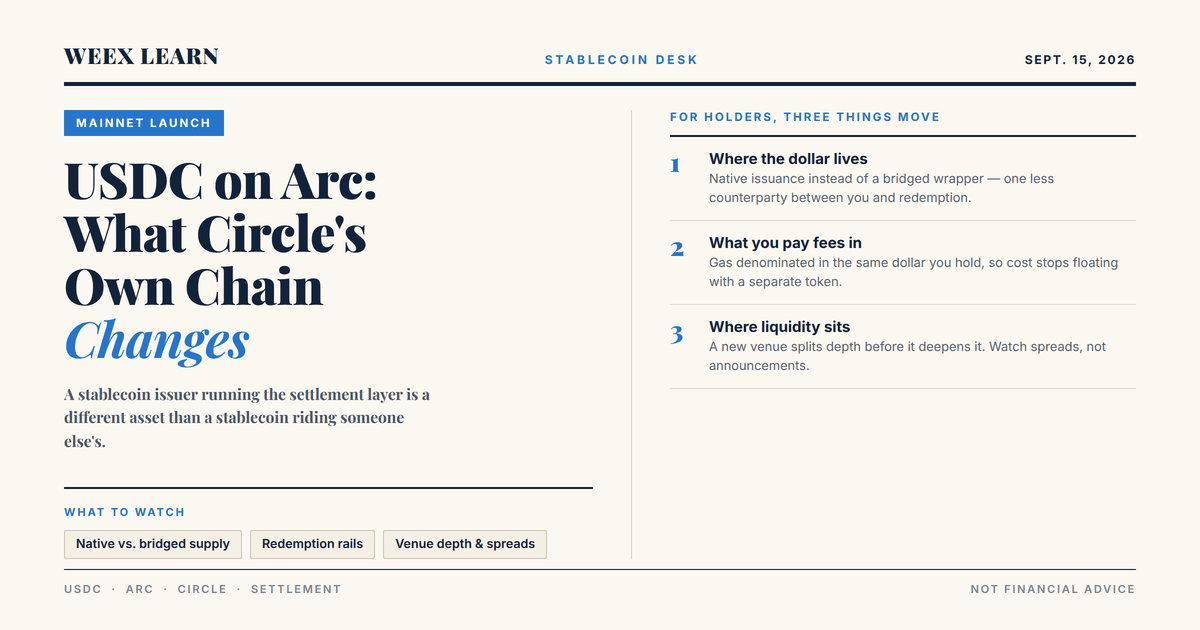
USDC on Arc: What Circle's Mainnet Launch Changes for Holders
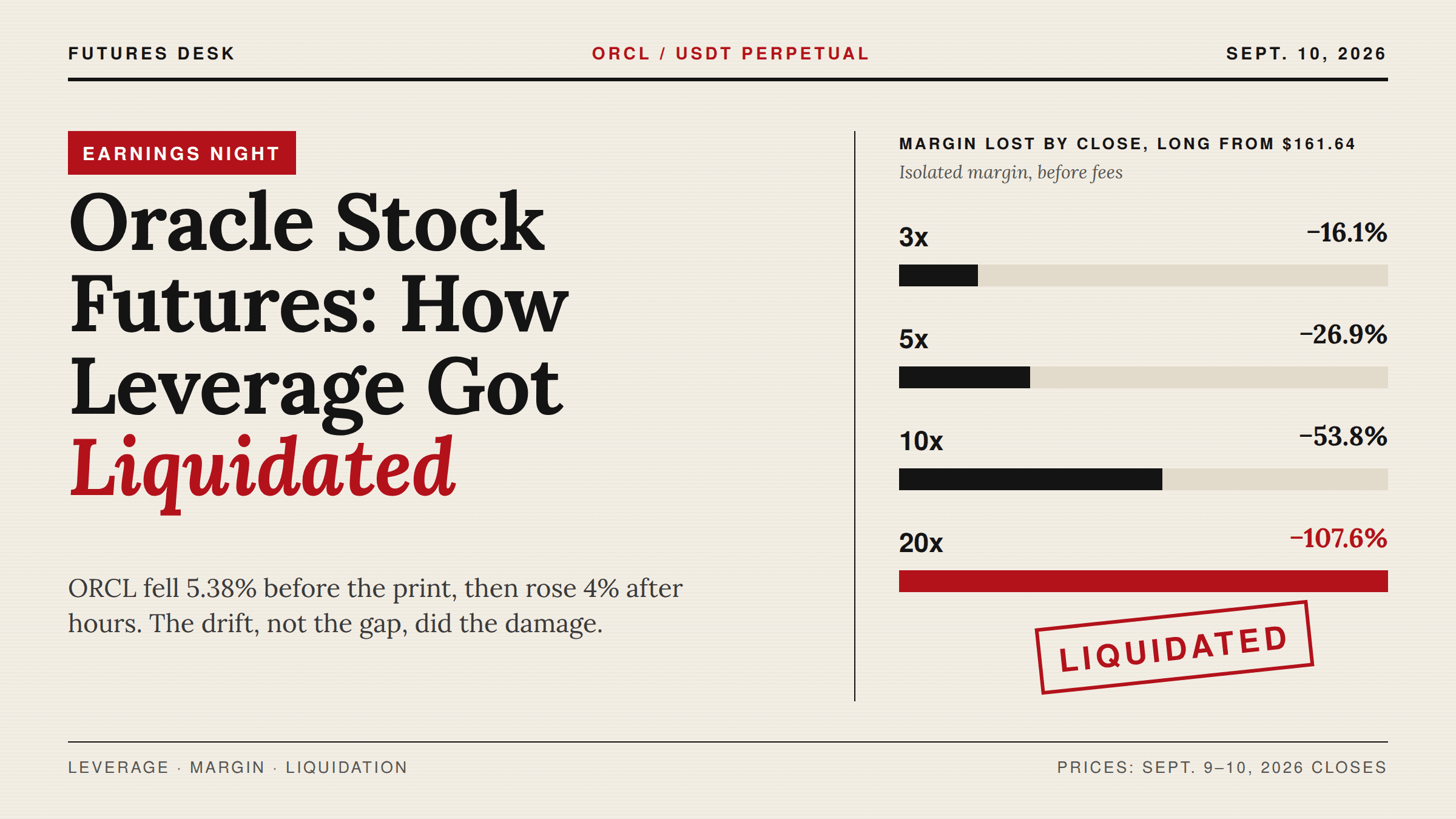
Oracle Stock Futures After Earnings: How Leverage Got Liquidated

MU Stock Reclaims $1,000 Again: What's Actually Different This Time

XST Coin Price Fell Over 40% for Two Straight Days: What That Pattern Actually Means
Is The US Becoming The Crypto Capital? Brad Garlinghouse's Bold Predictions Explained
GPT-6 Astra and Crypto: The AI Token Bid and the Cyber Risk
Nike Is Being Removed From the S&P 100: What a 12 Year Low Actually Means for the Stock
Lululemon Stock Crashes to an 8 Year Low Right Before Its New CEO Even Starts

PONS Robinhood Chain Token: What the Buyback Rally Rests On

Dell Stock Surges 9.4% After Smashing Earnings Estimates: What Drove the AI Server Beat
Flying Tesla Roadster (FTR) Coin: What Is It and What to Check Before Trading a Roadster Memecoin
WEEX 2026 New User Guide: Register, Complete KYC, and Claim the Welcome Bonus (Step-by-Step)
How to Buy Crypto Anonymously: 5 Methods, Real Costs and Limits
ENA Token Price Drops After October 5 Unlock: What Happened to Ethena?
How to Day Trade Crypto for Beginners: Fees, Hours, Risk Math
Stock Market Crash Risk in 2026: The Warning Signs Worth Watching


