
Trading Psychology for Beginners: Crypto Traps and Hard Rules

 Prefer us on Google

Trading psychology for beginners is the study of how fear, greed, regret and fatigue push new traders into decisions they would never make on paper, and how to stop it with rules written in advance. In crypto, the problem is sharper than in stocks: the market never closes, leverage is a click away, and new listings can move 50% before you finish reading the announcement. The practical fix is not "control your emotions." It is a small set of numbers you commit to before you trade: a fixed percentage of risk per trade, a pre-trade checklist, a mandatory cooling-off period after losses, and a journal that shows you your own patterns.
This guide covers the four behavioral traps that hurt crypto beginners most, the research behind them, and the specific rules that neutralize each one, including a worked position-sizing example you can copy.
Why Trading Psychology Matters More in Crypto
Most trading psychology advice was written for stock markets that open at 9:30 a.m. and close at 4 p.m. Those hours work as a built-in circuit breaker: you get a night to sleep on a loss before the next decision. Crypto removes that pause. Bitcoin trades through weekends, holidays and 3 a.m., which means the only thing standing between a frustrated trader and the next order is the trader.
The odds are already stacked against active short-term traders before emotion enters the picture. A 2019 working paper by Fernando Chague, Rodrigo De-Losso and Bruno Giovannetti, "Day Trading for a Living?", tracked Brazilian futures day traders who started between 2013 and 2015 and persisted for at least 300 days. They found that 97% lost money, and only 0.4% earned more than a bank teller's daily pay. That was a regulated market with fixed hours. Remove the hours, add 50x leverage, and the margin for error shrinks.
The Research: Loss Aversion and the Disposition Effect
Two findings from behavioral finance explain most beginner mistakes.
The first is loss aversion. In their 1979 paper on prospect theory in Econometrica, Daniel Kahneman and Amos Tversky showed that people feel losses more intensely than equivalent gains. Later estimates commonly put the ratio at roughly 2 to 1: losing $100 hurts about as much as winning $200 feels good. In trading, that asymmetry makes a red position feel like something to escape at any cost, including the cost of logic.
The second is the disposition effect, a term coined by Hersh Shefrin and Meir Statman in 1985. It describes the habit of selling winners too early and holding losers too long. Terrance Odean's 1998 study in the Journal of Finance, which analyzed 10,000 discount brokerage accounts from 1987 to 1993, found investors realized 14.8% of their available gains versus 9.8% of their available losses, about 1.5 times more willing to lock in a winner than to close a loser. Odean also found the winners they sold went on to outperform the losers they kept.
In crypto, the disposition effect has a nasty twist. On spot, holding a loser is painful but survivable. On a leveraged perpetual, holding a loser past your stop ends with the exchange closing the position for you at the liquidation price.
Four Crypto Trading Psychology Traps Beginners Fall Into
1. The 24/7 Market and Decision Fatigue
Because there is no closing bell, beginners tend to watch charts for hours and treat every candle as a signal. Fatigue erodes judgment, and late-night sessions breed impulsive entries. The tell: you open a position with no plan written down, "just to see."
2. Leverage and the Liquidation Cascade
Leverage magnifies price moves into account moves. At 10x, a 1% move against you is a 10% loss on your margin; a roughly 10% move, minus maintenance margin, can wipe the position out. When many traders hold similar leveraged bets, forced liquidations push price further, triggering the next layer of liquidations. On October 10, 2025, more than $19 billion in leveraged positions were liquidated across exchanges in a single day, about 87% of them longs, according to widely cited CoinGlass data, the largest single-day wipeout on record at the time. Most of those traders were not wrong about the long-term direction. They were wrong about how much room their position had.
If liquidation mechanics are new to you, check the liquidation price on the order panel before every leveraged entry, and treat it as a hard boundary rather than a stop.
3. FOMO Around New Listings and Pumps
Fear of missing out peaks around token launches, exchange listings and viral rallies. The pattern is familiar: a coin is up 40% in an hour, social feeds fill with screenshots, and a beginner buys near the high because the move "proves" it is going higher. New listings are especially dangerous because order books are thin, spreads are wide and price discovery is chaotic for the first hours or days. Buying the first green candle of a listing is betting on the most volatile period in that token's life.
4. Revenge Trading After a Stop-Out
A stop-loss fires, the price reverses without you, and the urge arrives: get it back now. Revenge trades are usually larger, faster and less planned than the trade that lost. Some traders double size to recover the loss in one move, which is how a 1% loss becomes a 10% loss within an hour. Loss aversion is doing the driving here; the loss feels like a debt that must be repaid immediately.
-- Price
Rules That Replace Willpower: A Beginner's Toolkit
Willpower fails under stress; rules set in advance only need compliance. The numbers below are sensible beginner defaults, not laws. Tighten them freely, but do not loosen them until you have months of journal data.
Rule 1: Risk a Fixed 1% per Trade
Decide the maximum you will lose on any single trade as a percentage of your account, and size the position from that number, not from how confident you feel. Here is the math worked through:
- Account size: $2,000
- Risk per trade at 1%: $20
- Planned entry: $2.00 per token
- Stop-loss: $1.90, so the risk per token is $0.10
- Position size: $20 / $0.10 = 200 tokens, or a $400 position
If the stop is hit, you lose $20 plus fees and any slippage, roughly 1% of the account. Ten losses in a row would leave you at about $1,808, painful but still trading.
Now the leverage check. If you open that $400 position with 5x leverage, you post about $80 in margin, and your liquidation level sits roughly 20% below entry, well beyond your 5% stop. At 20x, you post about $20, and liquidation sits under 5% away, before maintenance margin pulls it even closer. Your $1.90 stop could sit below your liquidation price, which means the exchange closes you out before your plan does. The rule that follows: your stop must always trigger before liquidation. If it does not, cut the leverage.
WEEX's take-profit and stop-loss guide for futures explains how to attach these orders to a position, including the caveat that stops may not fill exactly at the trigger during sharp moves.
Rule 2: Run a Pre-Trade Checklist
Before every order, answer these in writing. One "no" means no trade.
- Can I state the reason for this trade in one sentence?
- Is my stop-loss price set, and is it above my liquidation price?
- Does the position size match my 1% risk limit?
- Is my target at least twice as far from entry as my stop (2:1 reward-to-risk)?
- Have I lost two trades today already? If yes, stop.
- Is this a new listing or a coin up more than 20% today? If yes, wait at least 30 minutes.
- Would I take this trade if I had not seen anyone else talking about it?
Rule 3: Enforce a Cooling-Off Period
Cooling-off rules turn revenge trading into a scheduling problem.
- After any stop-out: no new trade in the same asset for 1 hour.
- After 2 consecutive losses: halve your position size for the rest of the day.
- After hitting a 3% daily loss: stop trading until the next day.
- After a liquidation: no trading for 24 hours, and no new deposits for 48 hours.
Rule 4: Keep a Simple Trading Journal
A journal turns vague feelings into data. Log every trade with these fields:
- Date, time and asset
- Long or short, leverage used
- Entry, stop-loss and target prices
- Position size and percentage of account risked
- Reason for entry, in one sentence
- Emotional state before entry (calm, bored, anxious, excited, frustrated)
- Exit price and result in dollars and R (multiples of your planned risk)
- Rule broken, if any
Review the journal weekly. If more than 25% of your trades break a rule, or your average loss is bigger than your planned 1R, the problem is execution, not strategy.
Practice Before You Pay for the Lesson
The cheapest way to build trading psychology for beginners is to rehearse the rules on small size first. Trade the smallest position your exchange allows for a few weeks and follow every rule above exactly. What counts is whether you kept your stops and filled in the journal, not the P&L. Once you can follow the process when the stakes are low, scaling up is a sizing decision rather than a personality change. WEEX's risk management guide for traders covers the platform's trigger orders and margin modes if you want to set these rules up on a live account.
None of this guarantees profit, and nothing here is investment advice. What it does is limit how much damage a bad day can do, which is the main job of trading psychology for beginners in a market that never closes.
FAQ
1. What is the biggest psychological mistake new crypto traders make?
Using too much leverage while trading without a stop-loss. It combines loss aversion, which makes you hold losers, with a liquidation price that ends the trade for you. Fixed 1% risk with a stop above liquidation addresses both.
2. How do I stop revenge trading?
Make it impossible by rule rather than resisting it by willpower. A mandatory 1-hour break after any stop-out and a hard daily loss limit of around 3% remove the opportunity to chase losses while the urge is strongest.
3. Is 1% risk per trade too conservative for a small account?
For a beginner, no. A 1% rule means a 10-trade losing streak costs under 10% of the account, leaving room to learn. Traders who risk 10% per trade can lose most of their account in a single bad week.
4. Does the disposition effect apply to crypto traders?
The original research, including Odean's 1998 study, looked at stock investors, but the same bias of selling winners early and holding losers long shows up wherever traders face gains and losses. In leveraged crypto, holding a loser too long often ends in liquidation rather than a slow recovery.
This content is provided for general informational purposes only and doesn't constitute financial, investment, legal, or tax advice. Any events, rewards, online promotions, or related information mentioned herein should not be considered a recommendation, solicitation, or invitation to purchase, sell, trade, or otherwise deal in any crypto assets. Crypto assets are highly volatile and may result in loss. The availability of WEEX services, products, and related events may vary by region. You are responsible for ensuring that your participation is in accordance with applicable local laws and regulations.
You may also like
How to Day Trade Crypto for Beginners: The Math Behind One Trade
What Is a Bitcoin ETF? How Creation, Custody and Fees Work
What Is Blockchain and How Does It Work? One Transaction, Traced
WEEX Convert Fees: What Zero-Fee Conversion Really Costs You
WEEX Convert Quote: How the 8-Second Price Lock Really Works
WEEX Convert Limits: Minimum and Maximum Amounts Explained
How to Check a WEEX Convert Order: History, Rate and Status

USDC Significant EMT Status in the EU: What Changes on November 12 Under MiCA
Walrus (WAL) Jumps 30%: Sui Storage Token Rallies on AI Data
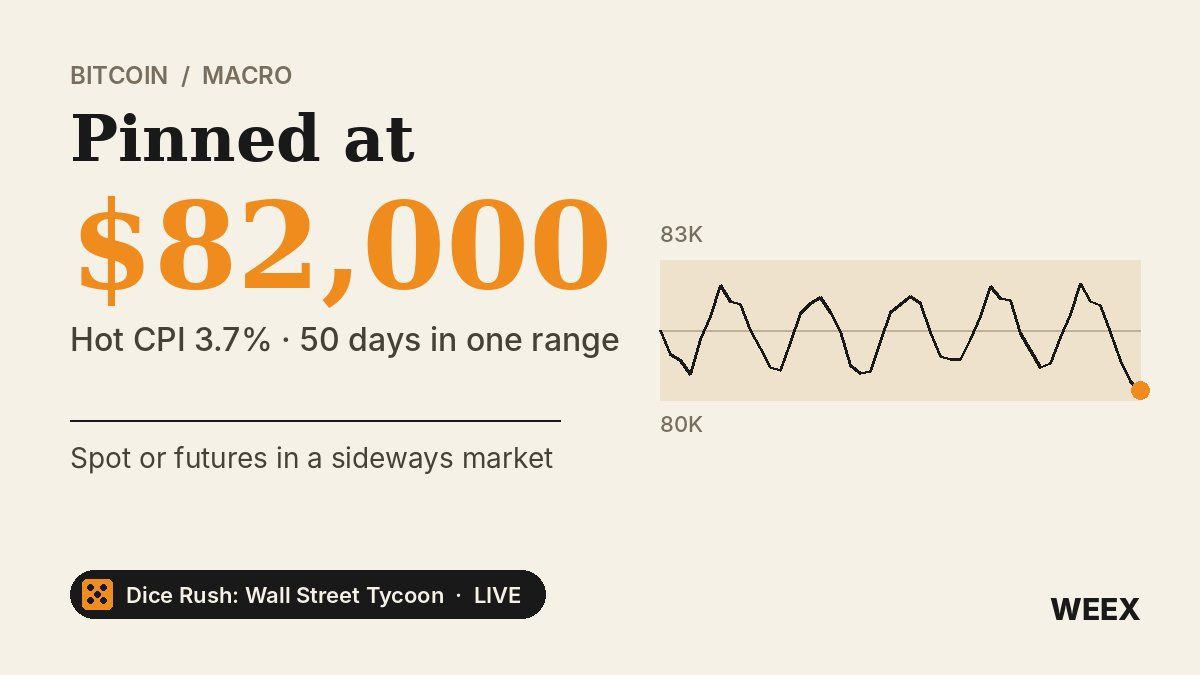
Bitcoin Price After Hot CPI: Why BTC Is Pinned Near $82,000
What Is a Limit Order? How It Works and When to Use It
Best Crypto Miner for Beginners: What to Check on Cost, Power, Hashprice and Profit Before You Buy
Limit Order vs Market Order: Which One to Use When Trading Crypto
What Is a Limit Order? How It Works in Crypto With BTC Examples
Stop Limit Order: How It Works and Why It Can Fail to Fill
Best Crypto Platform for Beginners: Pick by Goal, Not Brand

Best Crypto Podcasts for Beginners: A 4-Week Listening Plan

How to Buy Crypto Anonymously: 5 Methods, Real Costs and Limits

Will Bitcoin Break $87,000 This Week? CPI, Fed Speakers and ETF Outflows to Watch

Conflux (CFX) Price Jumps on China's National Blockchain Network Plan: Does the Policy Actually Name CFX?
BTC Futures Analysis: $80K Held, but Longs Are Still Paying Up
ETH Futures: Why Ether Is Falling Faster Than Bitcoin This Week
ENA Token Price Drops After October 5 Unlock: What Happened to Ethena?
What Is Blockchain and How Does It Work? One Real Payment Traced

How to Buy Crypto With a Prepaid Card: Step-by-Step Guide
Best Crypto Trading Strategies for Beginners: What to Know Before You Trade
LayerZero Unlock October 2026: Can ZRO Hold $2 Amid Whale Inflows?
How to Buy Crypto With Apple Pay in 5 Steps: Why Your Bank May Decline the Payment
Why Does Bitcoin (BTC) Drop? How to Read a BTC Liquidation Heatmap Without Guessing the Bottom
Best Crypto Wallet App in 2026: How to Choose Between Hot, Cold, Custodial, and Web3 Wallets
How to Day Trade Crypto for Beginners: The Math Behind One Trade
What Is a Bitcoin ETF? How Creation, Custody and Fees Work
What Is Blockchain and How Does It Work? One Transaction, Traced
WEEX Convert Fees: What Zero-Fee Conversion Really Costs You
WEEX Convert Quote: How the 8-Second Price Lock Really Works
WEEX Convert Limits: Minimum and Maximum Amounts Explained
Contents
Popular coins
Latest articles


