What Is a Grid Trading Bot? How Does Crypto Grid Trading Work?

 Prefer us on Google
Crypto markets are known for frequent price fluctuations. While some traders try to predict market direction, others use automated strategies to capture smaller price movements.
A grid trading bot is one of the most common automated trading strategies. Instead of predicting whether the market will rise or fall, it places multiple buy and sell orders within a predefined price range and attempts to profit from repeated price movements.
However, a grid trading bot is not a guaranteed profit tool. Its performance depends on market conditions, parameter settings, trading fees, and risk management.
For beginners, understanding how grid trading works and when it may fail is more important than simply activating a bot.
How Does Crypto Grid Trading Work?
A grid trading bot works by dividing a selected price range into multiple levels, creating a “grid” of trading points.
When the price falls to a lower grid level, the bot may automatically place a buy order. When the price rises to a higher grid level, it may place a sell order.
For example, suppose Bitcoin is trading around $60,000. A trader sets a grid range between $55,000 and $65,000.
The bot may create several trading levels:
- Buy orders below the current price;
- Sell orders above the current price.
If BTC moves between these levels, the bot repeatedly buys lower and sells higher.
The main idea behind grid trading is not predicting the exact market direction. Instead, it attempts to take advantage of normal price fluctuations within a range.
Key Parameters of a Grid Trading Bot
The results of a grid trading strategy depend heavily on how the bot is configured. Several parameters are especially important.
| Parameter | Explanation |
|---|---|
| Price Range | The upper and lower limits where the bot operates |
| Number of Grids | The number of trading levels created inside the range |
| Investment Amount | The amount of capital allocated to the strategy |
| Grid Spacing | The distance between each buy and sell level |
| Stop Loss / Take Profit | Risk control conditions for closing the strategy |
Price Range
The price range determines where the bot will operate.
A range that is too narrow may trigger frequent trades but can quickly become invalid if the market moves strongly.
A range that is too wide may create fewer trading opportunities.
Choosing a suitable range usually requires considering historical price movements and current market conditions.
Number of Grids
More grids create smaller price intervals, which may increase trading frequency.
Fewer grids create larger intervals, which may result in fewer but larger trades.
There is no universal “best” grid setting. The appropriate choice depends on the asset, volatility, and trading goals.
When Does Grid Trading Work Best?
Grid trading generally performs better in markets with repeated price movements inside a certain range.
Sideways or Range-Bound Markets
A sideways market is usually the environment where grid strategies are most commonly used.
For example, if Bitcoin repeatedly moves between $55,000 and $65,000 without a strong breakout, a grid bot may capture smaller price movements by buying near lower levels and selling near higher levels.
When Grid Trading May Perform Poorly
Grid trading is less suitable for strong directional markets.
During a strong upward trend, the bot may sell assets too early and miss further gains.
During a prolonged decline, the bot may continue buying as prices fall, increasing exposure to a losing position.
This is why understanding market conditions is an important part of using grid strategies.
Advantages and Limitations of Crypto Grid Trading
Grid trading bots provide several advantages, especially for users who prefer systematic execution.
One benefit is automation. Once the strategy parameters are configured, the bot can monitor prices and execute orders without requiring constant manual operation.
Another advantage is that grid trading follows predefined rules. This can help reduce emotional decisions caused by short-term market movements.
However, grid trading also has limitations.
The first limitation is that it does not predict market trends. A strategy that works well in a stable range may struggle when the market suddenly moves in one direction.
The second limitation is that trading costs matter. Frequent transactions can increase the impact of:
- Trading fees;
- Slippage;
- Funding costs in leveraged markets.
A strategy that looks profitable before costs may perform differently in real trading conditions.
How Do APIs Support Grid Trading Bots?
A grid trading bot needs access to market data and trading functions to operate automatically. This connection is usually provided through an exchange API.
Through an API, a trading program can:
- Receive real-time price data;
- Monitor market conditions;
- Submit and manage orders.
The typical process is: Receive market data → Check grid conditions → Trigger trading rules → Submit orders
For developers building automated trading systems, the WEEX API provides resources for connecting programs with market data and trading functions.
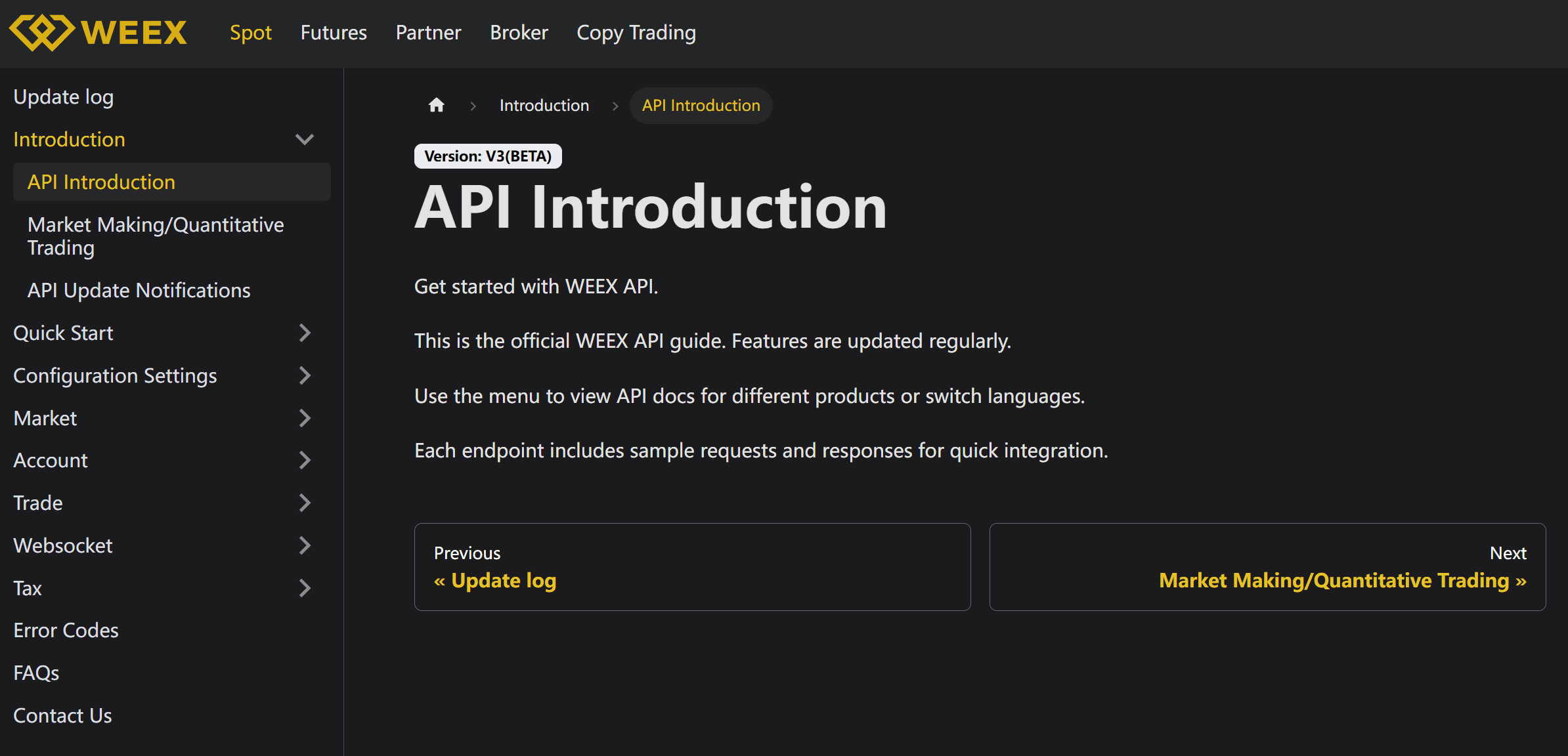
For example, a developer can use API connections to allow a grid bot to monitor BTCUSDT prices and execute orders based on predefined rules.
However, an API is only a technical connection tool. It does not determine whether a grid strategy will be profitable. Users still need to design appropriate parameters, test the strategy, and manage risk.
When using API-based trading systems, security is also important. Users should only enable necessary permissions and protect API credentials from unauthorized access.
Common Mistakes When Using Grid Trading Bots
Assuming Grid Trading Guarantees Profits
One of the biggest misunderstandings is that grid bots can generate consistent profits automatically.
In reality, grid trading depends on market conditions. A sudden market trend can cause the strategy to perform poorly.
Using Too Much Capital at the Beginning
New users often allocate large amounts before understanding how the strategy behaves.
A better approach is to test with a smaller amount, evaluate performance, and adjust gradually.
Ignoring Trading Costs
Because grid strategies may execute many transactions, fees can have a meaningful impact on results.
Users should always consider actual trading costs when evaluating performance.
Using Grid Trading in the Wrong Market
A grid strategy designed for sideways markets may not work well during strong trends.
Before using a grid bot, traders should understand whether current market conditions match the strategy.
Is a Grid Trading Bot Suitable for Beginners?
Grid trading is often considered beginner-friendly because its logic is relatively easy to understand.
It may be suitable for users who:
- Want to learn automated trading;
- Prefer rule-based strategies;
- Understand basic market risks.
However, beginners should not assume that a simple setup means low risk.
Before using real funds, it is better to understand:
- How the grid parameters affect results;
- How the strategy performs in different markets;
- How losses are controlled.
Testing and gradual adjustment are important parts of using any automated trading strategy.
Conclusion
A grid trading bot is an automated strategy that uses predefined price levels to execute repeated buy and sell orders. It is commonly used in range-bound markets where prices fluctuate within a certain area.
The effectiveness of grid trading depends on several factors, including market conditions, parameter settings, fees, and risk management.
Exchange APIs, such as WEEX API, can provide the technical connection needed for automated trading systems, but they do not guarantee successful results.
For beginners, the best approach is to understand the strategy first, test it carefully, start with limited exposure, and continue improving based on real performance.
This content is provided for general informational purposes only and doesn't constitute financial, investment, legal, or tax advice. Any events, rewards, online promotions, or related information mentioned herein should not be considered a recommendation, solicitation, or invitation to purchase, sell, trade, or otherwise deal in any crypto assets. Crypto assets are highly volatile and may result in loss. The availability of WEEX services, products, and related events may vary by region. You are responsible for ensuring that your participation is in accordance with applicable local laws and regulations.
You may also like
How to Use Crypto Trading APIs? A Beginner’s Guide

What Is Crypto Arbitrage Trading? How Do Arbitrage Bots Work?
Kioxia Stock and SK Hynix: What Rivals Sharing the Same Shareholder Actually Means

Is HIMS Stock a Buy After the Earnings Selloff? What the Full-Year Guidance Raise Actually Implies

ASTS Stock Falls After Missing Q2 Estimates: What the Revenue Miss and Japan Launch Actually Mean
Intel Stock Is Up Over 170% in 2026: What the AI Foundry Turnaround Actually Required
Intel Stock Sale Draws Over $100 Billion in Demand: What the 5x Oversubscription Actually Signals
RKLB Stock Price Targets Range From $64 to $150: What the Analyst Disagreement Actually Reveals
RKLB Stock Has Fallen Sharply Since SpaceX's IPO: What History Says Happens to Number Two Players
SPCX Stock Price Target Raised to $450 by Arete Research: What the Upgrade After the Cursor Deal Actually Means
SPCX Stock Closes Above Its $135 IPO Price for the First Time in Weeks: What the Recovery Actually Signals
XST Coin: Which Token Is It, and How Thin Is the Market?
HOOD Stock at $94: Record Revenue, Crypto Slump, 24/7 Access
XRP News: Which August 2026 Headlines Actually Move Price

CRWV Stock After Q2: Demand Is Fine, the Interest Bill Isn't
PROM on 12 August 2026: What Upbit Added and What the Price Did
What Is Prom (PROM)? The Polygon CDK Chain, the Token and Where It Trades
Best Crypto Trading Bot Strategies for Beginners
How High Can XST Reach? Buy, Hold, or Wait?
How to Backtest a Crypto Trading Strategy? A Beginner’s Guide
How to Build a Crypto Trading Bot With an Exchange API: A Beginner’s Guide
Crypto Trading Bot vs Manual Trading: Which Is Better?
Is Cronos (CRO) Still Worth Buying in 2026? Ecosystem Growth, Staking Yields and Risk Factors
Google Stock and the $200 Billion Anthropic Financing Program: What the Largest AI Deal in History Means for GOOG
Why Is Cronos (CRO) Gaining Trader Attention? Key Drivers Behind the Recent Volume Surge
Is Bitcoin Preparing for a Bullish Breakout? Key Technical Indicators and On-Chain Data
How to Avoid Liquidation During Market Crashes? Futures Risk Management Strategies
Which AI Crypto Tokens Are Surging Today? Top Decentralized AI Projects to Watch
Is Cronos (CRO) Preparing for a Major Rally? Catalysts, Risks and the 2026 Outlook
Which Major Tokens Face Massive Unlocks Tomorrow? Market Impact and Price Predictions
How to Use Crypto Trading APIs? A Beginner’s Guide
What Is Crypto Arbitrage Trading? How Do Arbitrage Bots Work?
Kioxia Stock and SK Hynix: What Rivals Sharing the Same Shareholder Actually Means
Is HIMS Stock a Buy After the Earnings Selloff? What the Full-Year Guidance Raise Actually Implies
ASTS Stock Falls After Missing Q2 Estimates: What the Revenue Miss and Japan Launch Actually Mean
Intel Stock Is Up Over 170% in 2026: What the AI Foundry Turnaround Actually Required
Contents
Popular coins
Latest articles