

1inch Team Suspected of Rug Pull? On-Chain Data Reveals Truth Behind Multi-Million Dollar Fund Movement


Original Title: "1inch Team Accused of Dumping, On-Chain Data Reveals Whale's Fancy Swing Trading"
Original Author: Ethan, Odaily Planet Daily
A large sell-off attributed to the "1inch Team" has once again sparked criticism.
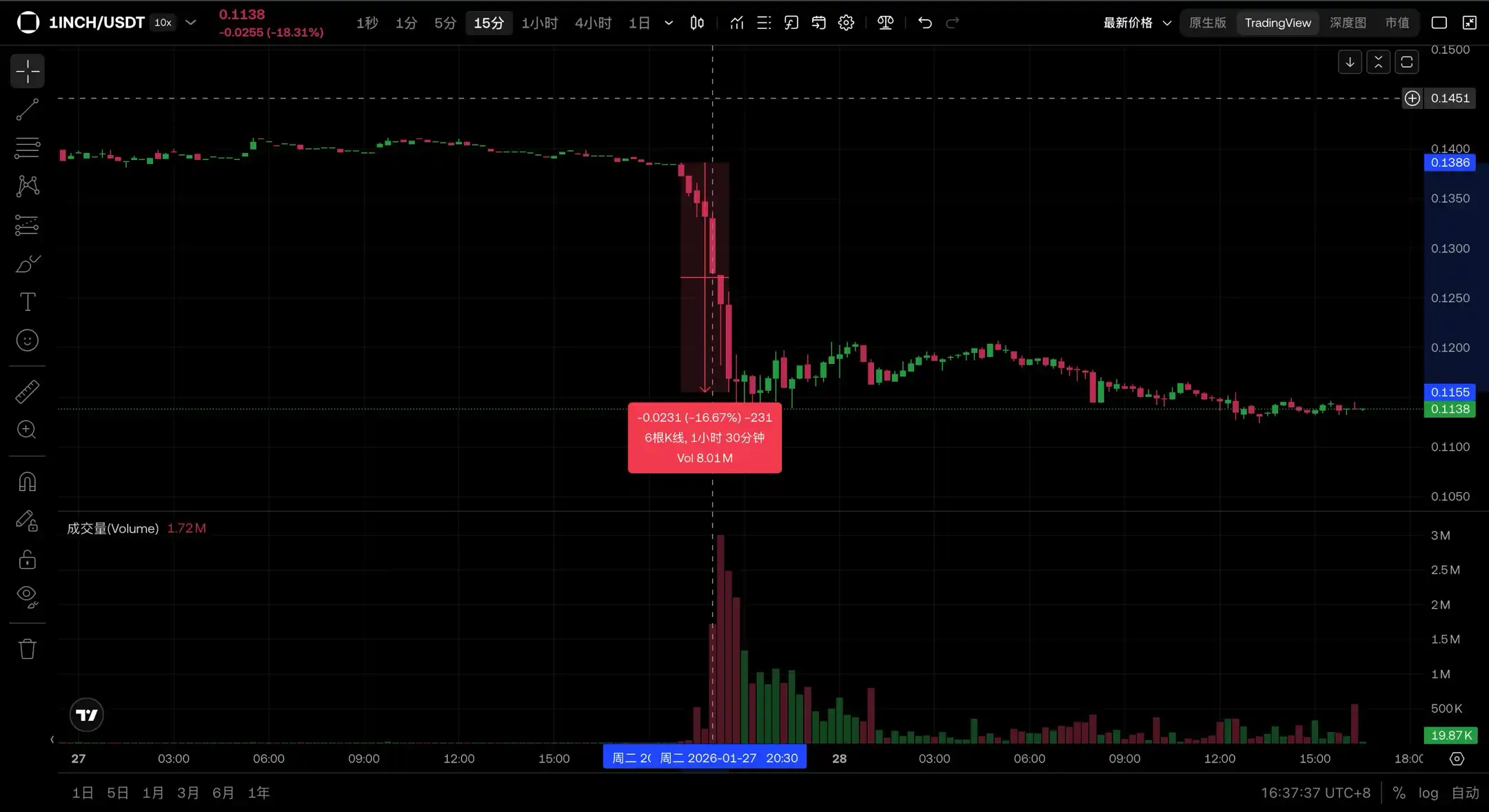
Recently, the on-chain data platform ARKHAM showed that three wallets labeled as the "1inch Team" collectively sold 36.36 million 1INCH tokens, worth $5.04 million. According to OKX market data, following this event, the price of the 1INCH token plummeted by 16.7% to $0.1155 in a short period, currently trading at $0.1164. A question quickly arose in the market regarding this sell-off: Was this really the project team dumping their tokens?
Looking solely at this sell-off, the outcome was less than ideal. On-chain data indicates that the aforementioned 1INCH tokens were primarily transferred to the relevant address in late November 2024, with a cost estimated around $0.42 per token at the time, equivalent to approximately $15.27 million. By the time of this sell-off, the price of 1INCH had dropped to around $0.14. Considering the slippage impact due to the large fund size during the sell-off, the actual loss from just this batch of tokens could exceed $10 million.
Reference Comparison: 1inch Team's Previous Trading Style
Previously, the 1inch Team's investment fund's on-chain operations during various market fluctuations were seen by the market as that of a "professional coin trading team."
As early as February to April, the 1inch Team's investment fund began consistently accumulating 1INCH at low levels. At that time, when market sentiment had not yet warmed up, 1INCH was hovering around $0.2 for a long time. During this phase, the team invested approximately $6.648 million, buying 33.19 million 1INCH tokens, with an average buy-in price of around $0.2.
However, this round of buying did not cause significant price fluctuations. What truly caught the market's attention was the concentrated accumulation in early July. From July 6th to 9th, the 1inch Team's investment fund once again made a move, injecting about $4.4 million in just a few days, purchasing 22.99 million 1INCH tokens. As buy orders continued to appear, the price of 1INCH rose from around $0.18 to $0.206, marking a phase increase of about 14%. During this period, the team transferred 3 million USDC to Binance, withdrew 1INCH to their own address in batches, did not use up the related funds at once, and continued to buy in at opportune times.
After July 10, the pace of operations noticeably accelerated. On the afternoon of July 10, the team once again bought around $880,000 worth of 4.12 million 1INCH tokens, while also adding 2 million USDT to Binance to prepare ammunition for future trades. On the evening of July 11, on-chain monitoring showed that the team allegedly bought another 11.81 million 1INCH tokens at a higher price range, with the transaction price rising to around $0.28. At this point, the address's holdings temporarily increased to 83.97 million 1INCH tokens, with a book value exceeding $23 million. On July 13, the team continued to withdraw 6.334 million 1INCH tokens from Binance.
If we rewind the timeline to early February, the 1inch team's investment fund has invested approximately $13.64 million since the beginning of the year, buying 55.85 million 1INCH tokens at a blended cost of around $0.244. With the price of 1INCH surging above $0.39 in mid-July, this portion of the position has already realized a profit of several million dollars.
It is worth noting that the team is not "buy-only." On the evening of July 13, they began to realize profits on a small scale, selling around 904,000 1INCH tokens at $0.33, exchanging them for $298,000; and at an earlier stage, they had sold some 1INCH in batches at around $0.28.
At the same time, the team is also simultaneously taking profits on another significant position: the ETH purchased in February at an average price of $2577 has begun to be sold in tranches above $4200, with the ETH position alone realizing millions of dollars in profit.
On August 11, according to on-chain analyst Yu Jin's monitoring, the 1inch team's investment fund has started to cash out some of its earlier positions on-chain. The data shows that they sold 5,000 ETH at an average price of $4215, exchanging it for $21.07 million USDC; and sold around 6.45 million 1INCH tokens at an average price of $0.28, exchanging it for approximately $1.8 million USDC.
In terms of the cost of the positions, the aforementioned ETH was bought by the 1inch team at an average price of around $2577 in February this year; the corresponding 1INCH was mainly accumulated in July, with a blended cost of around $0.253. Based solely on the ETH and 1INCH positions that have been sold this time, the 1inch team's investment fund has realized approximately $8.36 million in book profits.
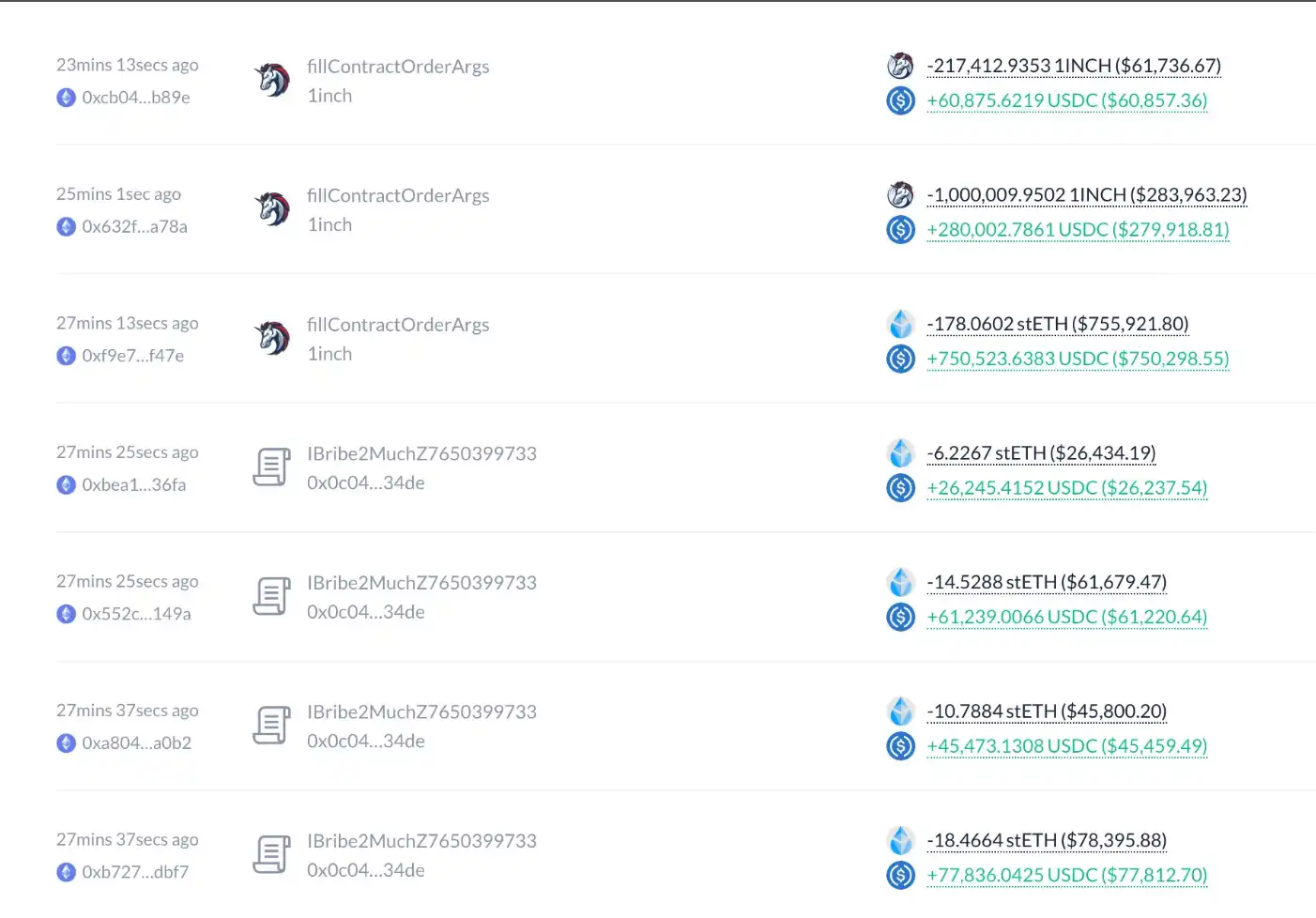
Looking back further, the 1inch team's "buy the dip, sell the rip" strategy on BTC is equally clear. Between February and March this year, they bought 160.8 WBTC at an average price of around $88,000 during a BTC pullback phase, and then completed their exit when BTC approached $100,000 again in May, achieving a total profit of nearly $1 million.
Considering the on-chain activities of BTC, ETH, and 1INCH, the 1inch team's investment fund maneuvers seem like a well-rehearsed fund strategy: accumulating positions during market corrections, consistently adding during uptrends, and gradually taking profits once the price enters a high range.
But this time, was it really them in control?
It is worth noting that the large sell-off near $0.14 this time, when compared to the 1inch team's past on-chain activities, shows a significant deviation if this sell-off was indeed led by the team directly. In their historical trades with BTC, ETH, and 1INCH, the team more commonly phased out profits after a confirmed trend, rather than concentrating sales in an obviously illiquid range.
Therefore, some market participants have started to question whether the sell-off labeled as from the "1inch team" truly originated from the team or a wallet under their direct control.
Subsequently, 1inch's official response to the related controversy was provided here. In their statement, they explicitly mentioned that this sell-off did not occur in any wallet controlled by the 1inch team, entity, or treasury multisig, and the team cannot intervene in third-party holders' asset allocations and trading decisions.
In other words, the on-chain labels indicating relationships do not equate to actual control. Based on the execution timing and price range, this sell-off most likely came from a third-party holder disconnected from the project's control, rather than a shift in the 1inch team's trading strategy.
In a phase with already limited liquidity, a single large sell-off was quickly interpreted as "team dumping," signaling an excessive compression of information. This interpretation overlooks the natural gap between address labels and actual control rights after extended token circulation.
Back to 1inch itself. The team emphasized in an official statement that the recent market turbulence did not alter its core business and long-term direction. Since 2019, 1inch has accumulated a trading volume close to $800 billion, maintaining daily trading volumes in the hundreds of millions even during market downturns. The team also mentioned plans to review the token economics this year to enhance overall resilience in low liquidity and bear markets. Against this backdrop, the discussion surrounding "Did the 1inch team dump the price?" seems more like a misinterpretation amplified by on-chain data, liquidity conditions, and sentiment analysis.
However, even if it is ultimately proven to be a misunderstanding, this sell-off has still constituted a real-world second impact on 1INCH's already weakening price. Since the last cycle's peak of $6, 1INCH has experienced a prolonged downward trend and is now hovering around $0.11.
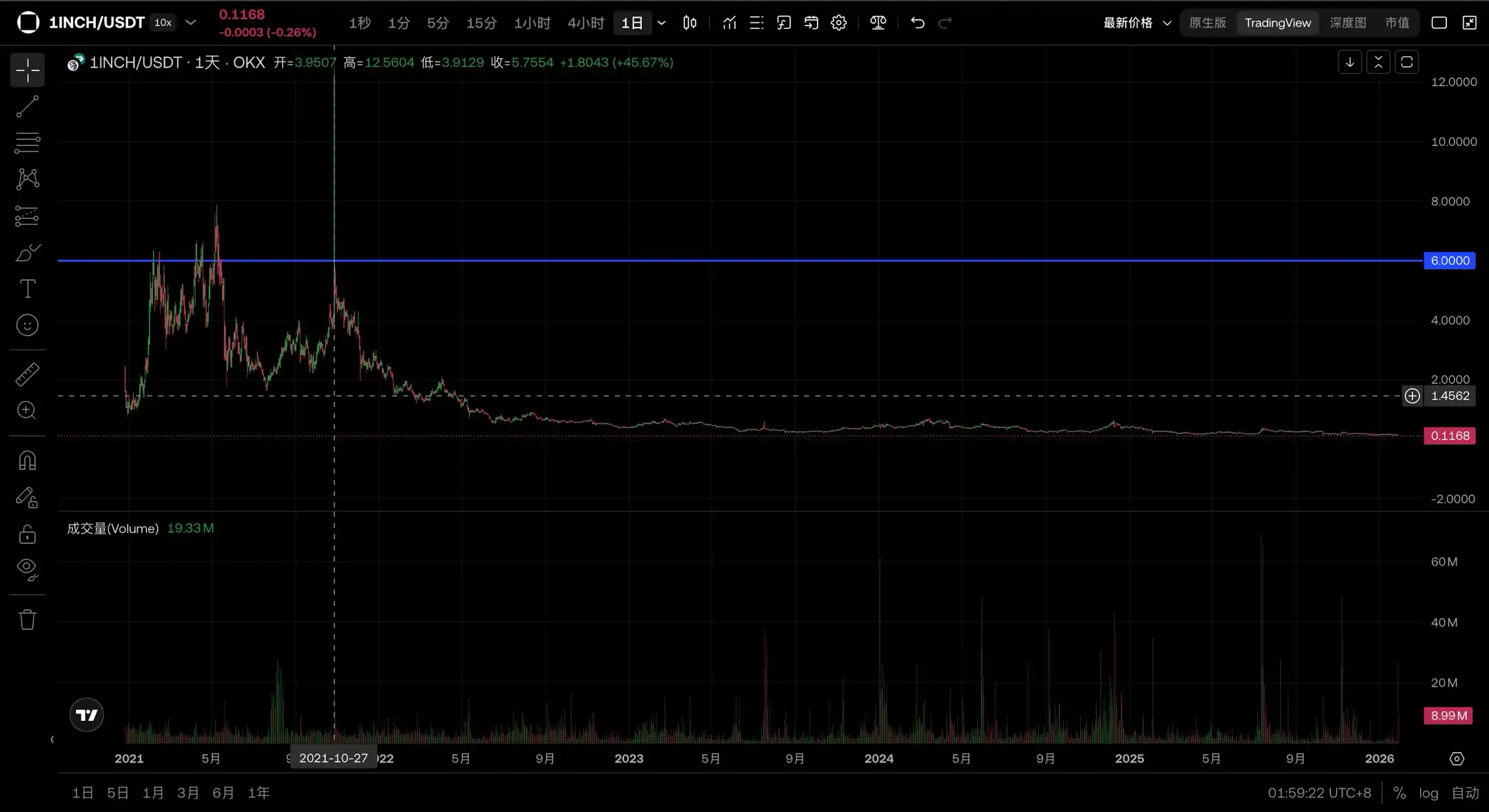
In such a trend, the market evidently had no sufficient cushion to absorb any sudden sell-off signals. In these amplified sell-off events, those who ultimately bear the brunt of emotional impact are often the weakest in terms of risk tolerance — retail investors.
You may also like

The arrival of the Web 3.0 era: A review of Hong Kong court rulings on digital assets

Track Markets At a Glance: New WEEX Price Widgets for iOS & Android
To streamline your market data access, WEEX has officially launched "Market Watchlist" desktop widgets

The billion-dollar lesson: The focus of DeFi security is shifting from code to operational governance

A Brief Analysis of Stablecoin Licenses and On-Chain Funding
BVNK Founder: Three Stages of Stablecoin Development

The truth about Trump's son's Bitcoin game: he made a staggering $100 million while retail investors lost $500 million

What Is Futures Trading? Hours, Platforms, and How to Start Trade Futures(2026 Guide)
Learn how to start futures trading, understand trading hours, and choose the best futures trading platform. Includes real data, strategies, and ways to maximize returns with rebates.

The Rise of Composable RWA

MAGA Up 350% in 24 Hours, PEPE Up 46% in One Day: Which Memecoins Are Next in 2026?
MAGA +350% in 24hrs. PEPE +46% in one day. RAVE +4,500% then -90%. In 2026's memecoin market, the gains are real. So are the traps? Here's how to tell the difference before you buy.

RCD Espanyol vs Real Madrid: Can the Pericos Delay the Inevitable?
RCD Espanyol vs Real Madrid lineups, standings, and stats for May 3, 2026. Real Madrid visits RCDE Stadium as Barcelona closes in on the LALIGA title. Full preview inside.
MegaETH goes live with an FDV exceeding 2 billion USD. Which ecological projects are worth paying attention to?

Dialogue with "Wood Sister" Cathie Wood: The next bull market is about to arrive
Can prediction markets win the competition for perpetual contracts?

Who is trading on Trade.xyz?

Binance quietly placed a bet on a leading large model company

Best Crypto Discord Server 2026: Why Jacob’s Crypto Clan Is Gaining Massive Attention
Jacob’s Crypto Clan has grown into one of the most active crypto Discord communities, with over 45K members and continuing to expand. This rapid growth reflects strong demand for structured trading insights and real-time collaboration.

Tom Lee Buying ETH: Why Wall Street’s Loudest Ethereum Bull Keeps Doubling Down
Tom Lee keeps buying ETH through every dip, every drawdown, and every moment of market doubt. Inside the strategy that's turning Ethereum into a treasury asset — and what it signals for the rest of the market.

Stripe Sessions 2026: AI Agent, Global Payments, and Invisible Crypto Infrastructure
The arrival of the Web 3.0 era: A review of Hong Kong court rulings on digital assets
Track Markets At a Glance: New WEEX Price Widgets for iOS & Android
To streamline your market data access, WEEX has officially launched "Market Watchlist" desktop widgets
The billion-dollar lesson: The focus of DeFi security is shifting from code to operational governance
A Brief Analysis of Stablecoin Licenses and On-Chain Funding
BVNK Founder: Three Stages of Stablecoin Development
The truth about Trump's son's Bitcoin game: he made a staggering $100 million while retail investors lost $500 million


