
$20 Billion Valuation, Is Kalshi Engaging in an Arms Race with Polymarket?

Original Article Title: "A $20 Billion Valuation - Kalshi and Polymarket Kick Off Arms Race?"
Original Article Author: Mach, Foresight News
Recently, according to The Wall Street Journal, top prediction markets Polymarket and Kalshi have been in talks with potential investors, with valuations around $20 billion each. In November 2025, news broke that Polymarket was discussing funding at a $12 billion valuation. In December of that year, Kalshi completed a $1 billion funding round, valuing the company at $11 billion.
In just a few months, these valuations are estimated to have doubled once again.
Based on public market data and industry reports, as of the end of February 2026, the global prediction market's cumulative nominal trading volume has reached $127.5 billion, with Polymarket at $56.07 billion and Kalshi at $44.71 billion, together accounting for 79% of the market share.
While leading in cumulative trading volume, Kalshi's growth rate in 2025 was more remarkable, not only reversing its market share from a minority at the beginning of the year to over 60%, but also driving monthly active users from 600,000 to over 5.1 million, demonstrating a faster pace of scale expansion. In comparison, leveraging its native crypto advantage, Polymarket maintained global event coverage and cumulative trading advantages, but user growth was relatively stable, with monthly active peaks hovering around 700,000. The two core metrics - trading volume and monthly actives - clearly outline Kalshi's explosive catch-up and Polymarket's sustained deep cultivation, forming a pattern of the two prediction market giants standing side by side.
Specifically in terms of trading volume performance, Kalshi's growth trajectory shows a leap from a low base to a high volume.
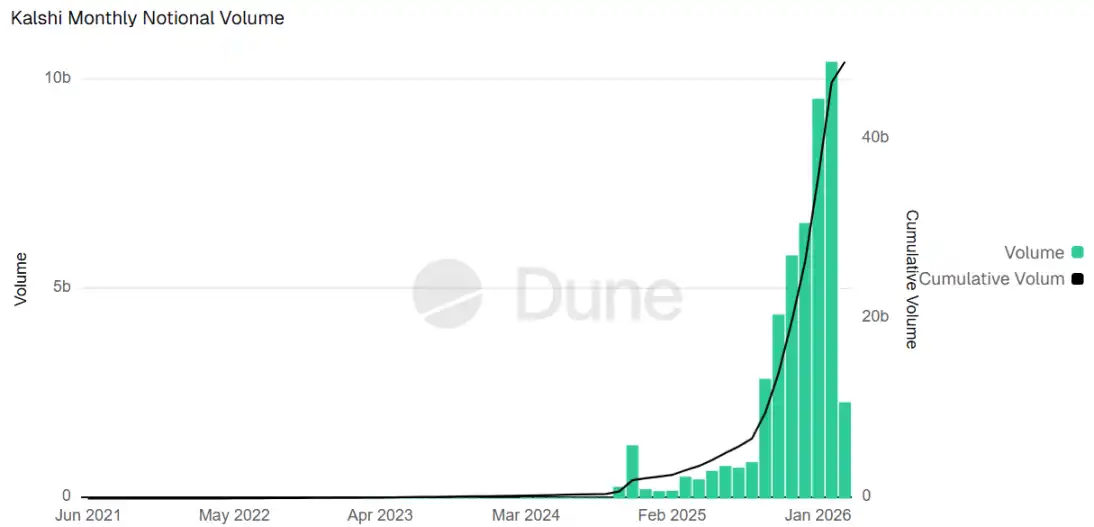
In 2024, Kalshi's annual nominal trading volume was approximately $1.9 billion, limited by early regulatory frameworks and market awareness, mainly relying on a few event-driven activities. By 2025, this number soared to around $23.8 billion, representing a year-on-year increase of over 1100%. This surge is directly reflected in monthly and weekly records: September saw a monthly trading volume of $28.6 billion, climbing further to $43.9 billion in October, and then skyrocketing to $65.8 billion in December. The strong start to 2026 continued, with January's monthly trading volume exceeding $104 billion.
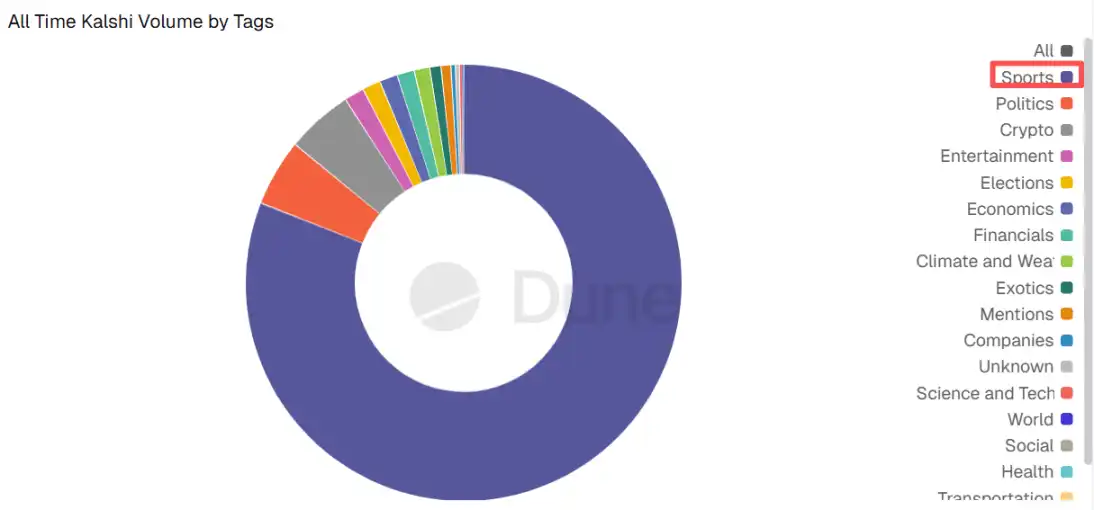
The sports event contract contributed approximately 81% of the trading volume.
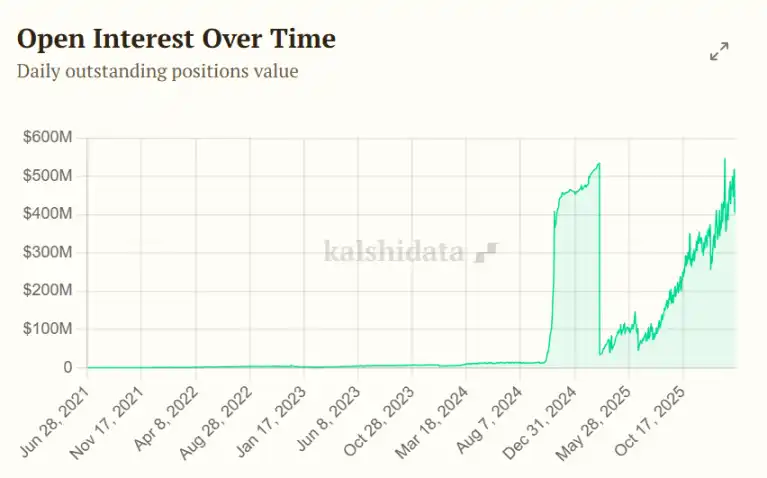
As of March 9, Kalshi's total cumulative trading volume has exceeded $48.6 billion. The current open interest hovers around $500 million.
Polymarket's trading volume reflects earlier accumulation advantages and later robust maintenance. According to Dune data, in 2024, Polymarket's monthly nominal trading volume experienced explosive growth, with the October 2024 monthly trading volume reaching $42.66 billion, hitting a historical high, and its cumulative trading volume rising to $7.6 billion.
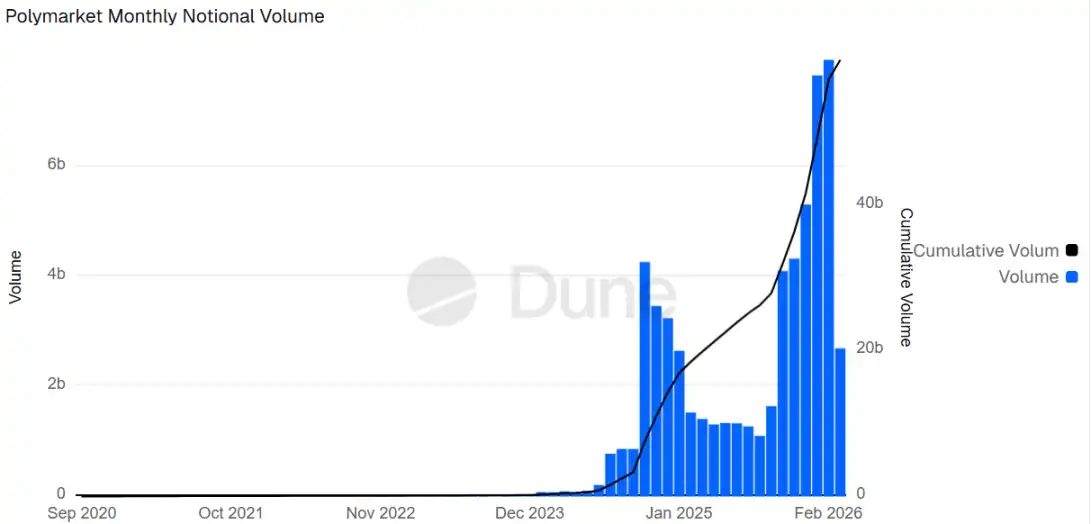
Subsequently, although its monthly trading volume slowly declined, it still maintained at a high level. The turning point occurred in September 2025 when Polymarket began its pulse-like surge in trading volume.
In October, the monthly trading volume exceeded $41 billion, and in November, it surpassed $43 billion.
Fast forward to 2026, in just January, its trading volume surpassed $76.58 billion, and in February, it surpassed $79 billion. As of March 9, its cumulative trading volume exceeded $599 billion.
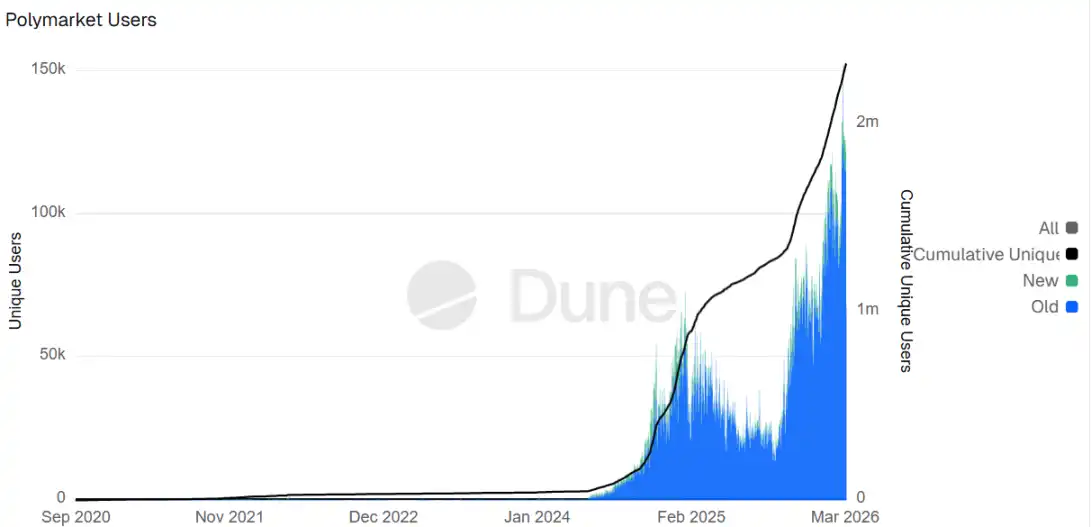
According to Dune data, its total number of users has soared from 40,000 in 2024 to the current 2.31 million.
It is worth noting that Polymarket still has an advantage in liquidity depth in political and crypto events, with some weekly transaction volumes accounting for up to 57%. However, its overall market share fell from 95% in 2025 to 35-40%, gradually stabilizing thereafter.

The divergence in the trading volume data of the two platforms fundamentally stems from the differences in business focus and user access models. As a CFTC-regulated entity, focusing on compliant USD transactions, covering over 42 U.S. states, Kalshi has the upper hand in sports dominance, while Polymarket maintains its lead in politics and crypto, jointly driving the entire market's weekly nominal trading volume to stabilize at billions of dollars.
In terms of ecosystem collaboration, the two major prediction markets have been very active, deeply integrating with mainstream institutions, media, and sports IP. Both have not only opened offline grocery stores but also expanded wildly online.
Kalshi, leveraging its compliance advantage, strategically partnered with Tradeweb and received a minority equity investment, embedding real-time probability data into its institutional trading platform. Robinhood emerged as the largest traffic source, contributing to over 50% of the trading volume in the second half of 2025. Simultaneously, exclusive media partnerships were established with CNBC and CNN, directly integrating data into programs and reports.
On the other hand, Polymarket focused on Wall Street data output and entertainment penetration. In June of last year, Polymarket partnered with X to become its official prediction partner. A strategic investment of up to $2 billion was secured from ICE, incorporating the data into financial product flows. In November, Polymarket signed a multi-year exclusive agreement with TKO Group, becoming the official prediction market partner for UFC and Zuffa Boxing, with data featured in broadcasts and live events.
In January 2026, Polymarket entered into an exclusive partnership with a Dow Jones-owned media outlet, providing prediction market data to media including Barron's and The Wall Street Journal.
Interestingly, both are official NHL prediction market partners, and Google has integrated data from both into its search and finance platforms.
Overall, looking at the trading volume and monthly active data from the past two years, they have collectively propelled the prediction markets from niche tools to mainstream information and risk management platforms. This trend has not only reshaped the valuation logic of the crypto industry but also provided real-time signal references for traditional finance. With potential upcoming financing rounds and the addition of hot geopolitical events (US-Iran conflict), World Cup matches, and the eve of the US presidential election, both platforms are expected to reach historic highs in data throughout 2026.
You may also like

CFTC Reportedly Plans New Prediction Market Rules Focused on Manipulation Risk and Public Interest Review
The CFTC is reportedly preparing new prediction market rules focused on manipulation risk, public interest review, and retail trader protections.

Meet the new WEEX trial fund—your gateway to greater profits

WEEX Labs Lands at Dutch Blockchain Week: A Disruptive Crypto × AI Conversation Sets Sail in Amsterdam

SK Hynix Reportedly Plans U.S. ADR Listing as Early as August, With SEC Approval Possible in Late June
SK Hynix may pursue a U.S. ADR listing as early as August, with SEC approval reportedly possible in late June amid strong AI chip supply chain demand.

SpaceX vs Tesla vs xAI: Which Elon Musk Trade Has the Biggest Upside in 2026?
OpenAI Reveals It Has Confidentially Submitted an S-1 to the SEC, Keeping the Door Open for a Future IPO
On June 9, according to an OpenAI announcement, the company recently confidentially submitted a draft S-1 registration statement to the U.S. Securities and Exchange Commission (SEC), beginning the preliminary compliance process for a potential initial public offering. OpenAI said it chose to disclose this proactively because it expected the news might leak; however, the company has not yet set a specific listing timeline, and related arrangements may still take some time.

Latest research from 13 top universities including Cornell University: The current state, challenges, and misconceptions of the fusion of Crypto and AI
Deconstructing Anthropic: The Best AI Company, Possibly Also a Type of Organizational Invention
Apollo and Blackstone Reportedly Back $35 Billion Anthropic Chip Financing as Deal Details Remain Unclear
On June 9, according to currently available news alerts, Apollo and Blackstone Group participated in a $35 billion financing for an Anthropic “chip project.” Based on the original wording of the report, the funding has already been raised, but public information remains limited. The financing structure, use of proceeds, project entity, and whether Apollo and Blackstone participated through equity, debt, or project financing have not yet been disclosed.

Humanity Protocol Security Incident Escalates: More Than $31 Million Stolen From Related Addresses as Attacker Continues Selling H for ETH
On June 9, according to monitoring by Onchain Lens, more than $31 million has been stolen from addresses linked to Humanity Protocol, and the attack is still ongoing, with the hacker continuously swapping H tokens for ETH. Project founder Terence Kwok later confirmed the security incident on X, saying the issue involved a private key leak.

Bloomberg: As Bitcoin Weakens, Stablecoins and RWA Continue to Drive Expansion in Crypto Businesses
In June, Bloomberg reported that despite Bitcoin falling below $60,000 last week, wiping out about $235 billion in market value within seven days, and dropping close to 50% from last year’s peak, some core businesses in the crypto industry are still expanding, mainly in stablecoins, real-world asset tokenization (RWA), payments, and infrastructure. The report also noted that overall altcoin activity has contracted significantly: altcoin market capitalization has fallen from a peak of about $431 billion in November 2021 to around $170 billion, and among the tens of millions of tokens issued in recent years, fewer than 1,700 still maintain meaningful trading activity.

Galaxy Deep Research Report: How Hyperliquid's HIP-4 Upgrade Changes the Landscape of Prediction Markets?
Binance Research: RWA Market Expected to Expand Nearly 6x from Early 2025, with Public Equities and Onchain Payments Heating Up Together
In June, Binance Research said in its monthly market report that the real-world asset (RWA) market is expected to grow by about 589% from the beginning of 2025. Bond- and money market fund-related RWA expanded by about $6.5 billion, up 83% year over year, while publicly traded equity RWAs grew by about 422%. The report also noted that monthly crypto debit card transaction volume exceeded $747 million in May, up 48.6% year to date.

Japan to Assess a Framework for Yen Stablecoins and Crypto ETFs as Asia’s Compliant Payments Narrative Heats Up
Recently, according to the original report, Japan is considering the launch of yen stablecoins and cryptocurrency ETFs. Public information remains limited at this stage, and there is still no complete policy text, regulatory draft, or clear implementation timeline, so this is better characterized as a “policy discussion” rather than formal implementation. The original wording also noted that advancing stablecoin regulation in Asia is driving XRP usage and supporting growth in the XRPL ecosystem. However, based on currently available public information, there is not enough evidence to directly establish a clear causal relationship between this round of discussion in Japan and XRP or XRPL.

ZachXBT: Humanity private key leak and abnormal surge in H token should be viewed separately
On June 9, according to related disclosures, on-chain investigator ZachXBT posted an update on Humanity’s roughly $31 million security incident, saying that after further analyzing fund flows, he currently tends to believe the project team was not involved in an “inside job” or a self-staged attack. According to him, the official explanation about the private key leak was broadly accurate, but before the token unlock, the price of H had been artificially pushed higher, and the hacker later took advantage of that market environment; therefore, the private key leak and the earlier abnormal price pumping should be regarded as two separate and independent events. This reframing has shifted the market’s understanding of the nature of the incident. Earlier discussion around Humanity had focused on whether the team directly participated in the attack or used the security incident to cover up internal operations. ZachXBT’s latest remarks shift the focus from “whether it was self-theft” to “whether there were pre-unlock market structure issues.” He also questioned whether the team may have.

Morning Report | OpenAI has submitted an S-1 registration statement draft to the U.S. SEC; Morpho completes $175 million financing

Morning Report | BitMine increased its holdings by 126,971 ETH last week; trader Eugene announced his exit from the crypto market

Wang Chuan: How can one not feel anxious after the neighbor Old Wang made thirty times profit by investing in storage stocks? (Seven) - A quarter-century cycle
CFTC Reportedly Plans New Prediction Market Rules Focused on Manipulation Risk and Public Interest Review
The CFTC is reportedly preparing new prediction market rules focused on manipulation risk, public interest review, and retail trader protections.
Meet the new WEEX trial fund—your gateway to greater profits
WEEX Labs Lands at Dutch Blockchain Week: A Disruptive Crypto × AI Conversation Sets Sail in Amsterdam
SK Hynix Reportedly Plans U.S. ADR Listing as Early as August, With SEC Approval Possible in Late June
SK Hynix may pursue a U.S. ADR listing as early as August, with SEC approval reportedly possible in late June amid strong AI chip supply chain demand.
SpaceX vs Tesla vs xAI: Which Elon Musk Trade Has the Biggest Upside in 2026?
OpenAI Reveals It Has Confidentially Submitted an S-1 to the SEC, Keeping the Door Open for a Future IPO
On June 9, according to an OpenAI announcement, the company recently confidentially submitted a draft S-1 registration statement to the U.S. Securities and Exchange Commission (SEC), beginning the preliminary compliance process for a potential initial public offering. OpenAI said it chose to disclose this proactively because it expected the news might leak; however, the company has not yet set a specific listing timeline, and related arrangements may still take some time.

Popular coins
Latest Crypto News


