
- Buy Crypto
- Markets
 Futures
- Spot
- Copy Trade
- Earn
- More
2025 Token Postmortem: 84% Peak at Launch, High-Cap Project Turns into a "Rug Pull" Epicenter?

Original Title: 113 token launches. $1.3B+ raised. One pattern that kills all
Original Source: Solus Group
Original Translation: CryptoLeo, Odaily Planet Daily
Editor's Note: In a recent analysis, analyst Ash stated in a popular post that out of over 100 new tokens from 2025 TGEs, 84.7% of tokens had an FDV lower than the FDV at TGE. The median FDV of these tokens dropped by 71% from issuance (median market cap drop of 67%). Only 15% of tokens saw an increase in FDV from TGE. Overall, most tokens from 2025 new issuances fall under the category of "peak price at TGE."
Building on this data, an even more interesting article (from Solus Group) was found, which analyzed the trends post-TGE of 113 tokens from 2025, along with their funding status, community activity, and correlation with exchange listings. The research revealed that factors commonly seen as indicators of project quality such as high funding, active community, and exchange listings have little impact on the token's performance. While we used to select good projects based on these criteria, this assessment model for projects in 2025 has "broken down." One particularly thought-provoking set of data is as follows:
-Projects with a trading price lower than the IDO price had an average revenue of $1.36 million.
-Projects with a trading price higher than the IDO price had an average revenue of $0.79 million.
However, all these projects received support from venture capitalists, indicating that the market values hype over actual performance, stories over data, and promises over the product itself. Web3 can no longer pretend that "all is well" or refer to bot traffic as "growth." Of course, this article only draws some statistical conclusions and is not a universal standard for all projects. Good projects and large funding can still represent the direction of the crypto industry.
A $2 million funding, participation from top VCs, 500k community fans, listing on major exchanges, unprecedented excitement on the first day of trading, jubilation on Discord, and a celebratory atmosphere all over social media.

In a previous article, we revealed the truth behind a 0.96x ROI: by 2025, on average, each token was actually dead on arrival, proving the system to be invalid. Now, we have analyzed 113 token launch cases since 2025, providing irrefutable data to support this — data that most founders dare not confront.
The research results are shocking: large funding amounts are ineffective, a massive community is irrelevant, and every variable you optimize for holds no statistical value.
But beneath the surface lies a more sinister truth that continues to plague many founders: the current state of project revenue is a bearish signal, where the token price of profitable projects is lower than that of non-profitable ones, a dynamic that is life or death. If profitability continues to be punished while speculation is rewarded, the entire industry will not survive.
Editor's note: Previously, Solus Group published data revealing that, for projects launched in 2025, the average Token Generation Event (TGE) project had a 0.96 ROI from day one, indicating that their product launch was in a loss-making position from day one.
Founder Data Trap: Funding Paradox, High Funding Does Not Equal Token Advantage
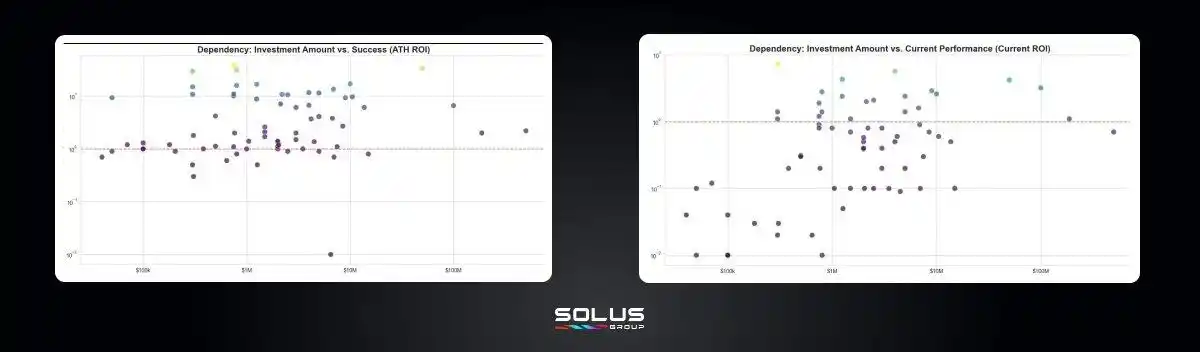
Correlation between funding and token performance: 0.04, statistically negligible.
Projects with $10 million in funding perform identically to those with $1 million in funding. The chart above proves this — regardless of the funding amount, the distribution of tokens within the ROI range is random. Top-performing projects such as Myshell, B² Network, Bubblemaps, Mind Network, Particle Network, and Creator.Bid (which saw valuations increase 10x to 30x at their ATH) raised between $300,000 and $3 million. Meanwhile, projects like Boundless and Analog, which raised over $10 million, only saw a multiple of around 1x.
Current token performance is even worse, with most tokens, regardless of funding size, having an ROI of less than 1x. For example, tokens from projects with funding between $5 million and $100 million have an ROI of 0.1x to 0.7x (e.g., Fleek, Pipe Network, Sahara AI), similar to projects with minimal funding.
The fact is: Large fundraising accelerates project token death.

The least funded projects ($300,000 to $5 million) have a higher return on investment for every dollar raised, they execute faster, pivot cheaper, and don't get drowned in the quarterly VC token unlock schedule, where a large token unlock destroys project gains.
If you're pursuing $10 million for the sake of "competition," you are preparing to fail.
Fan Myth: A large project community is also just a "paper tiger"
A social media following of 500,000 and 50,000, the stats are identical.
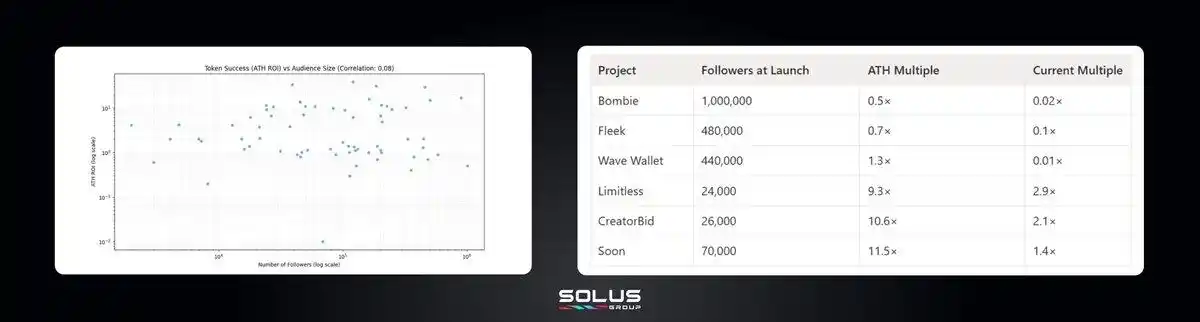
Correlation: 0.08 (Token ATH) and -0.06 (Token current state)
Data shows that audience size has no predictive value on token performance, projects with a large fan base have mixed performance - some skyrocket, some plummet, small-audience projects do the same with no trend, no pattern, and no correlation.
The Discord group you are in is not a community, it's a speculative audience waiting to leave.
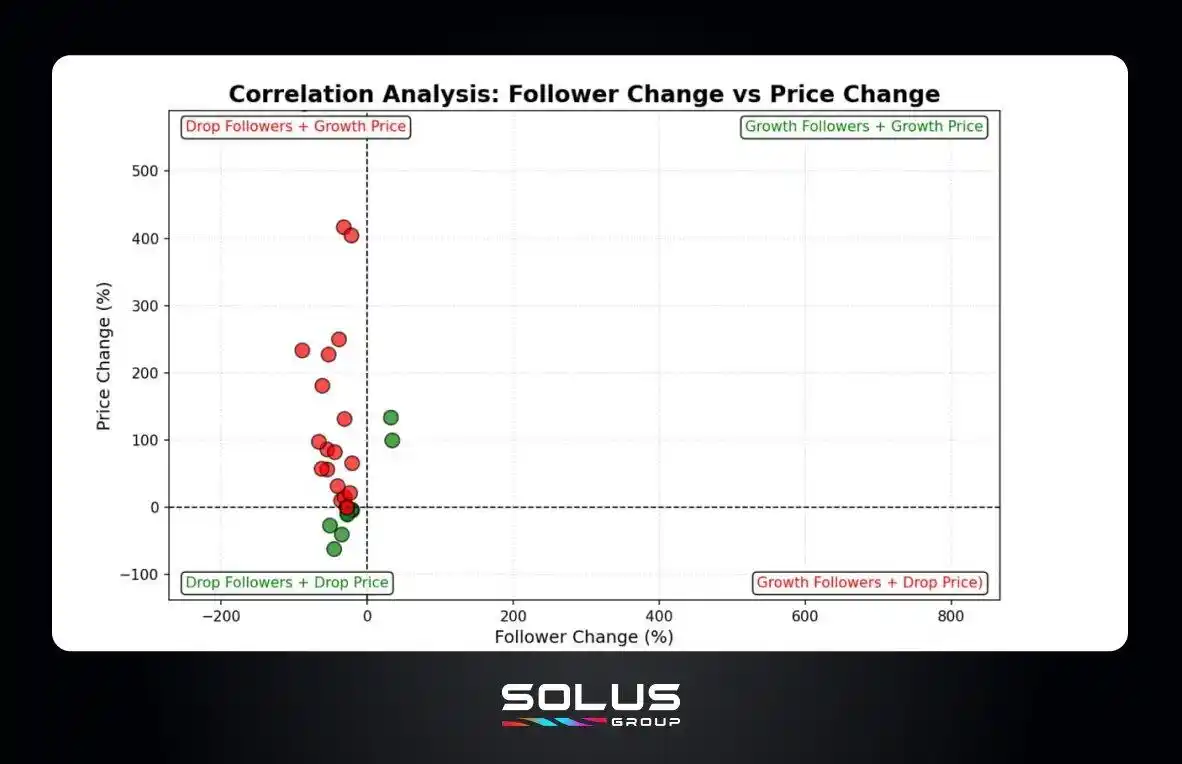
Reality is: Price dictates community development, not community drives price.
When the price crashes, followers disappear. The chart proves this - the bottom-left quadrant (decreasing followers + price drop) is very dense. When the price surges, followers sometimes grow with it, but it's not consistent.
This means:
Your "active community" has never really cared about the product - they care about the token price movement. Once the token performance disappoints, they disappear, community growth is a lagging indicator, not a leading one.
This is not just theory, but a viewpoint publicly expressed by @belizardd (Researcher/Trader/KOL):
Most people are here purely for speculation, not the product itself. We find few protocols that perform well post TGE, and mostly, those protocols have low initial token FDV, raised low amounts, and generous airdrops. Frankly, I wouldn't blindly ape into anything right now. Risk/reward is not worth it, I'm just waiting for the market to pick up.
Speculators know the game is up. They are in a wait-and-see mode. Meanwhile, the founder keeps pouring 60% of the budget into Discord bots, Twitter giveaways, and KOL promotions — burning money on statistically irrelevant metrics.
The real question is: "If the token crashes 50% tomorrow, how many people will still be around?"
Answer: Almost none.
Token Price Trap, Beware of Overvaluation/Undervaluation
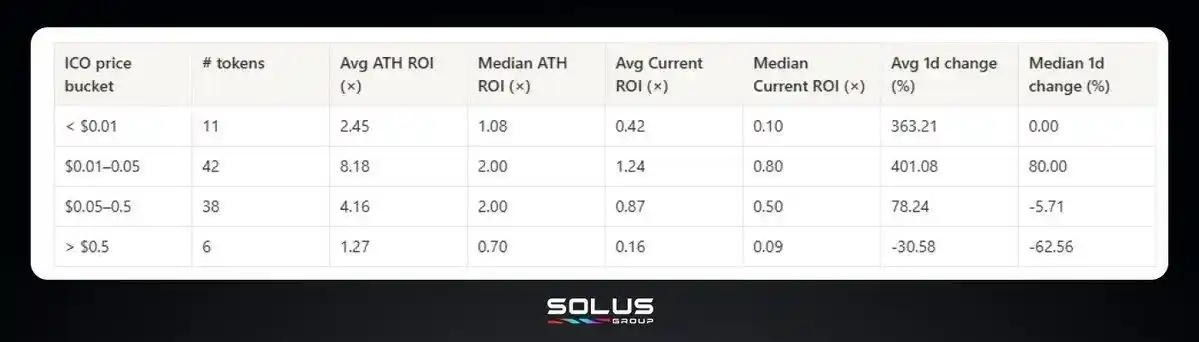
Median investment return calculated based on token listing price:
· Below $0.01: 0.1x (lose 90%)
· $0.01 to $0.05: 0.8x (survivable range)
· $0.05 to $0.50: 0.5x (lose 50%)
· Above $0.50: 0.09x (lose 91%)
Let's reiterate:
A token issuance price below $0.01 does not make your token "easier to get into," it just makes you a low-price coin attracting profit-driven capital that pumps and dumps quickly.
Pricing above $0.50 does not make your token a "premium token," it just looks overvalued. An overly high token price will kill the retail market, and whales won't buy it.
The $0.01 to $0.05 token price range is the only survivable pricing range, which is both high enough to signal legitimacy of the project and low enough to leave room for upward movement. Within this price range, out of 97 projects, only 42 had a positive median token performance.
If your tokenomics peg your valuation at $0.003 or $1.20, stop recalibrating. The data indicates your project has already failed.
Industry Landscape: Stop Building for 2021
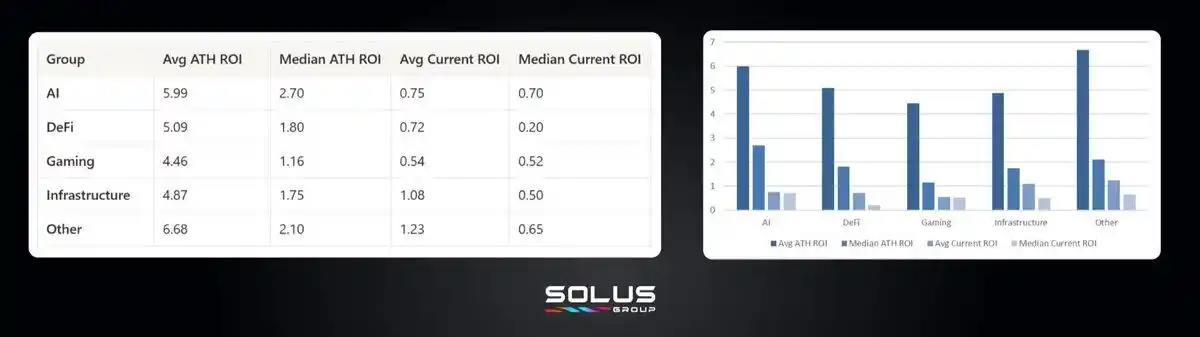
Loser: Gaming
Average ATH ROI: 4.46x (Lowest)
Current Median ROI: 0.52x
GameFi tokens are like lottery tickets, played once and then forgotten forever.
Trap: DeFi
Average ATH ROI: 5.09x (Looking Good)
Current Median ROI: 0.2x (Disastrous)
The early price surge of DeFi followed by a crash has been more extreme than any other sector, highlighting the brutal gap between hype and reality.
Winner: AI
Average ATH ROI: 5.99x (Highest Surge)
Current Median ROI: 0.70x (Best Retention)
AI token prices have surged and held steady. This trend shows persistence, drawing in funds accordingly.
If you are developing GameFi, your execution needs to be ten times above average to achieve mediocre results. If you are in DeFi, be prepared for rapid rises and steep falls. In the AI sector, the market will provide opportunities, but only if you can deliver. The demands in infrastructure are even more stringent: compared to standard decentralized applications like AI agents, you will consume more time and resources, yet your current ROI median is slightly below the universally scorned GameFi field.
Data doesn't care about the project you are passionate about.
IDO/IEO Data Overview: A Good Platform Can't Save a Project
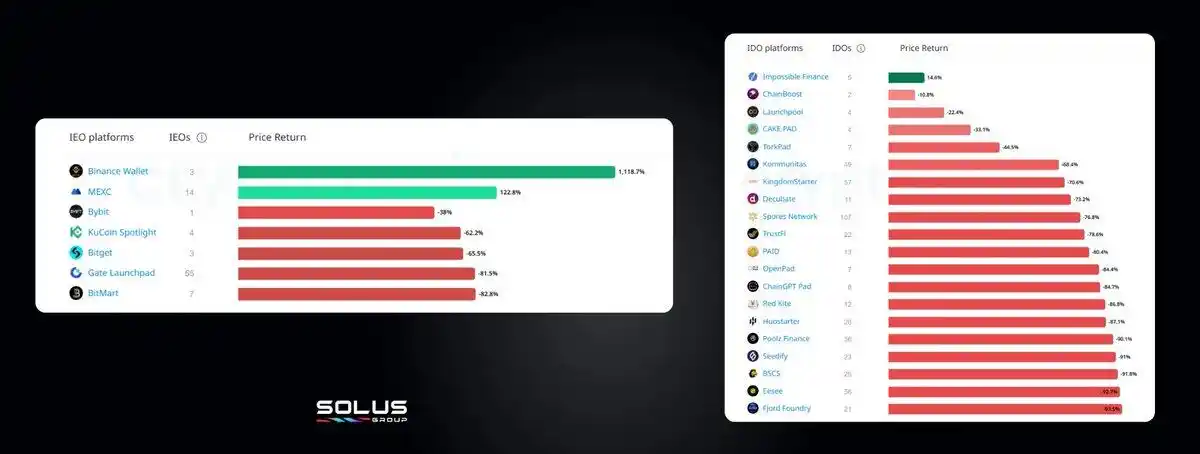
You spent months building connections, only to secure a seat on Binance Launchpad or a first-tier IDO allocation, thinking that passing through platform filters meant protection. The data shows otherwise.
IDO Platforms: Nearly all projects are in a loss position
Only one project across 5 IDO platforms has a return rate of +14.6%, that's it. The return rates for all other projects range from -70% to -93%.
The so-called "Advanced Launchpad" did not provide protection for buyers, but rather offered them a way to lose money.
IEO Platform: The Ultimate Manifestation of Survival Bias
The Binance wallet displayed a return rate of 11x. It looks unbelievable, but it was only issued 3 times, with a too small sample size. MEXC showed a return rate of +122.8% over 14 issuances—a larger sample, but still an outlier. All other projects? Underperformed. Bybit's IEO token had a loss rate of 38%, with other projects experiencing even more severe losses.
This proves:
Platform selection is like a lottery with a better branding effect. The victory of a few outlier data distorts the average, and post-token-distribution drops dominate a large number of tokens. The "curation service" fee you pay—whether through relationships, listing fees, or token allocation—cannot reliably protect token ROI.
Platforms cannot save bad tokens, nor can they help good ones.
Reflecting on 2025, Looking Ahead to 2026
The projects based on 2025 have failed at every level.
Layer Zero: Foundation
Problem: "Speculative Tokenomics." Selling tokens recklessly to illiquid markets without an organic revenue model to absorb the shock.
Layer One: Fundraising
Problem: "Edit first on the PDF, then deal with it later."
Layer Two: Marketing
Problem: KOL model, users hired through paid armies who disappear without a trace once the payments stop.
Layer Three: Liquidity
Problem: Assuming liquidity will increase with hype, which is not the case—institutional investors wait for evidence.
Layer Four: User Retention
Problem: Zero retention infrastructure. The "project community" is 10,000 Telegram users who will abandon you within 90 days.
2026 should not replay old games. Behind all this lies a deeper problem—the infrastructure is indeed important, and even with perfect infrastructure, timing is everything. As Ivan Paskar, Growth Lead at Altius Labs, said:
A token cannot fix broken things — they will amplify reality. Right Timing = Momentum Amplification. Wrong Timing = Years of Effort Instantly Gone. Most teams don't fail in token design, they fail in misjudging the phase & macro environment they're in, timing is not a detail, it's everything.
What Projects Should Do in 2026
Survival isn't about following the old script, it's about crafting a new script.
1. Meticulous Design
Target raise between $300K to $5M, the best ROI per dollar invested is here. More funds = more problems.
2. Survival Cost
Initial price between $0.01 to $0.05. Other prices struggle to survive. If your tokenomics don't fit in this range, they have issues.
3. Product First, Token Second
If you can't explain why your token exists in one sentence, then it doesn't. Utility before speculation.
4. Ignore Vanity Metrics
Follower count is a distraction, wallet activity, retention rate, and per-user income are the key metrics.
5. Industry Realism
Understand your industry's failure rate before writing code. GameFi needs twice the execution efficiency to break even. AI has a tailwind — as long as you can deliver.
6. Integrate or Die
The era of mergers and acquisitions is approaching. If you can't expand independently, find an acquirer. Acquisition is not a failure, it's a smart move.
These six principles are critical. But the truth is: the standard script is outdated, there's no longer a one-size-fits-all standard mode.
You may also like

Morning News | Nexthop AI completes $500 million Series B funding; "xMoney" will begin early testing next month; The U.S. Department of Justice is investigating Iran's use of Binance to evade sanctions
Champion Crowned at WEEX AI Hackathon: Revealing Strategy That Won $600K
A trader with only 6 months of AI trading experience won $600,000 at the WEEX AI Hackathon. Discover the strategy, tools, and lessons behind this breakthrough victory.

Bitcoin Price Stalls in the Face of Stubborn $72K Barrier
Key Takeaways: Bitcoin’s price struggles to surpass the $72,000 resistance level, facing repeated rejections. Increased supply at loss…

Bitcoin Price Confronts ‘Challenging’ Cycle Phase After Failing $72K Resistance
Key Takeaways: Bitcoin remains in a tight range after failing to surpass the $72,000 resistance. Increased supply in…

Bitcoin and Gold: Examining the Shift in ETF Flows
Key Takeaways: Bitcoin ETFs recently saw an increased inflow of $273 million over 30 days ending March 6,…

Bitcoin Leads, Altcoin Indicators Hit Lows: Are We Entering an Altseason?
Key Takeaways: Bitcoin’s price resurgence to $71,000 indicates a potential market stabilization. TOTAL2, a metric excluding Bitcoin, aligns…
XRP Price Chart Mirrors 2017 Rally Setup: Implications for Future Movements
Key Takeaways: XRP’s current weekly chart echoes the 2017 cycle low, suggesting the potential for a 1,577% surge.…
Bitcoin Order Book Imbalance: Can $70K Support Hold?
Key Takeaways: Bitcoin’s sell-side liquidity is at a two-month high, reminiscent of the January 2026 scenario. Within 5%…

When Buying Bitcoin, Don’t Expect Immediate Profits: A Three-Year Outlook
Key Takeaways: Bitcoin holders benefit most significantly after a three-year period, observing substantial gains post-volatility. Investors who bought…

DOJ Investigates Binance’s Alleged Role in Iran Sanctions Evasion
Key Takeaways: The U.S. Department of Justice (DOJ) is scrutinizing Binance over possible involvement in US sanctions evasion…

Ether Rides High at $2K: Traders Eye Overhead Short Liquidity
Key Takeaways: Ether’s trading volume surges past $2,000 driven by intensified derivatives action. A fresh net inflow of…

South Korea Offloads $21.5 Million in Bitcoin Reclaimed After Custody Breach
Key Takeaways: South Korean authorities recovered and liquidated 320.8 Bitcoin following a phishing incident. The sale took place…
BitMEX Co-Founder Arthur Hayes Hesitant on Bitcoin Investment Amid Fed’s Firm Monetary Policy
Key Takeaways: Arthur Hayes, the co-founder of BitMEX, is currently holding off on investing in Bitcoin, waiting for…

SlowMist Unveils Web3 Security Shield for Autonomous AI Agents
Key Takeaways: SlowMist has designed a five-layer security system for Web3 AI agents to mitigate risks associated with…

Ripple Eyes Australian Financial License Through Strategic Acquisition
Key Takeaways: Ripple intends to obtain an Australian Financial Services License (AFSL) by acquiring BC Payments Australia. The…

VanEck Crypto ETFs Now Accessible Through Basic Capital’s 401(k) Platform
Key Takeaways: VanEck’s digital asset ETFs are now available to U.S. 401(k) holders via Basic Capital, marking a…
India Detains Darwin Labs Co-Founder amid GainBitcoin Investigation
Key Takeaways: India’s CBI has arrested Ayush Varshney, co-founder of Darwin Labs, for his involvement in the GainBitcoin…

Strive Commits $50M to Strategy’s STRC Preferred Stock
Key Takeaways: Strive Asset Management invests $50 million in STRC, a digital credit instrument connected to Strategy’s Bitcoin…
Morning News | Nexthop AI completes $500 million Series B funding; "xMoney" will begin early testing next month; The U.S. Department of Justice is investigating Iran's use of Binance to evade sanctions
Champion Crowned at WEEX AI Hackathon: Revealing Strategy That Won $600K
A trader with only 6 months of AI trading experience won $600,000 at the WEEX AI Hackathon. Discover the strategy, tools, and lessons behind this breakthrough victory.
Bitcoin Price Stalls in the Face of Stubborn $72K Barrier
Key Takeaways: Bitcoin’s price struggles to surpass the $72,000 resistance level, facing repeated rejections. Increased supply at loss…
Bitcoin Price Confronts ‘Challenging’ Cycle Phase After Failing $72K Resistance
Key Takeaways: Bitcoin remains in a tight range after failing to surpass the $72,000 resistance. Increased supply in…
Bitcoin and Gold: Examining the Shift in ETF Flows
Key Takeaways: Bitcoin ETFs recently saw an increased inflow of $273 million over 30 days ending March 6,…
Bitcoin Leads, Altcoin Indicators Hit Lows: Are We Entering an Altseason?
Key Takeaways: Bitcoin’s price resurgence to $71,000 indicates a potential market stabilization. TOTAL2, a metric excluding Bitcoin, aligns…


 App
App