
72 Minutes Before Attack, Six Mysterious Accounts Raked in $1.2 Million

Original Article Title: "Accurate Entry in the First 71 Minutes! Six Mysterious Accounts Bet Big on Iran Airstrike, Raking in 1.2 Million, Trump Camp Embroiled in 'Insider Trading Suspicion'"
Original Article Author: Dong Jing, Wall Street News
The news of the U.S. launching a military strike against Iran sent shockwaves through the global market, but before the sound of the explosion, someone had quietly positioned themselves in the prediction market.
According to the blockchain analytics firm Bubblemaps, six suspicious insider-like accounts on the Polymarket platform concentrated their bets on "yes" hours before the U.S. airstrike on Iran, collectively making a profit of around $1.2 million. These accounts were all registered in February, with most wallets only being funded within the final 24 hours before the strike, and apart from the mentioned bets, had no other transaction records.
This event has brought strong attention to regulatory loopholes in prediction platforms. At the same time, the U.S. Commodity Futures Trading Commission (CFTC) recently issued a warning regarding insider trading issues in prediction markets, with regulatory pressure mounting.
According to the Wall Street News article, the U.S. and Israel launched a large-scale joint military strike against Iran on February 28. As reported by CCTV News, Trump posted a video on the "True Social" platform that day, confirming that the U.S. military had carried out a "major combat operation" against Iran and addressed Tehran, saying, "After the operation is over, take over your government."
Following the public release of the news, the price of Bitcoin dropped, while oil futures on the Hyperliquid platform rose due to escalating regional conflict expectations. The trading volume of this futures market reached nearly $90 million on February 28, and since December last year, the total trading volume of related contract markets regarding U.S. strikes against Iran has exceeded $529 million, demonstrating the market's high level of interest in this geopolitical event.
Six Accounts Make Precise Bets, Profiting $1.2 Million
According to an analysis report published by Bubblemaps on the social platform X, six Polymarket accounts concentrated their purchases on the "Will the U.S. strike Iran before February 28, 2026" contract market, buying "yes" shares, and all made a profit when the market settled at $1, with a total profit of around $1.2 million.
One of the accounts bought over 560,000 "yes" shares at a price of around $0.108 per share, ultimately making a profit of nearly $560,000; another account purchased nearly 150,000 shares at $0.20, also recording a six-figure profit.
The visualization graph released by Bubblemaps shows a clear connection between six wallets, with a highly similar fund flow path.
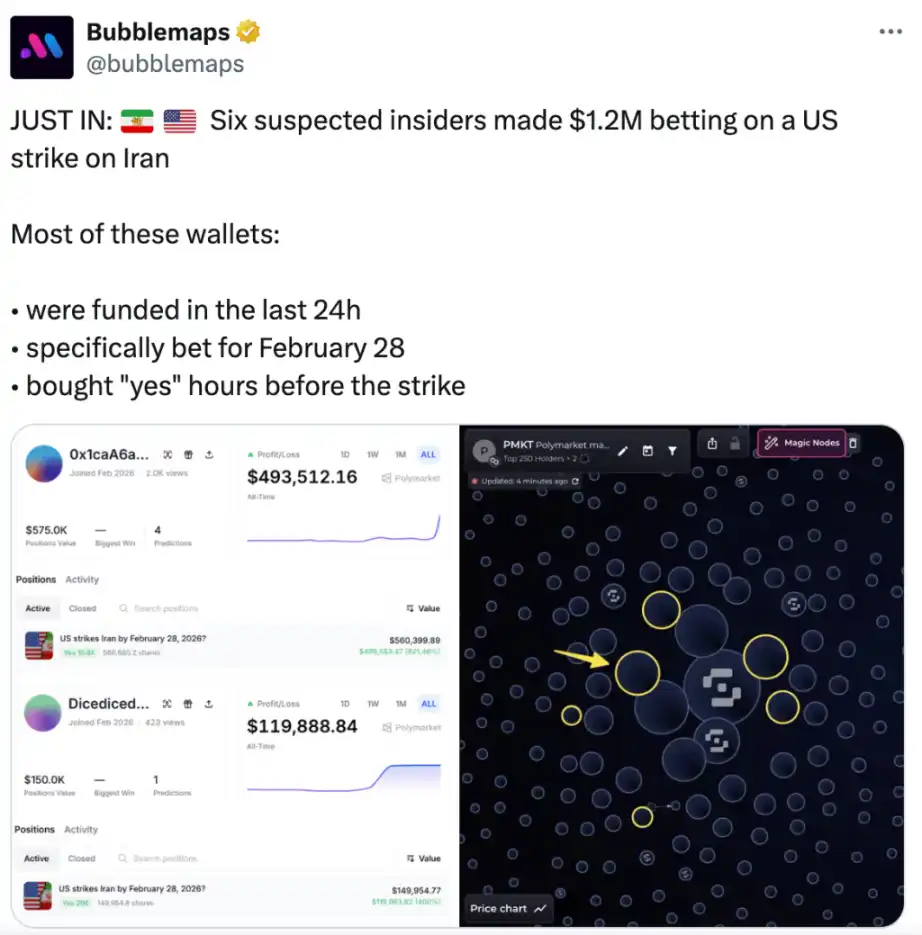
The above accounts were all created in February, with most of them making their first deposit within 24 hours before the attack occurred, and these accounts had no other transaction activity in their history except for this deposit. This behavioral pattern closely matches typical insider trading characteristics.
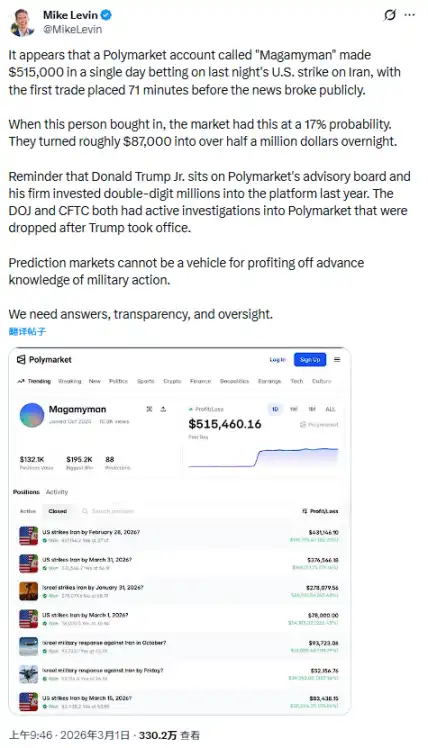
Additionally, according to a post by MikeLevin on the social platform X, among the six accounts mentioned, a Polymarket account named "Magamyman" made a daily profit of $515,000, with its first transaction taking place 71 minutes before the relevant news was publicly disclosed.
At that time, the market priced the likelihood of a U.S. strike on Iran at only 17%. The account entered with around $87,000 and made a profit of over $500,000 overnight.
It is worth noting that MikeLevin also pointed out in the post that Donald Trump Jr., the current member of the Polymarket Advisory Council, whose company invested tens of millions of dollars in the platform last year.
Furthermore, the U.S. Department of Justice and CFTC had previously investigated Polymarket, but the investigations were dropped after Trump took office. He called on relevant parties to provide an explanation for this matter and to promote transparency and regulatory follow-up.
Regulatory Pressure Mounts, Insider Trading Issues in Prediction Markets Surface
At this moment, U.S. regulatory agencies are increasing scrutiny on insider trading behavior in prediction markets.
Polymarket's competitor platform Kalshi announced this week that it has suspended and penalized two users suspected of insider trading. One of them is a visual effects editor for MrBeast's show "Beast Games," who was accused of trading using non-public information about the show's outcomes, resulting in a two-year ban and a fine of over $20,000; another case involved a political candidate betting on the election contract of their own candidacy.
Kalshi stated that the platform has investigated about 200 cases, with over ten cases still in active investigation.
The CFTC subsequently issued a warning, stating that insider trading on event contracts may violate U.S. law, with Chairman Mike Selig positioning the trading market as the "first line of defense."
Meanwhile, insider trading issues on the Polymarket platform are not new. Blockchain investigator ZachXBT teased last week that he would be releasing a report on a certain crypto platform, sparking market speculation and leading to a Polymarket contract where users could bet on "which company will be named."
Per LookIntoChain, 12 wallets were identified to have heavily bet on Axiom before the investigation results were made public, with employees of the company being accused of trading on non-public information.
You may also like

Morning News | CME Group launches Nasdaq Cryptocurrency Index futures; Asset management giant Janus Henderson strategically invests in Ethena

Bitcoin Layer 2 Network Botanix: Why Did We Choose to Dissolve?

Why did Oracle deliver the strongest financial report in history, yet its stock price fell?
When the P2P illicit funds from ten years ago turned into 60,000 bitcoins

Dialogue with OmenX Founder: Why does the prediction market need an evolution from "spot" to "derivatives"?
Galaxy in-depth report: Is Solana still worth paying attention to?

Young people in South Korea make a "final effort" in the epic bull market

The pricing controversy of Trade.xyz exposes the fatal weakness of Pre-IPO perpetual contracts

How much longer can Ethereum's last big buyer hold on?

World Cup 2026 Coming – WEEX Celebrates with $1M Prize Pool & Michael Owen Live

Morning Report | OpenAI has submitted an S-1 registration statement draft to the U.S. SEC; Morpho completes $175 million financing

Galaxy Deep Research Report: How Hyperliquid's HIP-4 Upgrade Changes the Landscape of Prediction Markets?

Latest research from 13 top universities including Cornell University: The current state, challenges, and misconceptions of the fusion of Crypto and AI

Deconstructing Anthropic: The Best AI Company, Possibly Also a Type of Organizational Invention

Every exchange is a "Universal Exchange."

The counterattack of traditional finance: Alliance chains are quietly reviving
Pantera Capital Partner: How Tokenization is Restructuring the Private Equity and Early Investment Ecosystem?

Mastercard Launches Agent Pay for AI, Plans to Record AI Agent Payment Authorizations on Polygon
Mastercard launched Agent Pay for AI, a new payment protocol designed to help AI agents make small payments such as pay-per-use access to data and APIs. The system plans to record human-granted AI agent permissions on Polygon, focusing on verifiable authorization, identity, and payment controls.
Morning News | CME Group launches Nasdaq Cryptocurrency Index futures; Asset management giant Janus Henderson strategically invests in Ethena
Bitcoin Layer 2 Network Botanix: Why Did We Choose to Dissolve?
Why did Oracle deliver the strongest financial report in history, yet its stock price fell?
When the P2P illicit funds from ten years ago turned into 60,000 bitcoins
Dialogue with OmenX Founder: Why does the prediction market need an evolution from "spot" to "derivatives"?
Galaxy in-depth report: Is Solana still worth paying attention to?


