
A single tweet caused a 17% crash in oil prices, who's not a Meme yet

In 1974, then U.S. Secretary of State Henry Kissinger flew to Riyadh and reached a deal with Saudi Arabia that would change the global landscape: Saudi agreed to sell oil exclusively in exchange for U.S. dollars, which would then be recycled to purchase U.S. Treasury bonds.
At that time, Nixon had just severed the link between the dollar and gold, the U.S. was facing runaway inflation, the dollar reserves were dwindling, gold was flowing out in massive quantities, and the Bretton Woods system collapsed. Many believed that the golden era of the dollar was over.
However, the deal Kissinger struck with Saudi Arabia established what would later be known as the "Petrodollar" system. It was this system that allowed the dollar to survive for half a century after the collapse of the gold standard.
It is also for this reason that whenever someone threatens to block the oil lanes, it is not just an energy issue for the U.S., but also an assault on the foundation of the entire dollar system. This is why the Strait of Hormuz, a narrow waterway like a throat, has always been seen by the U.S. as a key point that must be defended over the past fifty years, even if it means using military force if necessary.
Understanding this historical background, fifty years later, helps us better understand today's situation.
Early this morning, while most people in China were still asleep, a violent tremor lasting less than an hour had already wiped out billions of dollars in market value on the global crude oil futures market.
It all started with a social media post.
U.S. Energy Secretary Chris Wright posted on Platform X, saying, "The U.S. Navy has successfully escorted an oil tanker through the Strait of Hormuz to ensure the continued flow of oil to the global market."
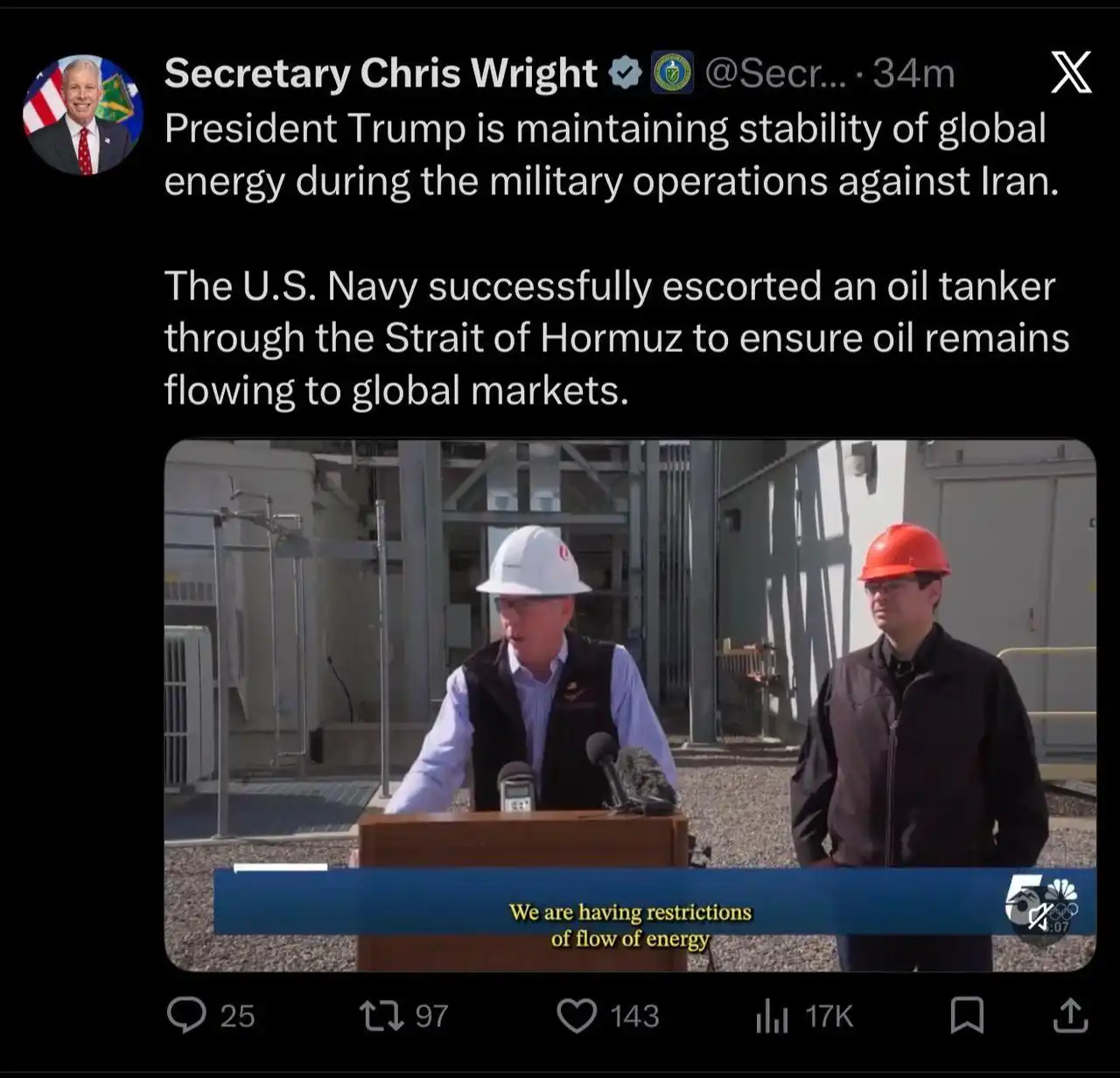
After this tweet, the WTI crude oil price plummeted in a few minutes, with a drop of up to 17%, briefly falling below $80 per barrel. In the previous weeks, due to the tense situation in the Middle East, Brent crude had just soared from $70 to $120.
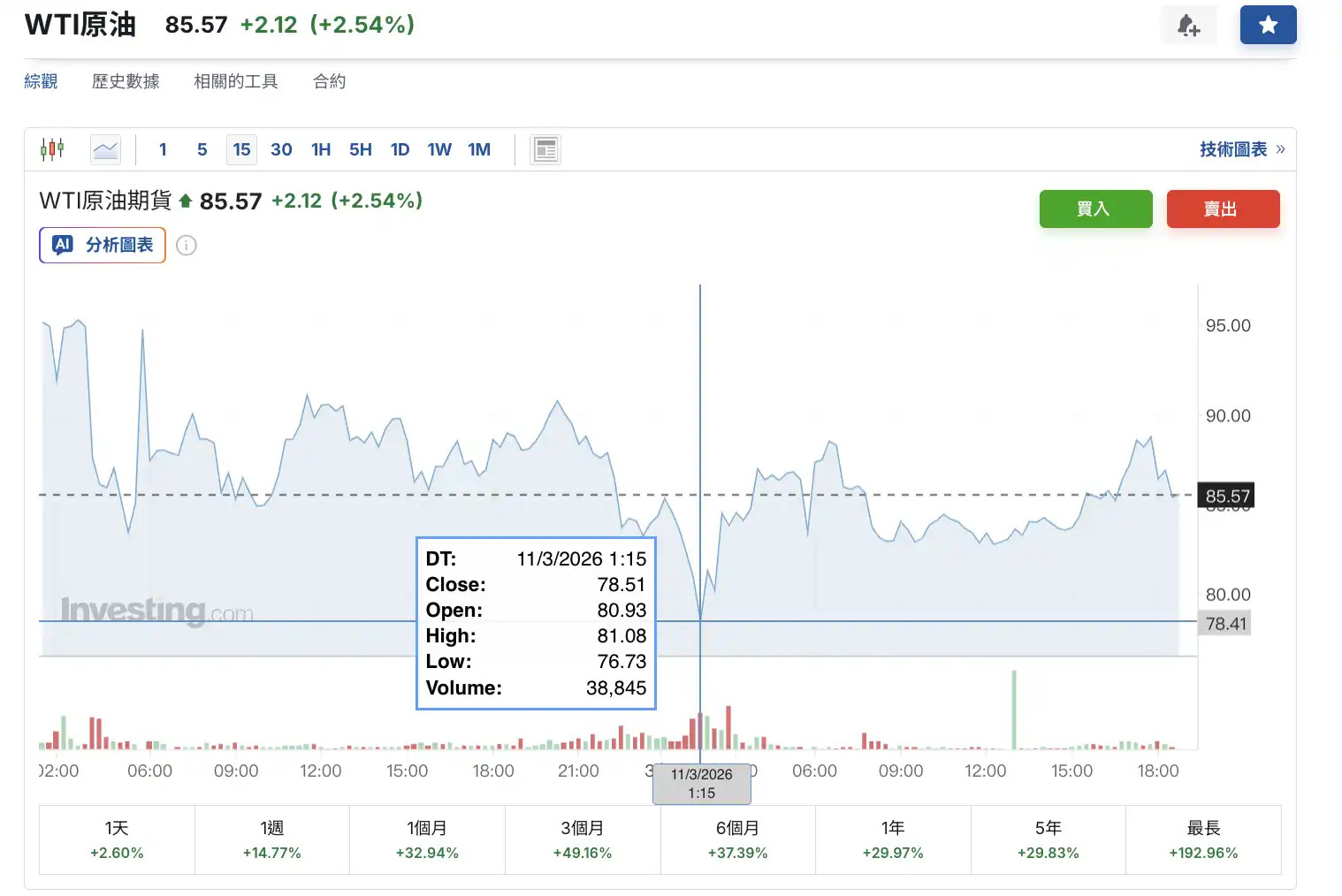
For those traders betting on further oil price increases, this moment was a nightmare.
However, the plot quickly reversed.
Less than an hour later, White House Press Secretary Karoline Leavitt urgently clarified during a press briefing: the U.S. Navy is currently not escorting any oil tankers. Subsequently, Energy Secretary Chris Wright quietly deleted the post without any explanation. The oil price then rebounded but could not return to its initial position.
A post, from publication to deletion, took less than sixty minutes. But the impact it left on the global financial market is far more than just that one hour.
Since the escalation of the US-Iran conflict at the end of February, the game around oil has continued to intensify. Especially after Iran announced the blockade of the Strait of Hormuz, this narrow waterway that handles about one-fifth of global oil transportation suddenly closed, causing a significant impact on the global energy market. As the situation escalated, international oil prices skyrocketed from $70 to $120 per barrel within a few days, putting the energy market in a highly tense state.
Almost all traders were waiting for the same signal: when will the Strait of Hormuz reopen? Under this collective anxiety, any slight movement could trigger drastic price swings. The rapid drop triggered by that post made by the Energy Minister was a concentrated reflection of this emotion.
So, why did oil prices plummet by 17% in just a few minutes? Because humans find it challenging to react that quickly, but algorithms can. In today's financial markets, a significant portion of trading volume comes from high-frequency trading algorithms and AI trading systems. They scan the entire internet in real time, including government officials' social media accounts, grab keywords, and automatically place orders.
There were three key words in that post: Navy, Escorted, Hormuz. The algorithm identified these words, then, combined with contextual semantics, quickly reached a conclusion: blockade lifted, supply restored, weakening the logic of price increase.
So the program immediately sold.
All of this happened in about 0.003 seconds.
Algorithms do not make calls to confirm if the oil tanker has indeed crossed the strait; they only recognize text, they only pursue speed. An unverified post, in this mechanistic "collective unconscious," was instantly converted into billions of dollars in market value evaporation.
A real oil tanker crossing the Hormuz Strait requires hours of sailing, actual military escort, fuel costs, and real-world risks. Whereas a post about "escort" took only 0.003 seconds to cause a significant price swing in this commodity.
In other words, crude oil, once dominated by supply and demand fundamentals, inventory data, and production agreements, has now, to some extent, become not much different from a meme.
During the last US election, Trump and Musk keenly grasped the sensitivity of it all. This is an information age, so one created Truth Social, while the other bought Twitter.
As the Information Age has progressed to this day, government officials' social media accounts have become one of the most sensitive sources of information in the market. This also means that power itself has begun to possess a certain Meme-like attribute: extremely fast propagation, high emotional intensity, and very prone to misinterpretation and amplification.
Traditional policy information dissemination is slow and rigorous. White House statements, State Department bulletins, Department of Defense press briefings, these mechanisms inherently involve verification, fact-checking, and layers of confirmation. However, when officials directly post policy-related information on X, these steps are skipped.
What we can foresee is that as we further enter the AI Agent era, both the capture of information and the speed of transactions will increase exponentially, with steep rises and falls occurring in milliseconds.
Viewed from a broader perspective, this may indicate a larger change: we are entering an era of "comprehensive asset Meme-ification." Almost any financial asset may, at some point, be driven by emotion, narrative, and social media.
Years ago, Kissinger used oil to extend the life of the dollar by fifty years. But he probably never imagined that one day oil itself would also become a kind of Meme.
No asset has an absolutely unbreakable fundamental moat. All moats are fundamentally based on some form of consensus. And under the dual acceleration of social media and algorithmic trading, this consensus is more fragile and dangerous than ever before.
Perhaps in some sense, this is also the triumph of the Meme.
You may also like

Morning Report | BitMine increased its holdings by 126,971 ETH last week; trader Eugene announced his exit from the crypto market

Wang Chuan: How can one not feel anxious after the neighbor Old Wang made thirty times profit by investing in storage stocks? (Seven) - A quarter-century cycle

Cryptocurrency CEXs are flocking to sell US stocks, and traditional brokerages are facing an "uninvited guest."

$75 billion in foreign capital has fled, and South Korean retail investors have absorbed it all using leverage

Japan’s Three Megabanks Plan Joint Stablecoin Issuance in Fiscal 2026
MUFG, SMBC, and Mizuho reportedly plan to jointly issue fiat-pegged stablecoins in fiscal 2026, signaling Japan’s growing push into bank-led digital payment infrastructure.

Humanity Discloses H Token Dual-Chain Attack Details, With Losses on Ethereum and BSC Exceeding $36 Million
Humanity said the H token attack across Ethereum and BSC caused more than $36 million in losses after leaked ProxyAdmin keys enabled malicious contract upgrades and token minting.
White House Discusses CLARITY Act With Law Enforcement Ahead of Senate Vote
The White House discussed the CLARITY Act with law enforcement ahead of a Senate vote, focusing on illicit finance risks and developer protections.

Bitcoin Trading Guide 2026: Strategies for Experienced Traders

What Is XAUT and PAXG? Why Tokenized Gold Is Booming in 2026

Will the SpaceX IPO Hurt Bitcoin? Here's What Traders Are Watching

Foreign selling in the South Korean stock market accelerates, with cumulative net sales reportedly reaching $75 billion this year
On June 9, The Kobeissi Letter, citing Goldman Sachs data, reported that global investors are selling South Korean stocks at an unusually rapid pace. In the latest trading session, foreign investors sold about $801 million worth of Kospi constituent stocks again; total foreign outflows last week reached about $10 billion, and the market has been in net foreign selling on nearly every trading day over the past month. According to the data cited in the report, foreign investors have sold about $75 billion worth of South Korean stocks so far this year. Meanwhile, South Korean retail and institutional investors together recorded roughly $69 billion in net buying over the same period, suggesting that the market’s main buying support has come from domestic capital rather than returning overseas funds. The information currently disclosed still mainly comes from The Kobeissi Letter’s retelling and Goldman Sachs data summaries, while public details on the statistical period and the specific definition of “selling” remain relatively limited.

Fortune Warns of Strategy’s Financing Structure Risks as Bitcoin Premium Narrows
Fortune warned that Strategy’s Bitcoin treasury model faces growing financing risks as MSTR’s net asset premium narrows and preferred stock dividend pressure increases.

Ferrari Challenge Le Mans: Carl Moon to Dominate in WEEX Livery

Sahara AI Responds to SAHARA’s Sharp Drop: No Contract or Product Security Issues Found, Internal Investigation Underway
Sahara AI responded to SAHARA’s 60% price drop, saying no token contract or product security issues have been found and an internal investigation is underway.

WEEX Deposit/Withdrawal Dynamic Island: Your Asset Status, Always in Sight
Scaling Crypto Derivatives: The Digital Asset Infrastructure Behind High-Volume Trading
In the fast-moving digital asset ecosystem, derivatives platforms face an extreme architectural test. High-leverage futures markets demand more than just standard security—they require absolute operational precision, zero-latency matching engines, and ironclad structural scalability, all while navigating intense market volatility.
As global platforms scale to meet these demands, the industry is shifting away from rigid, monolithic setups toward a more agile, "decoupled" infrastructure philosophy.
The Blueprint for High-Volume Copy TradingFor elite global exchanges like WEEX (founded in 2018), this architectural choice becomes critical when scaling high-volume retail features like social copy trading. When thousands of users automatically mirror the real-time strategies of elite traders simultaneously, it triggers sudden, monumental spikes in concurrent transactional volume.
To prevent execution latency or settlement bottlenecks during these peak volatility events, a platform's primary engine must remain entirely dedicated to risk management, copy-trade synchronization, and order matching.
The Architectural Rule: New-generation platforms must separate front-end user execution engines from heavy backend infrastructural overhead to eliminate operational friction.
By separating these layers, platforms can maintain complete sovereignty over their trading environments and user experiences while strategically aligning with institutional-grade infrastructure ecosystems. This strategic framework allows modern exchanges to leverage advanced Digital Asset Custody infrastructure such as Cobo’s behind the scenes, ensuring that backend wallet management scales elastically alongside trading spikes.
Capitalizing on Market Momentum and 400× LeverageIn a derivatives arena where platforms offer up to 400× leverage on perpetual contracts, capital efficiency and market agility are core business metrics. To capture market momentum, an exchange needs the ability to rapidly expand its asset offerings, supporting everything from legacy crypto assets to sudden, trending altcoins across a massive library of trading pairs.
Adopting a flexible, scalable Wallet-as-a-Service (WaaS) solution such as Cobo’s could completely rewrite the development timeline for high-growth exchanges. Instead of spending months of engineering capital building out custom backend wallet architectures for every new blockchain network, platforms can deploy localized infrastructure in days.
This agility allows platforms to instantly scale their listings to over a thousand trading pairs without compromising security or delaying time-to-market. It mirrors the exact operational advantages seen during high-velocity market events, similar to how advanced wallet infrastructure empowers platforms during sudden asset surges; allowing exchanges to pass that speed and liquidity directly to their global user base.
A Mature Foundation for GrowthThe synergy between trusted infrastructure ecosystems and global trading platforms represents the natural evolution of a maturing crypto market. As WEEX continues to scale its global spot and derivatives offerings for over 6 million users, adopting robust backend paradigms proves that platforms no longer have to compromise between cutting-edge trading velocity and uncompromised structural security.

Get Paid to Onboard? Try WEEX’s New Homepage with Rewards for Registration, Deposit & Trade
WEEX Custom Layout: Build Your Perfect Trading Workspace in Seconds
Morning Report | BitMine increased its holdings by 126,971 ETH last week; trader Eugene announced his exit from the crypto market
Wang Chuan: How can one not feel anxious after the neighbor Old Wang made thirty times profit by investing in storage stocks? (Seven) - A quarter-century cycle
Cryptocurrency CEXs are flocking to sell US stocks, and traditional brokerages are facing an "uninvited guest."
$75 billion in foreign capital has fled, and South Korean retail investors have absorbed it all using leverage
Japan’s Three Megabanks Plan Joint Stablecoin Issuance in Fiscal 2026
MUFG, SMBC, and Mizuho reportedly plan to jointly issue fiat-pegged stablecoins in fiscal 2026, signaling Japan’s growing push into bank-led digital payment infrastructure.
Humanity Discloses H Token Dual-Chain Attack Details, With Losses on Ethereum and BSC Exceeding $36 Million
Humanity said the H token attack across Ethereum and BSC caused more than $36 million in losses after leaked ProxyAdmin keys enabled malicious contract upgrades and token minting.

Popular coins
Latest Crypto News


