AI Model Claude Discovers 25-Year-Old US Cryptography Secret; Satoshi's Choice Under Scrutiny Again

 Prefer us on Google


Has the National Security Agency (NSA) deliberately introduced a hidden weakness in one of the key cryptographic standards to break encrypted information? This question has remained unanswered for over 25 years, as no one knew exactly how the agency selected the numbers used in that standard. Now, the AI model Claude from Anthropic has managed to find the origin of these numbers in less than 30 minutes!
According to Mihan Blockchain, the story dates back to the year 2000, when the National Institute of Standards and Technology (NIST) accepted a set of cryptographic standards, some of which were provided by the NSA. Since this agency did not provide a clear explanation about the origin of these numbers, there was concern that they might have been chosen in a way that would give the agency a secret way to break the encryption. Claude has now identified the origin of five sets of these numbers.
How Did Claude Uncover the Secret of the Cryptographic Numbers?
To understand the significance of this discovery, it is important to know that many internet security systems use a method called elliptic curve cryptography. This method allows systems to verify digital signatures without exposing the private key of the signer to others. The security of this process depends on specific mathematical parameters; therefore, if these parameters are deliberately chosen in a certain way, it could create a hidden weakness in the system.
The problem began when the NSA proposed some of the numbers needed to create these curves but did not explain on what basis they were chosen. This ambiguity led researchers to suspect that these numbers were not random and that their selection could have created a way for covert access to encrypted information.
Claude was able to link five sets of these numbers to a common program for generating pseudo-random numbers. This program used timestamps from 1997 and 1998, and its output appeared random. Now others can also reconstruct this process and verify the results.
Anthropic stated:
"In fact, this finding has made us more confident that the curves were chosen without a backdoor or intentional weakness."
However, it is still unclear why some numbers were discarded; therefore, this discovery reduces the likelihood of intentional manipulation but does not completely rule it out. This project also received a $36,864 award, which is intended for charitable purposes.
Why Has Satoshi Nakamoto Entered This Discussion?
The discussion about the possibility of a backdoor in US cryptographic standards has long been intertwined with Satoshi Nakamoto's choices in designing Bitcoin. Instead of using the discussed curves, Bitcoin uses another curve called secp256k1, whose parameters are based on simple and well-known numbers. This choice reduces concerns about the secrecy of the parameter selection method, although Satoshi has never explained why this curve was chosen.
After Edward Snowden's revelations in 2013 about the NSA's efforts to undermine another cryptographic standard, Bitcoin's choice received more attention. Nicolas Bacca, co-founder of Ledger, also reacted to this discussion by writing "Checkmate, Satoshi"; a reference suggesting that Satoshi's different choice may have kept Bitcoin safe from potential dangers in those standards.
However, Adam Back, CEO of Blockstream, had a different perspective and emphasized that the ambiguity surrounding these numbers was a result of the NSA's lack of explanation.
In any case, Claude's discovery does not mean identifying a weakness in Bitcoin. This model has not found any new vulnerabilities in Bitcoin's cryptography, and this finding does not change the current security assessment of it. A more significant concern for the future is the advancement of quantum computing; a technology that, if it reaches sufficient processing power, could challenge the security of Bitcoin and other cryptographic systems.
-- Price
This content is provided for general informational purposes only and doesn't constitute financial, investment, legal, or tax advice. Any events, rewards, online promotions, or related information mentioned herein should not be considered a recommendation, solicitation, or invitation to purchase, sell, trade, or otherwise deal in any crypto assets. Crypto assets are highly volatile and may result in loss. The availability of WEEX services, products, and related events may vary by region. You are responsible for ensuring that your participation is in accordance with applicable local laws and regulations.
You may also like

QCP: AI Credit Risk Heats Up, Bitcoin May Face Range Breakthrough

French National Assembly Passes Tax Amendment on Stablecoin Transactions, Effective 2027

Bitcoin miner stocks driven by AI sentiment, not BTC prices

Black Monday Posts Break Records
Bitcoin Recovery Faces Challenges as Exchange Reserves Rise and Spot Demand Turns Negative
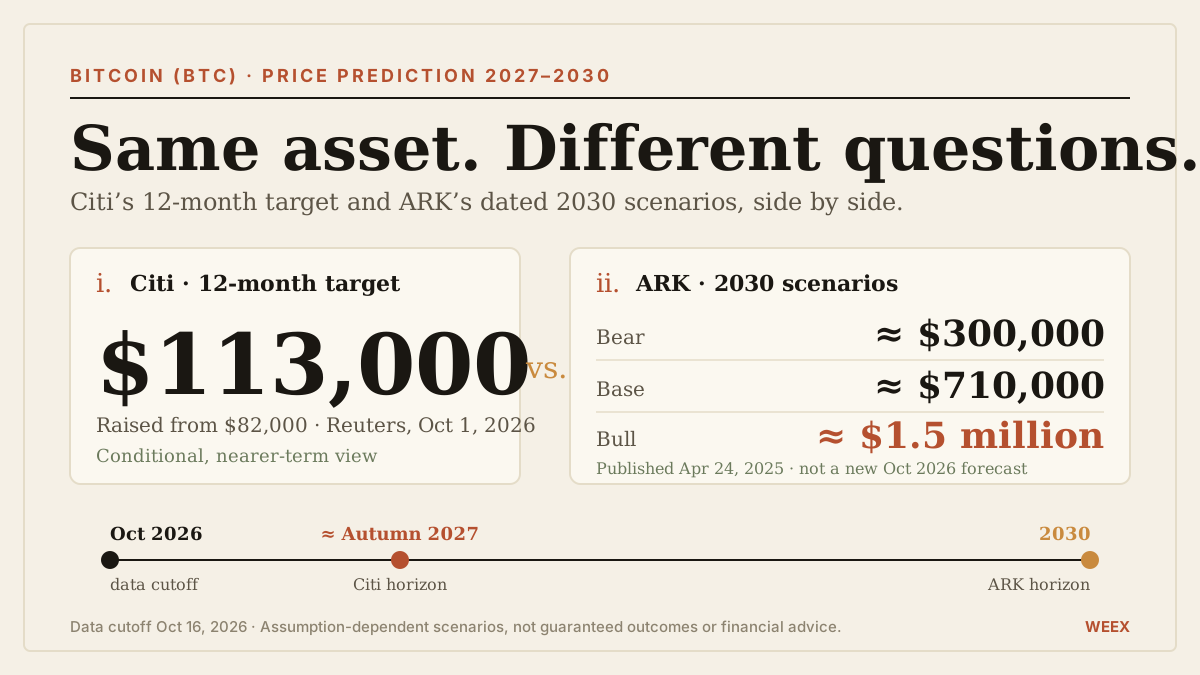
Bitcoin (BTC) Price Prediction 2027–2030: Citi’s $113,000 Target vs. Cathie Wood’s ARK Scenarios
Bitcoin price prediction for 2027–2030: compare Citi’s $113,000 target with ARK’s dated scenarios, demand assumptions, valuation math and key risks.

Mr&强 Analyzes BTC and ETH Short-Term Strategies

Bitcoin futures open interest declines, signaling weaker demand

Cathie Wood Predicts Long-Term Growth for Bitcoin Despite Dollar Strength

Peter Schiff Predicts Bitcoin Crash Over 99%
Liquidity in Cryptocurrency Market Approaches a Turning Point! Circle Aims to Enter 40 Emerging Markets

One dead, Qonto in flames, Nuñez resigns: why the streets worry crypto investors

Security Vulnerability Detected in ILITY Network, Cross-Chain Bridge Suspended

Bitcoin Spot ETF Sees Net Outflow of $229 Million Last Week, BlackRock's IBIT Leads with $165 Million Outflow

Morgan Stanley Recommends Up to 4% in Cryptocurrencies for Aggressive Portfolios

Deutsche Bank to Start Bitcoin and Ethereum Custody Within Weeks — Expansion to Asia by 2027

Bitcoin Ranges After Weekly Low Sweep| WEEX TradFi Daily(October 19, 2026)
Early on October 19, equity futures rebounded from last week’s chip selloff. Major indexes closed lower last week, the Nasdaq posted its worst week since June, the semiconductor ETF fell about 10%, and CoreWeave lost about 25%, while energy stocks were relatively resilient. Bitcoin traded near $82,000 after sweeping lows around $80,000, with markets watching the $79,800 and $83,600 zones.
WEEX Exclusive:Bitcoin Ranges After Weekly Low Sweep| WEEX TradFi Daily(October 19, 2026)

ECB: Lagarde defends rate hikes before the IMF and urges Brussels on digital euro

Sam Price Discusses Bitcoin Market Divergence

唐华斑竹 Analyzes Bitcoin Trends, Suggests Monitoring Support Levels

Saylor Envisions Bitcoin-Backed Stablecoin with Annual Yield of 6% to 8%

Strive CEO Emphasizes Going Long on Bitcoin and Short on USD, Claims Currency Depreciation is Irreversible

Bloomberg analyst warns BTC 50-week average decline may signal stock and metal downturns

Sam Price Focuses on Strategy Stock Price Drop and MSCI Index Adjustment

US Institutions See Net Inflows in Bitcoin as Demand for Dollar-Based Stablecoins Grows
Sam Price Focuses on the Hormuz Strait Tanker Incident, Crude Oil Prices Fluctuate
$4.8 Million Bitcoin Stolen from Scammer with Manipulated Ledger Wallet

Sazmining Offers Proto Hashboards at 4187 Dollars Each
Bitcoin or Dollar Returns: Same Strategy, Opposite Results
QCP: AI Credit Risk Heats Up, Bitcoin May Face Range Breakthrough
French National Assembly Passes Tax Amendment on Stablecoin Transactions, Effective 2027
Bitcoin miner stocks driven by AI sentiment, not BTC prices
Black Monday Posts Break Records
Bitcoin Recovery Faces Challenges as Exchange Reserves Rise and Spot Demand Turns Negative
Bitcoin (BTC) Price Prediction 2027–2030: Citi’s $113,000 Target vs. Cathie Wood’s ARK Scenarios
Bitcoin price prediction for 2027–2030: compare Citi’s $113,000 target with ARK’s dated scenarios, demand assumptions, valuation math and key risks.