
Arthur Hayes: AI 'Safety First' is Actually a Demand Destruction of Computing Power, and the U.S. Government's All Choices Lead to Money Printing, Ultimately Benefiting Bitcoin

 Prefer us on Google


On September 22, Arthur Hayes published a new long article titled "Safety First," with the core argument that the claims by Anthropic, OpenAI, and SpaceX of 'safety first' guiding their slowdown in AGI development are not out of concern for human welfare, but rather a result of economic realities. The market does not want AI; it wants AI at 'Chinese prices,' meaning it needs to be 100 times cheaper than it is now. Hayes points out that 'safety first' essentially leads to a destruction of computing power demand. If the spending on training new models decreases and laboratories shift towards efficiency optimization, customers will spend less on computing power. The three major AI laboratories do not generate any profits, and their computing power demand supports over $1 trillion in investment-grade debt and hundreds of billions in low-quality debt, which rely on profitable tech companies like Nvidia, Broadcom, Google, and Microsoft for off-balance-sheet backing.
The real backstop is the U.S. insurance policyholders. Hayes cites an analysis by Nick Nameth that reveals a "self-insurance scam": PE giants (such as Apollo, KKR, Brookfield, etc.) acquire insurance companies, stuffing AI data center debts and SaaS private credit impacted by AI into insurance assets, and then provide false backing through related self-insurance reinsurance companies with minimal capital. Nameth estimates that the total amount of these false reinsurance assets reaches $1.54 trillion. Once the AI data center debts are downgraded by rating agencies due to insufficient computing power demand, insurance companies will be forced to add capital, while the related reinsurance companies will be unable to pay, leading to insolvency for the insurance companies. Most states in the U.S. have insurance coverage limits of only $250,000 to $300,000, and existing insurance companies only pay into the guarantee fund afterwards, which encourages all parties involved to maximize risk-taking. When AIG was bailed out in 2008, TARP funds ultimately flowed to Goldman Sachs and led to record bonuses, while ordinary people only received foreclosure notices. Hayes believes this scenario will repeat itself.
For crypto investors, the conclusion is a win-win. If the U.S. government chooses to become the 'last buyer of computing power,' it will print money under the guise of national security to fund unproductive economic goods, driving up financial speculation and Bitcoin prices; if the government chooses to bail out insolvent insurance companies, it will also need to print money to cover bad AI debts, increasing the money supply and pushing up Bitcoin.
Hayes specifically points out that the Federal Reserve voted unanimously last week to raise interest rates by 25 basis points, and RMP bond purchases have stopped since August 14, but commercial banks have taken over to create over $100 billion in currency, and the rate hike has allowed banks to earn an additional $7.5 billion in excess reserve interest annually. This money will be used to expand loans and market speculation, and the net effect remains stimulative. The crypto market's fluctuations after a small rise at the end of August are about to end, the supply of dollars will continue to grow, and Bitcoin along with some selected altcoins will rise. Hayes also describes this situation as "incredibly wonderful," stating that the government will not allow the free market to stop building AI data centers, leading to an oversupply of computing power, increased usage of AI agents, and a surge in money printing that will drive investors to chase crypto assets.
-- Price
This content is provided for general informational purposes only and doesn't constitute financial, investment, legal, or tax advice. Any events, rewards, online promotions, or related information mentioned herein should not be considered a recommendation, solicitation, or invitation to purchase, sell, trade, or otherwise deal in any crypto assets. Crypto assets are highly volatile and may result in loss. The availability of WEEX services, products, and related events may vary by region. You are responsible for ensuring that your participation is in accordance with applicable local laws and regulations.
You may also like

CFTC argues CME lacks standing in perpetual futures lawsuit

Bitcoin Wallet Moves 411.45 BTC Worth 33400000 Dollars Amid Lawsuit

El Salvador’s National Bitcoin Office Hosts Five November Events Led By Herbert And Keiser

CNN Fear and Greed Index Falls to 18 Points

Charles Schwab Opens Bitcoin and Ethereum Trading to U.S. Retail Investors

Sparkassen Launches Bitcoin Trading via DekaBank

Sam Price Points Out Bitcoin Rebounds to $82,444

Elon Musk Offers a SpaceX Share to Every American Child: The American Dream at 140 Satoshis

White House Crypto Committee: Four People Departed in 14 Months

Echo Protocol Gradually Shuts Down, Halting New Deposits for Lending and LSD Services

Value of Deposits in Cryptocurrency Vaults Exceeds $10 Billion

Sales of Bitcoin by Medium-Term Investors Decreased by 36%

Michael Saylor: "Bitcoin is returning to a bull market"
18 Bitcoin Mining Equipment Seized in Paraguay
Financial Repression and AI's Impact on National Security

Jeff Park Discusses AI Pain Trade Impact on Bitcoin
Metaplanet Enters US Stock Market Through SLE, Deal Approved by Shareholders

BingX, YouHodler and Santander’s Openbank join EU MiCA register
QCP: AI Credit Risk Heats Up, Bitcoin May Face Range Breakthrough

French National Assembly Passes Tax Amendment on Stablecoin Transactions, Effective 2027
Bitcoin miner stocks driven by AI sentiment, not BTC prices
Black Monday Posts Break Records
Bitcoin Recovery Faces Challenges as Exchange Reserves Rise and Spot Demand Turns Negative
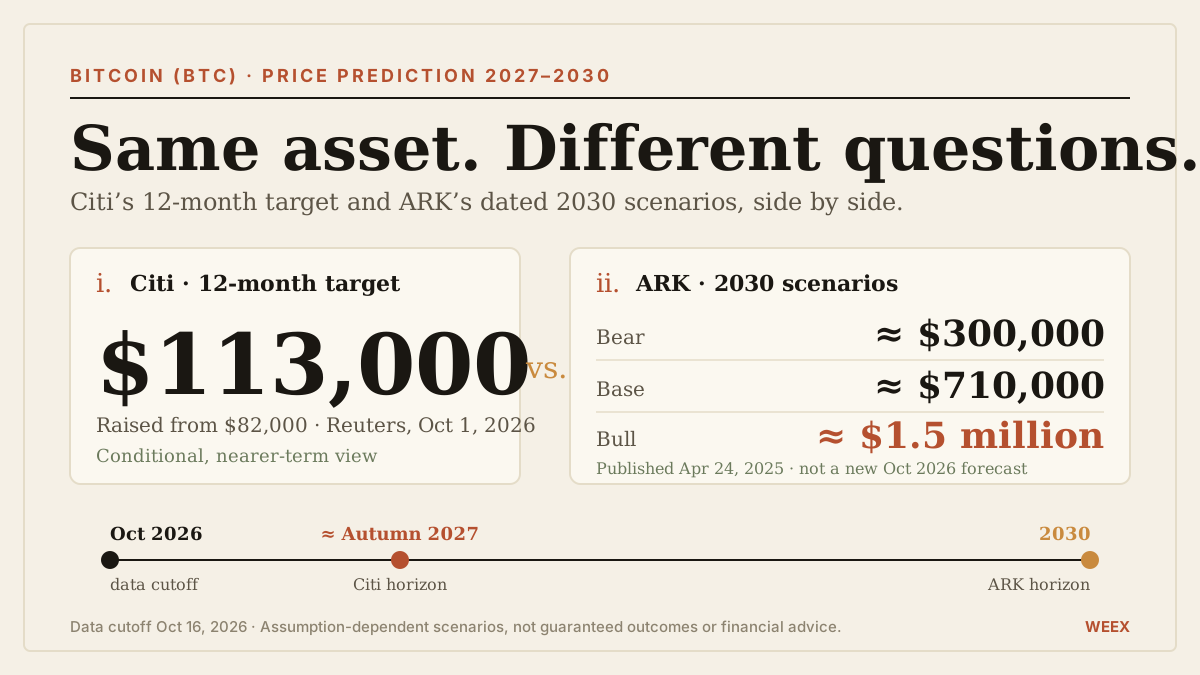
Bitcoin (BTC) Price Prediction 2027–2030: Citi’s $113,000 Target vs. Cathie Wood’s ARK Scenarios
Bitcoin price prediction for 2027–2030: compare Citi’s $113,000 target with ARK’s dated scenarios, demand assumptions, valuation math and key risks.

Mr&强 Analyzes BTC and ETH Short-Term Strategies

Bitcoin futures open interest declines, signaling weaker demand

Cathie Wood Predicts Long-Term Growth for Bitcoin Despite Dollar Strength

Peter Schiff Predicts Bitcoin Crash Over 99%
Liquidity in Cryptocurrency Market Approaches a Turning Point! Circle Aims to Enter 40 Emerging Markets
One dead, Qonto in flames, Nuñez resigns: why the streets worry crypto investors
CFTC argues CME lacks standing in perpetual futures lawsuit
Bitcoin Wallet Moves 411.45 BTC Worth 33400000 Dollars Amid Lawsuit
El Salvador’s National Bitcoin Office Hosts Five November Events Led By Herbert And Keiser
CNN Fear and Greed Index Falls to 18 Points
Charles Schwab Opens Bitcoin and Ethereum Trading to U.S. Retail Investors
Sparkassen Launches Bitcoin Trading via DekaBank
Contents
Latest articles


Latest coin listings on WEEX


