
Bitcoin Could Be "Less Volatile" Than Gold and Surpass Its Market Value

 Prefer us on Google


- The scarcity of BTC would be an advantage in competing with gold as a store of value.
- Greater market depth could cushion BTC's price movements.
Economist Saifedean Ammous argued that the growth of liquidity and capitalization of bitcoin (BTC) could reduce its price fluctuations in the long term, potentially making it a less volatile monetary asset than gold and larger in size. The author of The Bitcoin Standard defended that the scarcity of BTC is an advantage for its consolidation as money, not an obstacle to its use.
In response to criticisms from Professor Lawrence H. White, Ammous argued that the difficulty of expanding the supply of an asset is precisely one of the characteristics that made gold a dominant money. From his perspective, bitcoin takes that property further because its issuance follows predictable rules and does not depend on the decisions of a central issuer.
The economist considered that a growing demand for bitcoin does not need to translate into an expansion of its supply. Instead, it can elevate its purchasing power and allow its holders to accumulate larger monetary balances. According to his thesis, this process would favor savings, liquidity, and lower volatility as the market matures.
Ammous questioned the idea that the ability to increase supply in response to higher demand is an advantage for money. To illustrate his position, he suggested that if that characteristic were decisive, other metals like copper or iron would have had better conditions to impose themselves over gold as a monetary reserve; an idea that has also been explored by CriptoNoticias.
In his view, the limited expansion of gold reserves contributed to its historical position as money. Bitcoin, whose issuance is subject to predetermined rules, would deepen that characteristic by further reducing the possibility of diluting its supply.
The author also rejected the notion that a higher market capitalization cannot be related to a reduction in volatility. In his response, he cited analyses attributed to Fidelity and Charles Schwab, as well as research on realized volatility, bid-ask spreads, and BTC liquidity, which would point to a decrease in fluctuations over time.
 The realized volatility of Bitcoin over one year has shown a downward trend as the market matures. Source: @saifedean / X
In the analysis, he argued that greater market depth can help absorb trades without causing such pronounced price movements. However, that evolution does not guarantee that volatility will continue to decrease nor that bitcoin will become more stable than gold, as we also explained in CriptoNoticias.
Another central point of his argument is that holding BTC also constitutes a way of using it as money. For Ammous, those who hold the asset with the purpose of preserving their purchasing power for future expenses are accumulating monetary balances, even if they do not use it habitually to pay for goods and services.
Therefore, he considers it premature to demand widespread adoption of bitcoin as a means of payment before recognizing its monetary advancement. In his response, he estimated that BTC represents about 1% of global cash balances and argued that it still has room to grow.
This stance contrasts with that of White, who questions whether an asset with strong price fluctuations can offer the necessary predictability for everyday exchanges. The professor also highlighted the competition from stablecoins, designed to maintain a stable value and used to transfer units linked to fiat currencies.
Ammous responded that the transaction volume of stablecoins primarily reflects the use of dollars through new transfer channels and does not demonstrate that bitcoin needs a flexible supply.
His forecast is that the progressive monetization of BTC will boost its liquidity, reduce its volatility, and expand its valuation until it surpasses that of gold. This is an expectation about the future evolution of the asset, not a confirmed outcome. The pace of adoption, demand, and market conditions will be decisive in assessing whether that scenario materializes.
-- Price
This content is provided for general informational purposes only and doesn't constitute financial, investment, legal, or tax advice. Any events, rewards, online promotions, or related information mentioned herein should not be considered a recommendation, solicitation, or invitation to purchase, sell, trade, or otherwise deal in any crypto assets. Crypto assets are highly volatile and may result in loss. The availability of WEEX services, products, and related events may vary by region. You are responsible for ensuring that your participation is in accordance with applicable local laws and regulations.
You may also like

CNN Fear and Greed Index Falls to 18 Points

Charles Schwab Opens Bitcoin and Ethereum Trading to U.S. Retail Investors

Sparkassen Launches Bitcoin Trading via DekaBank

Sam Price Points Out Bitcoin Rebounds to $82,444

Elon Musk Offers a SpaceX Share to Every American Child: The American Dream at 140 Satoshis

White House Crypto Committee: Four People Departed in 14 Months

Echo Protocol Gradually Shuts Down, Halting New Deposits for Lending and LSD Services

Value of Deposits in Cryptocurrency Vaults Exceeds $10 Billion

Sales of Bitcoin by Medium-Term Investors Decreased by 36%

Michael Saylor: "Bitcoin is returning to a bull market"

18 Bitcoin Mining Equipment Seized in Paraguay
Financial Repression and AI's Impact on National Security

Jeff Park Discusses AI Pain Trade Impact on Bitcoin
Metaplanet Enters US Stock Market Through SLE, Deal Approved by Shareholders

BingX, YouHodler and Santander’s Openbank join EU MiCA register

QCP: AI Credit Risk Heats Up, Bitcoin May Face Range Breakthrough

French National Assembly Passes Tax Amendment on Stablecoin Transactions, Effective 2027
Bitcoin miner stocks driven by AI sentiment, not BTC prices
Black Monday Posts Break Records
Bitcoin Recovery Faces Challenges as Exchange Reserves Rise and Spot Demand Turns Negative
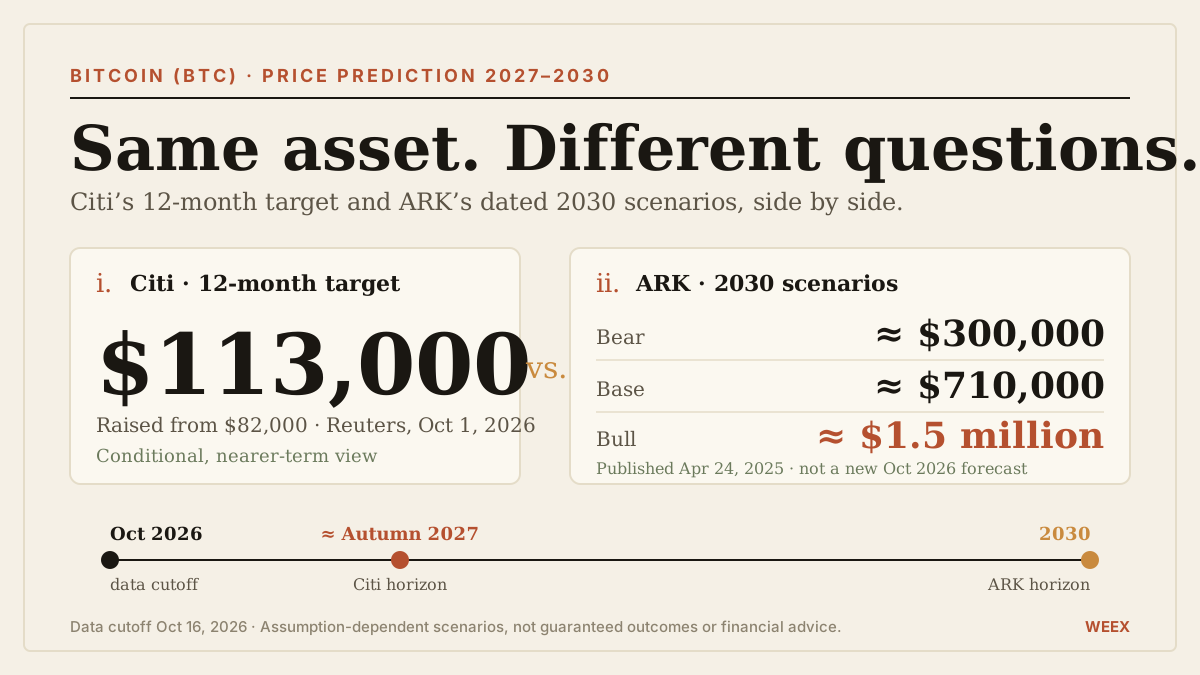
Bitcoin (BTC) Price Prediction 2027–2030: Citi’s $113,000 Target vs. Cathie Wood’s ARK Scenarios
Bitcoin price prediction for 2027–2030: compare Citi’s $113,000 target with ARK’s dated scenarios, demand assumptions, valuation math and key risks.

Mr&强 Analyzes BTC and ETH Short-Term Strategies

Bitcoin futures open interest declines, signaling weaker demand

Cathie Wood Predicts Long-Term Growth for Bitcoin Despite Dollar Strength

Peter Schiff Predicts Bitcoin Crash Over 99%
Liquidity in Cryptocurrency Market Approaches a Turning Point! Circle Aims to Enter 40 Emerging Markets
One dead, Qonto in flames, Nuñez resigns: why the streets worry crypto investors

Security Vulnerability Detected in ILITY Network, Cross-Chain Bridge Suspended

Bitcoin Spot ETF Sees Net Outflow of $229 Million Last Week, BlackRock's IBIT Leads with $165 Million Outflow
Morgan Stanley Recommends Up to 4% in Cryptocurrencies for Aggressive Portfolios
CNN Fear and Greed Index Falls to 18 Points
Charles Schwab Opens Bitcoin and Ethereum Trading to U.S. Retail Investors
Sparkassen Launches Bitcoin Trading via DekaBank
Sam Price Points Out Bitcoin Rebounds to $82,444
Elon Musk Offers a SpaceX Share to Every American Child: The American Dream at 140 Satoshis
White House Crypto Committee: Four People Departed in 14 Months


