
 Buy Crypto
- Markets
 Futures
- Spot
- Copy Trade
- Earn
- More
Bitcoin Enters Bond Market, Moody's Provides First-Ever Rating for Global Cryptocurrency-Backed Bond

Original Title: "Bitcoin Enters the Municipal Bond Market, Moody's Issues First-Ever Credit Rating for Crypto-Backed Bond"
Original Author: Sanqing, Foresight News
On March 31, Moody's Investors Service provided a provisional credit rating of Ba2 for a Bitcoin-backed bond issued by the New Hampshire Business Finance Authority (New Hampshire BFA) in the United States. This marks the first time a traditional rating agency has conducted a credit assessment of a Bitcoin-backed municipal bond.
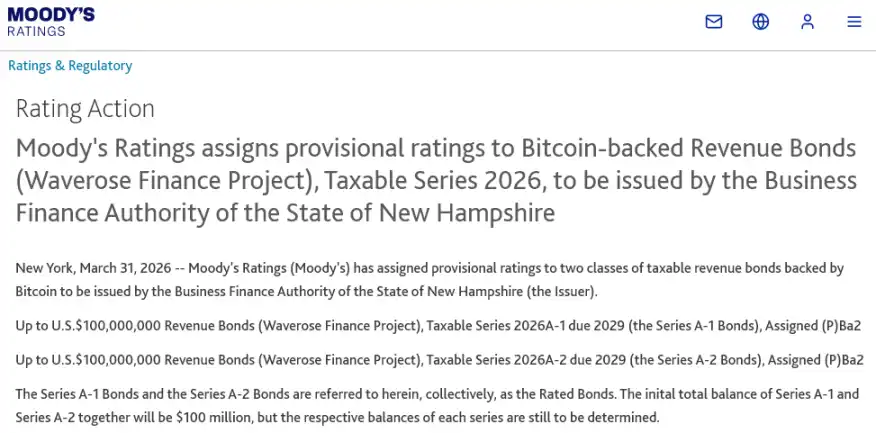
Image Source: MOODY'S Ratings & Regulatory
What Is This Bond?
This is a $100 million Bitcoin-backed taxable revenue bond linked to the Waverose Finance Project, divided into two series: 2026A-1 and 2026A-2, both maturing in 2029.
The bond was structured by Wave Digital Assets, Rosemawr Management serves as the investment manager, Orrick provides legal services, and the fees BFA receives from the transaction will be used to establish the "Bitcoin Economic Development Fund."
The core of the bond's structure does not rely on any entity's cash flow but instead directly repays using Bitcoin as collateral. The Bitcoin collateral is custody by BitGo Trust Company, Inc., held in regulated cold storage.
When the borrower needs to pay interest or repay principal, the collateral will be liquidated to cover the expenses. The bond also features a term favorable to holders. A-2 series holders have the right to receive additional BTC profit sharing if the Bitcoin price is higher than the pricing date at maturity after full principal and interest repayment.
Compared to Bitcoin lending tools on platforms like Coinbase, the significance of this bond lies in the fact that it has provided cryptocurrency with an opportunity to enter the public debt market for the first time. Borrowers no longer rely on private loans from centralized platforms but, by obtaining a traditional credit-rated public bond, can leverage institutional funds at scale and low cost within a compliant framework.
How Institutions Evaluate Bitcoin Risk
Moodys stated in a report that the provisional rating primarily reflects risks related to collateral, structure, and operations, with Bitcoin's high volatility being a key consideration.
To hedge against price volatility, the issuance structure introduced a 1.6x excess collateral requirement, with the BTC collateral value always required to be maintained above 160% of the debt exposure.
Once the collateral ratio falls to the 1.4x trigger line (i.e., LTV deteriorates to around 71%), a mandatory full redemption mechanism will be triggered, the bond will mature prematurely, and the Bitcoin will be liquidated for repayment.
In other words, to borrow $100, you must pledge at least $160 worth of Bitcoin. If the collateral value shrinks to below $140, the system will trigger a forced redemption, the bond will mature early, and the Bitcoin will be sold to repay the debt.
In the rating report, Moodys adopted a 72% advance rate and a shorter liquidation window to assess conservatism, simulating an extreme scenario where the Bitcoin price drops by around 28% from the pricing date. The test showed that the 1.6x initial excess collateral and 1.4x trigger mechanism still provide sufficient protection, supporting the Ba2 rating result.
This set of parameters is quite conservative, but for an asset with a historical drawdown of over 50%, this conservatism may also be a prerequisite for Moody's willingness to provide a rating.
Another detail worth noting separately is that, although this bond is named after the New Hampshire Business Finance Authority, it has no association with the state's public credit. Moodys clearly stated in the report that no public funds from the state can be used to repay the bond.
The issuer plays the role of a conduit issuer in the structure. It provides the issuance channel and nominal endorsement but does not take on any credit backstop responsibility.
This structure is not uncommon in the traditional municipal bond field and is typically used for special project financing in areas such as healthcare and education.
Why This Transaction is Important
To understand the historical significance of this bond, it needs to be viewed in a larger context.
Over the past few years, institutions' attitude towards Bitcoin has gone through three stages: from rejection to holding the asset (BTC reserves on the corporate balance sheet), and then to using it as collateral for financing (pledging BTC in exchange for fiat loans). This bond represents the beginning of the fourth stage: Bitcoin as the underlying collateral for a publicly rated debt instrument, entering the traditional public financial markets.
This track implies three things: opening a window for institutional investors to indirectly hold Bitcoin exposure through compliant channels; prompting Moody's to develop a rating methodology for crypto collateral, attracting more rating agencies to follow suit; demonstrating that Bitcoin can serve as an underlying logic for an "interest-bearing asset" under certain conditions, rather than just a zero-yield asset.
This bond issuance is not an isolated event. Concurrently, the US Department of Labor, under President Trump's executive order, issued a proposal to expand the range of digital assets available in retirement investment portfolios; multiple states are considering "Bitcoin Treasury Reserve" legislation; and New Hampshire became the first US state to pass a cryptocurrency reserve law.
At face value, a Ba2 rating is considered "junk bond" status, but this label itself can be misleading. In Moody's rating sequence, Ba2 is in the second tier of speculative grade, with a considerable distance from the bottom of the rating scale (C/D).
Tesla only achieved investment-grade ratings from S&P and Moody's in 2022 and 2023; Ford still maintains a speculative grade (Ba1) within the Moody's system, and barely holds the lowest investment-grade tier in the S&P system with a negative outlook. However, this does not prevent them from being key allocations for institutional investors.
Furthermore, the fact that this bond could attain a Ba2 instead of lower reflects that the 1.6x overcollateralization plus the forced liquidation mechanism passed relevant scenario simulations in Moody's stress tests. Therefore, Ba2 reflects the conservatism of the structural design, rather than a simple denial of the Bitcoin asset itself.
Looking back at historical precedents, the first MBS (mortgage-backed security) and the first green bond went through similar starting points when entering the rating system. As pricing experience accumulates and structural standards mature, ratings tend to improve. In this sense, Ba2 is merely a starting point.
You may also like

Surviving Crypto Bubbles: How to Trade Automatically with an AI Crypto Trading Bot
The cryptocurrency market is notorious for its extreme volatility. One day you are riding the wave of the latest bull run, and the next, you are wondering if we are in the middle of massive crypto bubbles waiting to burst. For human traders, managing emotion and timing the market perfectly during these swings is nearly impossible. But what if you could remove the guesswork?
In this guide, we will explore how to trade automatically and why using an AI crypto trading bot is your best defense against unpredictable market crashes and sudden altcoin rallies.
What Are Crypto Bubbles and Why Do They Burst?A crypto bubble occurs when the price of digital assets—especially during peak altcoin trading seasons—escalates rapidly, driven by hype rather than intrinsic value. When the hype fades, the bubble bursts, leading to sharp market corrections.
The biggest challenge during a bubble isn't just the price drop; it's the panic. Emotional decisions often lead to selling at the bottom or buying at the top. This is where artificial intelligence changes the game.
How to Trade Automatically: The Power of AIIf you want to survive a volatile market, you need to execute trades based on data, not fear. Learning how to trade automatically allows you to set predefined rules that execute 24/7.
By leveraging an AI crypto trading bot, you can:
Execute Instantly: AI reacts to market drops in milliseconds, executing stop-loss orders before humanly possible.Filter the Noise: AI algorithms analyze thousands of charts simultaneously, identifying true market trends rather than temporary FOMO (Fear of Missing Out).Trade Emotion-Free: A bot doesn't panic during crypto bubbles; it simply follows the math.Why WEEX is the Best AI Trading App for Your PortfolioWhen looking for the best ai trading app, you need a platform that combines institutional-grade security with user-friendly automation. At WEEX, we’ve integrated Next-Gen AI Skills directly into your trading dashboard.
Whether you are focusing on Bitcoin futures or high-frequency altcoin trading, WEEX's AI tools act as your 24/7 trading mentor. You simply describe your strategy, and the Agent handles the execution across spot and futures markets.
FAQ Q: Are AI crypto trading bots profitable during a bear market? A: Yes. AI bots can be programmed to short the market or scalp small profits during high volatility, making them effective even when crypto bubbles burst.Q: Is it hard to learn how to trade automatically? A: Not with WEEX. Our platform is designed for both beginners and pros. You don't need coding skills to deploy our advanced AI trading strategies.Don't let the next market correction wipe out your portfolio. Trade faster, think smarter, and feel less.
Sign up on WEEX today and unlock your AI trading edge.

How the US-Iran War Could Affect Oil and Bitcoin Prices (Latest Analysis)
The outbreak of the US-Iran war on February 28, 2026, has provided an unprecedented real-time laboratory for understanding how geopolitical oil shocks interact with an increasingly institutionalized cryptocurrency market. This article examines the relationship between crude oil prices and Bitcoin throughout the conflict, analyzing price movements, correlation patterns, and the underlying transmission mechanisms.

OpenAI Wants to Write Its Own Rules|Rewire News Brief

Chaos Labs Exits, Who Will Pick Up Aave's Risk?
Stealthy Financial War? Iran Collects Strait Transit Fees in Stablecoin

OpenAlice: One Person, That's a Jane Street | Project Overview

The Small-Town Youth Labeling Big AI Models

Morning Report | Strategy increased its holdings by 4,871 BTC last week; Toss plans to develop its own blockchain and issue a native cryptocurrency; OpenAI's CFO privately questioned the timing of the IPO in 2026

Research: Stablecoins have a trading volume of 35 trillion a year, how much of it is real payment?

Galaxy Research: AI agents are giving rise to new species on the blockchain, how zero-human companies activate the financial flywheel

Data Research: How big is the liquidity gap between Hyperliquid and CME crude oil?

WEEX P2P now supports GHS, ETB & ZAR—Merchant Recruitment Now Open
To make crypto deposits easier, WEEX has officially launched its P2P trading platform and continues to expand fiat support. We're excited to announce that the Ghana Cedi (GHS), Ethiopian Birr (ETB) and South African Rand (ZAR) are now available on WEEX P2P!
Why Are GPU Prices Skyrocketing Out of Control?

How to Master Claude Cowork Completely?

70-Page Confidential Letter Alleges First Charge of 'Lying,' Altman Tells Board 'I Can't Change My Personality'

Is Altcoin Season Starting in 2026? What Traders Should Watch Now
Altcoin season signals are becoming clearer in 2026 as capital rotation across crypto markets accelerates. Here’s what traders should watch and how strategy-based participation is evolving in the current market cycle.
Bitcoin ETF Inflows in 2026: Impact on BTC Price and Crypto Market Trends
Bitcoin ETF inflows are reshaping BTC price trends and crypto market liquidity in 2026. See how institutional capital is influencing volatility, trading behavior, and portfolio allocation strategies across crypto markets.
Visa's Stablecoin Strategy: Cards, Settlement, and the Future
Surviving Crypto Bubbles: How to Trade Automatically with an AI Crypto Trading Bot
The cryptocurrency market is notorious for its extreme volatility. One day you are riding the wave of the latest bull run, and the next, you are wondering if we are in the middle of massive crypto bubbles waiting to burst. For human traders, managing emotion and timing the market perfectly during these swings is nearly impossible. But what if you could remove the guesswork?
In this guide, we will explore how to trade automatically and why using an AI crypto trading bot is your best defense against unpredictable market crashes and sudden altcoin rallies.
What Are Crypto Bubbles and Why Do They Burst?A crypto bubble occurs when the price of digital assets—especially during peak altcoin trading seasons—escalates rapidly, driven by hype rather than intrinsic value. When the hype fades, the bubble bursts, leading to sharp market corrections.
The biggest challenge during a bubble isn't just the price drop; it's the panic. Emotional decisions often lead to selling at the bottom or buying at the top. This is where artificial intelligence changes the game.
How to Trade Automatically: The Power of AIIf you want to survive a volatile market, you need to execute trades based on data, not fear. Learning how to trade automatically allows you to set predefined rules that execute 24/7.
By leveraging an AI crypto trading bot, you can:
Execute Instantly: AI reacts to market drops in milliseconds, executing stop-loss orders before humanly possible.Filter the Noise: AI algorithms analyze thousands of charts simultaneously, identifying true market trends rather than temporary FOMO (Fear of Missing Out).Trade Emotion-Free: A bot doesn't panic during crypto bubbles; it simply follows the math.Why WEEX is the Best AI Trading App for Your PortfolioWhen looking for the best ai trading app, you need a platform that combines institutional-grade security with user-friendly automation. At WEEX, we’ve integrated Next-Gen AI Skills directly into your trading dashboard.
Whether you are focusing on Bitcoin futures or high-frequency altcoin trading, WEEX's AI tools act as your 24/7 trading mentor. You simply describe your strategy, and the Agent handles the execution across spot and futures markets.
FAQ Q: Are AI crypto trading bots profitable during a bear market? A: Yes. AI bots can be programmed to short the market or scalp small profits during high volatility, making them effective even when crypto bubbles burst.Q: Is it hard to learn how to trade automatically? A: Not with WEEX. Our platform is designed for both beginners and pros. You don't need coding skills to deploy our advanced AI trading strategies.Don't let the next market correction wipe out your portfolio. Trade faster, think smarter, and feel less.
Sign up on WEEX today and unlock your AI trading edge.
How the US-Iran War Could Affect Oil and Bitcoin Prices (Latest Analysis)
The outbreak of the US-Iran war on February 28, 2026, has provided an unprecedented real-time laboratory for understanding how geopolitical oil shocks interact with an increasingly institutionalized cryptocurrency market. This article examines the relationship between crude oil prices and Bitcoin throughout the conflict, analyzing price movements, correlation patterns, and the underlying transmission mechanisms.


 App
App