Bitcoin Mining vs AI: Generation Z No Longer Trusts Tech Billionaires on Climate

 Prefer us on Google


Two generations, zero common trust. In an op-ed published by Forbes on September 30, Anna Broughel describes baby boomers who grew up with the idea that a proactive state would eventually solve the climate issue through treaties and binding regulations. Their grandchildren no longer believe this. And they trust even less the tech billionaires who promise to save the climate with artificial intelligence and carbon capture.
The op-ed does not mention Bitcoin. However, mining has long served as a convenient target in this energy trial. Figures published since 2025 shift the accusation elsewhere, towards the data centers that train AI models.
Key Points
- The Montreal Protocol of 1987 remains, for the older generation, proof that public decision-making can correct atmospheric disruption.
- Six out of ten young people report climate anxiety at Deloitte, and 61% of respondents from Edelman express grievances against economic and political elites.
- Mining absorbs the equivalent of 0.54% of global electricity, with a cleaner energy mix than the average of the electricity sector.
- The IEA projects 950 TWh for data centers by 2030, far ahead of the consumption of cryptocurrency mining farms.
- In Europe, MiCA requires crypto platforms to publish the energy consumption of each asset, while data centers only report aggregated figures.
When Boomers Expected the State, Generation Z Distrusts Billionaires
Baby boomers have seen public power keep its promises at least once. The Montreal Protocol, signed in 1987, removed CFCs from aerosol cans, and the hole in the ozone layer has been closing since. Washington had created its environmental agency seventeen years earlier. Public intervention worked.
The record looks significantly less rosy to those born after 2000. Thirty editions of the climate conference later, 2024 has become the first calendar year measured above 1.5 °C of warming. The European Copernicus service has quantified it at 1.6 °C above pre-industrial levels. The Belém summit closed in November 2025 without a binding roadmap on fossil fuels.
Distrust has shifted targets along the way. Deloitte surveys over 23,000 young people in 44 countries each year, and its 2025 edition includes more than six members of Generation Z out of ten who experienced climate anxiety in the previous month. The Edelman barometer measured the same year that 61% of respondents harbored moderate or high grievances against businesses, governments, and the wealthy. The promises of carbon neutrality signed by tech leaders fall into this climate of suspicion. When asked by Forbes, activist Hannah Testa summarizes this rejection: her generation has no desire to wait for a miracle invention to take action.
Bitcoin vs AI: A Comparative Energy Bill
Let's talk numbers: the Cambridge Centre for Alternative Finance (CCAF) estimates the annual consumption of the Bitcoin network at 138 TWh, or 0.54% of global electricity. Decarbonized sources account for 52.4% of this energy mix. The global electricity mix, on the other hand, hovers around 41% low carbon according to Ember. An average miner thus consumes slightly cleaner electricity than their neighbor.
The International Energy Agency updated its projections in April 2026 with its report Key Questions on Energy and AI. Data centers consumed 485 TWh in 2025, a 17% increase in one year, and the agency projects 950 TWh by 2030. The gap with mining would shift from a factor of 3.5 today to nearly seven.
Miners have taken the lead. Galaxy Digital has converted its Helios site in West Texas into a data center leased to CoreWeave for AI compute hosting. IREN and TeraWulf have also shifted some of their megawatts in the same direction.
Mining retains an advantage that model training does not. A farm of machines can shut down in seconds, but AI computation cannot. On the Texas ERCOT network, farms resell their electricity to the grid during peak demand. Riot Platforms received $31.7 million in energy credits for the month of August 2023, when Texas was on the brink of supply failure.
A Distrustful Generation Set to Inherit the Levers
Anna Broughel concludes her column on the question of power. In the United States, boomers still hold Congress, boardrooms, and most of the capital. The younger generation primarily has their mobilization capacity on their side.
However, the balance of power is set to shift. The firm Cerulli Associates estimates that $124 trillion in wealth will change hands in the United States by 2048, with $105 trillion passed down to heirs.
These heirs do not view AI leaders with more leniency. In August 2026, a CNBC/Generation Lab survey of 1,088 Americans aged 18 to 34 found that about 70% of them were wary of Sam Altman, Elon Musk, Mark Zuckerberg, and Jensen Huang. Satya Nadella, the highest-ranked, only garnered the trust of 35% of respondents.
Bitcoin miners find themselves at a crossroads. Riot Platforms has signed a $9.1 billion hosting contract with Anthropic. Its megawatts will thus serve one of those AI labs that Generation Z is so wary of.
-- Price
In Europe, Bitcoin Must Show Its Bill, Not Data Centers
In Europe, where a petition still called for its outright ban as recently as June, Bitcoin is paradoxically the most transparent activity of the two. The delegated regulation (EU) 2025/422 implemented under MiCA requires every crypto asset service provider to publish on its website the annual energy consumption of the consensus mechanism of the assets it offers.
The figures are displayed raw. Brussels prohibits any carbon compensation from being deducted, to cut short greenwashing.
Data centers do not play on equal footing. The European directive on energy efficiency does require sites over 500 kW to declare their performance annually. However, this data is only published aggregated, by country and at the Union level, and the figures for each operator remain covered by business secrecy.
A French saver thus knows how much electricity the Bitcoin he buys on a regulated platform consumes. However, he is unaware of the cost of the data center running his AI assistant.
At least on the electricity bill, the young respondents surveyed by Deloitte are spot on. The Bitcoin network consumes 138 TWh per year with 52.4% of decarbonized energies, while the International Energy Agency expects 950 TWh from data centers by 2030 to run the models that these same billionaires sell as the climate solution.
This content is provided for general informational purposes only and doesn't constitute financial, investment, legal, or tax advice. Any events, rewards, online promotions, or related information mentioned herein should not be considered a recommendation, solicitation, or invitation to purchase, sell, trade, or otherwise deal in any crypto assets. Crypto assets are highly volatile and may result in loss. The availability of WEEX services, products, and related events may vary by region. You are responsible for ensuring that your participation is in accordance with applicable local laws and regulations.
You may also like

BingX, YouHodler and Santander’s Openbank join EU MiCA register

QCP: AI Credit Risk Heats Up, Bitcoin May Face Range Breakthrough

French National Assembly Passes Tax Amendment on Stablecoin Transactions, Effective 2027

Bitcoin miner stocks driven by AI sentiment, not BTC prices

Black Monday Posts Break Records
Bitcoin Recovery Faces Challenges as Exchange Reserves Rise and Spot Demand Turns Negative
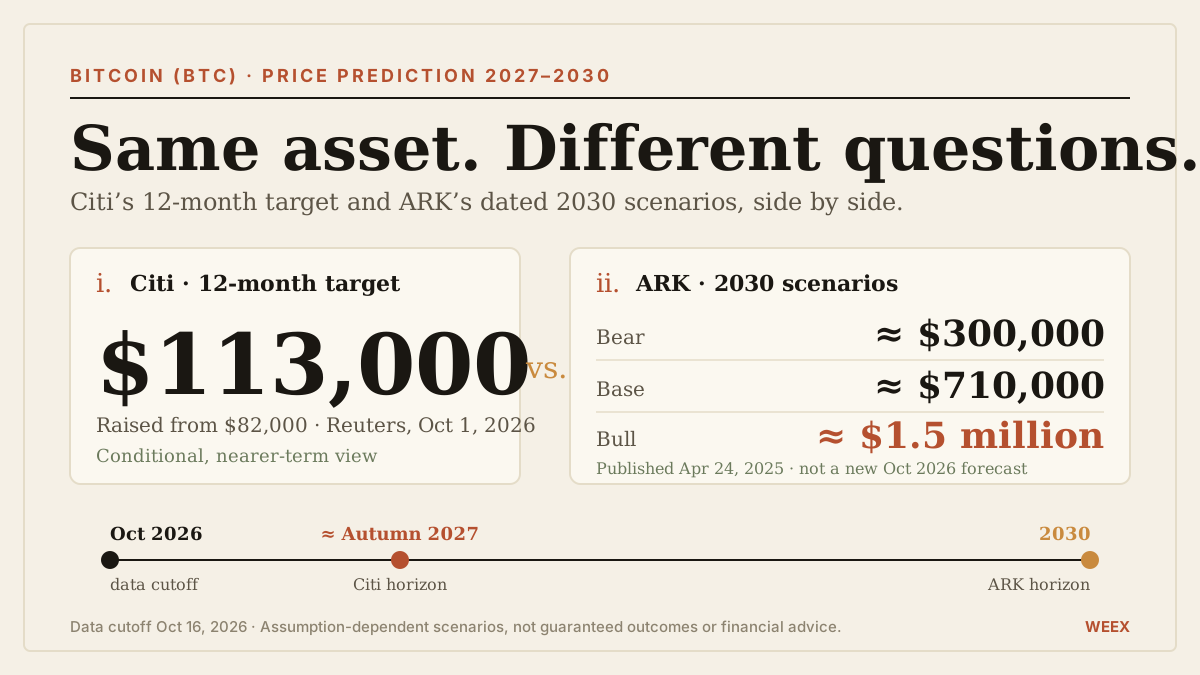
Bitcoin (BTC) Price Prediction 2027–2030: Citi’s $113,000 Target vs. Cathie Wood’s ARK Scenarios
Bitcoin price prediction for 2027–2030: compare Citi’s $113,000 target with ARK’s dated scenarios, demand assumptions, valuation math and key risks.

Mr&强 Analyzes BTC and ETH Short-Term Strategies

Bitcoin futures open interest declines, signaling weaker demand

Cathie Wood Predicts Long-Term Growth for Bitcoin Despite Dollar Strength

Peter Schiff Predicts Bitcoin Crash Over 99%
Liquidity in Cryptocurrency Market Approaches a Turning Point! Circle Aims to Enter 40 Emerging Markets

One dead, Qonto in flames, Nuñez resigns: why the streets worry crypto investors

Security Vulnerability Detected in ILITY Network, Cross-Chain Bridge Suspended

Bitcoin Spot ETF Sees Net Outflow of $229 Million Last Week, BlackRock's IBIT Leads with $165 Million Outflow

Morgan Stanley Recommends Up to 4% in Cryptocurrencies for Aggressive Portfolios

Deutsche Bank to Start Bitcoin and Ethereum Custody Within Weeks — Expansion to Asia by 2027

Bitcoin Ranges After Weekly Low Sweep| WEEX TradFi Daily(October 19, 2026)
Early on October 19, equity futures rebounded from last week’s chip selloff. Major indexes closed lower last week, the Nasdaq posted its worst week since June, the semiconductor ETF fell about 10%, and CoreWeave lost about 25%, while energy stocks were relatively resilient. Bitcoin traded near $82,000 after sweeping lows around $80,000, with markets watching the $79,800 and $83,600 zones.
WEEX Exclusive:Bitcoin Ranges After Weekly Low Sweep| WEEX TradFi Daily(October 19, 2026)

ECB: Lagarde defends rate hikes before the IMF and urges Brussels on digital euro

Sam Price Discusses Bitcoin Market Divergence

唐华斑竹 Analyzes Bitcoin Trends, Suggests Monitoring Support Levels

Saylor Envisions Bitcoin-Backed Stablecoin with Annual Yield of 6% to 8%

Strive CEO Emphasizes Going Long on Bitcoin and Short on USD, Claims Currency Depreciation is Irreversible

Bloomberg analyst warns BTC 50-week average decline may signal stock and metal downturns

Sam Price Focuses on Strategy Stock Price Drop and MSCI Index Adjustment
US Institutions See Net Inflows in Bitcoin as Demand for Dollar-Based Stablecoins Grows
Sam Price Focuses on the Hormuz Strait Tanker Incident, Crude Oil Prices Fluctuate
$4.8 Million Bitcoin Stolen from Scammer with Manipulated Ledger Wallet

Sazmining Offers Proto Hashboards at 4187 Dollars Each
BingX, YouHodler and Santander’s Openbank join EU MiCA register
QCP: AI Credit Risk Heats Up, Bitcoin May Face Range Breakthrough
French National Assembly Passes Tax Amendment on Stablecoin Transactions, Effective 2027
Bitcoin miner stocks driven by AI sentiment, not BTC prices
Black Monday Posts Break Records
Bitcoin Recovery Faces Challenges as Exchange Reserves Rise and Spot Demand Turns Negative