
Bloomberg has reported twice, Hyperliquid once again in Wall Street's radar

At 1:12 AM EST on February 28, during the exchange downtime, the trading volume of the prediction contract on Polymarket regarding the US striking Iran surged.
Source: @yenwod_
At 1:13 AM, the first open-source intelligence tweet about the airstrike appeared on Twitter.

One minute later, the price and trading volume of the crude oil perpetual contract on Hyperliquid's Trade.xyz followed an anomaly.
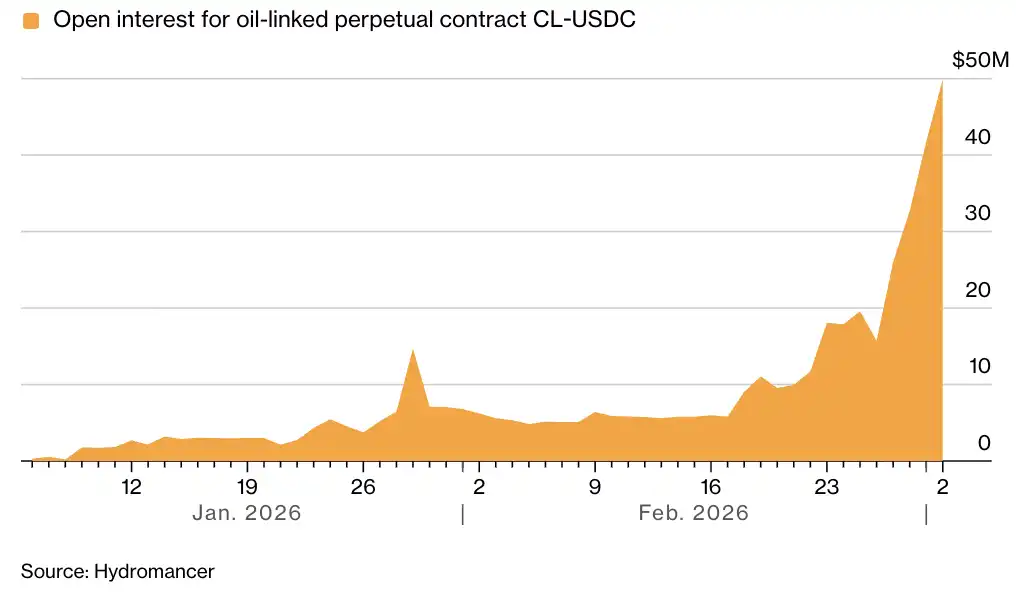
After the headline news broke, the crude oil perpetual contract on the Hyperliquid platform rose by 5%, with OI reaching $50 million. HYPE's price increased by 13%, leading the top 25 tokens by market cap.
24/7 Trading
Out of the past year's ten high-volatility macroeconomic events, eight occurred over the weekend. Hyperliquid's round-the-clock price discovery mechanism is drawing attention from the traditional financial markets.
In two recent articles about Hyperliquid, Bloomberg pointed out that as the intersection between the crypto market and traditional finance deepens, Wall Street is starting to closely watch platforms like Hyperliquid. During weekends when traditional markets are closed, on-chain derivatives offer continuous risk pricing capabilities. Bloomberg cited market participants stating that this round-the-clock pricing mechanism is a structural upgrade to enhance market efficiency. Weekend market movements validate a trend where round-the-clock on-chain trading of all asset classes is an inevitable direction for financial market development.
Decoupling
With the growth of HIP-3 supporting traditional market trading, HYPE's price performance has already begun to decouple from the default benchmark of the crypto market, Bitcoin. When news of the strike broke, the price of Bitcoin briefly fell and entered a period of volatility. In contrast, HYPE, which caters to trading demands for precious metals, stocks, and more, showed an independent trend.
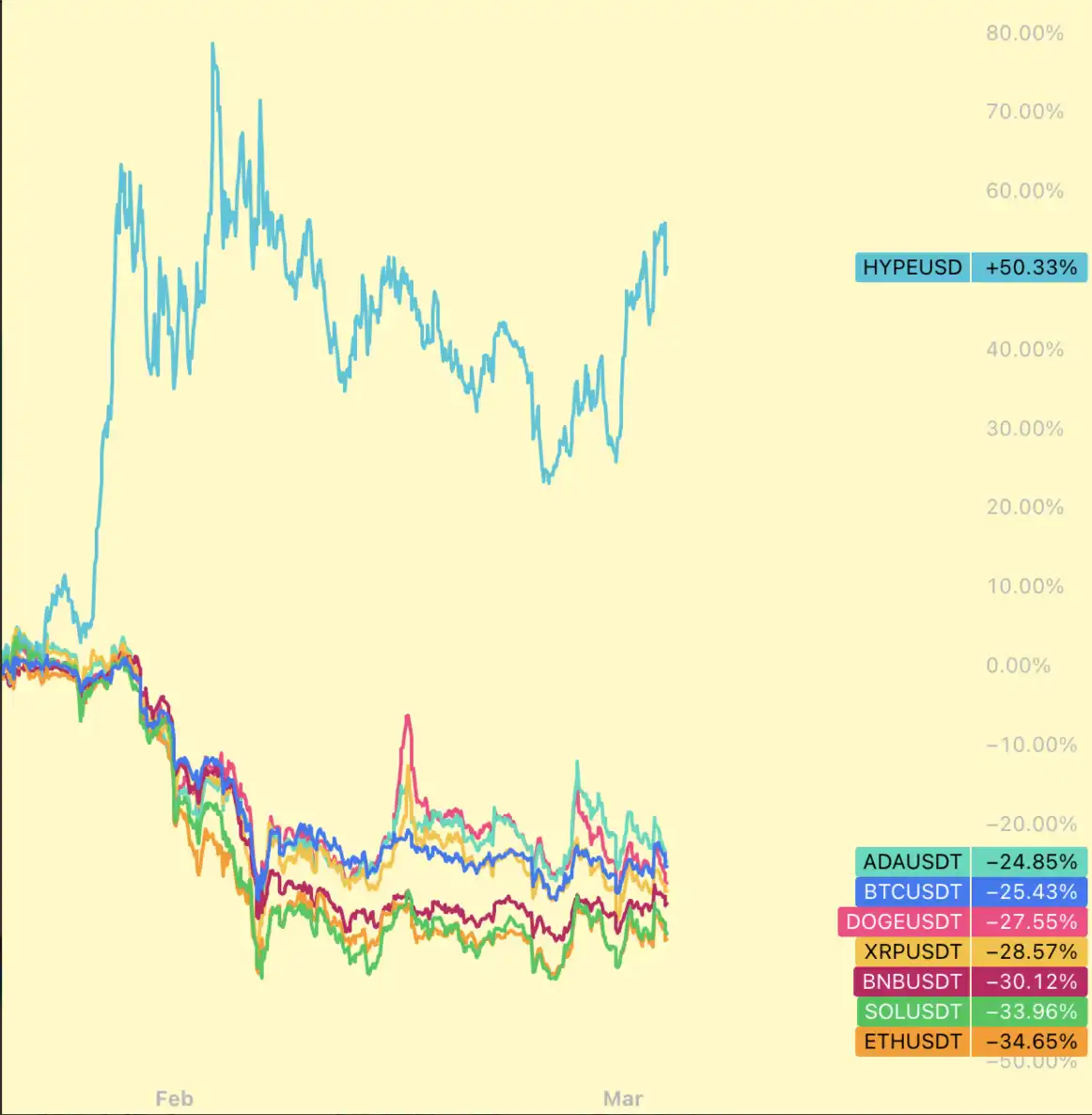
In late January, when silver broke $100 and gold broke $5500, the trading volume of silver-only contracts on the HIP-3 exchange tradexyz reached $1.2 billion, driving HYPE's 55% increase in three days, while Bitcoin only rose by 3% during that period.
Surge in Gold, Silver, and Copper Contract Trading Volume onTrade.xyz Since January
The Tokenomics explained the reason behind the HYPE surge. Hyperliquid's HIP-3 protocol dictates that 50% of all fee revenue generated by HIP-3 exchanges flows into the Hyperliquid Official Aid Fund for HYPE buybacks. Macro volatility drives up trading volume, increasing the buyback size, creating strong buying pressure for the HYPE token.
Fee Revenue Generated by HIP-3 Exchanges on
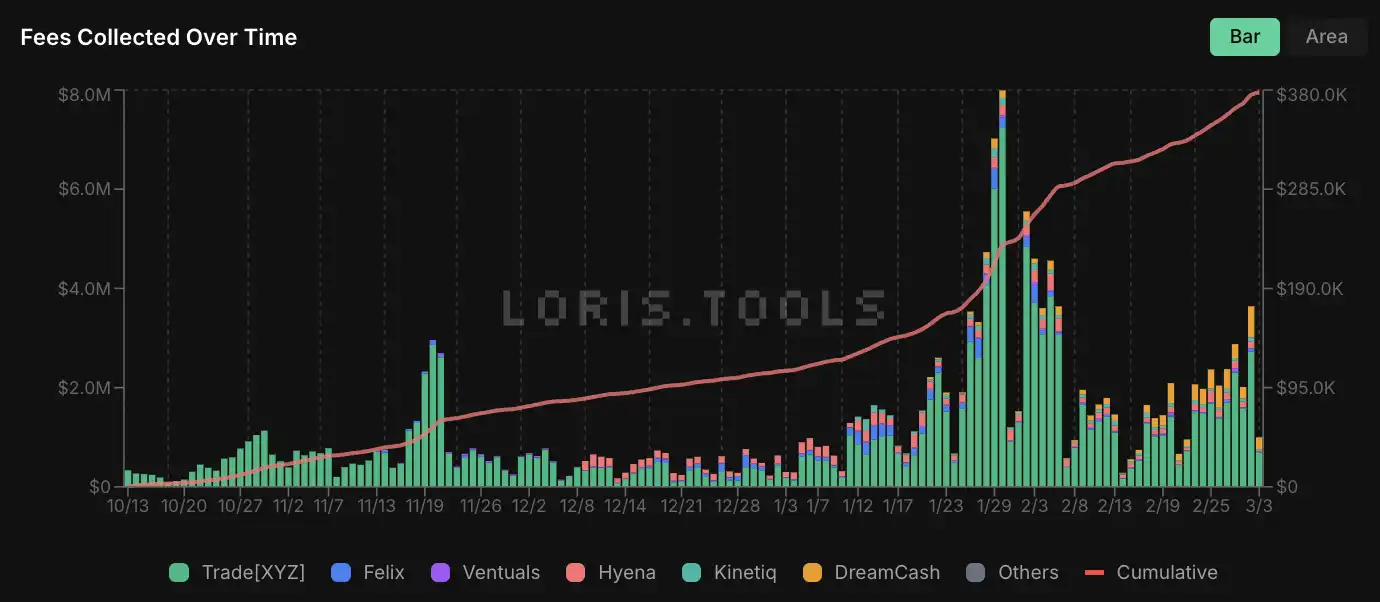
HYPE holders are not only betting on Hyperliquid's growth as an offshore Perp DEX but also on longing geopolitical uncertainty.
Hyperliquid is just the clearest expression of this narrative so far, and the market is finally starting to reflect that.
Discrepancy
Nevertheless, on-chain derivatives still have a ways to go to meet traditional institutional standards.
Hyperliquid's current edge lies in small to medium-sized retail orders. According to Blockworks Research, during normal trading hours, its Silver contract's spread is comparable to the COMEX micro contract. However, the depth discrepancy is significant. COMEX has a $13 million order book depth within ±5 bps, whereas Hyperliquid has only around $230k.
COMEX vs. Hyperliquid Order Book Depth Comparison
Source: Blockworks Research
In extreme market sell-offs, on-chain liquidity suffers from greater tail risks. 1% of Hyperliquid's Silver trades experience a slippage of over 50 bps, while COMEX still offers better execution costs in such scenarios.
COMEX vs. Hyperliquid Execution Slippage Comparison
Source: Blockworks Research
Currently, Hyperliquid's liquidity and funding rate model cannot yet meet the needs of large funds. To compete at an institutional level, on-chain platforms need to address KYC issues and may even need to establish technical and collaborative frameworks that match traditional clearing institutions. Many industry participants still believe that if the Chicago Mercantile Exchange (CME) were to launch 24/7 trading, it would have a natural hedging advantage and trust foundation.
However, the traditional financial market's reliance on a risk control model based on physical closure times has indeed shown its limitations. The ability to continuously price risk without waiting for Monday's opening is a core value proposition of offshore exchanges like Hyperliquid.
The transfer of market pricing power to the blockchain will be a long process. But we must dare to dream — just in case it comes true.
You may also like

Dialogue with OmenX Founder: Why does the prediction market need an evolution from "spot" to "derivatives"?

When the P2P illicit funds from ten years ago turned into 60,000 bitcoins

Morning News | CME Group launches Nasdaq Cryptocurrency Index futures; Asset management giant Janus Henderson strategically invests in Ethena

Why did Oracle deliver the strongest financial report in history, yet its stock price fell?

Bitcoin Layer 2 Network Botanix: Why Did We Choose to Dissolve?

Morning Report | OpenAI has submitted an S-1 registration statement draft to the U.S. SEC; Morpho completes $175 million financing

Galaxy Deep Research Report: How Hyperliquid's HIP-4 Upgrade Changes the Landscape of Prediction Markets?

Latest research from 13 top universities including Cornell University: The current state, challenges, and misconceptions of the fusion of Crypto and AI
Deconstructing Anthropic: The Best AI Company, Possibly Also a Type of Organizational Invention

Every exchange is a "Universal Exchange."

The counterattack of traditional finance: Alliance chains are quietly reviving
Pantera Capital Partner: How Tokenization is Restructuring the Private Equity and Early Investment Ecosystem?

Mastercard Launches Agent Pay for AI, Plans to Record AI Agent Payment Authorizations on Polygon
Mastercard launched Agent Pay for AI, a new payment protocol designed to help AI agents make small payments such as pay-per-use access to data and APIs. The system plans to record human-granted AI agent permissions on Polygon, focusing on verifiable authorization, identity, and payment controls.

Curve Deploys Llamalend v2 on Optimism With 250,000 OP Incentives
Curve launched Llamalend v2 on Optimism with 250,000 OP incentives from the Optimism Foundation. The upgrade expands Llamalend beyond its earlier crvUSD-focused model, adding broader collateral support, LlamaRisk market reviews, and the ability to use Curve LP tokens as collateral.

Raydium Old Liquidity Pool Reportedly Exploited, With $1.34 Million Moved to Ethereum and Tornado Cash
An old Raydium liquidity pool was reportedly exploited for around $1.34 million in USDC, RAY, and wSOL, with the stolen funds bridged to Ethereum and deposited into Tornado Cash. The incident highlights the tail risks of legacy DeFi pools, old contracts, and cross-chain fund laundering paths.
Kalshi Executive Challenges “SBF Backed AI Unicorns” Narrative, Says Leopold Aschenbrenner Was Key Figure
Kalshi executive John Wang questioned the “SBF backed AI unicorns” narrative, saying Leopold Aschenbrenner was the key figure behind major AI investment decisions.

New York Proposes Stricter Stablecoin Issuer Rules Aligned With Federal GENIUS Act
NYDFS proposed stricter stablecoin issuer rules aligned with the GENIUS Act, covering reserves, custody, redemption timelines, audits, and capital buffers.

CryptoQuant Says Bitcoin Profitable Supply Is Near 45% Pressure Zone as On-Chain Data Points to Market Repricing
CryptoQuant said Bitcoin’s profitable supply is nearing the 45% pressure zone, signaling rising market stress, unrealized losses, and a possible on-chain repricing phase.
Dialogue with OmenX Founder: Why does the prediction market need an evolution from "spot" to "derivatives"?
When the P2P illicit funds from ten years ago turned into 60,000 bitcoins
Morning News | CME Group launches Nasdaq Cryptocurrency Index futures; Asset management giant Janus Henderson strategically invests in Ethena
Why did Oracle deliver the strongest financial report in history, yet its stock price fell?
Bitcoin Layer 2 Network Botanix: Why Did We Choose to Dissolve?
Morning Report | OpenAI has submitted an S-1 registration statement draft to the U.S. SEC; Morpho completes $175 million financing


