

BTC Halving, But Bitcoin Wallet Still Valued at $4 Billion

Original Title: "BTC Halved, But Bitcoin Wallet Still Valued at 4 Billion"
Original Author: Lin Wanwan, Deepchain Beating
Bitcoin's price was halved, but the company selling BTC shovels announced its plan to list in the United States.
Early morning on January 21, 2025, in the central French town of Vierzon.
David Balland was woken from his sleep and, without fully understanding the situation, was forced into two cars with his wife. Ten minutes later, the two cars headed in different directions.
What happened in the next 48 hours was like a poorly made kidnapping movie. The kidnappers cut off one of Balland's fingers, took a photo, and sent it to his former colleagues, demanding a $10 million ransom in Bitcoin.
The French special forces GIGN deployed over 90 people, acted simultaneously in two locations, and ultimately rescued the couple.
Balland is the co-founder of Ledger.
The story had a decent ending. The kidnappers received part of the ransom in USDT, but Tether cooperated with law enforcement to freeze 95% of the funds. The on-chain transaction records were clear, and there was no way to escape. All ten suspects were arrested and faced life imprisonment.
The reason the kidnappers were able to locate Balland was due to a customer data leak at Ledger in 2020, where names, addresses, and phone numbers were exposed on the dark web. As a co-founder, Balland's information was naturally included.
The reason the kidnappers did not directly steal coins from the chain is because they couldn't. The private keys are stored in offline devices, so they couldn't steal them without being connected to the internet. Therefore, they had to resort to the most primitive method: kidnapping to force him to transfer the coins.
This precisely illustrates one thing: hardware wallets are useful. The online hacker methods are powerless against them; they can only resort to offline crimes.
However, Balland's experience also served as a warning to all holders: protecting your private keys is just the first step; safeguarding your identity information is equally important. No matter how well you hide your coins, if others know who you are and where you live, trouble may come knocking at your door.
Decoupling assets from identity is precisely the core logic of a Bitcoin wallet's self-custody. It is also the meaning behind Ledger's business existence.
After the kidnapping case, the British Financial Times broke the news: Ledger is preparing for a US listing. Goldman Sachs, Jefferies, and Barclays are jointly sponsoring the IPO, with the listing location set at the NYSE.
Meanwhile, Bitcoin is undergoing another round of sharp correction. From a peak of $126,000 in October 2025, it dropped to below $70,000.
The halving of BTC did not affect the industry's progress. In January 2026, Ledger was valued at over $4 billion.
1. Shovel Seller
The cryptocurrency industry is full of rags-to-riches and zero-to-hero stories. Some made billions overnight, while others woke up to empty wallets.
Ledger is unique in this industry. It doesn't create coins, run exchanges, or dabble in DeFi. It only does one thing: sells a small USB-like device, telling you to store your private keys inside so hackers can't steal them.
What does this company Ledger do?
It sells hardware wallets, simply put, wallets that help people secure their Bitcoin private keys.
At $79 each, they have sold over 7 million in the past decade.
There's an old saying in the startup world: in a gold rush, the ones who make the most money are not the gold miners but the ones selling shovels and jeans. In essence, Ledger is the shovel seller in the crypto world.
The beauty of this business is that it doesn't rely on betting on coin price movements.
During a bull market, newcomers flock in, needing to buy a wallet to secure their newly acquired coins. During a bear market, existing users who have experienced a crash value their remaining chips and also need a safe place to store them.
When the price goes up, your assets are more valuable, making it worth spending $79 to protect them. When the price goes down, you definitely don't want to be hacked on top of everything else, so you'd still spend $79 for peace of mind.
Whichever way you look at it, Ledger wins.
In November 2022, during the FTX liquidation week, Ledger's website servers were almost overwhelmed. "Not your keys, not your coins" – if you don't have your private keys, the coins are not yours. This old saying that has been circulating in the cypherpunk community for years suddenly became a consensus overnight.
Exchanges may exit scam, project teams may exit scam, but an offline hardware device won't betray you.
To translate, when others are in fear, it's actually the best time for their business.
This ability to transcend cycles is Wall Street's favorite story.
The list of Ledger's investors reads like a top-tier institutional directory, including 10T Holdings, Samsung Ventures, Morgan Creek, Cathay Innovation. In total, they have raised $575 million. Their valuation in 2023 was $1.5 billion, and now they are set to debut on the NYSE at a $4 billion valuation. In less than two years, it has almost tripled.
This math is actually quite straightforward. The total market capitalization of global crypto assets, even in the current correction period, is over $2 trillion. Ledger claims to custody around 20% of this, with over $100 billion in Bitcoin stored on users' devices.
Is a $40 billion valuation expensive for a company that safeguards $100 billion in assets?
Compared to traditional financial custodians, this figure is quite modest.
II. Crossing the Cycle
Ledger did not emerge overnight.
In 2014, several French engineers founded this company in Vierzon. At that time, the price of Bitcoin was hovering in the low hundreds of dollars, and most people thought it was a Ponzi scheme.
Ten years later, this company has gone through three complete bull-bear cycles: the madness of 2017, the crash of 2018, the renewed madness of 2021, the re-crash of 2022, the ETF market at the end of 2024, and the current correction.
Throughout each cycle, Ledger not only survived but also grew larger.
The secret, to put it simply, is that they sell a necessity.
Whether the price is $100,000 or $30,000, as long as you hold coins, you need a secure place to store them. This demand will not disappear with market trends.
In 2025, the company's revenue hit a historic high, reaching "hundreds of millions of dollars," as stated by CEO Gauthier. Compared to over $70 million in 2024, the growth is quite significant.
More importantly, the revenue structure is changing.
In the early years, Ledger only sold hardware wallets for $79 each, making a profit on each sale. Now their product line has expanded. The entry-level Nano S Plus still sells for $79, the mid-range Nano X with Bluetooth sells for $149, and the high-end Stax with an E Ink touchscreen sells for $279.
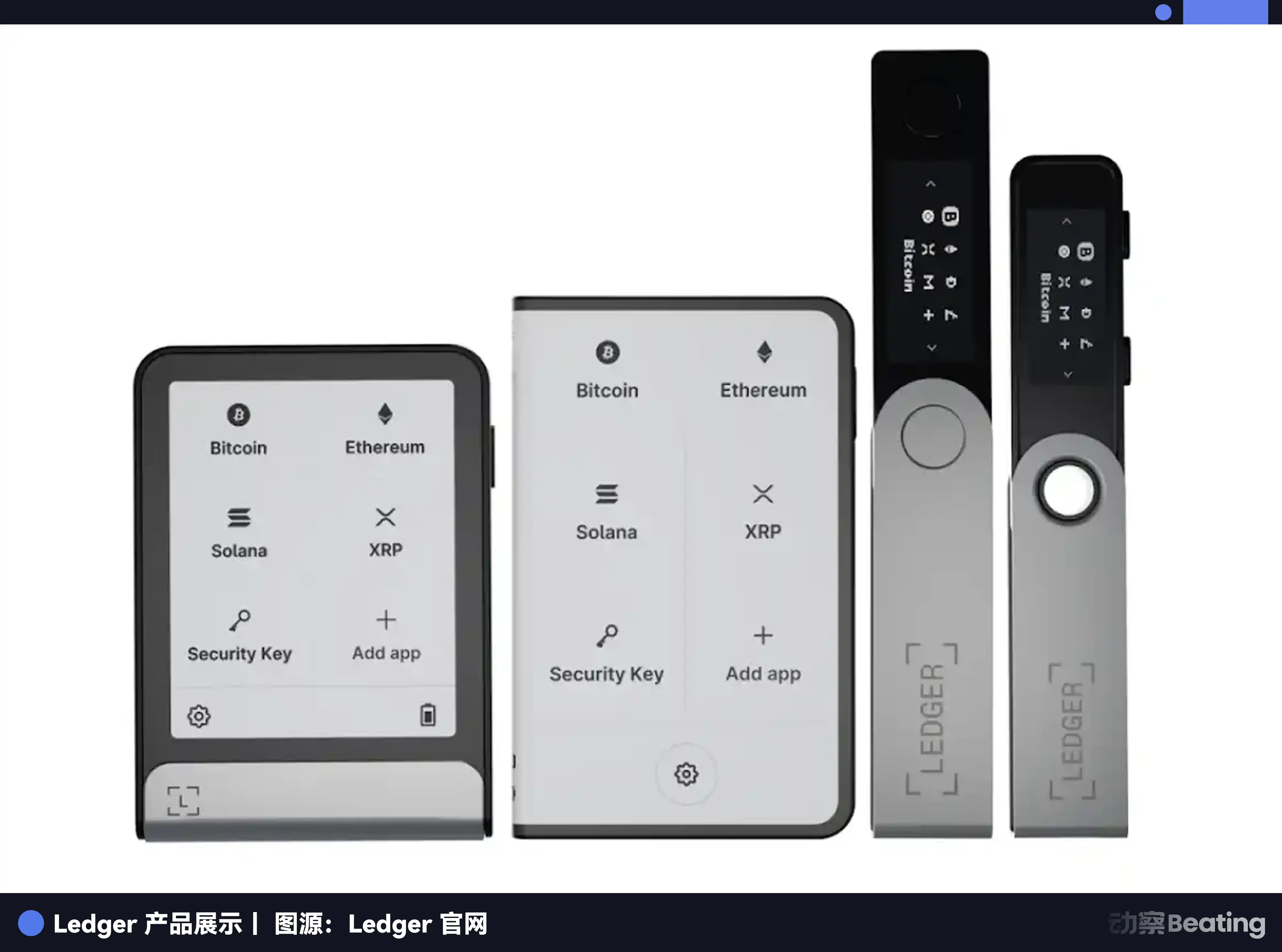
Outside of hardware, there is also software. The Ledger Live app allows direct coin purchases, exchanges, and staking, with the company taking a cut of each transaction. There is also an enterprise service, Ledger Enterprise, specifically tailored to institutional clients for custody solutions, serving over 100 clients and managing tens of billions of dollars in assets.
Transitioning from selling hardware to selling services, from one-time revenue to recurring revenue, Ledger has been on this path for ten years and is now finally seeing the results.
CEO Gauthier did not come from a founder background. Previously, he was the COO at the French ad tech company Criteo, helping the company achieve a €21 billion market cap and a successful IPO. After spending a few years in venture capital, he was brought in to lead Ledger in 2019.
A professional manager with IPO experience steering a company towards IPO. A very fitting arrangement.
After assuming the role, Gauthier did several things. He enlisted the help of iPod inventor Tony Fadell to design new products, upgrading the product line from a geeky gadget to consumer electronics. The $279 Ledger Stax looks like a Kindle and can display your NFT collection.
Under his leadership, the hardware wallet category has taken on a touch of luxury.
In October of last year, the company held an event called Ledger Op3n, where they unveiled the next-generation Nano Gen5 product. Featuring a touchscreen, the interactive experience was significantly enhanced. They also released a new version of the Ledger Live app, integrating more features.
From product to service to ecosystem, Ledger aims to be the gateway to the crypto world.

III. Ringing the Bell
For Ledger to ring the bell at the NYSE is not an isolated event.
In 2025, crypto companies raised a total of $34 billion through IPOs. Stablecoin issuer Circle raised over $10 billion, and the trading platform Bullish also raised over $10 billion. Gemini, the trading platform, experienced a 14% increase on its first day of trading. In January of this year, custody service provider BitGo was listed on the NYSE, soaring 24.6% on its first day, pushing its market cap to $26 billion.
A window that had been closed for three years has reopened.
In the winter of 2022, almost no one dared to mention an IPO. Luna crashed, FTX faced a scandal, Three Arrows Capital went bankrupt, and the entire industry was left in an awkward position. Just surviving at that time was considered a success, so who was still thinking about going public.
The turning point came in 2024. The Bitcoin spot ETF was approved, bringing Wall Street money into the game. During his election campaign, Trump promised to support the crypto industry, and after being elected, he signed an executive order to that effect. The SEC got a new chairman, and the regulatory stance clearly shifted.
Now, the lineup waiting to ring the bell is long, with many successful stories, from Circle to various trading platforms. There is also Kraken, the second-largest crypto exchange in the U.S., valued at $20 billion, aiming for the first half of this year. Consensys, the parent company of the MetaMask wallet, valued at $7 billion, hired JPMorgan Chase and Goldman Sachs as underwriters. Bithumb from South Korea engaged Samsung Securities, preparing to go public in Seoul.
The crypto industry is undergoing a collective "coming-of-age."
Over the past decade, this industry has experienced brutal growth. ICOs, DeFi, NFTs, meme coins, wave after wave of trends, with many seeking quick profits and few doing solid work.
Now it's different. Companies that have reached the IPO stage are survivors who have weathered the storms of the industry cycles. They have real revenue, auditable financial statements, and compliant operational systems.
This is the true sign of an industry maturing.
Among these companies, Ledger is somewhat special. It is not a trading platform, so its revenue does not depend on trading volume. It is not a stablecoin, so there are no concerns about reserve audits. It is infrastructure, the "utilities" of the crypto world.
No matter what coin you speculate on or what blockchain you use, there must always be a secure place to store your private keys. As long as this industry exists, as long as people hold crypto assets, Ledger's business will thrive.
This certainty is what the capital markets value most.
Gauthier once said, "The money of the crypto industry is in New York today; there is no second place in the world."
A French company choosing to go public in New York. The founding team is in Paris, but the capital is in Manhattan. This has been a common path for global tech entrepreneurship over the past decade.
When Bitcoin was created, Satoshi Nakamoto wanted to establish a payment system that did not require trust in any institution. Sixteen years later, the companies that have emerged around Bitcoin are, one by one, heading to the world's largest capital market, embracing the most traditional form of trust endorsement.
This shouldn't be considered a betrayal of our original aspirations; it's a sign of industry maturity.
The era of rampant growth is over. What follows is a new phase of institutionalization, compliance, and mainstream adoption. For those still in the industry, this is actually good news.
Bitcoin's price is still fluctuating. But the infrastructure built around Bitcoin is gradually moving towards the mainstream world.
After all, a halving of the coin price is just a brief comma in this cyclical process.
You may also like

The Rise of Composable RWA

MAGA Up 350% in 24 Hours, PEPE Up 46% in One Day: Which Memecoins Are Next in 2026?
MAGA +350% in 24hrs. PEPE +46% in one day. RAVE +4,500% then -90%. In 2026's memecoin market, the gains are real. So are the traps? Here's how to tell the difference before you buy.

RCD Espanyol vs Real Madrid: Can the Pericos Delay the Inevitable?
RCD Espanyol vs Real Madrid lineups, standings, and stats for May 3, 2026. Real Madrid visits RCDE Stadium as Barcelona closes in on the LALIGA title. Full preview inside.

MegaETH goes live with an FDV exceeding 2 billion USD. Which ecological projects are worth paying attention to?

Dialogue with "Wood Sister" Cathie Wood: The next bull market is about to arrive

Can prediction markets win the competition for perpetual contracts?

Who is trading on Trade.xyz?

Binance quietly placed a bet on a leading large model company

Best Crypto Discord Server 2026: Why Jacob’s Crypto Clan Is Gaining Massive Attention
Jacob’s Crypto Clan has grown into one of the most active crypto Discord communities, with over 45K members and continuing to expand. This rapid growth reflects strong demand for structured trading insights and real-time collaboration.

Tom Lee Buying ETH: Why Wall Street’s Loudest Ethereum Bull Keeps Doubling Down
Tom Lee keeps buying ETH through every dip, every drawdown, and every moment of market doubt. Inside the strategy that's turning Ethereum into a treasury asset — and what it signals for the rest of the market.

Stripe Sessions 2026: AI Agent, Global Payments, and Invisible Crypto Infrastructure

Where will South Korea's cryptocurrency taxation head?

Legendary investor Naval: Apple is dead, SaaS will follow suit, and entrepreneurs have 18 months to reshape their moats

Morning Report | Visa includes Polygon in its global stablecoin settlement program; MoonPay invests $100 million to acquire security company Sodot; Digital wallet platform Belo completes $14 million Series A financing

Full text of the Federal Reserve's decision: Holding steady for the third consecutive time but increasing divisions

Dan Bin takes action, building a position in Circle
The Impossible Triangle of DeFi Lending

Bitcoin ETF News: Why Bitcoin Is Falling Even After $2.43B ETF Inflows in April
Bitcoin ETF news today shows $2.43B in April inflows as institutions absorbed thousands of BTC, yet the price dropped from $79K to $76K. Traders are now watching whether the $80K resistance breaks or triggers another pullback.
The Rise of Composable RWA
MAGA Up 350% in 24 Hours, PEPE Up 46% in One Day: Which Memecoins Are Next in 2026?
MAGA +350% in 24hrs. PEPE +46% in one day. RAVE +4,500% then -90%. In 2026's memecoin market, the gains are real. So are the traps? Here's how to tell the difference before you buy.
RCD Espanyol vs Real Madrid: Can the Pericos Delay the Inevitable?
RCD Espanyol vs Real Madrid lineups, standings, and stats for May 3, 2026. Real Madrid visits RCDE Stadium as Barcelona closes in on the LALIGA title. Full preview inside.
MegaETH goes live with an FDV exceeding 2 billion USD. Which ecological projects are worth paying attention to?
Dialogue with "Wood Sister" Cathie Wood: The next bull market is about to arrive
Can prediction markets win the competition for perpetual contracts?


