
「Buying the Dip」 of 400,000 BTC: Is $74,000 a Rebound or a Reversal?

Original Title: "After 'Buying the Dip' of 400,000 BTC: Is $74,000 a Rebound or Reversal?"
Original Author: Mach, Foresight News
The cryptocurrency market recently saw a long-awaited strong rebound. On March 5, the price of Bitcoin once exceeded the $74,000 mark, with a nearly 8% increase within 24 hours, setting a new high for almost a month. Currently, the BTC price is fluctuating in the $72,000-$73,000 range, with the overall crypto market sentiment improving. ETH has risen to around $2,100, up over 7%, and some altcoin markets have experienced a slight rebound.
Regarding liquidation data, according to coinglass, the total value of liquidated positions in the past 24 hours was $595 million, with $482 million from short liquidations. The market's fear index has finally moved out of the extreme fear zone, rising to 29.
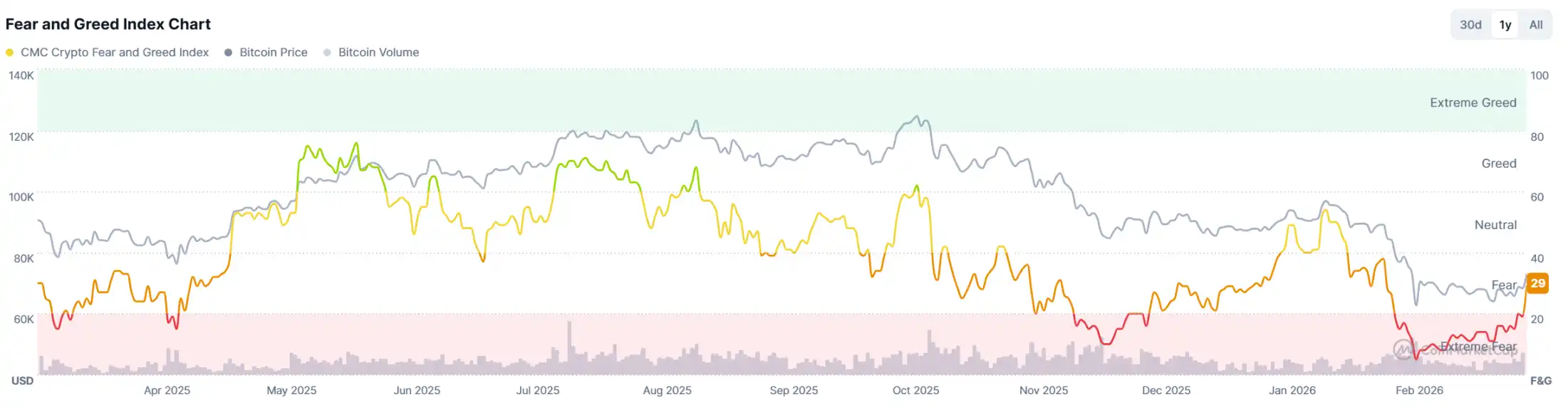
Recently, the White House officially submitted Kevin Wash's nomination as Federal Reserve Chair to the Senate, and the U.S. Senate rejected a war powers resolution limiting Trump's military actions against Iran. These two major political events quickly boosted global risk sentiment. The market generally believes that Wash, as a renowned economist, significantly enhances the Fed's policy continuity and market-friendly expectations with his nomination, while the Senate vote effectively eases concerns about escalated Middle East geopolitical tensions, avoiding the worst-case scenario.
Gold, as a safe-haven asset, has performed well, currently hovering around $5,150-$5,300 per ounce. U.S. crypto-related stocks surged, with MSTR closing up 10.37%, COIN up 14.57%, and CRCL up 5.63%.
In addition, according to Bitget market data, the daily Korean and Japanese stock indices opened higher, with the Korean KOSPI index rising by 565.69 points to 5,654.72 points, an 11.02% increase, and the Nikkei 225 index rising by 2,319 points to 56,564.54 points, a 4.28% increase.
BTC Spot ETF Sees Continuous Large Net Inflows Since Late February
Data shows that between the end of 2025 and early February 2026, Bitcoin spot ETF data occasionally showed large net inflows, but mostly large net outflows.
Since Bitcoin hit an all-time high in early October last year, as of February 20, 2026, the holdings of U.S. Bitcoin spot ETFs have experienced the largest reduction in this cycle, with a total decrease of approximately 100,300 BTC.
However, this trend began to change on February 20, showing multiple significant net inflows.
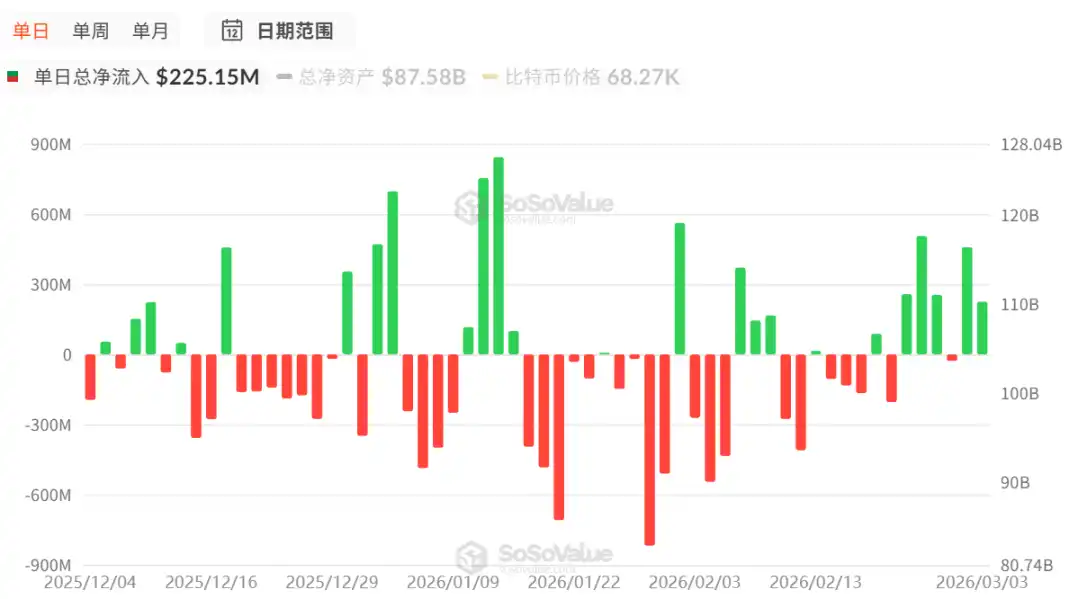
As of March 5, there were only 2 instances of net outflows, both not significant in value. Meanwhile, during this period, there were large net inflows of $4.58 billion and $5.06 billion in a single day.
Inflowing funds are starting to recover, so it's no surprise to see an increase in BTC price.
400,000 BTC Acquired in the $60K-$70K Range, Selling Pressure Easing
During the Bitcoin pullback in February, according to Glassnode data, a significant amount of on-chain accumulation occurred in the $60,000 to $70,000 range, with over 400,000 BTC acquired by investors, indicating strong "buy the dip" behavior.
The BTC supply in this price range has increased from around 997,000 BTC on January 1 to approximately 1.43 million BTC currently, representing an addition of about 429,000 BTC, a 43% increase. Over 8% of the circulating supply off exchanges is held in this range, forming a concentrated holding band.
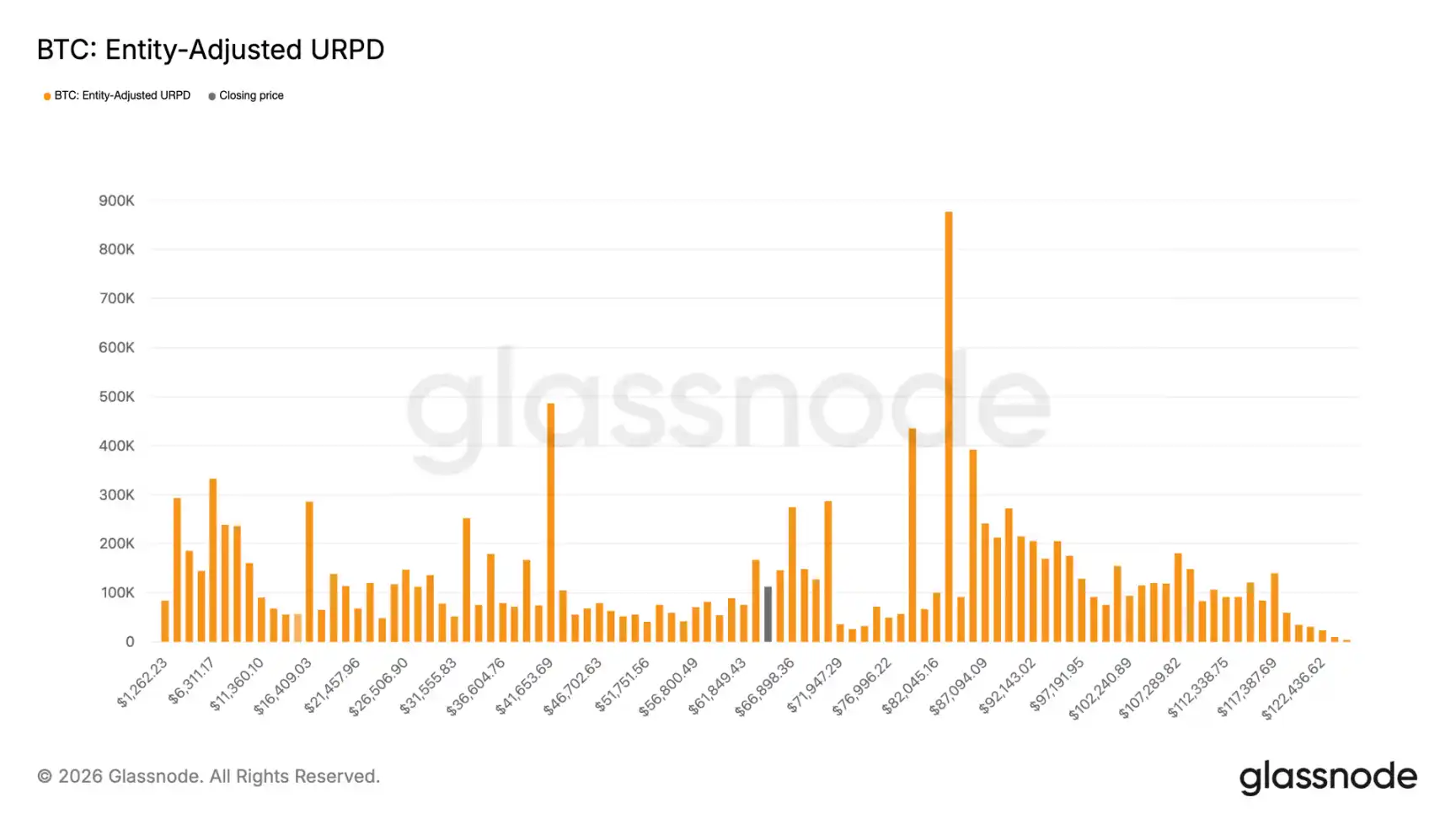
Furthermore, data from March 3 shows that after months of continuous net selling, Long-Term Holders' (LTH) net positions are now showing signs of stabilization.
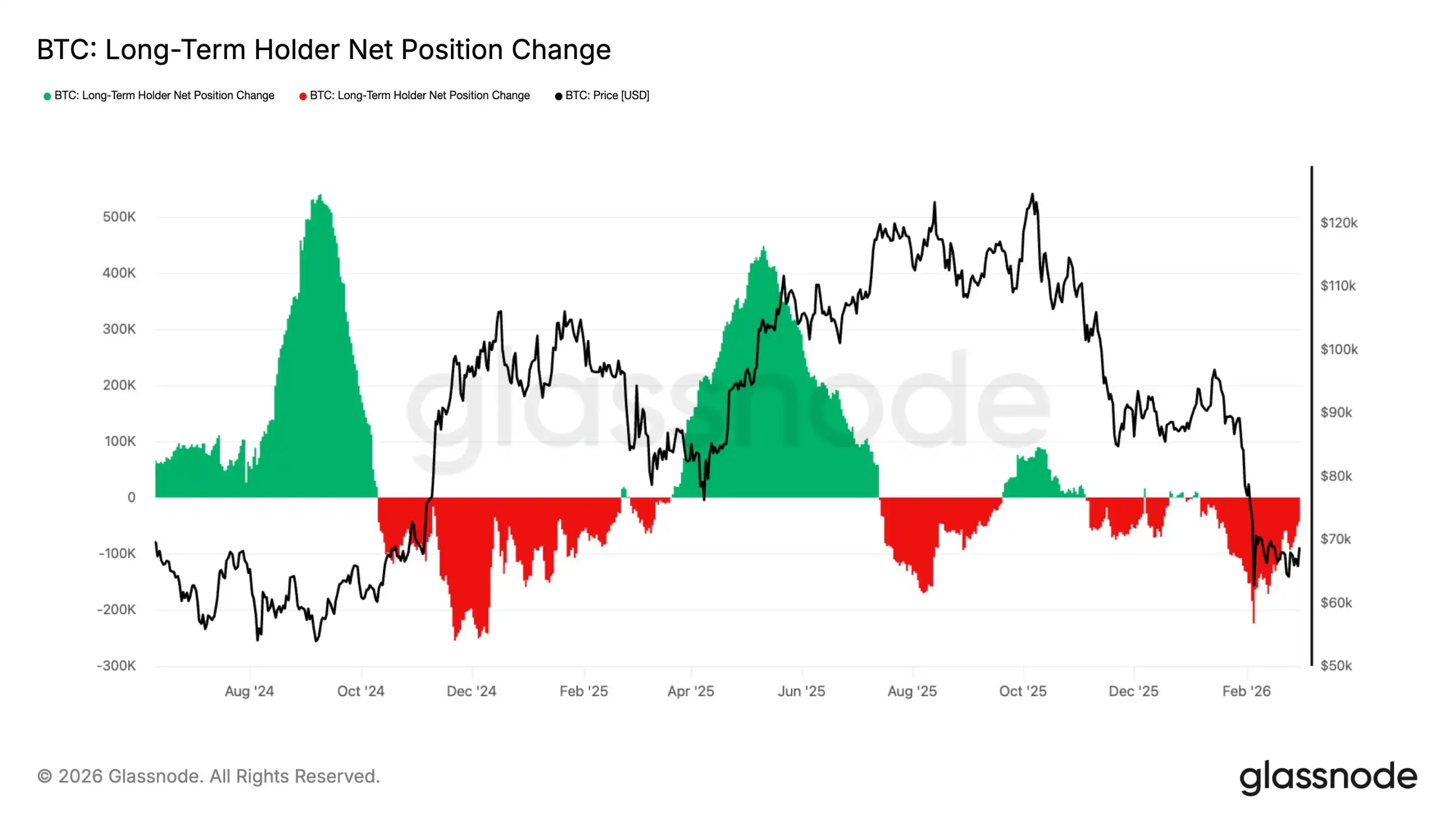
This indicates that as the Bitcoin price stabilizes, the selling pressure from experienced holders is easing. Resistance in BTC supply remains, but the intensity of selling is diminishing.
Stablecoin Market Cap Remains High, Up $1.737 Billion in the Past 7 Days
Stablecoin data continues to be one of the indicators to watch for market funds.
According to DeFiLlama data, the total market cap still stands at a high of $3,108.48 billion. In the past 7 days, USDT's total market cap increased by 0.03%, while USDC saw a 1.84% increase.
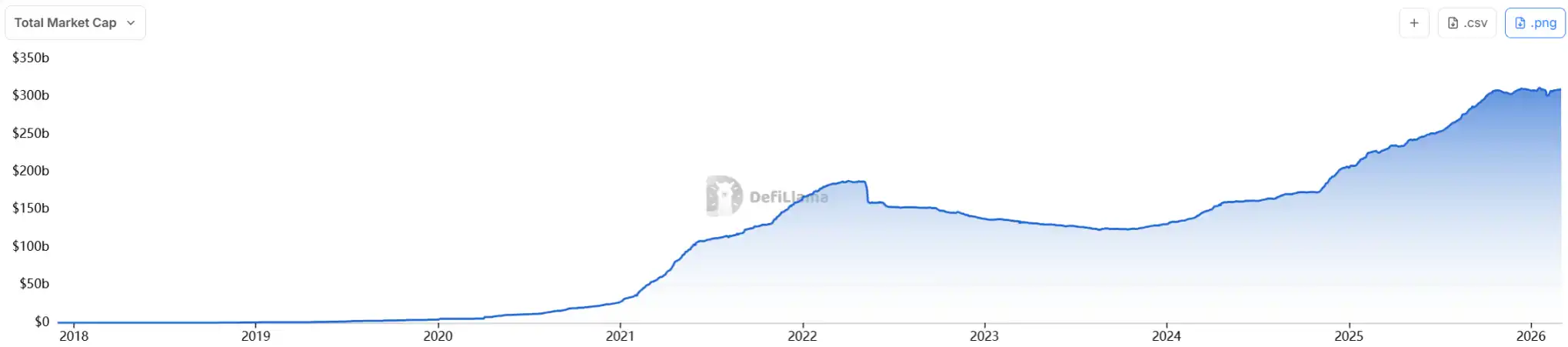
It is worth mentioning that in the past 1 month, USDC market capitalization has increased by 8.6%, PYUSD by 16.7%, U by 29.04%, and USDG by 12.87%.
The high-level operation of stablecoins not only provides ample market liquidity but also reflects a signal of ongoing capital inflow into the crypto ecosystem—trading volume remains at the trillion-dollar level, serving as a bridge, accumulating potential energy for the next phase of growth for assets like Bitcoin. Despite the lack of explosive growth, the stablecoin supply itself is an indication of market maturity and confidence restoration.
Michael Saylor continues to increase his Bitcoin holdings through the company's unlimited purchase strategy, with a current holding of over 720,000 BTC at an average cost of about $76,000. He has publicly stated multiple times: "We are in a phase similar to Apple's early 'desperate valley,' where Bitcoin, as digital property and digital credit, will outperform traditional assets."
ARK Invest founder Cathie Wood stated in an outlook report in early February 2026 that the Bitcoin downward cycle may be nearing its end. "The key to achieving asset allocation diversification is to introduce new assets with low correlation to existing assets, and Bitcoin fits the bill. The addition of low-correlation assets can, in the long run, enhance risk-adjusted returns. Therefore, Wood believes that institutions are indeed taking cryptocurrencies seriously. Previously, they may have hesitated due to the 'four-year cycle' narrative. Regardless of whether the four-year cycle exists, the market has indeed gone through a significant decline and is currently approaching what many technical analysts consider a potential low zone. Near the bottom, the market tends to experience sharp fluctuations. Afterwards, people often say: 'If only I had bought at that low point. The V-shaped rebound is quite significant.' Of course, this is not a commitment in any form, but it seems that multiple factors are gradually aligning."
Tom Lee, Chairman of Ethereum Treasury company BitMine, said in an interview with CNBC, "No one wants to see the U.S. involved in a conflict. But it must be pointed out that the market is much more resilient than expected. I don't think anyone can assert that we have hit bottom now, but it looks like we are building a bottom—bad news keeps coming out, yet the market can absorb it and remain stable. More importantly, I believe positions have been significantly reset. Looking back to last April, a simple signal was the VIX rising above 40. It went up to 80 last year, but this time it may not go that high. Another signal is: if there is another panic-inducing news, gold continues to fall, and the stock market turns higher on the same day, that means the market has cleared out. I think we are approaching that stage."
Tom Lee believes March is a period of bottom formation. Software, Mag 7, and crypto assets have already completed about 90% of their decline. They are outperforming the market, which shows leadership. Even in the event of global trade disruptions, you still need AI, and you still need Mag 7. The fundamentals of these companies remain strong. Investors need to remain patient and cautious, holding onto some cash. But I believe opportunities are emerging.
You may also like

Dialogue with OmenX Founder: Why does the prediction market need an evolution from "spot" to "derivatives"?

When the P2P illicit funds from ten years ago turned into 60,000 bitcoins

Morning News | CME Group launches Nasdaq Cryptocurrency Index futures; Asset management giant Janus Henderson strategically invests in Ethena

Why did Oracle deliver the strongest financial report in history, yet its stock price fell?

Bitcoin Layer 2 Network Botanix: Why Did We Choose to Dissolve?

Morning Report | OpenAI has submitted an S-1 registration statement draft to the U.S. SEC; Morpho completes $175 million financing

Galaxy Deep Research Report: How Hyperliquid's HIP-4 Upgrade Changes the Landscape of Prediction Markets?

Latest research from 13 top universities including Cornell University: The current state, challenges, and misconceptions of the fusion of Crypto and AI
Deconstructing Anthropic: The Best AI Company, Possibly Also a Type of Organizational Invention

Every exchange is a "Universal Exchange."

The counterattack of traditional finance: Alliance chains are quietly reviving
Pantera Capital Partner: How Tokenization is Restructuring the Private Equity and Early Investment Ecosystem?

Mastercard Launches Agent Pay for AI, Plans to Record AI Agent Payment Authorizations on Polygon
Mastercard launched Agent Pay for AI, a new payment protocol designed to help AI agents make small payments such as pay-per-use access to data and APIs. The system plans to record human-granted AI agent permissions on Polygon, focusing on verifiable authorization, identity, and payment controls.

Curve Deploys Llamalend v2 on Optimism With 250,000 OP Incentives
Curve launched Llamalend v2 on Optimism with 250,000 OP incentives from the Optimism Foundation. The upgrade expands Llamalend beyond its earlier crvUSD-focused model, adding broader collateral support, LlamaRisk market reviews, and the ability to use Curve LP tokens as collateral.

Raydium Old Liquidity Pool Reportedly Exploited, With $1.34 Million Moved to Ethereum and Tornado Cash
An old Raydium liquidity pool was reportedly exploited for around $1.34 million in USDC, RAY, and wSOL, with the stolen funds bridged to Ethereum and deposited into Tornado Cash. The incident highlights the tail risks of legacy DeFi pools, old contracts, and cross-chain fund laundering paths.
Kalshi Executive Challenges “SBF Backed AI Unicorns” Narrative, Says Leopold Aschenbrenner Was Key Figure
Kalshi executive John Wang questioned the “SBF backed AI unicorns” narrative, saying Leopold Aschenbrenner was the key figure behind major AI investment decisions.

New York Proposes Stricter Stablecoin Issuer Rules Aligned With Federal GENIUS Act
NYDFS proposed stricter stablecoin issuer rules aligned with the GENIUS Act, covering reserves, custody, redemption timelines, audits, and capital buffers.

CryptoQuant Says Bitcoin Profitable Supply Is Near 45% Pressure Zone as On-Chain Data Points to Market Repricing
CryptoQuant said Bitcoin’s profitable supply is nearing the 45% pressure zone, signaling rising market stress, unrealized losses, and a possible on-chain repricing phase.
Dialogue with OmenX Founder: Why does the prediction market need an evolution from "spot" to "derivatives"?
When the P2P illicit funds from ten years ago turned into 60,000 bitcoins
Morning News | CME Group launches Nasdaq Cryptocurrency Index futures; Asset management giant Janus Henderson strategically invests in Ethena
Why did Oracle deliver the strongest financial report in history, yet its stock price fell?
Bitcoin Layer 2 Network Botanix: Why Did We Choose to Dissolve?
Morning Report | OpenAI has submitted an S-1 registration statement draft to the U.S. SEC; Morpho completes $175 million financing


