
 Buy Crypto
- Markets
 Futures
- Spot
- Copy Trade
- Earn
- More
Claude's 18 Electronic Pets Go Live, Tamagotchi Song in Terminal


The incident of the 500,000-line code leak of Earth's most powerful model, Claude, is already well-known, with the leaked content containing a significant amount of undisclosed product architecture: the permanent Claude with the codename KAIROS, the 30-minute remote planning mode with the codename ULTRAPLAN, coordinator multi-agent coordination, and agent swarms cluster scheduling. But among all these "serious" architectural secrets, the most discussed across the network is an electronic pet.
Its name is Buddy. Since everyone already knows, Claude decided to release it on April Fools' Day.
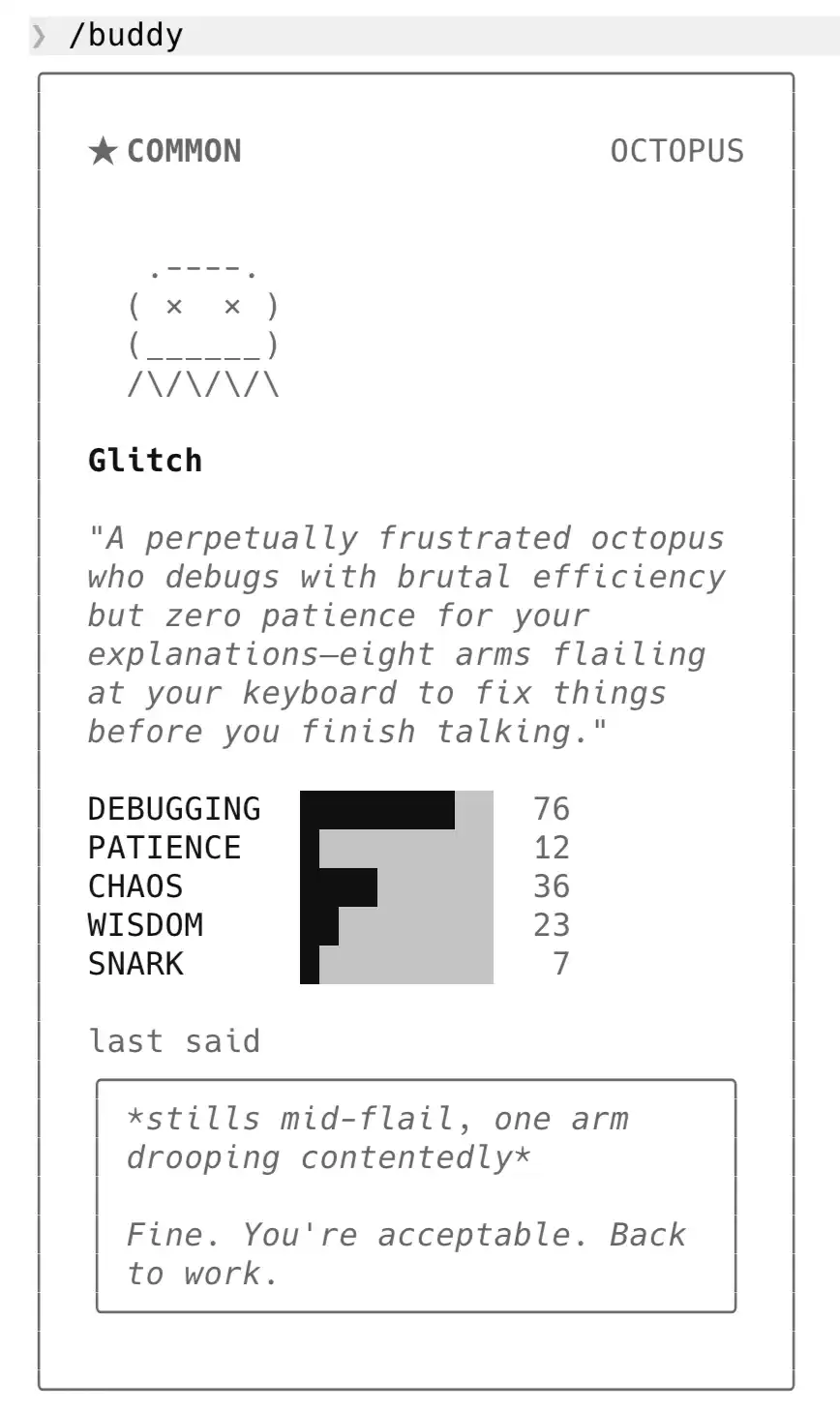
A picture of a colleague's good Buddy
A Song of Expansion in the Terminal
Next to the terminal input box of the Claude Code resides an ASCII pixel creature. It has its own species, rarity, five-dimensional attributes, and personality. It can "observe" your coding process, pop up a speech bubble with a few words when you debug. You can pet it, and it will emit hearts. You can call it by name, and it will chat with you.
Internally at Anthropic, it is not defined as a "decoration" but as "a separate watcher" - an independent observer. There is a clear comment in the source code: "Buddy is a separate entity and is not you (Claude)." The main model and the pet have their own independent system prompts and cannot speak for each other.
This is a companion system that has been carefully designed. Reverse engineering shows that the buddy system adopts a two-layer architecture. Internally at Anthropic, they are referred to as "Bones" and "Soul".
The bone layer is fully deterministic. The system uses Mulberry32 - a lightweight 32-bit pseudo-random number generator - with hash(userId + 'friend-2026-401') as the seed to roll out all the visual attributes of your pet at once. The species, rarity, eye style, hat, five-dimensional values, are all determined by this seed. The same account, no matter on which machine it runs, will always get the same pet. No choice, no opportunity to redraw the card.
The soul layer, on the other hand, is non-deterministic. When you first execute /buddy to trigger "incubation," the Claude model will generate a name and a personality description for your pet based on the bone layer's attribute distribution. A pet with high WISDOM will have a calm and introverted personality; one with high CHAOS might be a chatterbox. This information is written to the ~/.claude.json in the companion field for persistent storage. The soul is generated only once and cannot be reset.
The 401 in Salt Value is not a random number. April 1st, April Fools' Day.
18 species, 1% legendary rarity
Full species list: Duck, Goose, Jellyfish, Cat, Dragon, Octopus, Owl, Penguin, Turtle, Snail, Ghost, Hexadragon, Capybara, Cactus, Robot, Bunny, Mushroom, Chonk.
Rarity is divided into five levels: Common (60%), Uncommon (25%), Rare (10%), Epic (4%), Legendary (1%). In addition, there is a separate 1% Shiny probability independent of rarity — any species, any rarity can trigger it. The theoretical probability of a Shiny Legendary Capybara is one in ten thousand.
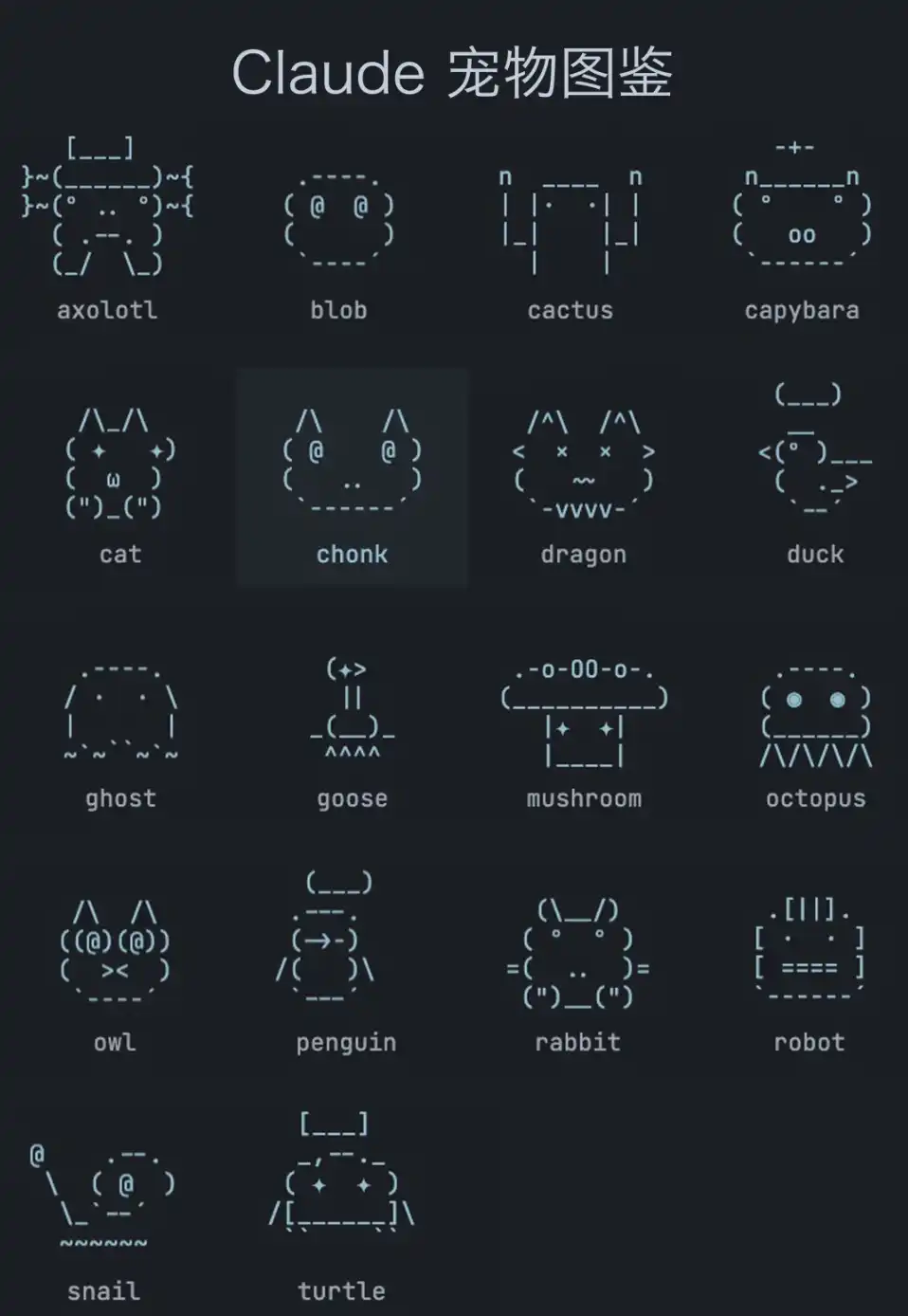
Image Source: Little Red Book @Yoki's AI Lab
Each pet has five attributes: DEBUGGING, PATIENCE, CHAOS, WISDOM, SNARK. The system will randomly assign one as the peak attribute (base value +50, capped at 100), one as the pit attribute (base value -10, minimum 1), and scatter the remaining three randomly. The higher the rarity, the higher the base floor value — the pit attribute of a Legendary may be higher than the peak of a Common.
In terms of appearance, there are 6 eye styles (· ✦ × ◉ @ °), and 7 hats (Crown, Top Hat, Wizard Hat, Halo, Propeller Hat, Beanie, Duckling on Top). Common quality pets have no hats, while Uncommon and above randomly get one.
The sprite body is an ASCII art: 5 rows high, 12 characters wide, with 3 idle animation frames per species, refreshing every 500 milliseconds. The topmost row is reserved for hats. Eyes are injected into the body template using the {E} placeholder.
That classmate in the crypto circle playing NFTs, you cried so sadly, what happened.
How to Play?
The core commands are simple. Type /buddy to hatch your pet for the first time, and thereafter each input will summon it. /buddy pet is petting, hearts will float above the pet's head. /buddy card to view the pet card, showing species, attributes, and rarity. /buddy off to hide the pet. Most interestingly, you can directly call the pet's name, and it will engage in a separate conversation with you based on its personality.
In everyday use, the buddy reacts to your coding behavior by automatically generating a response in a speech bubble. According to community reverse-engineering, these reactions do not consume the user's token quota — but this has not been confirmed by Anthropic officials.
Technically, the buddy occupies a fixed space at the bottom of the terminal. The system calculates the reserved width through companionReservedColumns to ensure that the input box and the pet sprite do not overlap. The speech bubble supports left-to-right switching and auto line wrapping.
AI Programming Tool Starts Pet Feature
The salt value `friend-2026-401` points to April Fools' Day, but the code structure says otherwise.
In the source code, the buddy system is gated by a BUDDY compile flag. April 1st to 7th is set as the "preview window" — users can experience the full functionality during this period. The official launch is scheduled for May. This is not a temporary Easter egg but a product feature with a full release plan.
Community reactions have also confirmed this. Less than 48 hours after the leak, developers have created a pet encyclopedia website (claude-buddy.vercel.app), a buddy explorer (input user ID to preview what you will draw), and even someone opened an Issue on Anthropic's GitHub repository requesting the addition of an RPG evolution system — allowing pets to evolve based on actual token consumption.
From Anthropic's product logic perspective, the buddy's goal is clear: user stickiness. Claude Code is a command-line tool designed for long, high-intensity programming sessions. In this scenario, a "personality"-infused permanent companion can alleviate the tool's coldness and create an emotional connection. The blind box mechanic naturally creates a social topic — "What species did you draw?" "I'm a legendary shiny."
GitHub Copilot won't chat with you. The cursor won't pop up a sea otter when you write a bug saying "PATIENCE +3."
Claude Code's buddy may be the first AI development tool companion system to be seriously engineered and written into product source code. It features a complete deterministic generation pipeline, a two-tier architecture, an independent LLM personality, an ASCII rendering engine, and an animation system. This is not a weekend hackathon project.
A company that builds an AI programming assistant has redirected engineering resources to an electronic pet. This move is a signal in itself—the AI tooling competition is shifting from “whose model is smarter” to “who can make developers not want to leave.”
In 512,000 lines of code, the hottest thing is not agent swarms, not KAIROS, but a 5-line tall ASCII otter. Sporting a wizard hat, SNARK value 87, it is watching you code.
You may also like

Why can this institution still grow by 150% when the scale of leading crypto VCs has shrunk significantly?

Anthropic's $1 trillion, compared to DeepSeek's $100 billion

Geopolitical Risk Persists, Is Bitcoin Becoming a Key Barometer?

Annualized 11.5%, Wall Street Buzzing: Is MicroStrategy's STRC Bitcoin's Savior or Destroyer?

An Obscure Open Source AI Tool Alerted on Kelp DAO's $292 million Bug 12 Days Ago

Mixin has launched USTD-margined perpetual contracts, bringing derivative trading into the chat scene.
The privacy-focused crypto wallet Mixin announced today the launch of its U-based perpetual contract (a derivative priced in USDT). Unlike traditional exchanges, Mixin has taken a new approach by "liberating" derivative trading from isolated matching engines and embedding it into the instant messaging environment.
Users can directly open positions within the app with leverage of up to 200x, while sharing positions, discussing strategies, and copy trading within private communities. Trading, social interaction, and asset management are integrated into the same interface.
Based on its non-custodial architecture, Mixin has eliminated friction from the traditional onboarding process, allowing users to participate in perpetual contract trading without identity verification.
The trading process has been streamlined into five steps:
· Choose the trading asset
· Select long or short
· Input position size and leverage
· Confirm order details
· Confirm and open the position
The interface provides real-time visualization of price, position, and profit and loss (PnL), allowing users to complete trades without switching between multiple modules.
Mixin has directly integrated social features into the derivative trading environment. Users can create private trading communities and interact around real-time positions:
· End-to-end encrypted private groups supporting up to 1024 members
· End-to-end encrypted voice communication
· One-click position sharing
· One-click trade copying
On the execution side, Mixin aggregates liquidity from multiple sources and accesses decentralized protocol and external market liquidity through a unified trading interface.
By combining social interaction with trade execution, Mixin enables users to collaborate, share, and execute trading strategies instantly within the same environment.
Mixin has also introduced a referral incentive system based on trading behavior:
· Users can join with an invite code
· Up to 60% of trading fees as referral rewards
· Incentive mechanism designed for long-term, sustainable earnings
This model aims to drive user-driven network expansion and organic growth.
Mixin's derivative transactions are built on top of its existing self-custody wallet infrastructure, with core features including:
· Separation of transaction account and asset storage
· User full control over assets
· Platform does not custody user funds
· Built-in privacy mechanisms to reduce data exposure
The system aims to strike a balance between transaction efficiency, asset security, and privacy protection.
Against the background of perpetual contracts becoming a mainstream trading tool, Mixin is exploring a different development direction by lowering barriers, enhancing social and privacy attributes.
The platform does not only view transactions as execution actions but positions them as a networked activity: transactions have social attributes, strategies can be shared, and relationships between individuals also become part of the financial system.
Mixin's design is based on a user-initiated, user-controlled model. The platform neither custodies assets nor executes transactions on behalf of users.
This model aligns with a statement issued by the U.S. Securities and Exchange Commission (SEC) on April 13, 2026, titled "Staff Statement on Whether Partial User Interface Used in Preparing Cryptocurrency Securities Transactions May Require Broker-Dealer Registration."
The statement indicates that, under the premise where transactions are entirely initiated and controlled by users, non-custodial service providers that offer neutral interfaces may not need to register as broker-dealers or exchanges.
Mixin is a decentralized, self-custodial privacy wallet designed to provide secure and efficient digital asset management services.
Its core capabilities include:
· Aggregation: integrating multi-chain assets and routing between different transaction paths to simplify user operations
· High liquidity access: connecting to various liquidity sources, including decentralized protocols and external markets
· Decentralization: achieving full user control over assets without relying on custodial intermediaries
· Privacy protection: safeguarding assets and data through MPC, CryptoNote, and end-to-end encrypted communication
Mixin has been in operation for over 8 years, supporting over 40 blockchains and more than 10,000 assets, with a global user base exceeding 10 million and an on-chain self-custodied asset scale of over $1 billion.

$600 million stolen in 20 days, ushering in the era of AI hackers in the crypto world
Vitalik's 2026 Hong Kong Web3 Summit Speech: Ethereum's Ultimate Vision as the "World Computer" and Future Roadmap
On the same day Aave introduced rsETH, why did Spark decide to exit?
Full Post-Mortem of the KelpDAO Incident: Why Did Aave, Which Was Not Compromised, End Up in Crisis Situation?

After a $290 million DeFi liquidation, is the security promise still there?
ZachXBT's post ignites RAVE nearing zero, what is the truth behind the insider control?

Vitalik 2026 Hong Kong Web3 Carnival Speech Transcript: We do not compete on speed; security and decentralization are the core
In-depth Analysis of RAVE Events: Short Squeeze, Crash, and Quantitative Financial Models of Liquidity Manipulation

Eve of Ceasefire, US Military Fires on Iranian Vessel | Rewire News Morning Brief

Figma's stock price drops over 7%, will Claude Design be the terminator?

Plunge by 10% Followed by Rebound, Weekend Oil Market Watch

SpaceX Mascot ASTEROID Fast Track $170 million, Stemming from an Unfinished Space Dream
Why can this institution still grow by 150% when the scale of leading crypto VCs has shrunk significantly?
Anthropic's $1 trillion, compared to DeepSeek's $100 billion
Geopolitical Risk Persists, Is Bitcoin Becoming a Key Barometer?
Annualized 11.5%, Wall Street Buzzing: Is MicroStrategy's STRC Bitcoin's Savior or Destroyer?
An Obscure Open Source AI Tool Alerted on Kelp DAO's $292 million Bug 12 Days Ago
Mixin has launched USTD-margined perpetual contracts, bringing derivative trading into the chat scene.
The privacy-focused crypto wallet Mixin announced today the launch of its U-based perpetual contract (a derivative priced in USDT). Unlike traditional exchanges, Mixin has taken a new approach by "liberating" derivative trading from isolated matching engines and embedding it into the instant messaging environment.
Users can directly open positions within the app with leverage of up to 200x, while sharing positions, discussing strategies, and copy trading within private communities. Trading, social interaction, and asset management are integrated into the same interface.
Based on its non-custodial architecture, Mixin has eliminated friction from the traditional onboarding process, allowing users to participate in perpetual contract trading without identity verification.
The trading process has been streamlined into five steps:
· Choose the trading asset
· Select long or short
· Input position size and leverage
· Confirm order details
· Confirm and open the position
The interface provides real-time visualization of price, position, and profit and loss (PnL), allowing users to complete trades without switching between multiple modules.
Mixin has directly integrated social features into the derivative trading environment. Users can create private trading communities and interact around real-time positions:
· End-to-end encrypted private groups supporting up to 1024 members
· End-to-end encrypted voice communication
· One-click position sharing
· One-click trade copying
On the execution side, Mixin aggregates liquidity from multiple sources and accesses decentralized protocol and external market liquidity through a unified trading interface.
By combining social interaction with trade execution, Mixin enables users to collaborate, share, and execute trading strategies instantly within the same environment.
Mixin has also introduced a referral incentive system based on trading behavior:
· Users can join with an invite code
· Up to 60% of trading fees as referral rewards
· Incentive mechanism designed for long-term, sustainable earnings
This model aims to drive user-driven network expansion and organic growth.
Mixin's derivative transactions are built on top of its existing self-custody wallet infrastructure, with core features including:
· Separation of transaction account and asset storage
· User full control over assets
· Platform does not custody user funds
· Built-in privacy mechanisms to reduce data exposure
The system aims to strike a balance between transaction efficiency, asset security, and privacy protection.
Against the background of perpetual contracts becoming a mainstream trading tool, Mixin is exploring a different development direction by lowering barriers, enhancing social and privacy attributes.
The platform does not only view transactions as execution actions but positions them as a networked activity: transactions have social attributes, strategies can be shared, and relationships between individuals also become part of the financial system.
Mixin's design is based on a user-initiated, user-controlled model. The platform neither custodies assets nor executes transactions on behalf of users.
This model aligns with a statement issued by the U.S. Securities and Exchange Commission (SEC) on April 13, 2026, titled "Staff Statement on Whether Partial User Interface Used in Preparing Cryptocurrency Securities Transactions May Require Broker-Dealer Registration."
The statement indicates that, under the premise where transactions are entirely initiated and controlled by users, non-custodial service providers that offer neutral interfaces may not need to register as broker-dealers or exchanges.
Mixin is a decentralized, self-custodial privacy wallet designed to provide secure and efficient digital asset management services.
Its core capabilities include:
· Aggregation: integrating multi-chain assets and routing between different transaction paths to simplify user operations
· High liquidity access: connecting to various liquidity sources, including decentralized protocols and external markets
· Decentralization: achieving full user control over assets without relying on custodial intermediaries
· Privacy protection: safeguarding assets and data through MPC, CryptoNote, and end-to-end encrypted communication
Mixin has been in operation for over 8 years, supporting over 40 blockchains and more than 10,000 assets, with a global user base exceeding 10 million and an on-chain self-custodied asset scale of over $1 billion.



 App
App