
- Buy Crypto
- Markets
 Futures
- Spot
- Copy Trade
- Earn
- More
Coin Metrics: Why Has Bitcoin's Current Cycle Been Extended?

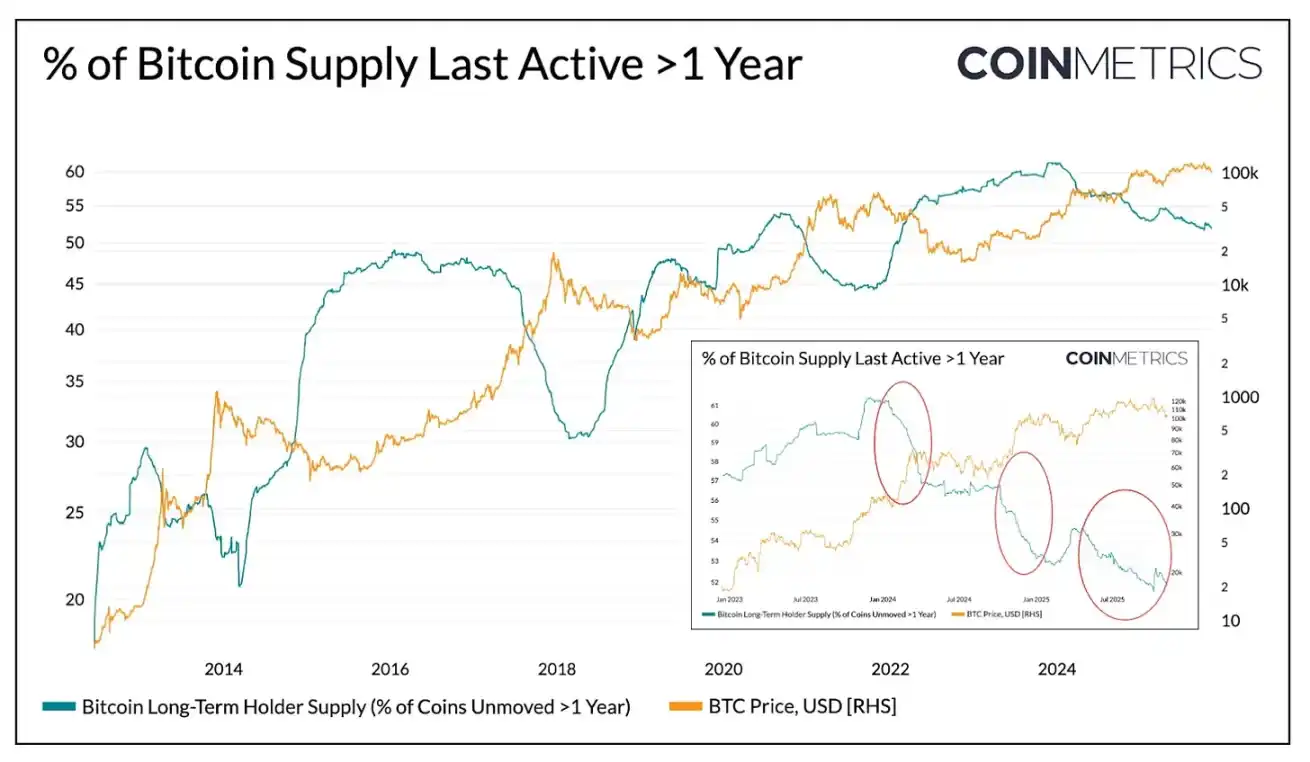
Data Source: Coin Metrics Network Data Pro
As of now, out of the 19.94 million circulating bitcoins, approximately 52% of the tokens have not moved in over a year, lower than the 61% figure at the beginning of 2024. Whether it is the growth rate during the bear market or the decline rate during the bull market, both have significantly leveled off. Batching of transactions has been observed in the first quarter of 2024, the third quarter of 2024, and recently in 2025. This indicates that long-term holders are selling their tokens in a more sustained manner, reflecting an extension of the ownership transfer cycle.
ETF and DAT: Core Drivers of Demand
In contrast, since 2024, the supply of short-term holders (tokens active in the past year) has been steadily increasing, as previously dormant tokens re-enter circulation. Meanwhile, with the launch of spot Bitcoin ETFs and the accelerated accumulation pace of Digital Asset Treasury (DAT), new and sustained demand has emerged, absorbing the supply distributed by long-term holders.
As of November 2025, the number of bitcoins active in the past year is 7.83 million, a 34% increase from the 5.86 million in early 2024 (dormant tokens re-circulating). During the same period, the holdings of spot Bitcoin ETFs and Strategies grew from approximately 600,000 bitcoins to 1.9 million bitcoins, representing almost 57% of the net increase in supply from short-term holders. Currently, these two channels together account for about 23% of the short-term holder supply.
Despite a recent slowdown in inflows over the past few weeks, the overall trend indicates that supply is gradually shifting towards more stable, long-term holding channels, which is a unique feature of the market structure in this cycle.
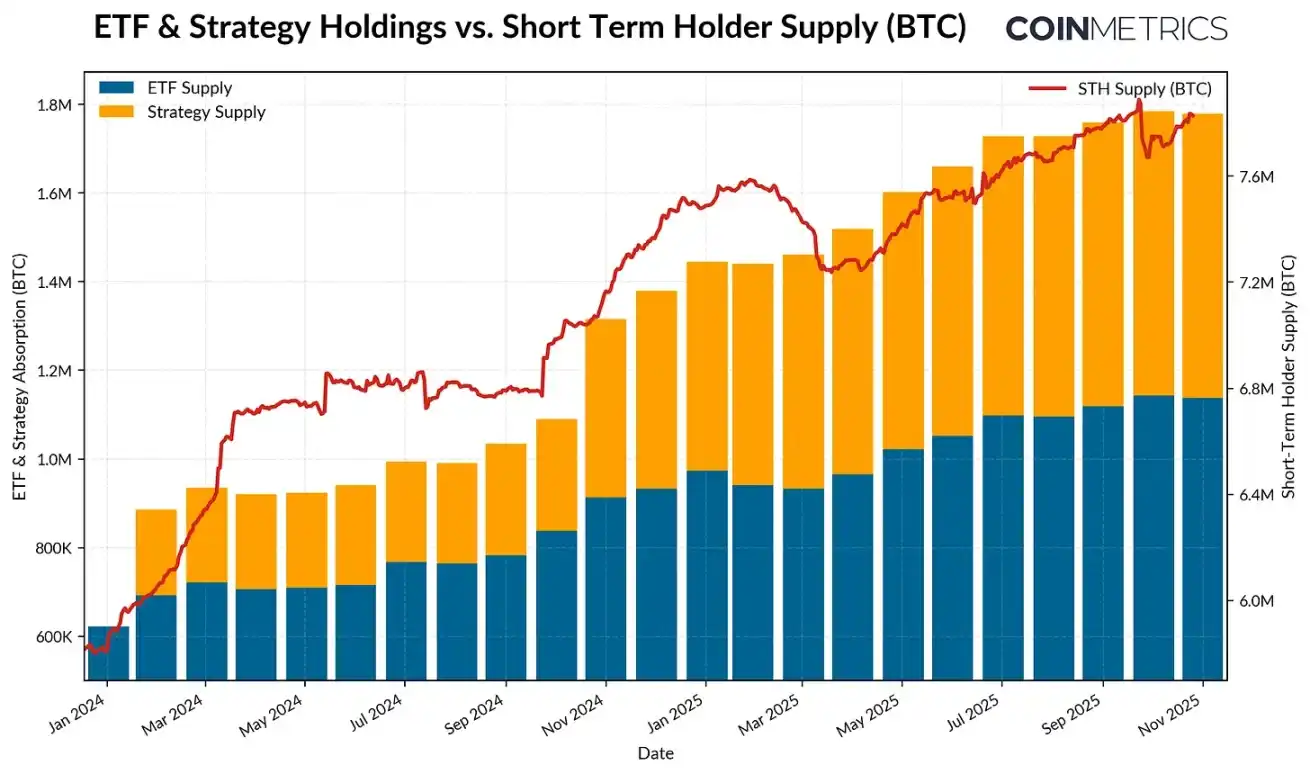
Data Source: Coin Metrics Network Data Pro & Bitbo Treasuries; Note: ETF supply does not include Fidelity FBTC, DAT supply includes Strategy
Short-Term and Long-Term Holder Behavior
The actual profit trend further confirms the gradual nature of Bitcoin's supply dynamics. The Spent Output Profit Ratio (SOPR) is used to measure whether holders are selling their tokens at a profit or loss, providing a clear reflection of different holder groups' behavior patterns throughout the market cycle.
In past cycles, both long-term and short-term holders' profit-taking behaviors often exhibited intense, synchronized fluctuations. However, recently, this relationship has diverged: the SOPR for long-term holders remains slightly above 1, indicating a steady realization of profits and moderate selling at peaks.
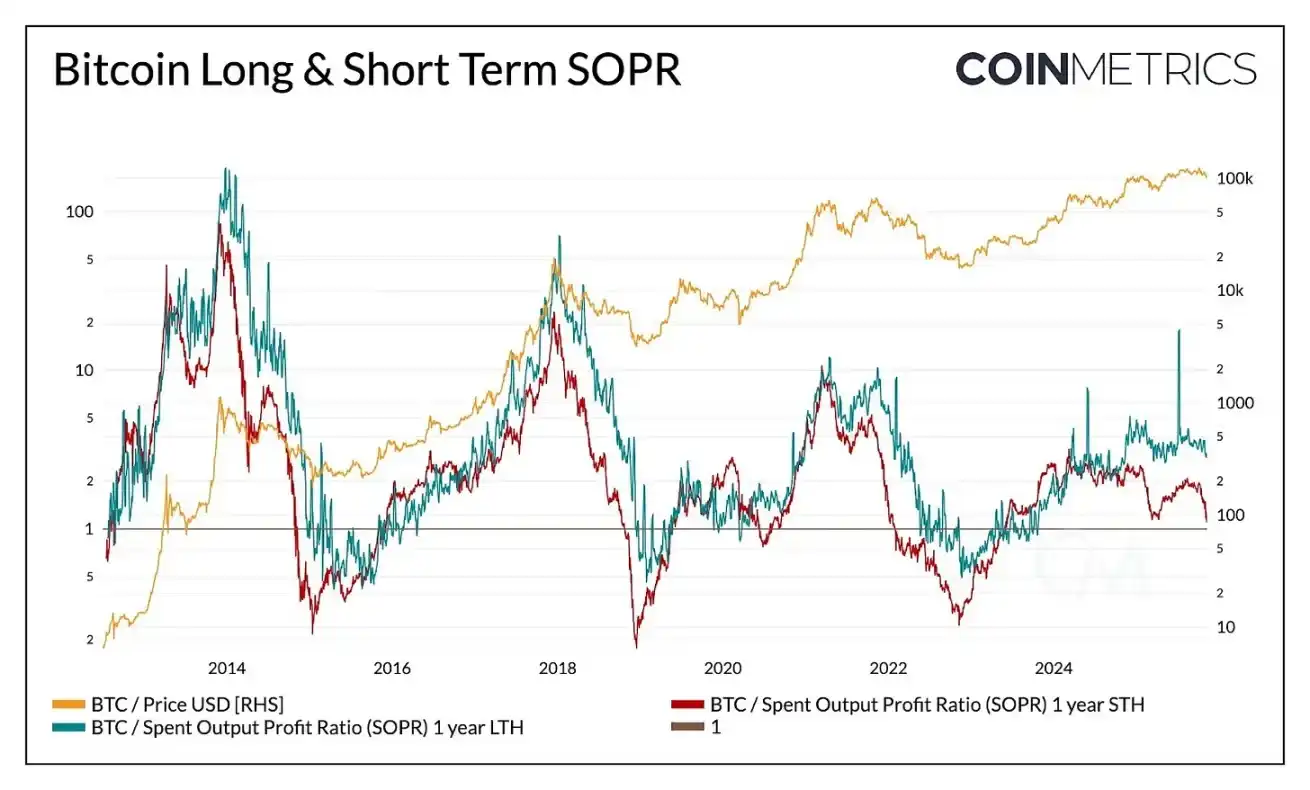
Data Source: Coin Metrics Network Data Pro
The SOPR for short-term holders hovers around the breakeven line, explaining the recent cautious market sentiment as many short-term holders' positions are near their cost basis. The divergence in behavior between these two holder types reflects the market's current state of greater stability: institutional demand has absorbed the supply distributed by long-term holders, moving away from the extreme volatility of the past. If the SOPR for short-term holders continues to surpass 1, it could signify a strengthening market momentum.
While a significant retracement would still compress the profit-taking ability of all holder groups, the overall pattern indicates a more balanced market structure: supply turnover and profit realization are gradually advancing, extending Bitcoin's cycle rhythm.
Bitcoin Volatility Decline
This structural stability is also reflected in Bitcoin's volatility, which has been on a downward trend. Currently, Bitcoin's 30-day, 60-day, 180-day, and 360-day actual volatility remains stable around 45%-50%, whereas its volatility in the past was often explosive, leading to significant market fluctuations. Now, Bitcoin's volatility characteristics are increasingly resembling those of large-cap tech stocks, indicating its maturation as an asset. This not only reflects improved liquidity but also underscores that institutional investors are becoming a major force in the market.
For asset allocators, a decline in volatility may enhance Bitcoin's attractiveness in portfolios, especially as its correlation with macro assets like stocks and gold continues to evolve.
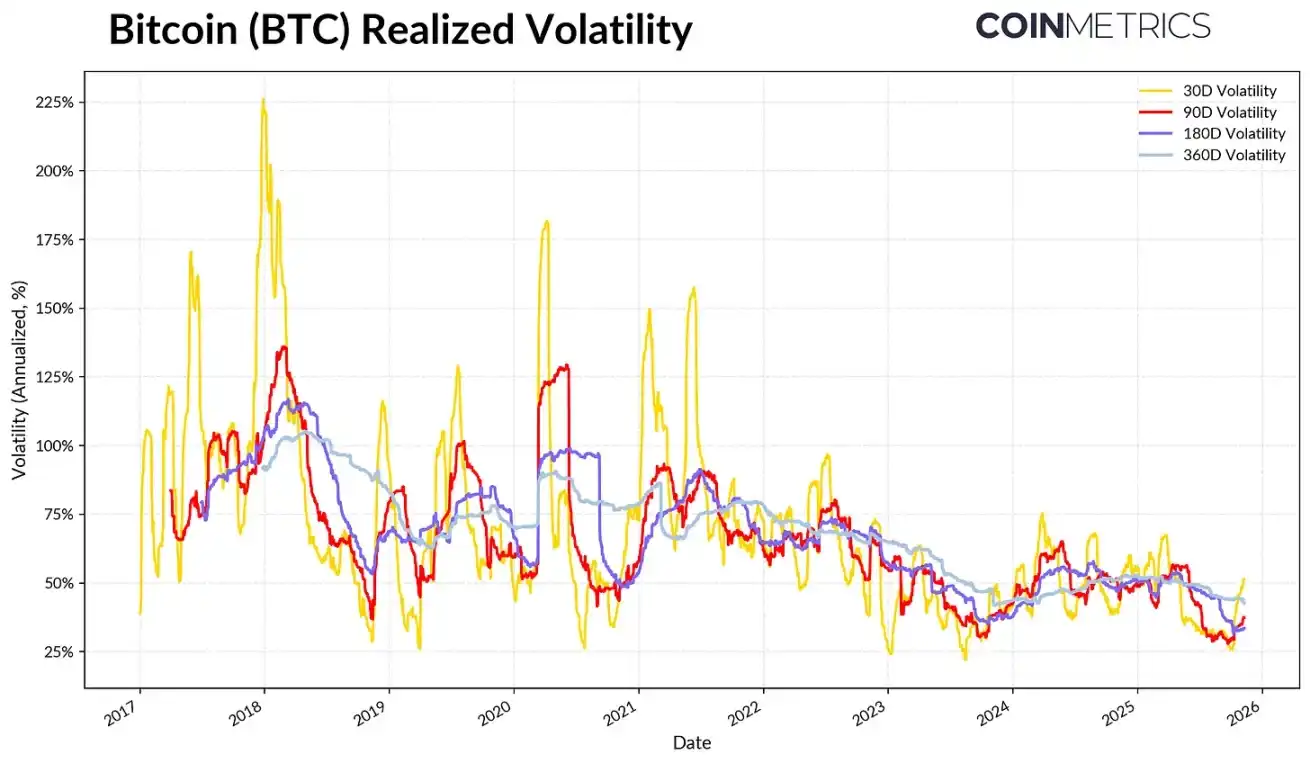
Data Source: Coin Metrics Market Data Pro
Conclusion
The on-chain trends of Bitcoin indicate that this current cycle is progressing in a smoother, longer phase, without the frenzied parabolic price action seen in previous bull markets. Long-term holders are gradually offloading their holdings, with much of it being absorbed by more sustainable demand channels such as ETFs, DCA, and broader institutional holdings. This shift signifies a maturing market structure: decreased volatility and circulation velocity, along with extended cycles.
Nevertheless, market momentum still hinges on the sustainability of demand. ETF fund inflows plateauing, some DCAs facing pressure, recent market-wide liquidation events, and short-term holder SOPR hovering around breakeven levels highlight a market in a phase of readjustment. Rising supply held by long-term holders (tokens unmoved for over a year), SOPR breaking above 1, inflows into spot Bitcoin ETFs and stablecoins could all be key signals for the resurgence of market momentum.
Looking ahead, a reduction in macro uncertainties, improved liquidity conditions, and regulatory progress related to market structure could reignite fund inflows and prolong the bull market cycle. Despite a cooling of market sentiment, after a recent deleveraging adjustment, with the support of institutional expansion and on-chain infrastructure advancement, the market fundamentals are stronger.
You may also like

Aster Chain officially launches: defining a new era of on-chain privacy and transparency

Stargate Debut Illustrated: The 1.4 Trillion Computing Power Empire Dream, Awakened

A Billion-Dollar Life Buy Threat Triggered by an Iranian Missile
BlackRock Launches ETHB: Ethereum ETF Enters 'Interest-Bearing Age'
Nvidia Starts Putting Chips in the Road | Rewire News Evening Update

RootData: February 2026 Cryptocurrency Exchange Transparency Research Report

「One and Done SEA」, so OpenSea chooses to wait a little longer

Ray Dalio: The Resolution of the US-Iran Conflict Is In the Strait of Hormuz

In just 70 days, Polymarket easily raked in tens of millions in fees
Matrixdock is launching the Silver Token XAGm, built on the FRS standard as an on-chain silver-backed asset.
a16z: The Hardest Enterprise Software, and the Greatest Opportunity in AI

Polymarket Market-Making Bible: Pricing Spread Formula

Ray Dalio: If the United States loses Hormuz, it will lose more than just a war

How to Earn Up to 40% Rebates on Crypto Futures Trading (WEEX Trade to Earn IV Guide)
WEEX Trade to Earn IV lets traders earn up to 40% fee rebates in real time through a tiered miner system tied to trading activity. With additional boosts from referrals, it offers a more reliable alternative to airdrops as the crypto market gains momentum.

NVIDIA Plays Trillion-Dollar Chess Game | Rewire News Morning Edition

Real-time Update | NVIDIA GTC 2026 Conference Highlights Galore
People Behind Pokémon Go: Started with CIA's Money, Now Mapping the World for the Military AI


 App
App