
- Buy Crypto
- Markets
 Futures
- Spot
- Copy Trade
- Earn
- More
Coinbase Launches Binance Alpha2.0 Competitor, But Base Leading DEX Suffers "Backstabbing"

Yesterday, Binance just released Binance Alpha2.0, allowing CEX users to purchase any DEX token directly from CEX without the need for withdrawal. CZ also commented, "I believe other CEXs will follow suit, and DEX trading volume will also increase." Following that, Coinbase made its move as well.
Last night, Coinbase announced the launch of Verified Pools, a set of rigorously screened liquidity pools. Users holding Coinbase Verifications certification credentials can seamlessly conduct on-chain transactions, linking their Prime Onchain wallet, Coinbase wallet, or other third-party wallets to Coinbase verification credentials for trading, addressing the opacity issue of traditional liquidity pools.
The Verified Pools are based on the Uniswap v4 protocol on the Base network and leverage a hooks mechanism to achieve customizable smart contract functionality. Additionally, they have partnered with DeFi research and risk management company Gauntlet to optimize liquidity pool configuration and ensure the overall health of the liquidity pool.
In the official announcement, Verified Pools are characterized as another important step taken by Coinbase to promote the mainstream adoption of on-chain applications. However, what surprised users in the Base community the most was that the Verified Pools are based on Uniswap V4 rather than Aerodrome, Base's largest on-chain DEX application. Some even referred to this behavior as a "betrayal" of Aerodrome.
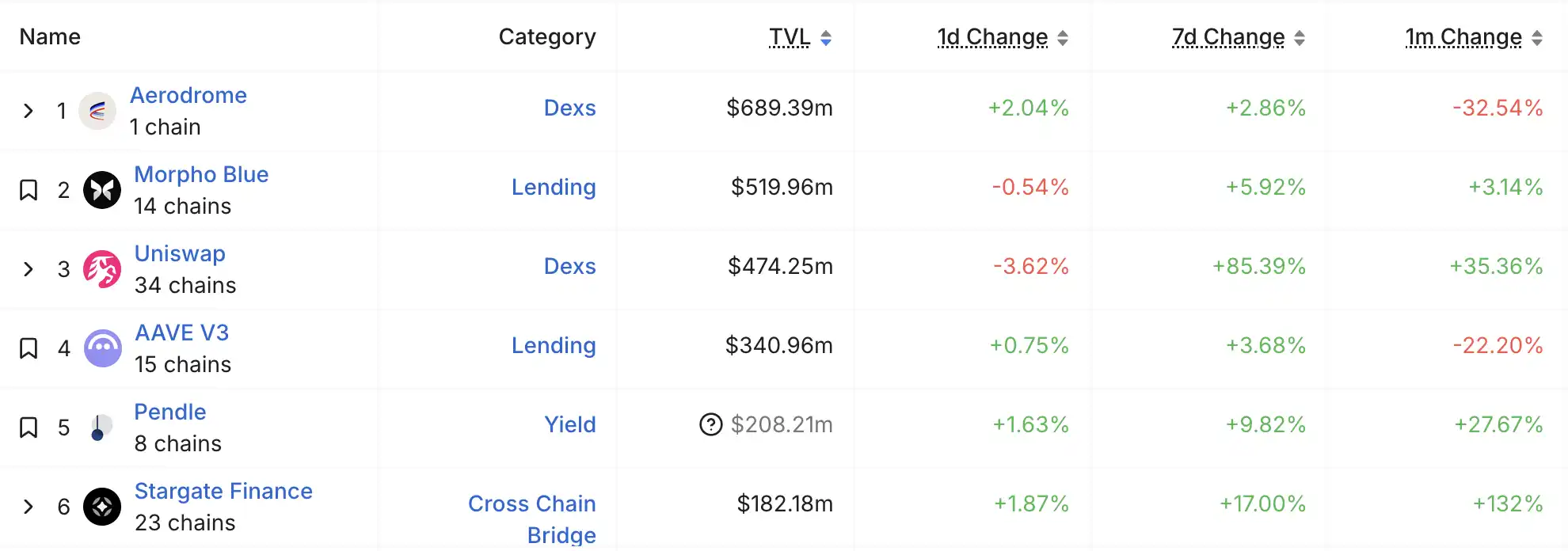
Aerodrome is ranked first in TVL on Base; Image Source: DeFiLlama
So why did Coinbase's Verified Pool choose Uniswap instead of Aerodrome?
Compliance First, Uniswap is a More Cost-Effective Choice
There are many people who do not understand Coinbase's approach, and even Sonic founder Andre Cronje questioned, "I'm really a bit puzzled. Aerodrome and Alex have always been the most steadfast supporters and advocates of Base. This could have been built entirely on Aerodrome. Isn't supporting your builders a motto?"
In response to these questions, Aerodrome co-founder Alexander Cutler stated, "We discussed this with them in the early stages of development and are fully capable of incorporating the same functionality — it just wasn't a priority at the time, but we will definitely pay attention to its adoption."
He mentioned that Coinbase approached Aerodrome for a collaboration in the verification pool last summer, but the verification pool's product-market fit still had many unresolved issues, so Aerodrome chose a larger opportunity as a priority target at that time.
The core of Coinbase's verification pool lies in its on-chain Credential system tied to KYC authentication. Uniswap V4's hooks mechanism can be customized to only allow LPs verified through Coinbase's KYC to participate, directly addressing regulatory compliance issues.
Uniswap V4's hooks are essentially a smart contract "plugin system," allowing developers to customize pool creation rules, fee structures, and permission management. This flexibility enables Coinbase to quickly deploy a whitelist access mechanism in line with its compliance framework and achieve strong binding of LP identities through the on-chain Credential system.
Related Read: "When Binance Launchpool Meets Uniswap V4, Whose Ace Is Bigger?"
As Aerodrome, being the native DEX on the Base chain, positions itself as a "liquidity hub," its underlying codebase does not natively support such complex permission layering designs. Even if achieved through forking or refactoring in the future, the development cycle and testing costs would be significantly higher than directly adopting Uniswap's mature solution.
As a publicly listed company, Coinbase has an extremely low tolerance for compliance risks. Although Aerodrome is the native DEX of the Base chain, its permissionless, highly autonomous protocol features conflict fundamentally with Coinbase's regulatory framework. If Aerodrome were to be directly integrated, Coinbase would bear the associated responsibility of protocol vulnerabilities, money laundering risks, and even regulatory scrutiny. In contrast, Uniswap V4's modular design allows Coinbase to gradually test the waters through a controlled KYC segregated pool, avoiding regulatory minefields while leveraging the brand credibility and liquidity network of Uniswap.
Alexander Cutler also acknowledges that it is "technically feasible," but explicitly states that prioritizing features like dynamic fee optimization that do not require permissioned pools is higher on the agenda.
In a reply to someone else's tweet, he wrote, "There are still many questions about how permissioned pools can gain enough traction to become a viable alternative to permissionless pools. If it truly gains market acceptance, we are ready to support it at any time. However, in the short term, it is unlikely to surpass opportunities like dynamic fees."
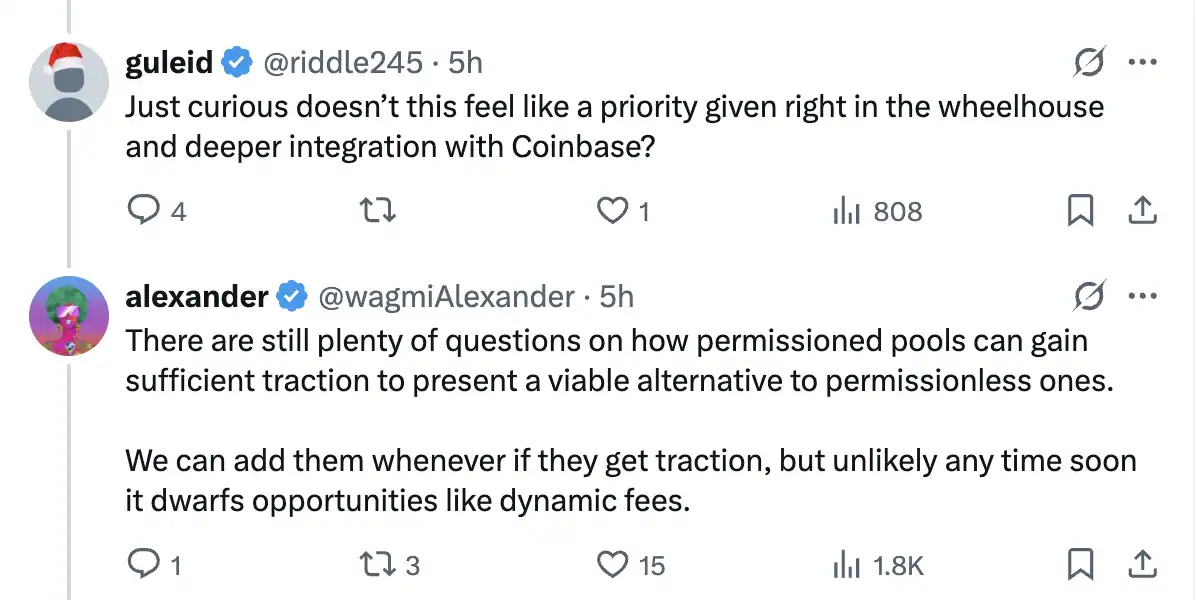
This choice reflects Aerodrome's preference to serve existing DeFi-native users rather than cater to Coinbase's compliance experiment. On the other hand, Coinbase's goal is to explore on-chain compliant trading scenarios through the validation pool and gradually migrate CEX users to on-chain, a path that requires instant usability and low compliance risk, with Uniswap V4 providing a readily available technical interface.
Experimental Nature Over PMF
For some, whitelist pools as one of the applications of Uniswap V4 was already anticipated, with Coinbase's validation pool being a practical implementation of this idea. The most direct contradiction lies in the high overlap of target users—institutional LPs on the Coinbase order book and compliant buyers are already accustomed to the low-friction environment of centralized trading platforms.
If on-chain concentrated liquidity merely replicates the order book functionality of CEX, users lack the incentive to migrate—on-chain transaction gas costs, price slippage, and operational complexity remain higher than CEX, with traditional users relying more on CEX for instant settlement, fiat channels, and customer support. Even if the validation pool can offer slightly higher market-making returns, liquidity fragmentation may reduce capital efficiency, leading to a "compliance premium that is difficult to cover migration costs" dilemma.
A deeper challenge comes from the liquidity allocation paradox. If the validation pool focuses on Coinbase's unlisted assets, it will fall into a "chicken and egg" cycle: the high-risk nature of unaudited assets conflicts inherently with the conservative positioning of the compliance pool, while funds seeking Alpha tend to favor early assets of permissionless pools. This could turn the validation pool into a "compliance buffer zone" for market makers—earning fees through liquidity provision rather than capturing asset appreciation.
Even if unlisted assets are allowed into the pool, the question remains whether they can become an "onboarding transition channel." As a publicly traded company, Coinbase's strict asset auditing standards will not be relaxed due to the presence of on-chain pools but may even tighten further due to compliance pressure.
Despite Coinbase's on-chain credential-linked KYC identity, ZachXBT once revealed a systemic vulnerability: The dark web could exploit/purchase KYC information to fabricate a "compliant identity" and inject tainted funds. If a hacker were to sell illicit ETH to a liquidity pool via a market maker, the disparity between on-chain anonymity and CEX risk control capabilities could lead to the entire pool being flagged as a "tainted asset pool," triggering regulatory scrutiny. More subtly, arbitrage bots still rely on market makers to balance prices, but the risk control capabilities of market makers are far inferior to those of centralized CEX systems, ultimately potentially shifting the risk to ordinary users.
In the short term, the liquidity pool seems more like an "on-chain feasibility study report" – reusing Uniswap V4's hooks mechanism to build a minimal compliance model, testing regulatory tolerance and user behavior data; in the medium term, the plan is to iterate the interactive interface developed for this into a standard on-chain transaction tool, paving the way for future integration of permissionless pools; the long-term goal is still to blur the boundaries between CEX and DEX, gradually realizing Brian Armstrong's vision of "on-chain/off-chain liquidity convergence."
However, whether this experiment can cross the "sandbox-to-reality" chasm depends on two key variables: First, whether the U.S. SEC will consider such pools as a "quasi-securities trading platform," and second, whether the speed at which CEX users migrate to the chain can support liquidity density. At the current stage, it is too early to assert its success or failure.
You may also like

Mining Companies' Great Migration: Some Have Already Secured $12.8 Billion in AI Orders
What Is Vibe Coding? How AI Is Changing Web3 & Crypto Development
What is vibe coding? Learn how AI coding tools are lowering the barrier to Web3 development and enabling anyone to build crypto applications.

The parent company of the New York Stock Exchange strategically invests in OKX: The intentions behind the $25 billion valuation

WEEX P2P update: Country/region restrictions for ad posting
To improve ad security and matching accuracy, WEEX P2P now allows advertisers to restrict who can trade with their ads based on country or region. Advertisers can select preferred counterparty locations for a safer, smoother trading experience.
I. Overview
When publishing P2P ads, advertisers can now set the following:
Allow only counterparties from selected countries or regions to trade with your ads.
With this feature, you can:
Target specific user groups more precisely.Reduce cross-region trading risks.Improve order matching quality.
II. Applicable scenarios
The following are some common scenarios:
Restrict payment methods: Limit orders to users in your country using supported local banks or wallets.Risk control: Avoid trading with users from high-risk regions.Operational strategy: Tailor ads to specific markets.
III. How to get started
On the ad posting page, find "Trading requirements":
Select "Trade with users from selected countries or regions only".Then select the countries or regions to add to the allowlist.Use the search box to quickly find a country or region.Once your settings are complete, submit the ad to apply the restrictions.
When an advertiser enables the "Country/Region Restriction" feature, users who do not meet the criteria will be blocked when placing an order and will see the following prompt:
If you encounter this issue when placing an order as a regular user, try the following solutions.
Choose another ad: Select ads that do not restrict your country/region, or ads that allow users from your location.Show local ads only: Prioritize ads available in the same country as your identity verification.
IV. Benefits
Compared with ads without country/region restrictions, this feature provides the following improvements.
Aspect
Improvement
Trading security
Reduces abnormal orders and fraud risk
Conversion efficiency
Matches ads with more relevant users
Order completion rate
Reduces failures caused by incompatible payment methods
V. FAQ
Q1: Why are some users not able to place orders on my ad?
A1: Their country or region may not be included in your allowlist.
Q2: Can I select multiple countries or regions when setting the restriction?
A2: Yes, multiple selections are supported.
Q3: Can I edit my published ads?
A3: Yes. You can edit your ad in the "My Ads" list. Changes will take effect immediately after saving.

What are the key highlights of this year's Ethereum's most important upgrade, the Glamsterdam upgrade?

March 6 Key Market Update You Can't Miss! | Alpha Morning Report

Sell Nvidia, Buy Power Plant: 27-Year-Old AI Investor Earns $5 Billion in One Year
The $24 Million Heist Behind It: The Most Dangerous Vulnerability in the Crypto World is Actually Human

Justin Sun Lawsuit Dismissed, BlackRock Bullish on Tokenization, What Is the English-Speaking Community Paying Attention To?

Morning News | NYSE parent company invests in OKX; Morgan Stanley provides $500 million loan to Core Scientific; Western Union partners with Crossmint to launch stablecoin USDPT

These former crypto builders have transitioned to the hottest AI projects globally

Ethereum Overhaul 2026 Blueprint, this time to abandon "gradualism"

What Is OpenClaw? How AI Agents Could Change Crypto Exchange Trading
OpenClaw is a rapidly growing open-source AI agent that can autonomously execute tasks and interact with software, including connecting to crypto exchanges through APIs to analyze markets and automate trading strategies. While this creates new opportunities for smarter trading, it also introduces security and operational risks. Through this article, WEEX aims to help users better understand the potential and risks of AI trading agents so they can explore new technologies while trading more safely and responsibly.
Ethereum 2029 Strawmap Guide: Ultra-Fast Consensus, Native Privacy, and the "Acceleration Variables" Brought by AI

Altcoin ETF Surge: SOL and XRP Inflows Total $23 Million as Institutions Diversify
Key Takeaways Institutional interest in altcoin ETFs is expanding, with SOL and XRP showing significant inflows on March…
Vitalik Drops Ethereum Endgame Bombshell: ETH USD to $3,000?
Key Takeaways Vitalik Buterin introduces the “Sanctuary Tech” manifesto to address Ethereum’s non-financial limitations. A current lack of…
Exclusive: Yuliya Barabash Predicts the Most Regulated Could Be the Biggest Crypto Winners
Key Takeaways The aftermath of FTX and Celsius collapses has ushered a new regulatory era, reshaping the crypto…

iPhone Crypto Wallets Under Threat from State-Grade Malware
Key Takeaways: The Coruna exploit kit exploits 23 iOS vulnerabilities, threatening iPhone users’ crypto wallets. Initially state-level surveillance,…
Mining Companies' Great Migration: Some Have Already Secured $12.8 Billion in AI Orders
What Is Vibe Coding? How AI Is Changing Web3 & Crypto Development
What is vibe coding? Learn how AI coding tools are lowering the barrier to Web3 development and enabling anyone to build crypto applications.
The parent company of the New York Stock Exchange strategically invests in OKX: The intentions behind the $25 billion valuation
WEEX P2P update: Country/region restrictions for ad posting
To improve ad security and matching accuracy, WEEX P2P now allows advertisers to restrict who can trade with their ads based on country or region. Advertisers can select preferred counterparty locations for a safer, smoother trading experience.
I. Overview
When publishing P2P ads, advertisers can now set the following:
Allow only counterparties from selected countries or regions to trade with your ads.
With this feature, you can:
Target specific user groups more precisely.Reduce cross-region trading risks.Improve order matching quality.
II. Applicable scenarios
The following are some common scenarios:
Restrict payment methods: Limit orders to users in your country using supported local banks or wallets.Risk control: Avoid trading with users from high-risk regions.Operational strategy: Tailor ads to specific markets.
III. How to get started
On the ad posting page, find "Trading requirements":
Select "Trade with users from selected countries or regions only".Then select the countries or regions to add to the allowlist.Use the search box to quickly find a country or region.Once your settings are complete, submit the ad to apply the restrictions.
When an advertiser enables the "Country/Region Restriction" feature, users who do not meet the criteria will be blocked when placing an order and will see the following prompt:
If you encounter this issue when placing an order as a regular user, try the following solutions.
Choose another ad: Select ads that do not restrict your country/region, or ads that allow users from your location.Show local ads only: Prioritize ads available in the same country as your identity verification.
IV. Benefits
Compared with ads without country/region restrictions, this feature provides the following improvements.
Aspect
Improvement
Trading security
Reduces abnormal orders and fraud risk
Conversion efficiency
Matches ads with more relevant users
Order completion rate
Reduces failures caused by incompatible payment methods
V. FAQ
Q1: Why are some users not able to place orders on my ad?
A1: Their country or region may not be included in your allowlist.
Q2: Can I select multiple countries or regions when setting the restriction?
A2: Yes, multiple selections are supported.
Q3: Can I edit my published ads?
A3: Yes. You can edit your ad in the "My Ads" list. Changes will take effect immediately after saving.


 App
App