Crypto: 67% of the wealthy own it, but only 4.7% actually use it

 Prefer us on Google


Two-thirds converted, a handful of practitioners. Nexo surveyed 1,000 wealthy investors across three countries for its report Future of Digital Wealth 2026. Two out of three own cryptocurrencies, but only 4.7% have truly integrated them into their wealth management. The primary obstacle cited relates more to logistics than conviction. Excerpts.
Key Points
- Among 1,000 wealthy investors surveyed by Nexo in three countries, two-thirds own digital assets
- Less than 5% of the panel actually use their cryptos in their wealth management
- One in five respondents counts on this market as the primary lever for enrichment in the next decade
- Custody, tax reporting, and lack of a consolidated view remain practical barriers, which are being lifted through regulation
Crypto: The Nexo report measures the gap among wealthy investors
According to the study, 67% of respondents hold at least one digital asset. However, this adoption remains largely superficial: Nexo considers that only 4.7% of respondents have fully integrated cryptocurrencies into their wealth management. For the majority, they remain an isolated line on an exchange account, with no real place in allocation, taxation, or wealth transfer.
In between, a population of passive holders. They have bought, often via a spot ETF or an exchange account, and have left it at that, without their private banker or tax advisor ever seeing them.
Nearly 20% of respondents, however, expect cryptocurrencies to be their main engine of enrichment over the next decade. The intention is there, but daily practice is much less so.
These results must nevertheless be placed in context. Nexo notably offers loan services secured by cryptocurrencies and thus has an interest in promoting their integration into wealth management. The platform resumed its activities in the United States in April 2025, two years after reaching a $45 million settlement with the SEC and several state regulators regarding its Earn Interest product. Nexo shares the results of its study on social media -- Source: X Account
Operational friction, the main barrier to cryptocurrency adoption
But let's return to the study. This disconnect between vision and reality has a cause identified in the survey, operational friction (which includes key custody, tax reporting, and the lack of a consolidated view between bank accounts and wallets). However, these barriers are falling one by one.
In January 2025, the SEC withdrew its accounting bulletin SAB 121, which required banks to record cryptocurrencies held on behalf of third parties on their own balance sheets, making the service economically unfeasible. Two months later, the OCC (the federal regulator of U.S. national banks) confirmed in its interpretive letter 1183 that its institutions can hold and trade digital assets without prior authorization.
The first 1099-DA forms, which require U.S. platforms to report their clients' disposals, arrived at taxpayers' homes at the beginning of the year for transactions in 2025. In the European Union, the DAC8 directive has mandated since January the same automatic reporting of information to service providers on crypto-assets.
The crypto wealth is now reportable without accounting gymnastics, which removes an argument for hesitant family offices. ETFs have become a simple way to gain exposure to Bitcoin.
Bitcoin and ETFs: The Missing Link in Wealth Management
The rapprochement, however, began at the top. Morgan Stanley allowed its approximately 15,000 advisors to offer spot Bitcoin ETFs to their clients starting in August 2024, becoming the first major Wall Street bank to take the plunge. A survey conducted by Coinbase and EY-Parthenon among 350 institutional investors later indicated 83% intention to increase allocations. U.S. spot Bitcoin ETFs now exceed $100 billion in assets under management.
Access is therefore no longer the issue. A holder of IBIT shares stakes nothing and does not borrow against their exposure: they check a box in a securities account, which partly explains why 67% of holders produce only 4.7% of integrated users.
The gap between 67% of holders and 4.7% of integrated users is bridged by reporting formats and balance sheet lines. Three of these barriers have fallen since January 2025, and the next is being played out in the back offices of private banks, whose clients have already purchased.
-- Price
This content is provided for general informational purposes only and doesn't constitute financial, investment, legal, or tax advice. Any events, rewards, online promotions, or related information mentioned herein should not be considered a recommendation, solicitation, or invitation to purchase, sell, trade, or otherwise deal in any crypto assets. Crypto assets are highly volatile and may result in loss. The availability of WEEX services, products, and related events may vary by region. You are responsible for ensuring that your participation is in accordance with applicable local laws and regulations.
You may also like

QCP: AI Credit Risk Heats Up, Bitcoin May Face Range Breakthrough

French National Assembly Passes Tax Amendment on Stablecoin Transactions, Effective 2027

Bitcoin miner stocks driven by AI sentiment, not BTC prices

Black Monday Posts Break Records
Bitcoin Recovery Faces Challenges as Exchange Reserves Rise and Spot Demand Turns Negative
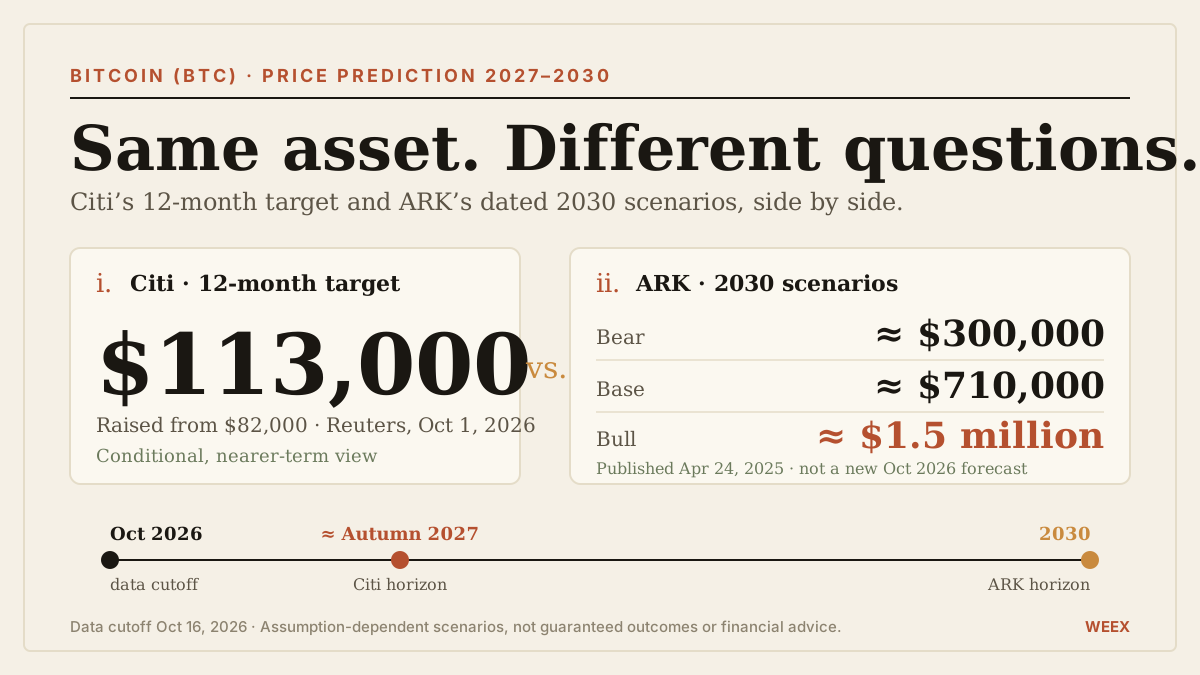
Bitcoin (BTC) Price Prediction 2027–2030: Citi’s $113,000 Target vs. Cathie Wood’s ARK Scenarios
Bitcoin price prediction for 2027–2030: compare Citi’s $113,000 target with ARK’s dated scenarios, demand assumptions, valuation math and key risks.

Mr&强 Analyzes BTC and ETH Short-Term Strategies

Bitcoin futures open interest declines, signaling weaker demand

Cathie Wood Predicts Long-Term Growth for Bitcoin Despite Dollar Strength

Peter Schiff Predicts Bitcoin Crash Over 99%
Liquidity in Cryptocurrency Market Approaches a Turning Point! Circle Aims to Enter 40 Emerging Markets

One dead, Qonto in flames, Nuñez resigns: why the streets worry crypto investors

Security Vulnerability Detected in ILITY Network, Cross-Chain Bridge Suspended

Bitcoin Spot ETF Sees Net Outflow of $229 Million Last Week, BlackRock's IBIT Leads with $165 Million Outflow

Morgan Stanley Recommends Up to 4% in Cryptocurrencies for Aggressive Portfolios

Deutsche Bank to Start Bitcoin and Ethereum Custody Within Weeks — Expansion to Asia by 2027

Bitcoin Ranges After Weekly Low Sweep| WEEX TradFi Daily(October 19, 2026)
Early on October 19, equity futures rebounded from last week’s chip selloff. Major indexes closed lower last week, the Nasdaq posted its worst week since June, the semiconductor ETF fell about 10%, and CoreWeave lost about 25%, while energy stocks were relatively resilient. Bitcoin traded near $82,000 after sweeping lows around $80,000, with markets watching the $79,800 and $83,600 zones.
WEEX Exclusive:Bitcoin Ranges After Weekly Low Sweep| WEEX TradFi Daily(October 19, 2026)

ECB: Lagarde defends rate hikes before the IMF and urges Brussels on digital euro

Sam Price Discusses Bitcoin Market Divergence

唐华斑竹 Analyzes Bitcoin Trends, Suggests Monitoring Support Levels

Saylor Envisions Bitcoin-Backed Stablecoin with Annual Yield of 6% to 8%

Strive CEO Emphasizes Going Long on Bitcoin and Short on USD, Claims Currency Depreciation is Irreversible

Bloomberg analyst warns BTC 50-week average decline may signal stock and metal downturns

Sam Price Focuses on Strategy Stock Price Drop and MSCI Index Adjustment

US Institutions See Net Inflows in Bitcoin as Demand for Dollar-Based Stablecoins Grows
Sam Price Focuses on the Hormuz Strait Tanker Incident, Crude Oil Prices Fluctuate
$4.8 Million Bitcoin Stolen from Scammer with Manipulated Ledger Wallet

Sazmining Offers Proto Hashboards at 4187 Dollars Each
Bitcoin or Dollar Returns: Same Strategy, Opposite Results
QCP: AI Credit Risk Heats Up, Bitcoin May Face Range Breakthrough
French National Assembly Passes Tax Amendment on Stablecoin Transactions, Effective 2027
Bitcoin miner stocks driven by AI sentiment, not BTC prices
Black Monday Posts Break Records
Bitcoin Recovery Faces Challenges as Exchange Reserves Rise and Spot Demand Turns Negative
Bitcoin (BTC) Price Prediction 2027–2030: Citi’s $113,000 Target vs. Cathie Wood’s ARK Scenarios
Bitcoin price prediction for 2027–2030: compare Citi’s $113,000 target with ARK’s dated scenarios, demand assumptions, valuation math and key risks.