
- Buy Crypto
- Markets
 Futures
- Spot
- Copy Trade
- Earn
- More
Crypto.Com witnessed a Ridiculous Governance Farce, as an Entity with 70% Voting Power Forced a 700 Billion CRO Coin Mint

Original Article Title: "Crypto.com Unfolds Absurd Governance Drama, Holding 70% Voting Power to Force 700 Billion CRO Mints"
Original Article Author: Symbol; Paper Box Ninja
Editor's Note: Several weeks ago, Crypto.com proposed a plan to reissue 700 billion burned CRO tokens. During the two-week voting period, the turnout fell short of the required threshold. If there wasn't enough participation by the deadline, the proposal would be scrapped. However, the day before the deadline, a sudden influx of 33 billion CRO token holders joined the vote, overwhelmingly pushing the proposal through. These sudden voters were none other than Crypto.com itself.
On Sunday, what seemed to be a potentially failing proposal—aimed at minting 700 billion CRO to offset the 2021 burn of an equivalent amount of tokens and reintroduce them to the market—struggled with a slim majority of affirmative votes over dissenting votes for most of the voting period (March 2 to 16) and failed to meet the required statutory quorum of 33.4%.
However, a dramatic turn of events unfolded at 14:00 UTC on Sunday, suddenly adding 33.5 billion CRO tokens to the affirmative votes, meeting the required votes for the proposal to pass by a significant margin. The final vote breakdown showed: 61.18% in favor, 17.61% against, 20.11% abstain, and 0.11% veto; with an overall turnout rate of 70.18%, far exceeding the minimum threshold of 33.4%.
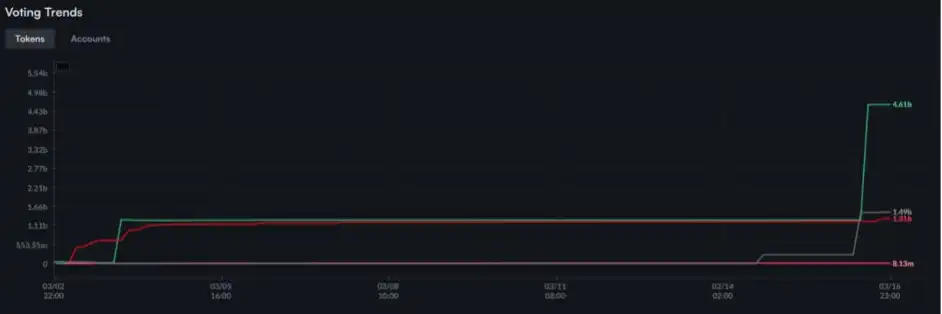
The last-minute surge in votes ultimately led to the proposal's passage. Source: Mintscan
The sudden surge in votes has left many disgruntled CRO holders feeling even more aggrieved, with them viewing it as a further betrayal of trust between Crypto.com and its holders. "Very disappointed," remarked one CRO whale on Telegram, "they almost all voted at the last minute, setting a malicious precedent that could be emulated by other projects."
The crux of this controversy lies in the bulk of the votes coming from large validators operated by Crypto.com. Three independent sources indicate that these validators control between 70% to 80% of the total voting power. As of March 10, only two of its validators—Starship and Falcon Heavy—voted in favor. Despite the affirmative vote accounting for only 11.86%, far below the 77.97% opposition vote and 8.47% abstain, it did not prevent the proposal from being approved.
A representative from Crypto.com also declined to comment on this.
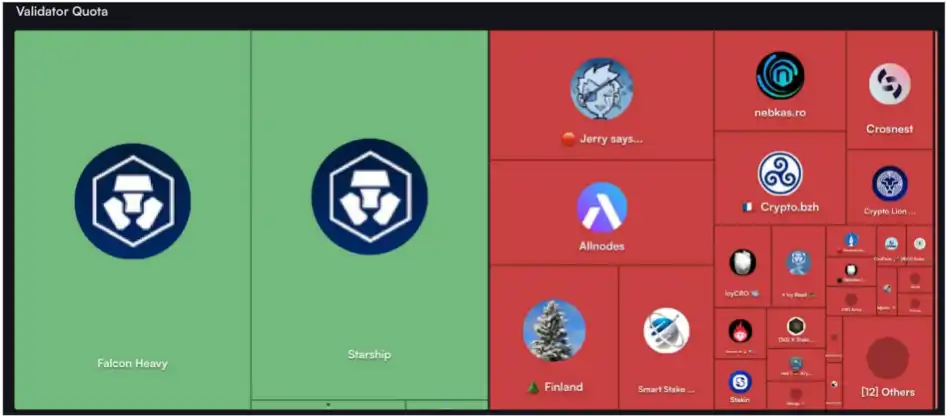
As of the March 10 voting results, data source: Mintscan
As the vote neared its end, three other validators controlled by Crypto.com—Electron, Antares, and Minotaur IV—also joined the yes camp; in addition, two smaller independent validators, Cosmostation and Polkachu.com, expressed their support, although their votes had little impact on the final result.
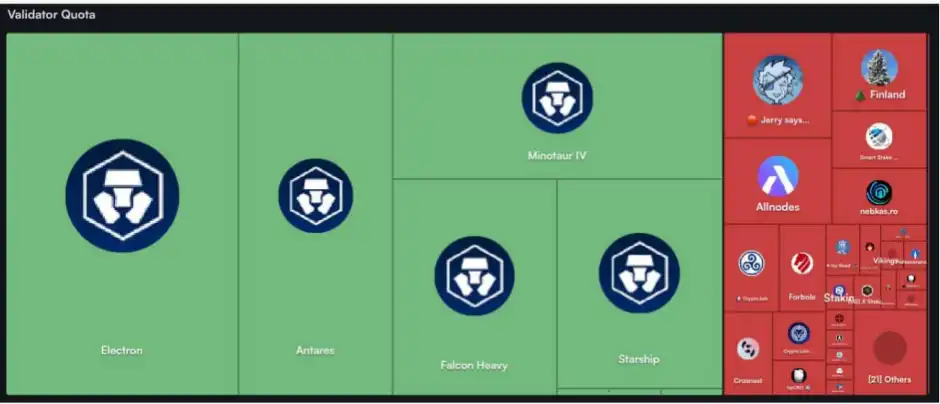
Final voting result, data source: Mintscan
With the proposal approved, the Cronos blockchain will undergo an upgrade tomorrow, during which 700 billion new tokens will be minted, while the 700 billion tokens burned in 2021 will remain out of circulation. These new tokens will be gradually released according to a five-year vesting plan and will undertake various functions, including initiating a potential CRO ETF.
However, the actions of the Crypto.com team did not stop there. On the day after the end of the vote, the team launched another proposal to burn 50 million CRO tokens (equivalent to 0.07% of the newly minted tokens) to supplement the previous three burns of the same amount. A CRO validator who voted against the re-minting proposal on Telegram indignantly wrote, "This is simply an insult to all CRO holders. How dare you propose to burn 50 million tokens on the same day you are reminting 700 billion tokens?"
The vote on this new proposal will continue for the next two weeks.
This article is a contributed piece and does not represent the views of BlockBeats.
You may also like
What Is Vibe Coding? How AI Is Changing Web3 & Crypto Development
What is vibe coding? Learn how AI coding tools are lowering the barrier to Web3 development and enabling anyone to build crypto applications.

The parent company of the New York Stock Exchange strategically invests in OKX: The intentions behind the $25 billion valuation

WEEX P2P update: Country/region restrictions for ad posting
To improve ad security and matching accuracy, WEEX P2P now allows advertisers to restrict who can trade with their ads based on country or region. Advertisers can select preferred counterparty locations for a safer, smoother trading experience.
I. Overview
When publishing P2P ads, advertisers can now set the following:
Allow only counterparties from selected countries or regions to trade with your ads.
With this feature, you can:
Target specific user groups more precisely.Reduce cross-region trading risks.Improve order matching quality.
II. Applicable scenarios
The following are some common scenarios:
Restrict payment methods: Limit orders to users in your country using supported local banks or wallets.Risk control: Avoid trading with users from high-risk regions.Operational strategy: Tailor ads to specific markets.
III. How to get started
On the ad posting page, find "Trading requirements":
Select "Trade with users from selected countries or regions only".Then select the countries or regions to add to the allowlist.Use the search box to quickly find a country or region.Once your settings are complete, submit the ad to apply the restrictions.
When an advertiser enables the "Country/Region Restriction" feature, users who do not meet the criteria will be blocked when placing an order and will see the following prompt:
If you encounter this issue when placing an order as a regular user, try the following solutions.
Choose another ad: Select ads that do not restrict your country/region, or ads that allow users from your location.Show local ads only: Prioritize ads available in the same country as your identity verification.
IV. Benefits
Compared with ads without country/region restrictions, this feature provides the following improvements.
Aspect
Improvement
Trading security
Reduces abnormal orders and fraud risk
Conversion efficiency
Matches ads with more relevant users
Order completion rate
Reduces failures caused by incompatible payment methods
V. FAQ
Q1: Why are some users not able to place orders on my ad?
A1: Their country or region may not be included in your allowlist.
Q2: Can I select multiple countries or regions when setting the restriction?
A2: Yes, multiple selections are supported.
Q3: Can I edit my published ads?
A3: Yes. You can edit your ad in the "My Ads" list. Changes will take effect immediately after saving.

What are the key highlights of this year's Ethereum's most important upgrade, the Glamsterdam upgrade?

March 6 Key Market Update You Can't Miss! | Alpha Morning Report

Sell Nvidia, Buy Power Plant: 27-Year-Old AI Investor Earns $5 Billion in One Year
The $24 Million Heist Behind It: The Most Dangerous Vulnerability in the Crypto World is Actually Human

Justin Sun Lawsuit Dismissed, BlackRock Bullish on Tokenization, What Is the English-Speaking Community Paying Attention To?

Morning News | NYSE parent company invests in OKX; Morgan Stanley provides $500 million loan to Core Scientific; Western Union partners with Crossmint to launch stablecoin USDPT

These former crypto builders have transitioned to the hottest AI projects globally

Ethereum Overhaul 2026 Blueprint, this time to abandon "gradualism"
What Is OpenClaw? How AI Agents Could Change Crypto Exchange Trading
OpenClaw is a rapidly growing open-source AI agent that can autonomously execute tasks and interact with software, including connecting to crypto exchanges through APIs to analyze markets and automate trading strategies. While this creates new opportunities for smarter trading, it also introduces security and operational risks. Through this article, WEEX aims to help users better understand the potential and risks of AI trading agents so they can explore new technologies while trading more safely and responsibly.
Ethereum 2029 Strawmap Guide: Ultra-Fast Consensus, Native Privacy, and the "Acceleration Variables" Brought by AI

Altcoin ETF Surge: SOL and XRP Inflows Total $23 Million as Institutions Diversify
Key Takeaways Institutional interest in altcoin ETFs is expanding, with SOL and XRP showing significant inflows on March…
Vitalik Drops Ethereum Endgame Bombshell: ETH USD to $3,000?
Key Takeaways Vitalik Buterin introduces the “Sanctuary Tech” manifesto to address Ethereum’s non-financial limitations. A current lack of…
Exclusive: Yuliya Barabash Predicts the Most Regulated Could Be the Biggest Crypto Winners
Key Takeaways The aftermath of FTX and Celsius collapses has ushered a new regulatory era, reshaping the crypto…

iPhone Crypto Wallets Under Threat from State-Grade Malware
Key Takeaways: The Coruna exploit kit exploits 23 iOS vulnerabilities, threatening iPhone users’ crypto wallets. Initially state-level surveillance,…

Bitcoin Nears Two-Year ‘Make-or-Break’ Resistance: Future Implications
Key Takeaways Bitcoin’s price is approaching key resistance levels around $73,000, observed for the first time since early…
What Is Vibe Coding? How AI Is Changing Web3 & Crypto Development
What is vibe coding? Learn how AI coding tools are lowering the barrier to Web3 development and enabling anyone to build crypto applications.
The parent company of the New York Stock Exchange strategically invests in OKX: The intentions behind the $25 billion valuation
WEEX P2P update: Country/region restrictions for ad posting
To improve ad security and matching accuracy, WEEX P2P now allows advertisers to restrict who can trade with their ads based on country or region. Advertisers can select preferred counterparty locations for a safer, smoother trading experience.
I. Overview
When publishing P2P ads, advertisers can now set the following:
Allow only counterparties from selected countries or regions to trade with your ads.
With this feature, you can:
Target specific user groups more precisely.Reduce cross-region trading risks.Improve order matching quality.
II. Applicable scenarios
The following are some common scenarios:
Restrict payment methods: Limit orders to users in your country using supported local banks or wallets.Risk control: Avoid trading with users from high-risk regions.Operational strategy: Tailor ads to specific markets.
III. How to get started
On the ad posting page, find "Trading requirements":
Select "Trade with users from selected countries or regions only".Then select the countries or regions to add to the allowlist.Use the search box to quickly find a country or region.Once your settings are complete, submit the ad to apply the restrictions.
When an advertiser enables the "Country/Region Restriction" feature, users who do not meet the criteria will be blocked when placing an order and will see the following prompt:
If you encounter this issue when placing an order as a regular user, try the following solutions.
Choose another ad: Select ads that do not restrict your country/region, or ads that allow users from your location.Show local ads only: Prioritize ads available in the same country as your identity verification.
IV. Benefits
Compared with ads without country/region restrictions, this feature provides the following improvements.
Aspect
Improvement
Trading security
Reduces abnormal orders and fraud risk
Conversion efficiency
Matches ads with more relevant users
Order completion rate
Reduces failures caused by incompatible payment methods
V. FAQ
Q1: Why are some users not able to place orders on my ad?
A1: Their country or region may not be included in your allowlist.
Q2: Can I select multiple countries or regions when setting the restriction?
A2: Yes, multiple selections are supported.
Q3: Can I edit my published ads?
A3: Yes. You can edit your ad in the "My Ads" list. Changes will take effect immediately after saving.


 App
App