
- Buy Crypto
- Markets
 Futures
- Spot
- Copy Trade
- Earn
- More
Deciphering Crypto Product Customer Acquisition Cost: How "Precious" Are Crypto Users Really?

Original Article Title: The Numbers Behind Cost Per Wallet
Original Article Author: Asaf Nadler, COO of Addressable
Original Article Translation: Luffy, Foresight News
Approximately a month ago, I published an article on "Cost Per Wallet" (CPW). This unique Web3 growth quantification metric measures the cost of acquiring website visitors who install a wallet on their browser.
The article received a strong response. Marketers, advertising agencies, and project founders joined the discussion, sharing their thoughts, challenges, and key data points. One question stood out prominently among the numerous direct messages and replies:
"Tell me about the cost - what is the situation in a specific time, region, and platform? Will success or failure change the way cost is calculated?"
This article will answer this question with detailed data. I analyzed over 200 programmatic advertising campaigns launched by more than 70 advertisers on the Addressable platform in 2024, targeting over 1.5 million users globally. The aim was to study CPW in different market cycles, regions, campaign executions, and segmented audiences.
2024 CPW Trends: How Does the Market Cycle Affect Costs?
Bull and Bear Cycles: 2024 experienced two drastically different market cycles. At the beginning of the year, the market performed strongly, with the first quarter in a bull market, seeing a 21% increase in total cryptocurrency market value compared to the previous quarter, reaching $1.7 trillion. However, this momentum reversed in the second quarter, with a 12% decrease quarter-over-quarter, further deteriorating by 27% in the third quarter. By the fourth quarter, the market rebounded strongly, with a 109% increase quarter-over-quarter, entering another bull market phase. These market changes naturally impacted CPW, but the impact was not uniform.
The fluctuation of CPW in different market cycles reveals not only the expected pattern of lower costs in a bull market and higher costs in a bear market. It also highlights the sensitivity of different regions to market fluctuations, the importance of timing, and the strategic advantage of targeting markets with strong resilience against downturns.
Developed Markets: Developed markets like the US and Western Europe often offer more predictable CPW during a bull market phase but with significant elasticity. In the first quarter, the CPW in the US remained at $5.87, but as the market sentiment shifted in the third quarter, costs skyrocketed almost fourfold to $22.81. Western Europe showed a similar pattern, with even more significant fluctuations, surging from $1.18 to $32.79. While these markets can provide scale and quality during a bull market, when market sentiment turns bearish, costs increase significantly, reducing their sustainability during market downturns.
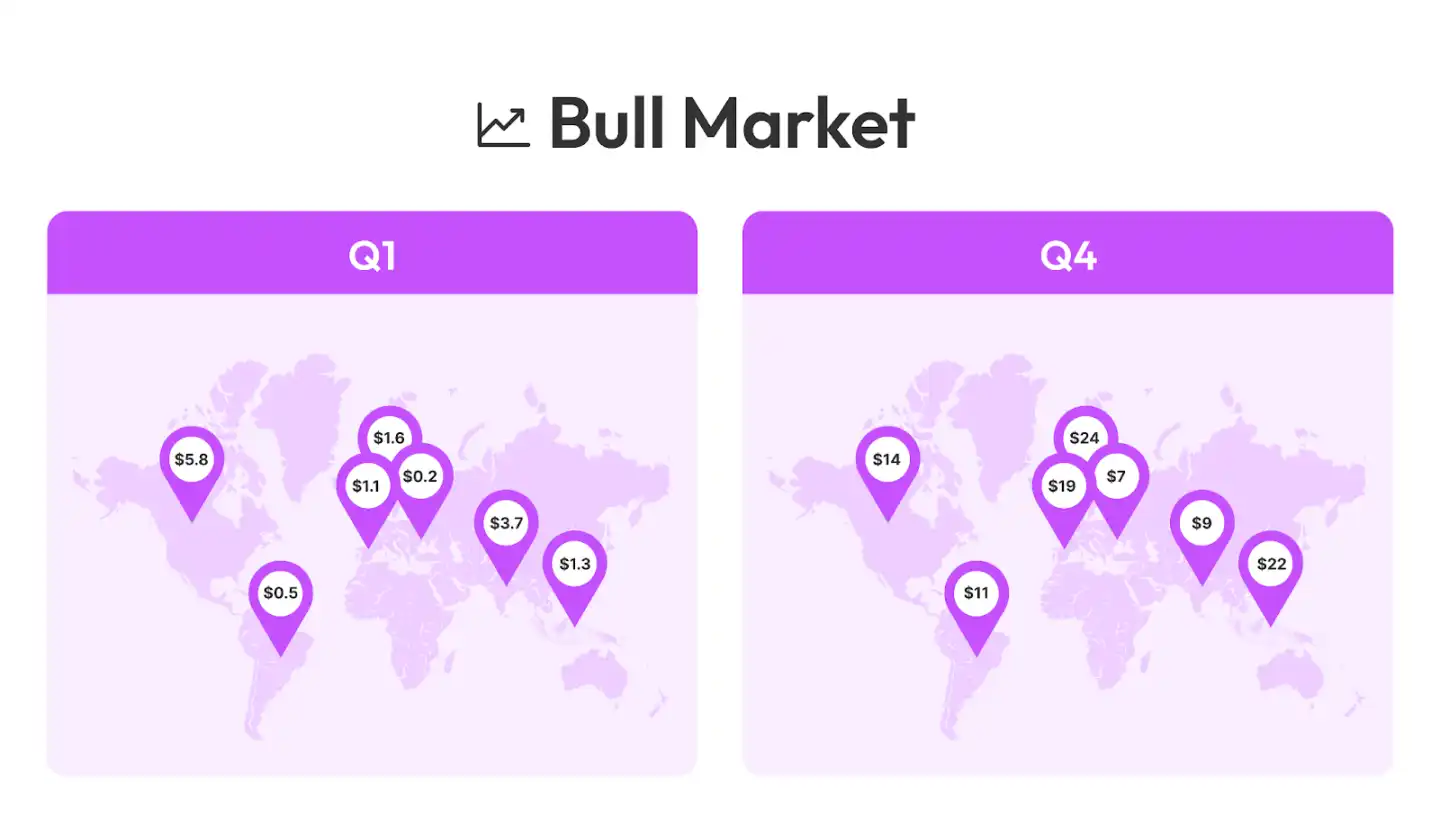
Emerging Markets: Exhibit different risk-return profiles. Under favorable conditions, their Cost Per Wallet (CPW) is extremely low, but cost volatility can be highly pronounced. For example, the Latin America region saw its CPW drop to nearly free at $0.56 in the first quarter, only to surge by 60 times to $34.38 in the third quarter, reflecting sudden liquidity constraints and demand shifts in the region. The Eastern Europe region experienced an even more astonishing spike, with CPW soaring 99 times from $0.21 to $20.79, indicating that costs can sharply rise when market conditions deteriorate.
Southeast Asia Region: Demonstrates the most stable performance across market cycles, with CPW fluctuation within a 5x range, from $3.73 in the first quarter to $16.61 in the third quarter. This stability suggests that local market factors, adoption curves, or advertiser demand may create a more predictable environment, making it a highly attractive region for brands aiming to maintain cost stability under different macro conditions, especially for projects looking to test product usage unaffected by market cycles.
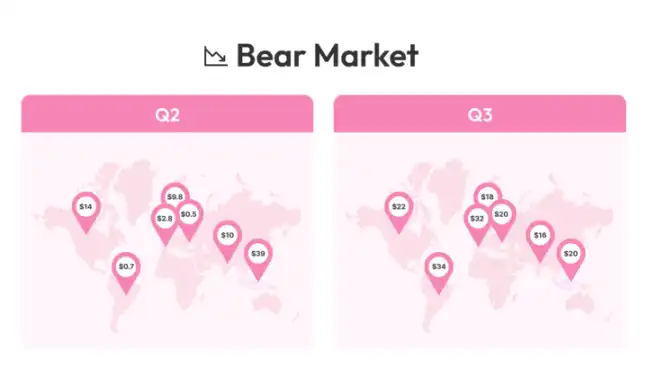
The key point is that market cycles not only impact CPW but also determine when and where attracting wallet holders is truly feasible. While developed regions are highly efficient during bull markets, costs surge in bear markets. Emerging markets offer ultra-low costs but come with significant volatility. The Southeast Asia region, with its relative stability, may have the best long-term potential for brands seeking to reduce risk across different market cycles.
CPW of Top-Performing and Worst-Performing Marketing Campaigns
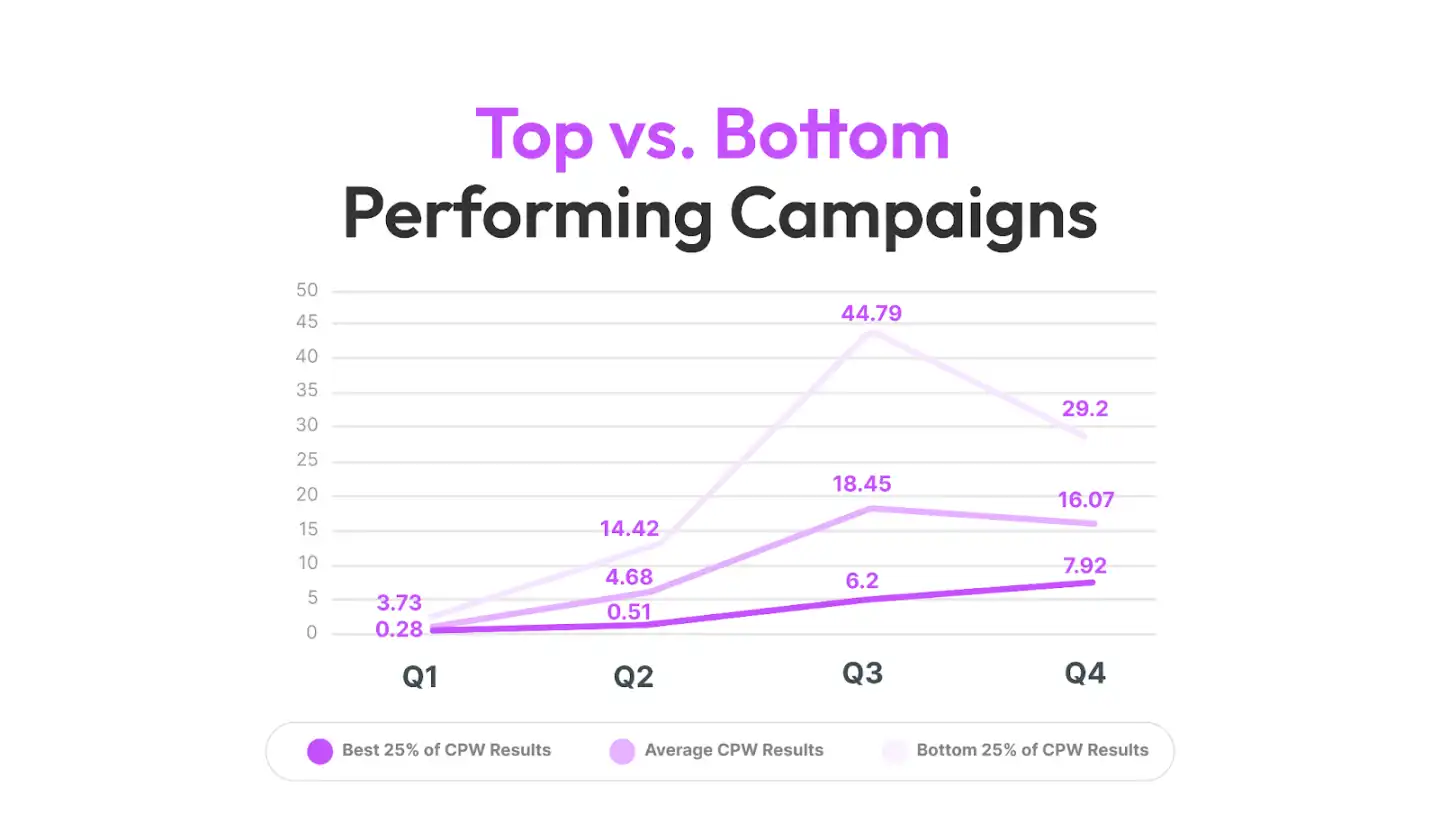
Market cycles are not the sole factor. Top-performing marketing campaigns always maintain a lower CPW, even in bearish market periods. In fact, the top 25% ranked campaigns achieve a customer acquisition cost per wallet of only $6 - $8, even in a bear market cycle, which is remarkable. Meanwhile, poorly performing campaigns see CPW fluctuate between $4.68 and $44.79.
This performance delta can be attributed to Product-Market Fit (PMF), community strength, market momentum, incentive measures, and creative execution. Campaigns that align well with their audience, have optimized messaging, regardless of market conditions, can sustain a manageable CPW.
For those trapped in high CPW marketing campaigns, shifting to low-cost regions is not the only solution. Optimizing target audience positioning, messaging, incentive measures, and creative strategies can increase efficiency, keeping CPW stable across any market.
CPW Segmented by Audience
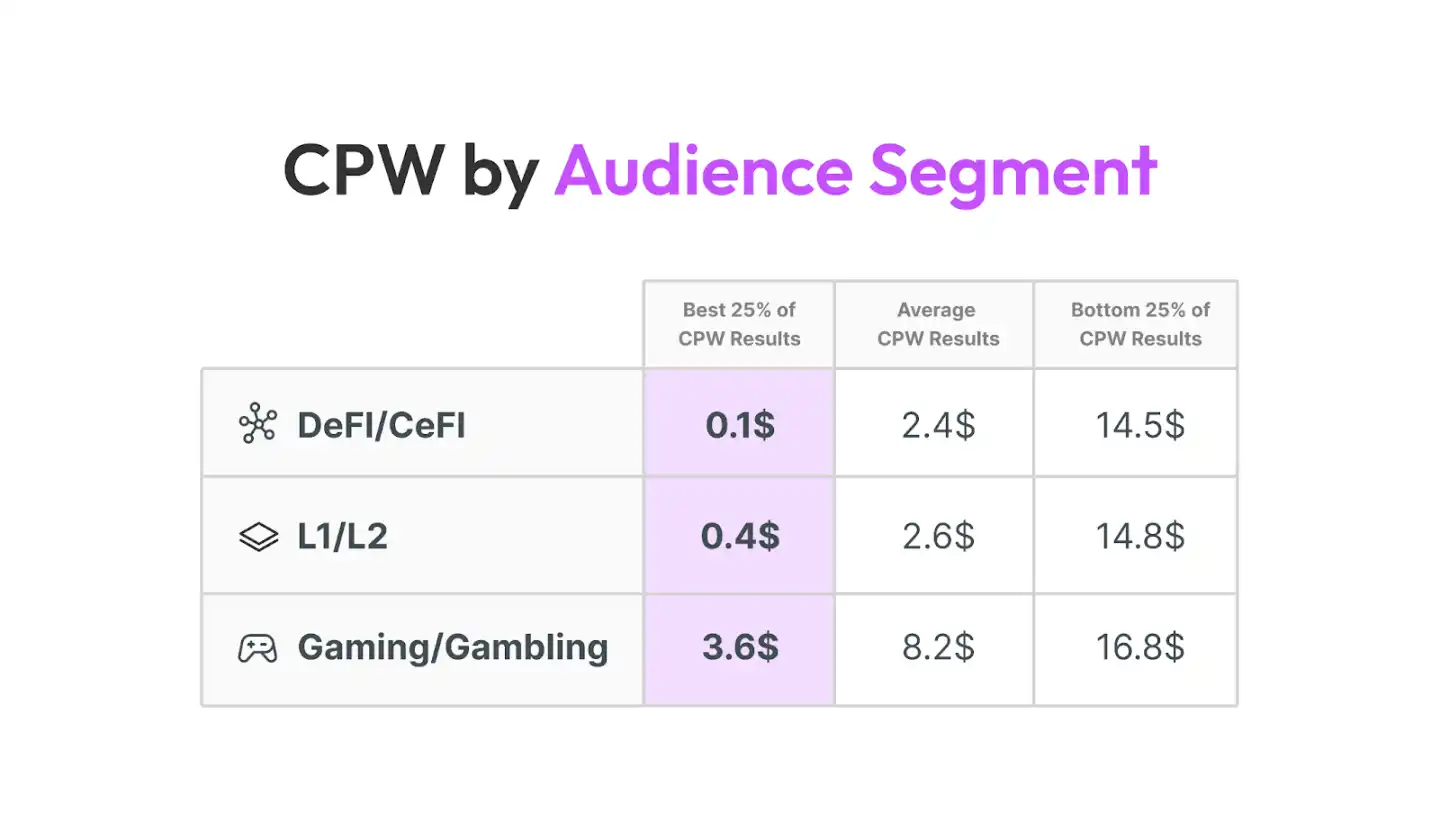
The cost efficiency of Decentralized Finance (DeFi) / Centralized Finance (CeFi) marketing campaigns is highest, with a median CPW of $2.79 and a bottom quartile of only $0.10. L1/L2 projects follow closely, with a median CPW of $3.23, reflecting their higher adoption rates.
Game and Gambling marketing campaigns have the highest cost, with a median CPW of $8.74 and a bottom quartile of $3.40, perhaps due to high user churn, frequent speculation, and intense competition. If Web3 games are indeed "unstoppable," we need to find a more robust user acquisition engine to make them sustainable, akin to Web2 games.
Conclusion: Using CPW as a Web3 Growth Framework
CPW is not solely determined by market cycles but is also influenced by the effectiveness of marketing campaign execution. The top-performing 25% of campaigns can maintain a CPW of $6 to $8 throughout the year, even during market downturns, while poorly performing campaigns see CPWs fluctuate significantly from $4.68 to $44.79. This demonstrates that market conditions are not an excuse; marketing teams that track data, optimize target audience positioning, refine messaging, and incentives are able to outperform market cycles and maintain cost-efficiency irrespective of macro trends.
This also prompts a shift in strategy when launching products. Targeting U.S. whales during a bear market is a costly gamble, leading to unsustainable CPWs. Conversely, starting from regions like Southeast Asia, which are more stable and cost-effective, allows a brand to optimize its product-market fit before expanding to developed markets. Teams that do not adopt this strategy may risk prematurely exhausting their budget before proving market demand and optimizing conversion rates.
Finally, these insights from ad-driven marketing campaigns challenge the notion that Web3 advertising "doesn't work." In fact, these results indicate that ad-driven Web3 growth is measurable, scalable, and not a dead end.
You may also like
What Is Vibe Coding? How AI Is Changing Web3 & Crypto Development
What is vibe coding? Learn how AI coding tools are lowering the barrier to Web3 development and enabling anyone to build crypto applications.

The parent company of the New York Stock Exchange strategically invests in OKX: The intentions behind the $25 billion valuation

WEEX P2P update: Country/region restrictions for ad posting
To improve ad security and matching accuracy, WEEX P2P now allows advertisers to restrict who can trade with their ads based on country or region. Advertisers can select preferred counterparty locations for a safer, smoother trading experience.
I. Overview
When publishing P2P ads, advertisers can now set the following:
Allow only counterparties from selected countries or regions to trade with your ads.
With this feature, you can:
Target specific user groups more precisely.Reduce cross-region trading risks.Improve order matching quality.
II. Applicable scenarios
The following are some common scenarios:
Restrict payment methods: Limit orders to users in your country using supported local banks or wallets.Risk control: Avoid trading with users from high-risk regions.Operational strategy: Tailor ads to specific markets.
III. How to get started
On the ad posting page, find "Trading requirements":
Select "Trade with users from selected countries or regions only".Then select the countries or regions to add to the allowlist.Use the search box to quickly find a country or region.Once your settings are complete, submit the ad to apply the restrictions.
When an advertiser enables the "Country/Region Restriction" feature, users who do not meet the criteria will be blocked when placing an order and will see the following prompt:
If you encounter this issue when placing an order as a regular user, try the following solutions.
Choose another ad: Select ads that do not restrict your country/region, or ads that allow users from your location.Show local ads only: Prioritize ads available in the same country as your identity verification.
IV. Benefits
Compared with ads without country/region restrictions, this feature provides the following improvements.
Aspect
Improvement
Trading security
Reduces abnormal orders and fraud risk
Conversion efficiency
Matches ads with more relevant users
Order completion rate
Reduces failures caused by incompatible payment methods
V. FAQ
Q1: Why are some users not able to place orders on my ad?
A1: Their country or region may not be included in your allowlist.
Q2: Can I select multiple countries or regions when setting the restriction?
A2: Yes, multiple selections are supported.
Q3: Can I edit my published ads?
A3: Yes. You can edit your ad in the "My Ads" list. Changes will take effect immediately after saving.

What are the key highlights of this year's Ethereum's most important upgrade, the Glamsterdam upgrade?

March 6 Key Market Update You Can't Miss! | Alpha Morning Report

Sell Nvidia, Buy Power Plant: 27-Year-Old AI Investor Earns $5 Billion in One Year
The $24 Million Heist Behind It: The Most Dangerous Vulnerability in the Crypto World is Actually Human

Justin Sun Lawsuit Dismissed, BlackRock Bullish on Tokenization, What Is the English-Speaking Community Paying Attention To?

Morning News | NYSE parent company invests in OKX; Morgan Stanley provides $500 million loan to Core Scientific; Western Union partners with Crossmint to launch stablecoin USDPT

These former crypto builders have transitioned to the hottest AI projects globally

Ethereum Overhaul 2026 Blueprint, this time to abandon "gradualism"
What Is OpenClaw? How AI Agents Could Change Crypto Exchange Trading
OpenClaw is a rapidly growing open-source AI agent that can autonomously execute tasks and interact with software, including connecting to crypto exchanges through APIs to analyze markets and automate trading strategies. While this creates new opportunities for smarter trading, it also introduces security and operational risks. Through this article, WEEX aims to help users better understand the potential and risks of AI trading agents so they can explore new technologies while trading more safely and responsibly.
Ethereum 2029 Strawmap Guide: Ultra-Fast Consensus, Native Privacy, and the "Acceleration Variables" Brought by AI

Altcoin ETF Surge: SOL and XRP Inflows Total $23 Million as Institutions Diversify
Key Takeaways Institutional interest in altcoin ETFs is expanding, with SOL and XRP showing significant inflows on March…
Vitalik Drops Ethereum Endgame Bombshell: ETH USD to $3,000?
Key Takeaways Vitalik Buterin introduces the “Sanctuary Tech” manifesto to address Ethereum’s non-financial limitations. A current lack of…
Exclusive: Yuliya Barabash Predicts the Most Regulated Could Be the Biggest Crypto Winners
Key Takeaways The aftermath of FTX and Celsius collapses has ushered a new regulatory era, reshaping the crypto…

iPhone Crypto Wallets Under Threat from State-Grade Malware
Key Takeaways: The Coruna exploit kit exploits 23 iOS vulnerabilities, threatening iPhone users’ crypto wallets. Initially state-level surveillance,…

Bitcoin Nears Two-Year ‘Make-or-Break’ Resistance: Future Implications
Key Takeaways Bitcoin’s price is approaching key resistance levels around $73,000, observed for the first time since early…
What Is Vibe Coding? How AI Is Changing Web3 & Crypto Development
What is vibe coding? Learn how AI coding tools are lowering the barrier to Web3 development and enabling anyone to build crypto applications.
The parent company of the New York Stock Exchange strategically invests in OKX: The intentions behind the $25 billion valuation
WEEX P2P update: Country/region restrictions for ad posting
To improve ad security and matching accuracy, WEEX P2P now allows advertisers to restrict who can trade with their ads based on country or region. Advertisers can select preferred counterparty locations for a safer, smoother trading experience.
I. Overview
When publishing P2P ads, advertisers can now set the following:
Allow only counterparties from selected countries or regions to trade with your ads.
With this feature, you can:
Target specific user groups more precisely.Reduce cross-region trading risks.Improve order matching quality.
II. Applicable scenarios
The following are some common scenarios:
Restrict payment methods: Limit orders to users in your country using supported local banks or wallets.Risk control: Avoid trading with users from high-risk regions.Operational strategy: Tailor ads to specific markets.
III. How to get started
On the ad posting page, find "Trading requirements":
Select "Trade with users from selected countries or regions only".Then select the countries or regions to add to the allowlist.Use the search box to quickly find a country or region.Once your settings are complete, submit the ad to apply the restrictions.
When an advertiser enables the "Country/Region Restriction" feature, users who do not meet the criteria will be blocked when placing an order and will see the following prompt:
If you encounter this issue when placing an order as a regular user, try the following solutions.
Choose another ad: Select ads that do not restrict your country/region, or ads that allow users from your location.Show local ads only: Prioritize ads available in the same country as your identity verification.
IV. Benefits
Compared with ads without country/region restrictions, this feature provides the following improvements.
Aspect
Improvement
Trading security
Reduces abnormal orders and fraud risk
Conversion efficiency
Matches ads with more relevant users
Order completion rate
Reduces failures caused by incompatible payment methods
V. FAQ
Q1: Why are some users not able to place orders on my ad?
A1: Their country or region may not be included in your allowlist.
Q2: Can I select multiple countries or regions when setting the restriction?
A2: Yes, multiple selections are supported.
Q3: Can I edit my published ads?
A3: Yes. You can edit your ad in the "My Ads" list. Changes will take effect immediately after saving.


 App
App