
February Correction: Is the Crypto Market Bottoming Out?





Original Article Title: February 2026 Market Update: Crypto Caught Between Gold & Growth
Original Article Author: Tanay Ved, Coin Metrics
Original Article Translation: Chopper, Foresight News
TL;DR
· In February, due to heightened risk-off sentiment and illiquidity, the correction in crypto assets widened, making the market more susceptible to shocks;
· Market demand weakened, with the Coinbase premium index turning negative, ETF outflows, and slowing stablecoin growth indicating reduced institutional participation;
· Amid valuation adjustment, structural trends continue to advance, with increased tokenization activity and deepening integration of on-chain infrastructure with traditional markets.
The crypto industry in February continued its recent trend, with fundamental developments overshadowed by a lackluster market, leaving assets caught in macro shifts. This article will review the market and on-chain dynamics that shaped the impact on crypto assets in February 2026.
Market Performance
February started with significant volatility. During the sell-off on February 5-6, Bitcoin briefly dropped below $61,000, marking one of the worst year-to-date performances for crypto assets in over a decade. The entire crypto market has been in a continuous pullback from its October 2025 peak: Bitcoin prices have almost halved, while Ethereum and Solana have retraced to levels seen before the approval of spot ETFs in 2024.
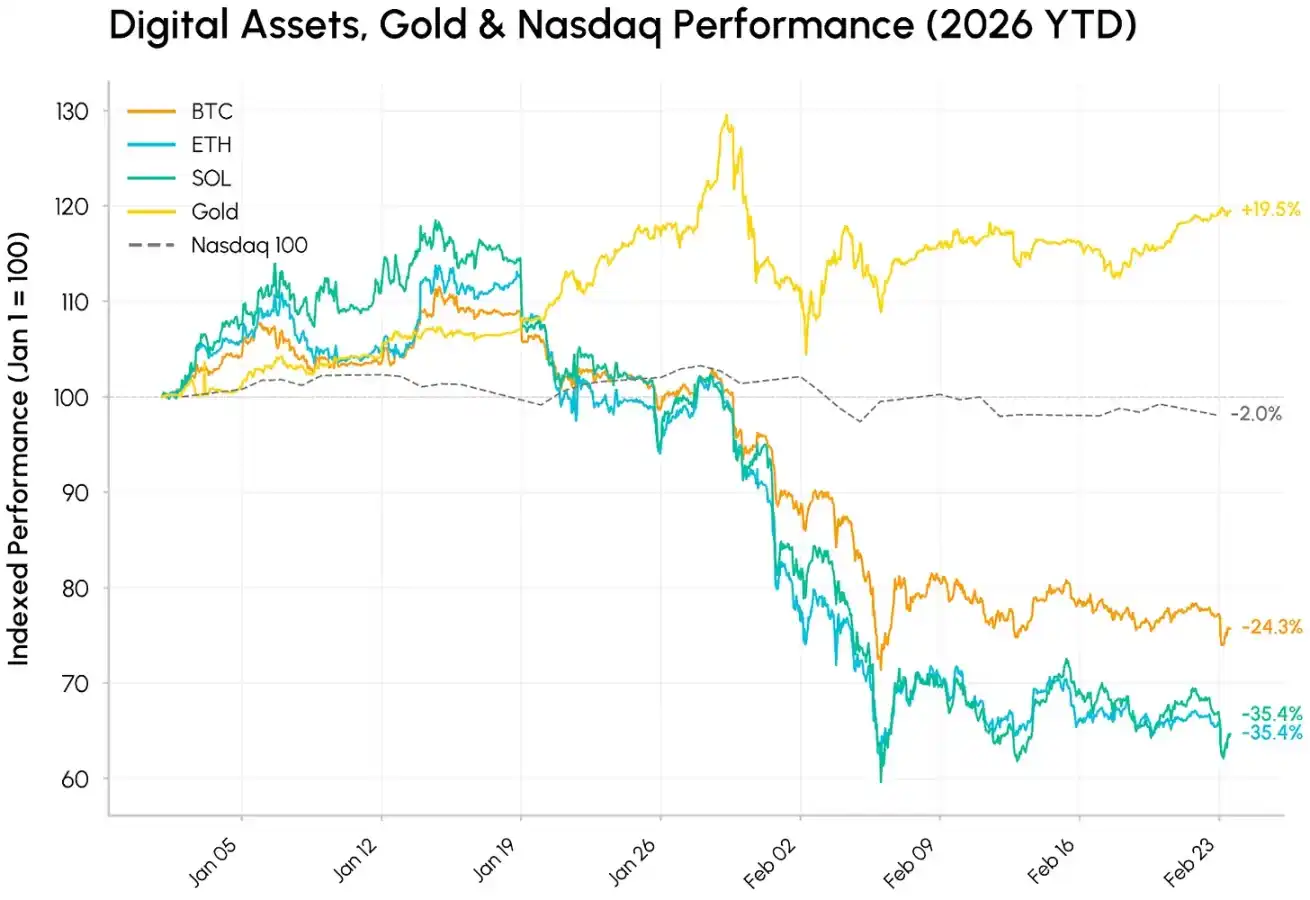
Meanwhile, various asset classes have shown starkly different trends: gold is up 15% year-to-date, benefiting from safe-haven and non-dollar store of value demand amid geopolitical and tariff uncertainties. In a risk-off environment, the trading characteristics of crypto assets more closely resemble high-beta tech stocks, falling alongside growth stocks as the market reacts sharply to the rapid evolution of AI and shock risks.
The weakness in crypto assets appears more like a result of waning risk appetite, low liquidity, and ongoing deleveraging, rather than a fundamental breakdown.
Funds Flow Retreat
Behind the pullback, core demand and liquidity have deteriorated simultaneously. The Coinbase premium index (measuring the BTC/USD spread on Coinbase vs. BTC/USDT on Binance) is a critical gauge of U.S. spot market demand. This index has been consistently negative since November 2025 and deepened further in February, indicating sustained selling pressure and a lack of institutional buying in the U.S. market. The recent premium recovery suggests that the most intense phase of U.S. spot selling may be over, but demand remains subdued.
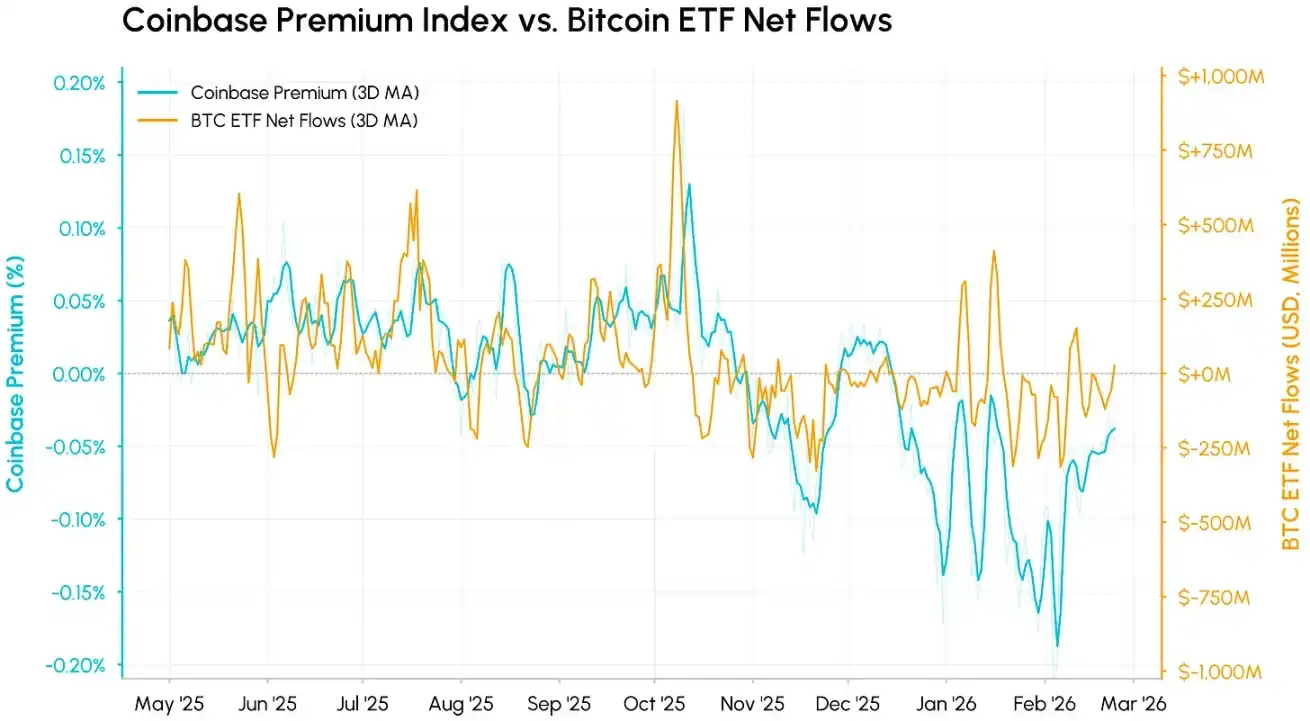
Overlay it with Bitcoin ETF fund flows, and the two are moving almost perfectly in sync. These two metrics measure U.S. institutional demand from different angles and both have recently dropped below the zero line. During each downturn, the premium often decreases before the fund flow, as spot prices react quickly while ETF redemptions take longer to materialize. So far this year, cumulative net outflows from spot Bitcoin ETFs have exceeded $4 billion, reversing much of last year's inflows.
Liquidity Thinness, Volume Volatility
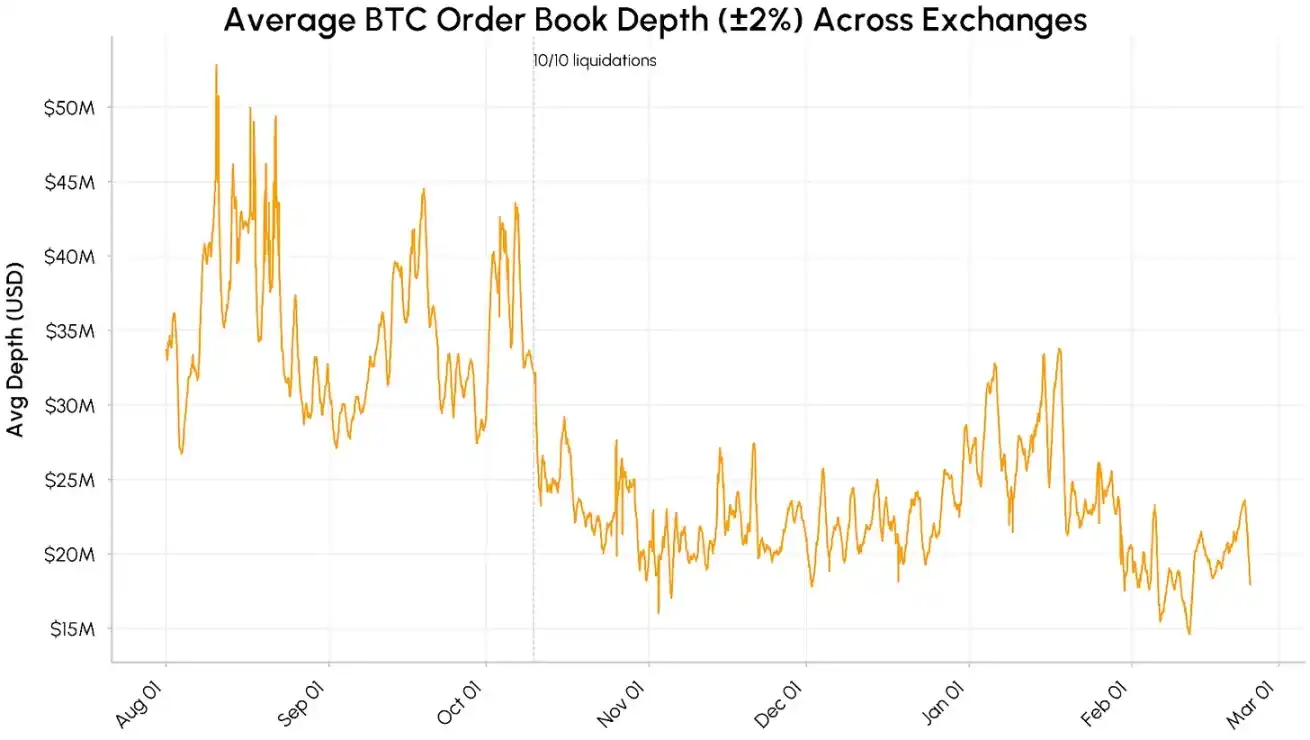
Market liquidity remains fragile. The Bitcoin spot order book depth on major trading platforms (liquidity within a ±2% range) fell from around $40–50 million in August–October 2025 to a range of $15–25 million and has stayed there. In February, liquidity further contracted, directly amplifying price swings.
The growth rate of stablecoin supply has also significantly slowed since December. The total market capitalization of USDT and USDC has hovered around $260 billion, indicating a halt in new capital inflows rather than an overall fund exodus. Overall, a retreat in institutional demand, insufficient order book depth, and slowing stablecoin growth suggest that the conditions for sustained recovery are still incomplete.
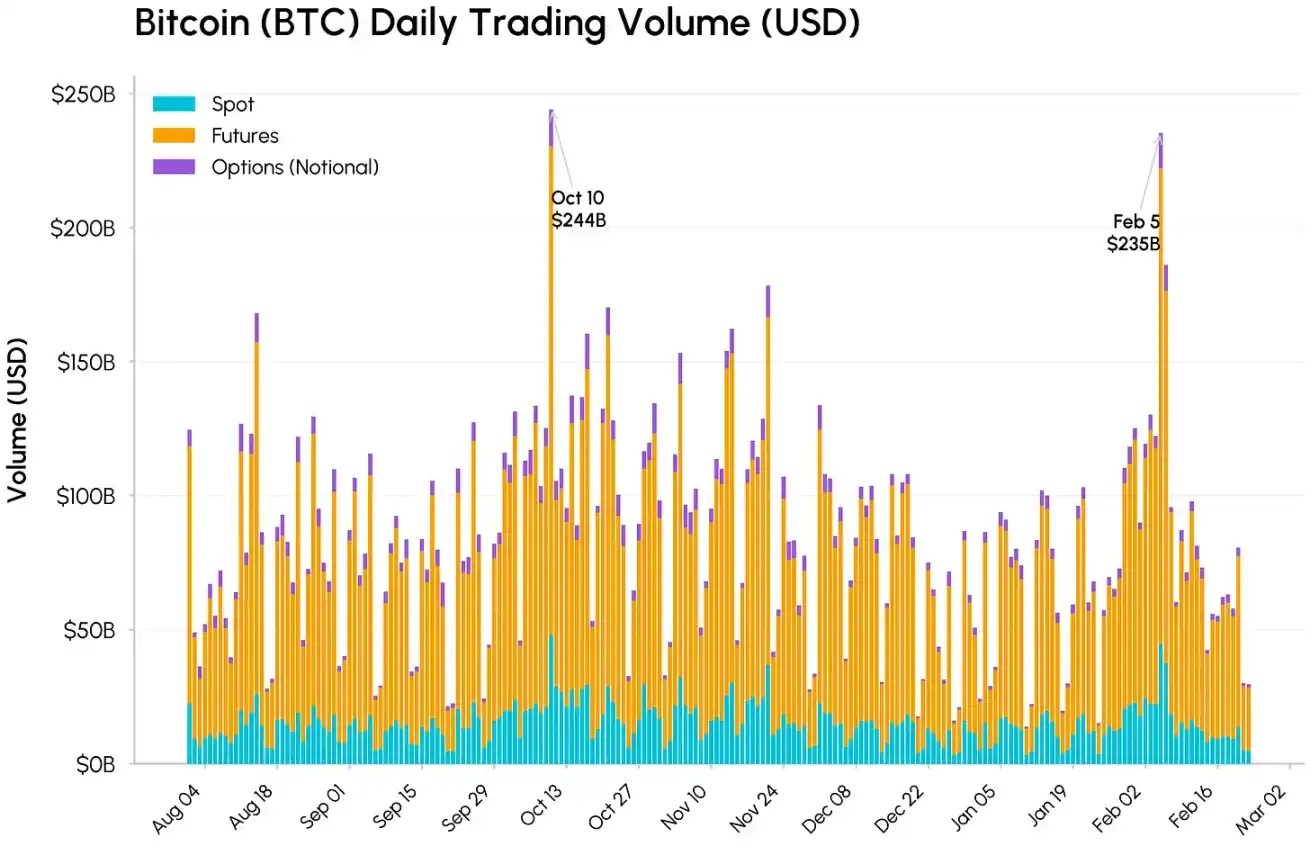
On October 10 and February 5, spot, futures, and options trading volumes all saw significant surges. Bitcoin's total trading volume reached $244 billion and $235 billion, respectively, with futures dominating at $177 billion on February 5. Although the market turbulence is comparable to October, spot trading volume is slightly lower than in October, aligning with intensified price swings caused by low order book liquidity. Historically, this type of high-volume sell-off often coincides with the end of forced selling, indicating that the most intense phase of this downturn may be nearing an end.
RWA Perpetual Contract on Hyperliquid
Meanwhile, the momentum of real-world asset tokenization and the integration of on-chain finance with traditional finance continues to grow. Hyperliquid is one of the main beneficiaries, with its on-chain perpetual contracts expanding from crypto assets to commodities, stocks, the Nasdaq 100 index, and other products.
This expansion is made possible by the HIP-3 protocol upgrade, allowing permissionless creation of perpetual markets for any asset, equipped with built-in oracles and fee structures.
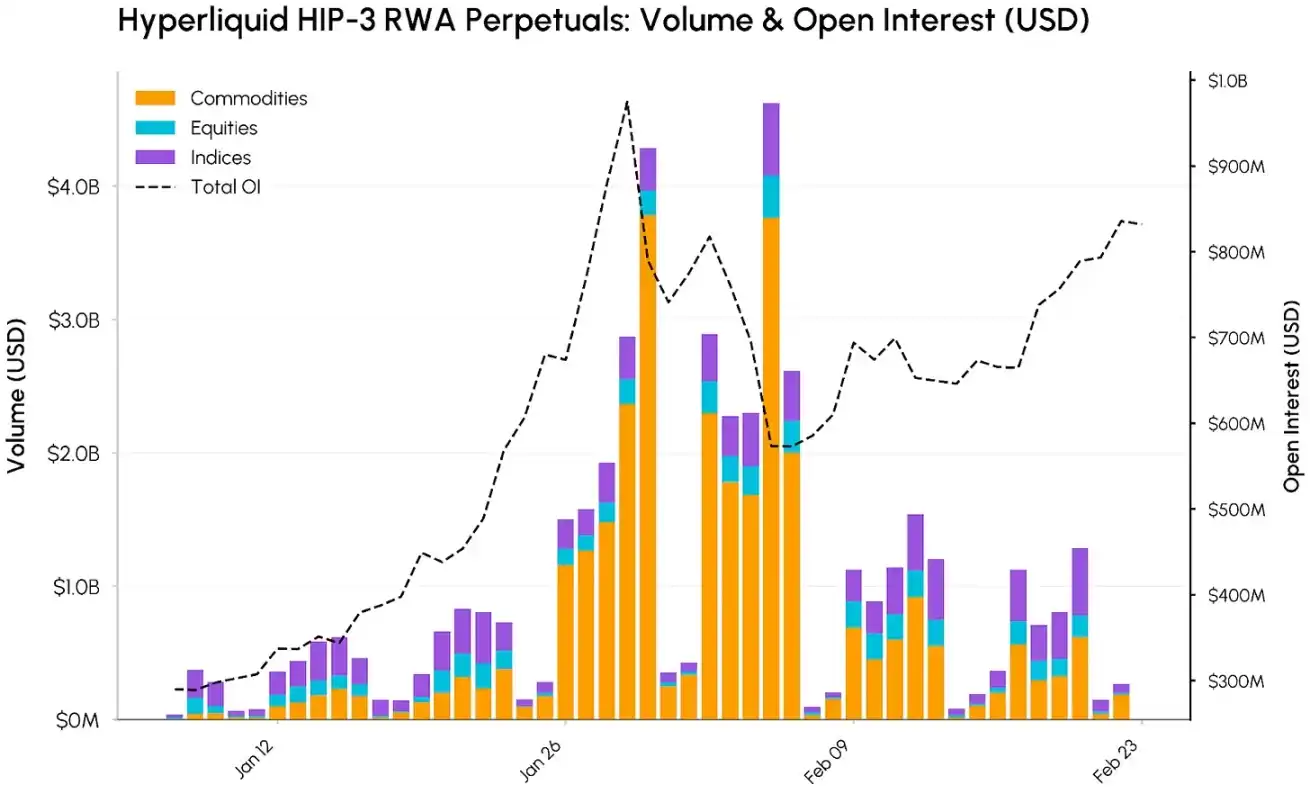
While Bitcoin and Ethereum still dominate the open interest of perpetual contracts, the HIP-3 market share within the platform continues to rise. On February 5, the total volume of HIP-3 perpetual contracts peaked at around $46 billion, mainly driven by commodities, reaching $38 billion in a single day, accumulating over $30 billion since January. Gold and silver performed particularly well, with silver reaching a peak trading volume of $34 billion.
Open Interest (OI) also saw synchronous growth. The total open interest of the HIP-3 market increased from around $2.9 billion in early January to a peak near $9.75 billion on January 29, before falling back to around $8.3 billion by the end of February. This indicates a continued demand in the market for on-chain commodities, stocks, and index exposure.
Bitcoin Enters the "Value Zone"
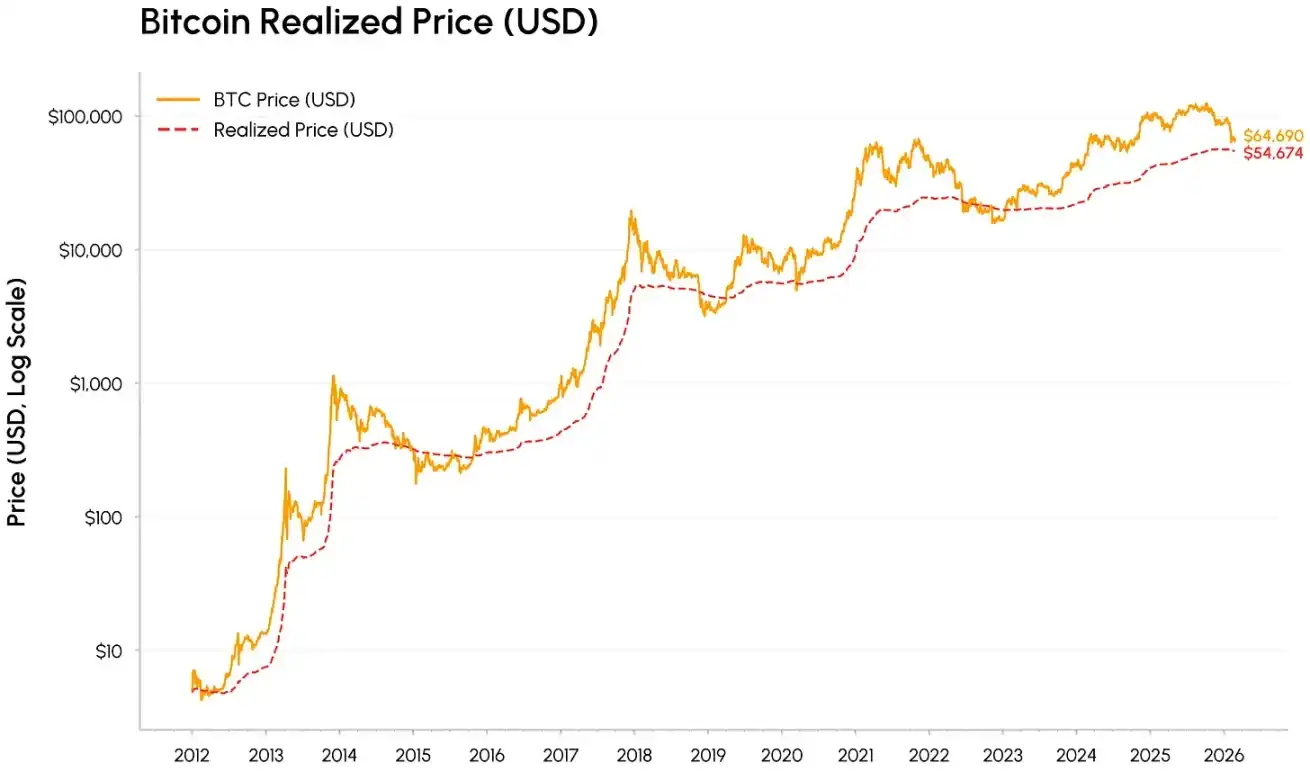
The current Bitcoin drop has approached the realized price (currently around $55,000), which is the average on-chain holding cost of all tokens. During historical cycle lows, Bitcoin often traded near or below the realized price, signaling the market's transition from euphoria to capitulation, eventually entering the accumulation phase.
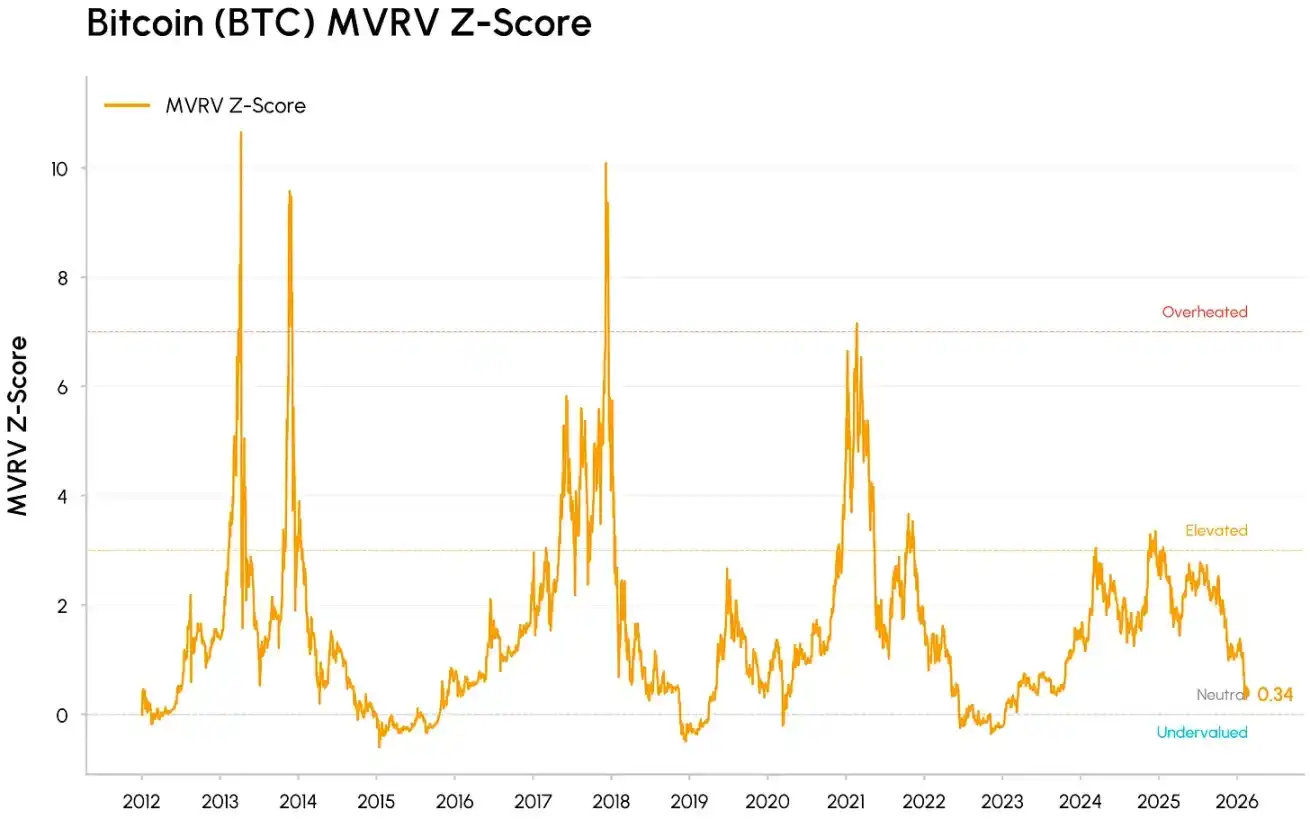
At the same time, valuation metrics such as MVRV (Market Value to Realized Value) have compressed to historical low valuation ranges but have not yet reached the extreme levels seen at the bottoms of previous bear markets. These signals suggest that the market has squeezed out a significant amount of the bubble and is gradually entering the value zone.
Despite the price adjustment, several trends are still driving the integration of crypto assets into mainstream financial infrastructure. Hyperliquid's HIP-3 demonstrates how cryptocurrency trading platforms are increasingly used for trading traditional assets. BlackRock's introduction of its tokenized fund BUIDL on Uniswap, along with Apollo's acquisition of the MORPHO token protocol, also highlights various institutions integrating DeFi liquidity and governance into their workflows.
Simultaneously, leading DeFi protocols like Aave and Uniswap are gradually moving towards a clearer direction of token holder interests and value accrual, transitioning the industry from being purely narrative and governance-driven to a cash flow-based asset approach. On the traditional finance front, CME's launch of 24/7 crypto futures trading, the CFTC's more positive stance on prediction markets, show that regulatory platforms and policymakers are adapting to the round-the-clock structure of the crypto market.
Conclusion
The February pullback appears more like a stress test on funds and liquidity in a risk-off environment rather than a fundamental collapse. Cryptocurrency continues to be traded as a liquidity-sensitive asset tied to growth, but its role in market infrastructure, institutional portfolios, and on-chain integration continues to deepen.
The short-term market may continue to fluctuate, but the progress of the CLARITY Act and the reversal of fund flows will be key catalysts driving whether the demand recovery can be sustained.
You may also like

How TradeXYZ, xStocks, and Alpaca break down the SpaceX IPO into three different strategies

Why Is BlackRock Investing $5 Billion in the SpaceX IPO?

Cryptocurrency market makers collectively seek change as it becomes increasingly difficult to make money

a16z Crypto Partner: Cash flow is the moat

Citibank releases "2030 Asset Tokenization Market Outlook": 6 major trends may create a $8.2 trillion market

The trillion-dollar valuation test: Are the three major super IPOs a celebration for tech stocks or a nightmare for the crypto market?

Morning Report | Digital Asset completes $355 million financing led by a16z Crypto; Meta completes operational separation from Manus
Morning News | CME Group launches Nasdaq Cryptocurrency Index futures; Asset management giant Janus Henderson strategically invests in Ethena

Bitcoin Layer 2 Network Botanix: Why Did We Choose to Dissolve?

Why did Oracle deliver the strongest financial report in history, yet its stock price fell?
When the P2P illicit funds from ten years ago turned into 60,000 bitcoins

Dialogue with OmenX Founder: Why does the prediction market need an evolution from "spot" to "derivatives"?
Galaxy in-depth report: Is Solana still worth paying attention to?

Young people in South Korea make a "final effort" in the epic bull market
The pricing controversy of Trade.xyz exposes the fatal weakness of Pre-IPO perpetual contracts
How much longer can Ethereum's last big buyer hold on?

World Cup 2026 Coming – WEEX Celebrates with $1M Prize Pool & Michael Owen Live

Morning Report | OpenAI has submitted an S-1 registration statement draft to the U.S. SEC; Morpho completes $175 million financing
How TradeXYZ, xStocks, and Alpaca break down the SpaceX IPO into three different strategies
Why Is BlackRock Investing $5 Billion in the SpaceX IPO?
Cryptocurrency market makers collectively seek change as it becomes increasingly difficult to make money
a16z Crypto Partner: Cash flow is the moat
Citibank releases "2030 Asset Tokenization Market Outlook": 6 major trends may create a $8.2 trillion market
The trillion-dollar valuation test: Are the three major super IPOs a celebration for tech stocks or a nightmare for the crypto market?


