

Geopolitical Risk Escalation: US Stocks, Precious Metals Simultaneously 'Turn Tail,' Bitcoin Struggles to Hold $81,000


Original Title: "From Geopolitical Tension to Liquidity Tightening, BTC Dragged into Crisis"
Original Author: Asher, Odaily Planet Daily
Another "Major Plunge" Unfolds
According to market data, from last night to this morning Beijing time, BTC swiftly plummeted from near $88,000, briefly dropping below $81,200, with a more than 7% decrease in 24 hours; ETH fell from a low of $2,940 to $2,690, nearly a 10% drop in 24 hours; SOL retreated from $123 to near $112, with a over 8% decrease in 24 hours. Coinglass data shows that over the past 12 hours, the market saw $1.094 billion in liquidations, with long liquidations amounting to as high as $1.021 billion; nearly 240,000 people were liquidated in the past 24 hours.
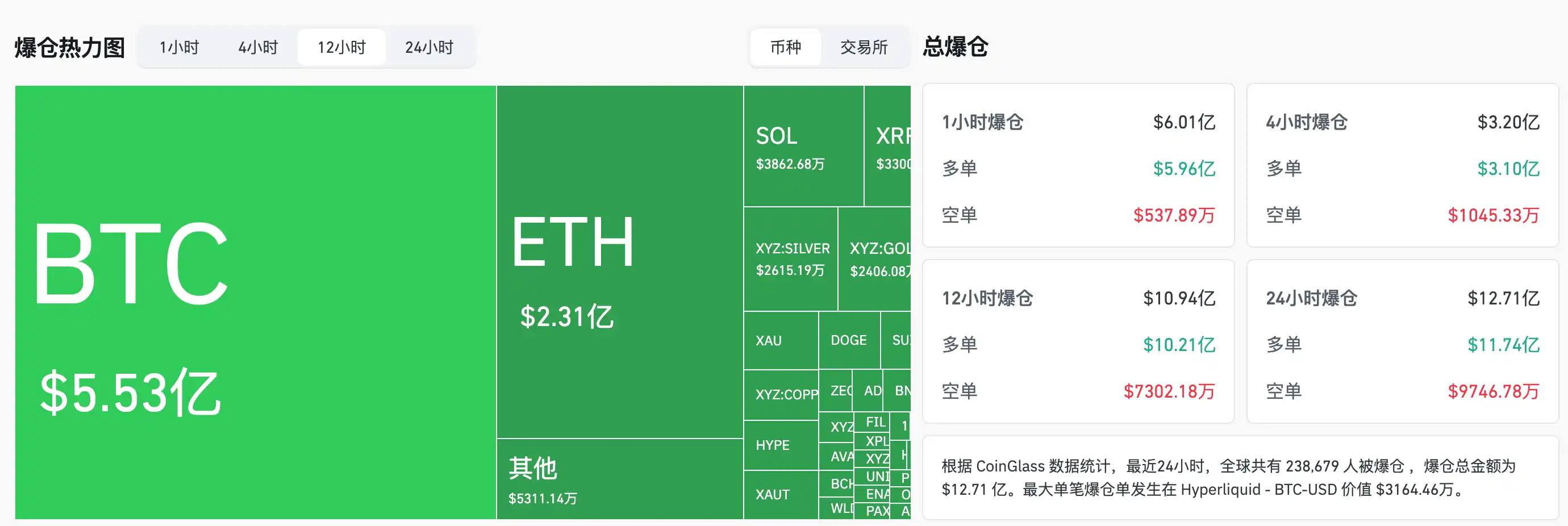
This downturn was not triggered by a single negative catalyst, but rather the result of multiple factors converging and releasing at the same time.
Middle East Tensions Suddenly Spike, Geopolitical Risk Resurfaces in the Market
The sudden escalation of geopolitical tensions was one of the key underlying factors attributed to last night's market decline.
Latest reports indicate that the U.S. aircraft carrier USS Abraham Lincoln and its strike group have entered a state of "all lights out" and communication blackout. This move is typically seen as a standard operational procedure before a major military action, leading the market to speculate that related actions against Iran are entering a highly sensitive phase.
Simultaneously, Iranian statements have also shifted notably towards a war-ready posture. Iranian First Vice President Eshagh Jahangiri, addressing the regional situation, stated that Iran has maintained a state of readiness since the current government took office, will not initiate war, but if conflict arises, it will defend itself resolutely, emphasizing that "the outcome of war will not be decided by the enemy." He pointed out that readiness for a war situation is currently necessary.
Although the situation has not yet escalated into a substantial conflict, this "highly opaque, unverifiable, and unpredictable" state itself is enough to affect market behavior. In an environment where liquidity is already scarce and risk appetite is diminishing, the uncertainty of geopolitics was quickly factored into prices, prompting funds to reduce directional exposure and opt for lower volatility assets.
FOMC "Hawkish Landing," Liquidity Expectations Repriced
The downturn in the crypto market is still inseparable from the Fed.
At the January FOMC meeting, the Fed kept the benchmark interest rate unchanged in the 3.50% to 3.75% range and emphasized in its statement that the unemployment rate had stabilized and inflation remained at a relatively high level. The Fed's stance did not significantly exceed market expectations but emotionally achieved a "anticipated conclusion" — the vague fantasy that the market previously held of a short-term rate cut or even a policy shift was formally compressed or even eliminated.
For risk assets, such moments often do not appear as a "new bearish factor" but rather as a manifestation of "the good news can no longer be further leveraged." Since 2025, Bitcoin has experienced pullbacks after several FOMC meetings, precisely due to this repeated interpretation of the mechanism: it is not that the policy suddenly turns hawkish, but rather that the market has to acknowledge that liquidity will not arrive early as expected.
When positions are already stacked, leverage is high, the confirmation of this "shoe dropping" is enough to trigger risk release — it is not the first domino falling, but rather causing all the already shaky structures to simultaneously lose support.
It's Not Just the Crypto Market in Decline, US Stocks and Precious Metals Are Also "Changing Faces"
What is even more alarming is that this decline is not a solo act by the crypto market.
On the US stock side, the stock index's decline has become a crucial signal of the market's weakening risk appetite. The Nasdaq 100 Index fell by about 1.6%, the S&P 500 Index by about 0.75%, and the Dow Jones Industrial Average also fell by about 0.2%. All three major indices are under pressure, with the tech sector particularly showing weakness, dragging down the overall market's risk appetite.
At the same time, the precious metals market, originally seen as "safe-haven assets," also experienced intense volatility. After a recent strong rally, the price of gold saw a sharp pullback last night, with clear profit-taking in the market. Silver also quickly retreated from its high, with a significant drop. This indicates that funds are not simply switching from risk assets to safe-haven assets but are overall reducing risk exposure in a high-volatility environment.
When stocks are falling, crypto assets are under pressure, and precious metals are simultaneously pulling back, the signals that the market is releasing are quite clear. Funds are reducing exposure across multiple asset classes, and overall risk appetite is quickly contracting.
In such an environment, Bitcoin naturally finds it challenging to stand alone. It is neither genuinely seen by the market as a safe-haven asset nor, due to its high volatility, is often the first to be sold off when sentiment shifts to risk aversion.
ETF Continuous Outflows Have Significantly Reduced the Crypto Market's Absorption Capacity
The change in funding provided the final piece of the puzzle for this round of decline.
From the data of the Bitcoin spot ETF, funds are continuously flowing out. The data shows that just in the past week, the BTC spot ETF has experienced continuous net outflows, with single-day outflows reaching over one billion U.S. dollars for multiple days, and the total net outflow has exceeded $1 billion.
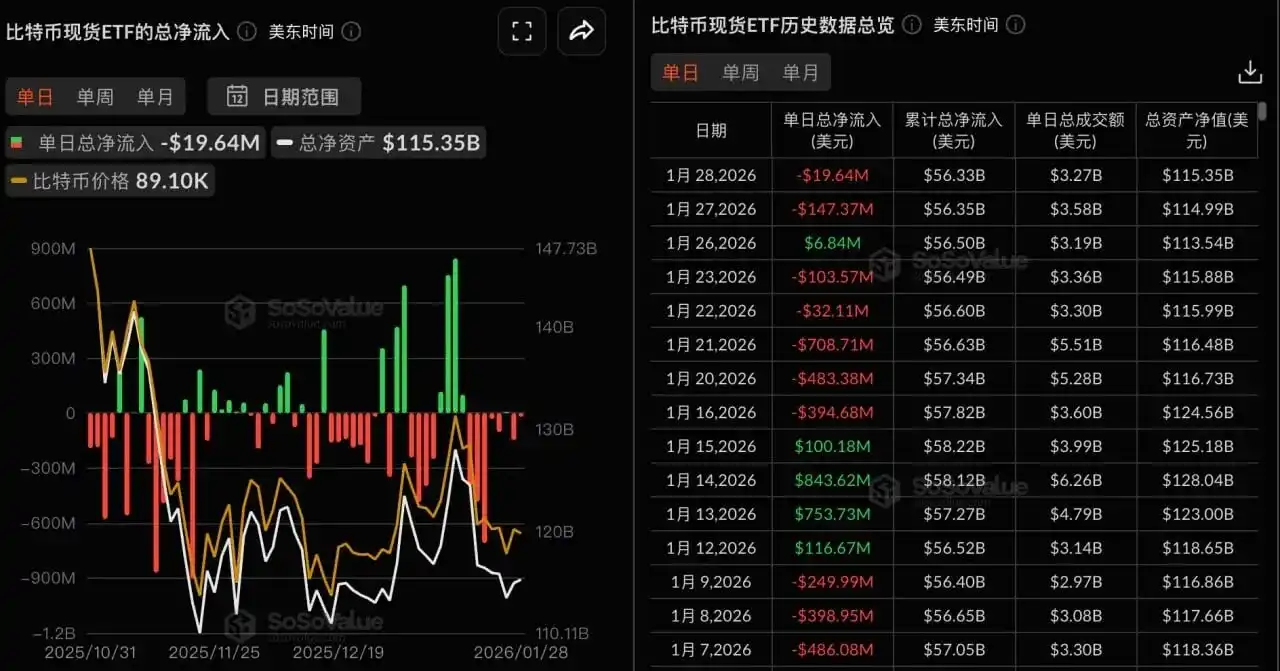
More importantly, the ETF fund outflow is not a one-time event, but a continuous, multi-day, trend-following reduction. This means that institutional funds have not chosen to "buy the dip" during the pullback, but are more inclined to reduce overall risk exposure, waiting for clearer macro and market signals.
In this funding environment, the market did not have a "cushion". When the price went down, the ETF did not provide sustained buying pressure, and the market relied more on existing funds to absorb selling pressure. Once key price levels were breached, selling quickly took over, with buying interest significantly subdued, forcing the price to rapidly search for a new balance through sharp declines.
Not a Black Swan Event, but a Concentrated Release of "Forced De-risking"
The essence of BTC's decline this time is not triggered by a sudden unexpected negative event, but is the result of the market's overall repricing of risk assets under the accumulation of multiple risk factors. Geopolitical uncertainty escalating, macro liquidity expectations being revised, against the backdrop of continued net outflows from the ETF, the crypto market lacked a stable structural support, ultimately triggering a proactive "braking" behavior in the market.
When long-term funds and passive buying interest are lacking, the market often breaks through key trend levels downward, forcing trend-following strategies and leveraged funds to passively exit, completing the first stage of risk reduction. In this process, Bitcoin fell below the highly watched 100-week moving average (near $85,000), a level that has repeatedly served as a "safety net" during corrections since last year, and is also a key defense line for many trend models and leveraged positions.
In conclusion, the current market has completed the first round of rapid deleveraging and emotional cleansing, but true stabilization still depends on two conditions: whether key technical levels can be regained and held, and whether risk capital is willing to re-enter the market for pricing. Before this happens, high volatility and low confidence may still characterize the stage.
You may also like

The arrival of the Web 3.0 era: A review of Hong Kong court rulings on digital assets

Track Markets At a Glance: New WEEX Price Widgets for iOS & Android
To streamline your market data access, WEEX has officially launched "Market Watchlist" desktop widgets

The billion-dollar lesson: The focus of DeFi security is shifting from code to operational governance

A Brief Analysis of Stablecoin Licenses and On-Chain Funding
BVNK Founder: Three Stages of Stablecoin Development

The truth about Trump's son's Bitcoin game: he made a staggering $100 million while retail investors lost $500 million

What Is Futures Trading? Hours, Platforms, and How to Start Trade Futures(2026 Guide)
Learn how to start futures trading, understand trading hours, and choose the best futures trading platform. Includes real data, strategies, and ways to maximize returns with rebates.

The Rise of Composable RWA

MAGA Up 350% in 24 Hours, PEPE Up 46% in One Day: Which Memecoins Are Next in 2026?
MAGA +350% in 24hrs. PEPE +46% in one day. RAVE +4,500% then -90%. In 2026's memecoin market, the gains are real. So are the traps? Here's how to tell the difference before you buy.

RCD Espanyol vs Real Madrid: Can the Pericos Delay the Inevitable?
RCD Espanyol vs Real Madrid lineups, standings, and stats for May 3, 2026. Real Madrid visits RCDE Stadium as Barcelona closes in on the LALIGA title. Full preview inside.
MegaETH goes live with an FDV exceeding 2 billion USD. Which ecological projects are worth paying attention to?

Dialogue with "Wood Sister" Cathie Wood: The next bull market is about to arrive
Can prediction markets win the competition for perpetual contracts?

Who is trading on Trade.xyz?

Binance quietly placed a bet on a leading large model company

Best Crypto Discord Server 2026: Why Jacob’s Crypto Clan Is Gaining Massive Attention
Jacob’s Crypto Clan has grown into one of the most active crypto Discord communities, with over 45K members and continuing to expand. This rapid growth reflects strong demand for structured trading insights and real-time collaboration.

Tom Lee Buying ETH: Why Wall Street’s Loudest Ethereum Bull Keeps Doubling Down
Tom Lee keeps buying ETH through every dip, every drawdown, and every moment of market doubt. Inside the strategy that's turning Ethereum into a treasury asset — and what it signals for the rest of the market.

Stripe Sessions 2026: AI Agent, Global Payments, and Invisible Crypto Infrastructure
The arrival of the Web 3.0 era: A review of Hong Kong court rulings on digital assets
Track Markets At a Glance: New WEEX Price Widgets for iOS & Android
To streamline your market data access, WEEX has officially launched "Market Watchlist" desktop widgets
The billion-dollar lesson: The focus of DeFi security is shifting from code to operational governance
A Brief Analysis of Stablecoin Licenses and On-Chain Funding
BVNK Founder: Three Stages of Stablecoin Development
The truth about Trump's son's Bitcoin game: he made a staggering $100 million while retail investors lost $500 million

Contents
Popular coins
Latest Crypto News


