

Giannis Antetokounmpo's Investment in Kalshi Sparks Outrage: Idol Crossover or Insider Trading Scheme?


Original Title: "After a $23.3 Million Bet on His Stay or Departure, Why Did NBA Star Giannis Antetokounmpo’s Investment in Kalshi Spark Outrage?"
Original Author: Zen, PANews
At 4 a.m. Beijing time on February 6, the most tumultuous NBA trade deadline in history finally came to a close. Amidst a flurry of dizzying trade news, the most anticipated big fish in free agency—the Milwaukee Bucks' star player, "The Greek Freak," ultimately, after two months of trade rumors and back-and-forth, chose to stay with his home team.
Simultaneously, the prediction market platform Kalshi saw its contract regarding "The Greek Freak's Stay or Departure” event begin its settlement phase. This contract had a total trading volume of over $23.3 million, making it the highest-volume NBA single-event contract apart from the "NBA Championship Winner".
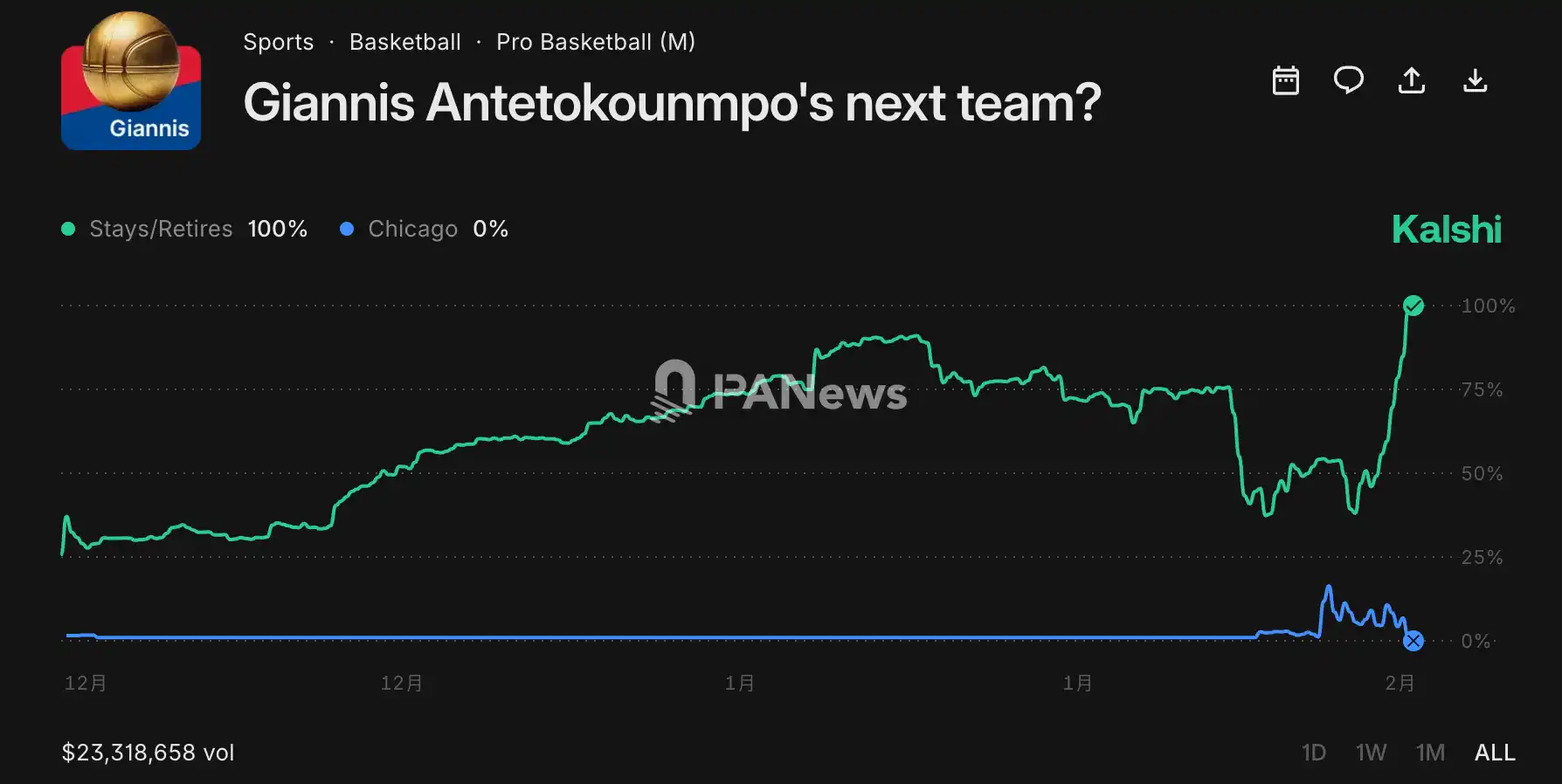
Just when people thought the trade deadline had passed and "The Greek Freak's" saga could finally come to a close, he unexpectedly proceeded to "take his talents to Kalshi," transforming into a shareholder of the platform. After gaining prolonged exposure through trade rumors, he ultimately signed a commercial partnership deal amidst much fanfare. This behavior has stirred discontent among many fans.
In a way, this is akin to another top NBA star, LeBron James, solemnly teasing before the start of last season that he would announce "Decision 2.0," mimicking a retirement announcement only to reveal, "I'm taking my talents to Tequila" in an advertisement laden with teasing fan implications.
However, more than James endorsing Tequila, for "The Greek Freak," what's even more controversial is his collaboration with Kalshi, seen by many fans as an "alternative betting platform." This collaboration raises concerns not just about advertising exposure and brand PR but more so about sports ethics, competitive fairness, and conflicts of interest.
The Greek Freak and Kalshi's Resonant Journey: From Underdog to Apex
The real name of "The Greek Freak" is Giannis Antetokounmpo. His Chinese nickname originated due to his long name with too many letters, leading the sports community to bestow upon him the title of "The Greek Freak" or simply "The Alphabet," and it gradually caught on.
In the NBA arena, there is never a shortage of inspirational stories, and "The Greek Freak's" rags-to-riches tale is a dramatic and legendary exemplar. Born in Greece to Nigerian undocumented immigrants, due to Greece's jus sanguinis principle, growing up in a family without legal documents or work permits, he couldn't obtain Greek citizenship. His parents struggled every day to make ends meet for him and his five siblings.
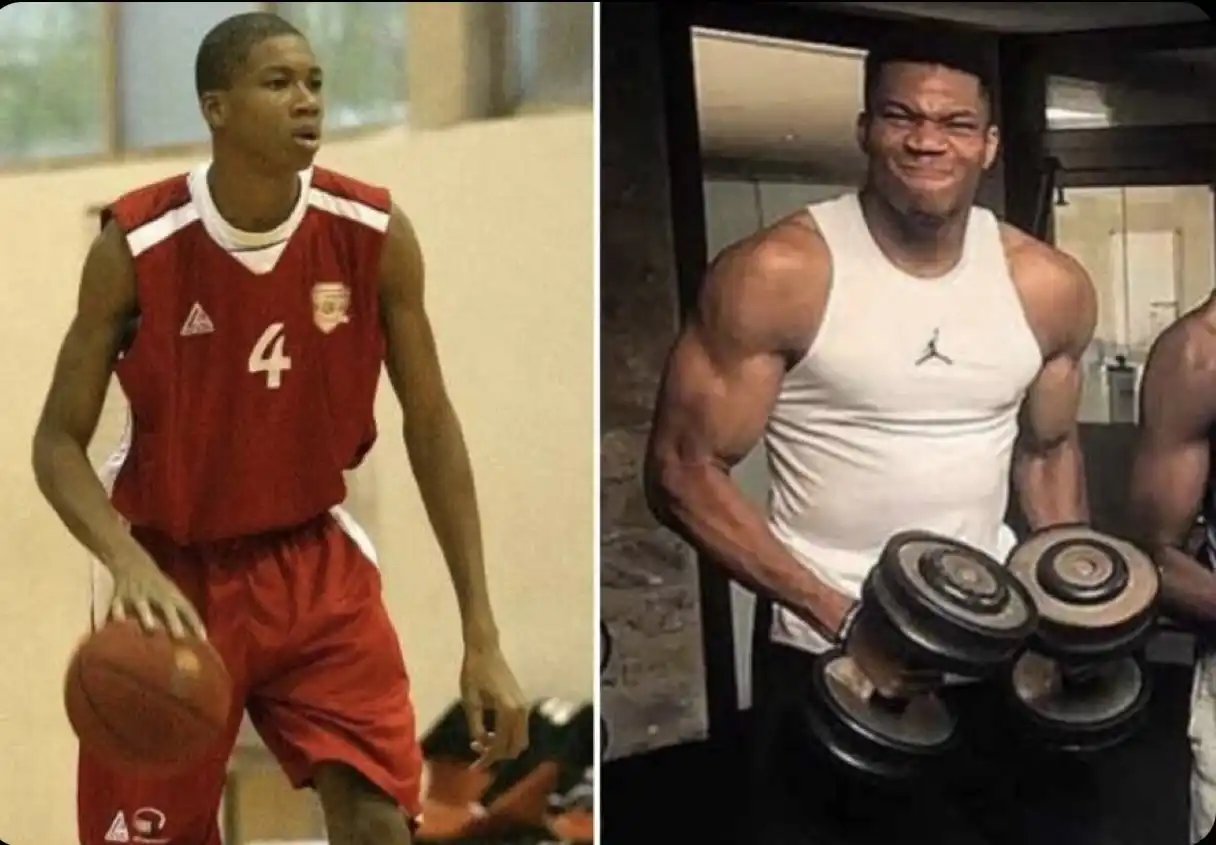
At the age of 13, the tall and athletically gifted Young Alphabet started learning basketball. Through hard work and extraordinary talent, Alphabet Boy became one of Europe's brightest basketball prospects by the age of 18. He attracted the attention of several top European clubs and later garnered significant interest from NBA scouts.
As Alphabet Boy prepared to go to the United States for the 2013 NBA Draft, he was actually in a "blackout" status. After a series of meetings between his agent, the Greek government, and strong advocacy from the then Minister of Sports, Giannis Ioannidis, on May 9, 2013, Alphabet Boy was granted Greek citizenship. On June 27, he was selected by the Milwaukee Bucks with the 15th overall pick in the first round, smoothly transitioning to the NBA.
Alphabet Boy's life philosophy, in his own words, is that "the spirit of relentless effort is most important." After entering the NBA, Alphabet Boy, through persistent effort and a spirit of continuous improvement, transformed step by step into an All-Star and a superstar. Starting in 2019, he has been a strong contender for the league's top player. Today, he holds two MVP trophies, led the Bucks to their first NBA championship since 1971, won the NBA Finals MVP, and has received numerous honors such as All-NBA Team selections and All-Star appearances.
From an unremarkable background to a rise to the top, the Kalshi platform has had a similar experience. Founded in 2018, Kalshi went through six years of obscurity, exploration, and struggle before finally shedding its non-compliant "blackout" status and gaining approval from the Commodity Futures Trading Commission (CFTC) to become a regulated trading platform.
Kalshi platform's "struggle experience" bears some resemblance to Alphabet Boy's personal journey of striving, perhaps making it one of the reasons why the two sides could collaborate.
The NBA's embrace of sports betting opened Pandora's Box
Alphabet Boy is the first NBA star publicly associated with Kalshi, but not the league's first public figure to venture into the prediction market.
In November 2025, the NBA conducted a review of a startup called Mojo Interactive Inc. entering the prediction market because the company's founders were Mark Loll, a shareholder of the Minnesota Timberwolves, and Alex Rodriguez. According to Mojo's CEO, Vineet Barala, the company began trading contracts related to sports events during last year's NFL season but had not engaged in trades related to NBA games.
Regarding this matter, an NBA spokesperson stated that the league is aware that two Timberwolves owners hold minority stakes in Mojo but are not involved in the company's day-to-day operations. "We are reviewing this arrangement to verify its compliance with the league's relevant regulations." At the same time, he also emphasized that NBA teams and league personnel are prohibited from trading NBA or WNBA contracts on any prediction market platform.
When it comes to team owners holding shares in gambling companies, NBA management is more lenient, as long as they do not directly oversee operations related to NBA betting. For example, Dallas Mavericks owner Mark Cuban is the President and CEO of the globally renowned casino and resort operating group Las Vegas Sands Corporation. The two Timberwolves owners have also assured the NBA that they fully comply with the league's established policies. While they demonstrate the legitimacy of their business, they also reveal that Pandora's box has been opened.
"The internet is full of various comments, and I have decided to speak out... Today, I joined Kalshi as a shareholder." Now, Giannis's joining statement has further muddled the relationship between the NBA and the prediction market. Among global sports leagues, the NBA is the most proactive in commercializing gambling partnerships, willing to embrace incremental revenue and more willing to manage risks with compliance terms.
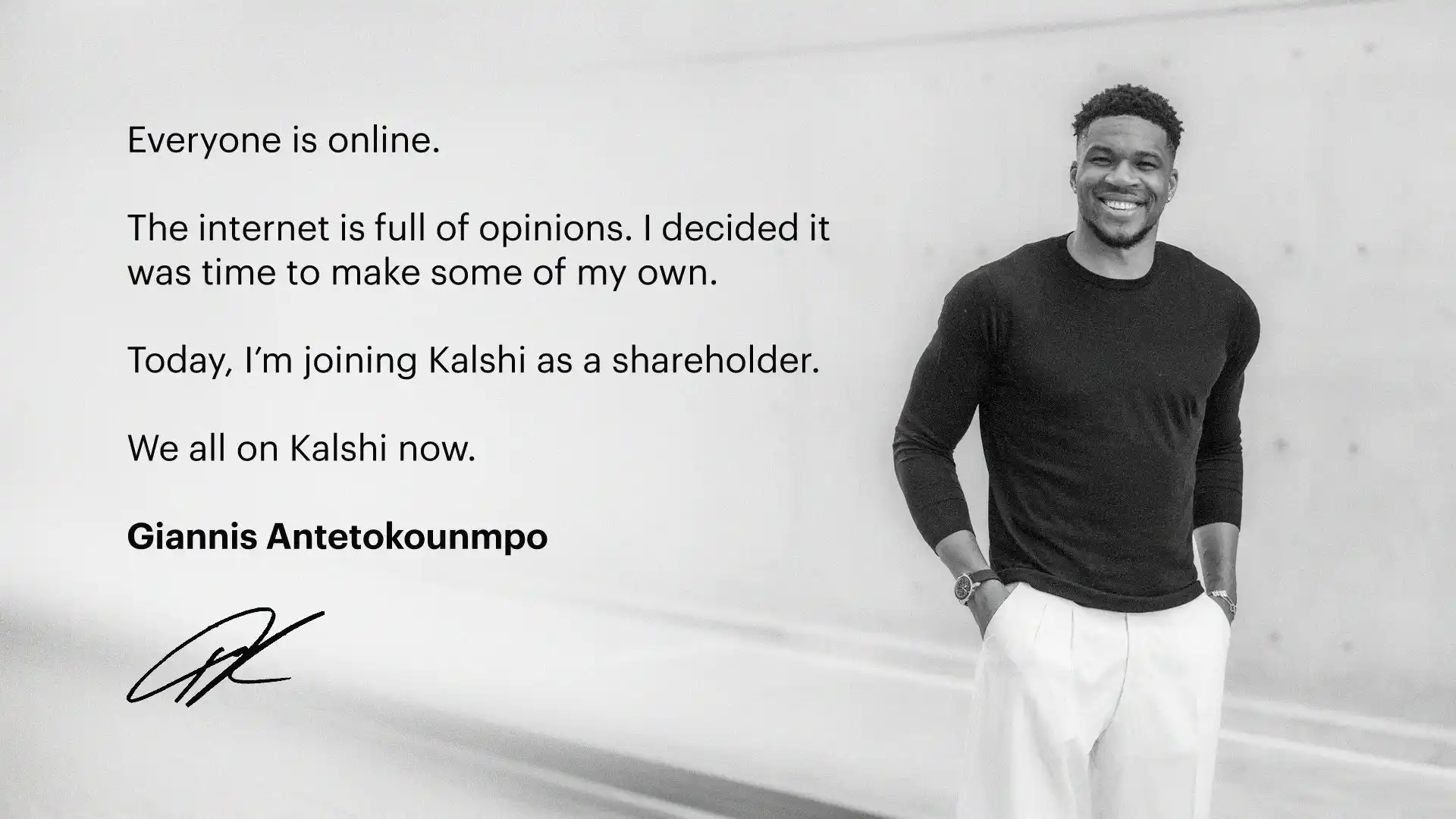
From a regulatory perspective, since the NBA signed a new version of the CBA with the Players Association in 2023, NBA players' business opportunities have become more extensive and flexible. The league even allows NBA players to engage in sports betting and entertainment marijuana businesses, with the only restrictions being that the "investment is passive" and "the player's stake does not exceed 1% of the gambling company" (50% for marijuana brands).
Therefore, setting aside the debate on whether a prediction platform qualifies as gambling, even if it falls under the realm of gambling, the partnership between Giannis and Kalshi does not violate league rules. This is also why a Kalshi spokesperson only disclosed that Giannis's ownership stake does not exceed the 1% threshold, without revealing specific ownership data. Prior to Giannis, LeBron had partnered with the gambling company DraftKings in 2024, serving as a brand ambassador for NFL and some non-NBA events. However, LeBron's involvement remained at the brand ambassador level and did not match the depth of Giannis's collaboration.
In contrast, the NFL, also a top-tier sports league, has taken a stricter stance on similar partnerships. Giannis's signing has raised suspicions about whether NFL athletes will follow suit. In response, an NFL spokesperson stated that league players are not allowed to own shares in prediction market companies.
The Era of Prediction and Gambling: How Fairness, Ethics, and Trust Are Making a Comeback
As soon as the news broke that Giannis had become a shareholder in Kalshi, social media exploded. The fan base that truly cares about Giannis found itself more on the opposing side, questioning how much money is enough for a billionaire to think this move is worthwhile.
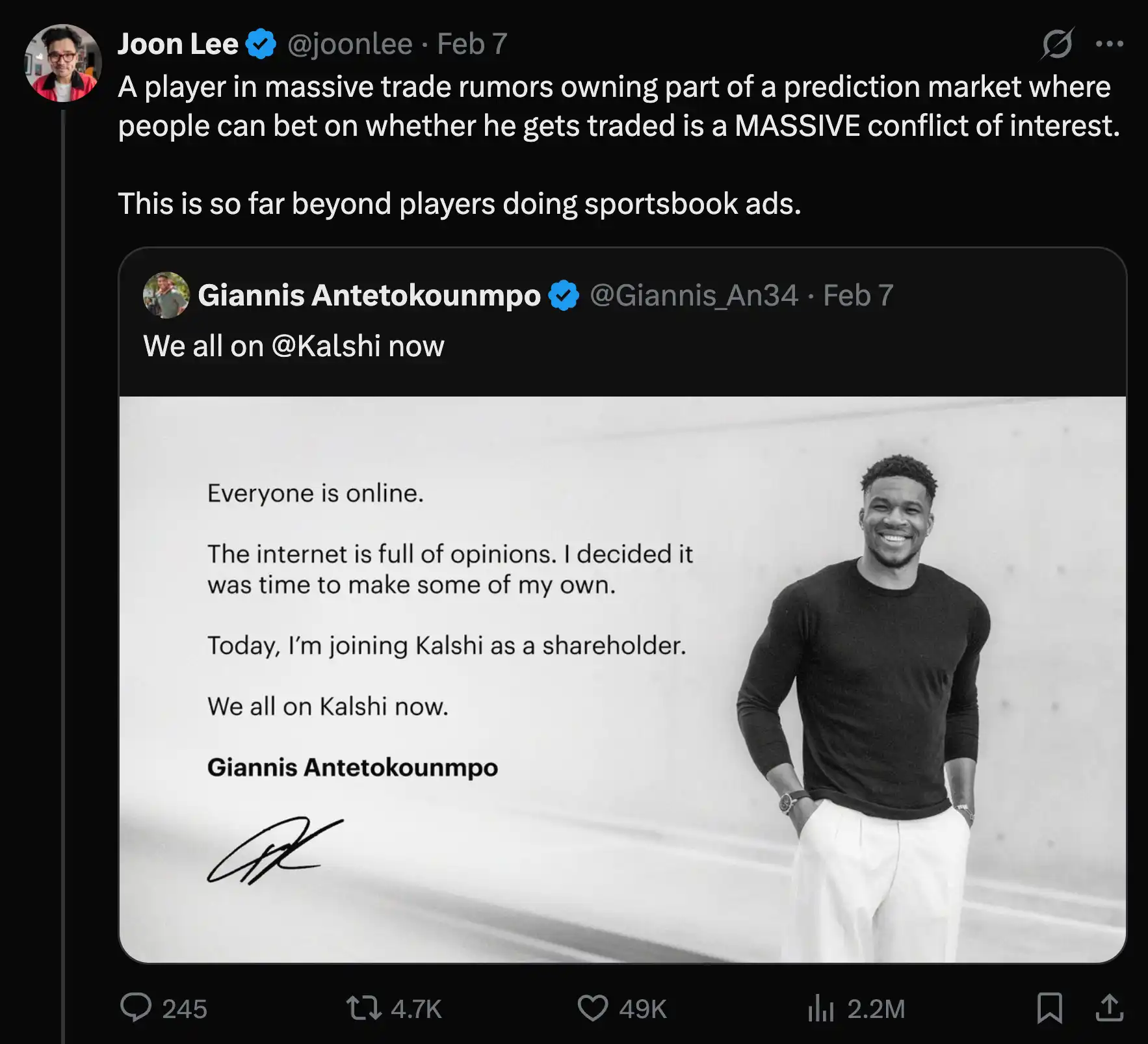
"A player involved in a large-scale trade rumor actually owning a stake in a prediction market where people can bet on whether he will be traded creates a massive conflict of interest," independent sports journalist Joon Lee said, suggesting that this collaboration goes far beyond a player endorsing a sports betting company. He also unexpectedly discovered in a Barron's report that Kevin Durant also appears to be an investor in Kalshi.
Previously, fans had seen more of endorsement-type collaborations, which essentially were more like advertising deals and did not involve equity ties. However, Giannis's "shareholder status" this time elevated the event to a more sensitive conflict zone. Even with a passive and minuscule stake, it still signifies an "interested party" status, especially in a rapidly growing enterprise valued in the billions of dollars.
In the collaboration statement, Kalshi emphasized that Giannis would be prohibited from participating in any NBA-related trades. However, the real risk remains, as fans are not confident in Giannis's self-regulatory willingness, ability, strength, and transparency of information. Many fans have even started speculating conspiracy theories about whether Giannis himself was involved in trade talks about his own future. Combining Giannis's contradictory statements leading up to the NBA trade deadline and his apparent involvement in the prediction market, some suspect he is manipulating insider trading while toying with the fans.
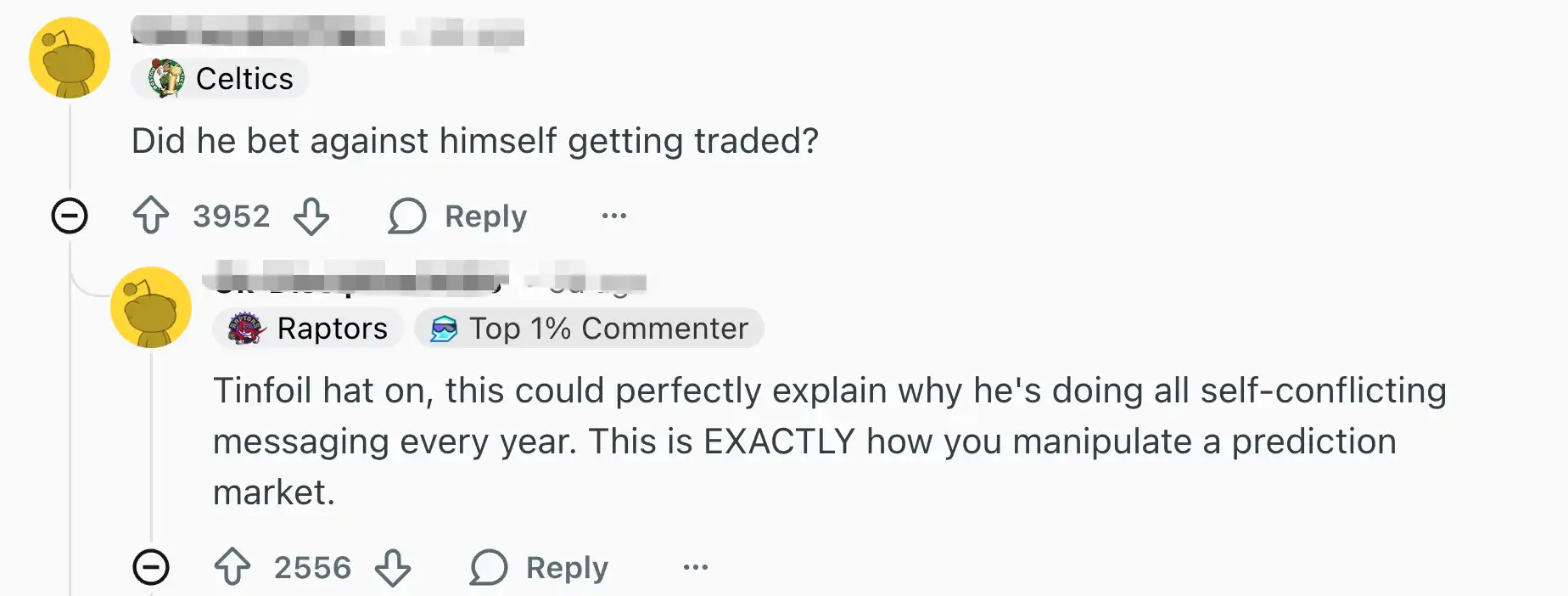
Today, the NBA league is deeply intertwined with the gambling industry, and fans have long been living in a world of odds and data. This has also heightened the motivation for insider dealings, leading to a quiet erosion of sports trust.
Just at the beginning of this NBA season, Portland Trail Blazers head coach Chauncey Billups was arrested on suspicion of illegal gambling; Miami Heat player Terrance Ross was arrested for allegedly using insider NBA player information to manipulate bets. The NBA's situation, where new scandals could erupt at any time, significantly undermines fans' confidence in sports ethics and trust in the integrity of the games.
Another consequence of fully financializing sports is that in an environment where gambling is ubiquitous, fans tend to perceive suspensions, rotations, injury return timelines, and even a post-game interview as variables that "could impact the market" for more games.
This is precisely the trickiest part of the prediction market era, where its financial logic will in turn rewrite the way sports narratives are appreciated. The thrilling process of a match can no longer be fully enjoyed by fans, and no one is interested in such inspirational stories anymore. People now only care about where the "Greek Freak" will go next, when he will retire, and how much money can be made from him.
In the age of gambling and prediction markets, doubts and controversies cannot be resolved by monologue. Restoring fairness, morality, and trust is a more difficult challenge that we need to address.
You may also like

MAGA Up 350% in 24 Hours, PEPE Up 46% in One Day: Which Memecoins Are Next in 2026?
MAGA +350% in 24hrs. PEPE +46% in one day. RAVE +4,500% then -90%. In 2026's memecoin market, the gains are real. So are the traps? Here's how to tell the difference before you buy.

RCD Espanyol vs Real Madrid: Can the Pericos Delay the Inevitable?
RCD Espanyol vs Real Madrid lineups, standings, and stats for May 3, 2026. Real Madrid visits RCDE Stadium as Barcelona closes in on the LALIGA title. Full preview inside.

MegaETH goes live with an FDV exceeding 2 billion USD. Which ecological projects are worth paying attention to?

Dialogue with "Wood Sister" Cathie Wood: The next bull market is about to arrive

Can prediction markets win the competition for perpetual contracts?

Who is trading on Trade.xyz?

Binance quietly placed a bet on a leading large model company

Best Crypto Discord Server 2026: Why Jacob’s Crypto Clan Is Gaining Massive Attention
Jacob’s Crypto Clan has grown into one of the most active crypto Discord communities, with over 45K members and continuing to expand. This rapid growth reflects strong demand for structured trading insights and real-time collaboration.

Tom Lee Buying ETH: Why Wall Street’s Loudest Ethereum Bull Keeps Doubling Down
Tom Lee keeps buying ETH through every dip, every drawdown, and every moment of market doubt. Inside the strategy that's turning Ethereum into a treasury asset — and what it signals for the rest of the market.

Stripe Sessions 2026: AI Agent, Global Payments, and Invisible Crypto Infrastructure

Where will South Korea's cryptocurrency taxation head?

Legendary investor Naval: Apple is dead, SaaS will follow suit, and entrepreneurs have 18 months to reshape their moats

Morning Report | Visa includes Polygon in its global stablecoin settlement program; MoonPay invests $100 million to acquire security company Sodot; Digital wallet platform Belo completes $14 million Series A financing

Full text of the Federal Reserve's decision: Holding steady for the third consecutive time but increasing divisions

Dan Bin takes action, building a position in Circle
The Impossible Triangle of DeFi Lending

Bitcoin ETF News: Why Bitcoin Is Falling Even After $2.43B ETF Inflows in April
Bitcoin ETF news today shows $2.43B in April inflows as institutions absorbed thousands of BTC, yet the price dropped from $79K to $76K. Traders are now watching whether the $80K resistance breaks or triggers another pullback.

What Is RWA in Crypto? Real-World Assets Explained (2026 Guide)
What Is RWA in Crypto?RWA stands for Real-World Assets — traditional financial assets like bonds, real estate, gold, and private credit that have been converted into blockchain tokens.
MAGA Up 350% in 24 Hours, PEPE Up 46% in One Day: Which Memecoins Are Next in 2026?
MAGA +350% in 24hrs. PEPE +46% in one day. RAVE +4,500% then -90%. In 2026's memecoin market, the gains are real. So are the traps? Here's how to tell the difference before you buy.
RCD Espanyol vs Real Madrid: Can the Pericos Delay the Inevitable?
RCD Espanyol vs Real Madrid lineups, standings, and stats for May 3, 2026. Real Madrid visits RCDE Stadium as Barcelona closes in on the LALIGA title. Full preview inside.
MegaETH goes live with an FDV exceeding 2 billion USD. Which ecological projects are worth paying attention to?
Dialogue with "Wood Sister" Cathie Wood: The next bull market is about to arrive
Can prediction markets win the competition for perpetual contracts?
Who is trading on Trade.xyz?

Contents
Popular coins
Latest Crypto News


