
Gulf Oil Crisis is Here

Original Article Title: "The Long-Awaited Gulf Oil Crisis Has Finally Arrived"
Original Article Author: Ye Zhen, Wall Street News
The Strait of Hormuz is nearly factually blocked, and the global energy market is being pushed into what could be the most serious energy crisis since the 1970s!
At Monday's opening, oil prices skyrocketed.
WTI crude oil futures surged by as much as 22%, surpassing the $110 mark; Brent crude oil futures also jumped by 20% to $111.04 per barrel. The gains have since moderated.
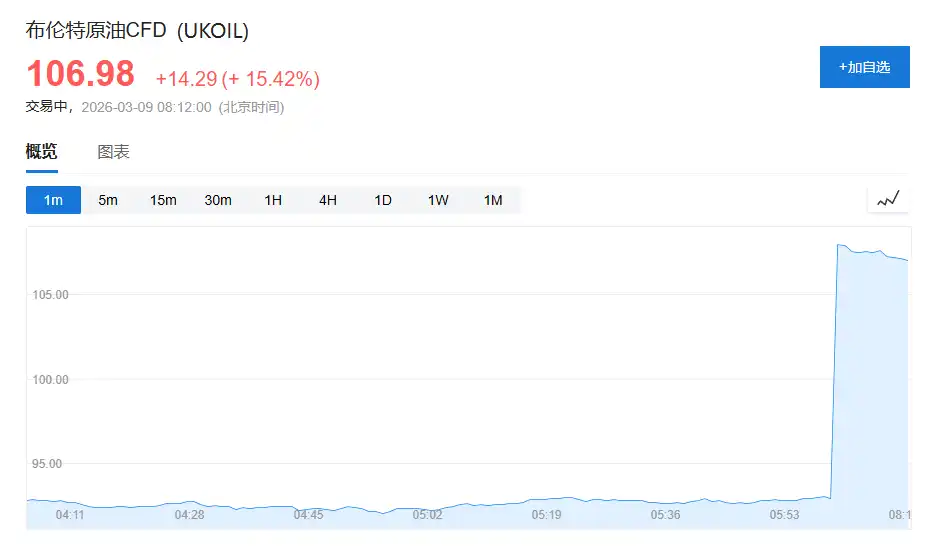
Meanwhile, due to blocked crude oil exports and rapidly dwindling storage space, more and more major Middle Eastern oil-producing countries are being forced to announce production cuts.
As previously mentioned by Wall Street News, the production cut wave in the Gulf region is rapidly spreading.
Kuwait has officially declared force majeure and significantly reduced production; the UAE has also begun adjusting offshore production levels to relieve storage pressure.
Goldman Sachs, on the other hand, directly "overturned" its previous optimistic assessment, warning that the actual flow reduction in the Strait of Hormuz far exceeded expectations. If it cannot be restored in the coming days, the upside risk to oil prices will significantly increase.
More importantly, the intensity of this crisis has far exceeded everyone's initial assessment.
At the beginning of the Israeli and U.S. attacks, Gulf state officials generally believed that the situation would still be controllable and escalate in a limited manner, as in previous conflicts.
But this time, there is an unprecedented new variable overlay:
Qatar has become the world's largest liquefied natural gas (LNG) exporting country.
When its core facilities are shut down, it is equivalent to a sudden cutoff of nearly 20% of global LNG supply. As a result, the energy shock has rapidly spread from the oil market to the natural gas market.
The result is: natural gas prices in Europe and Asia have surged simultaneously.
Next, from Chinese chemical manufacturing to the Asian power sector, a series of chain reactions may be faced.
The Hormuz Crisis Exceeds All Expectations
The speed of the crisis escalation caught the market off guard, largely due to the initial misjudgment by all parties.
According to The Wall Street Journal, weeks before the attacks in Israel and the U.S., officials from Gulf oil-producing countries received assurances from the U.S.: even in the event of retaliatory action, the target would only be U.S. military bases.
In other words, Iran would not attack energy facilities in Gulf countries, nor would it attempt to block the Strait of Hormuz.
After all, during the 12-day Israeli and American bombing of Iran last June, the Strait of Hormuz remained open.
Therefore, when the attack actually occurred, most officials remained optimistic.
Reportedly, some officials even exchanged Mr. Bean's middle finger meme in chat groups, likening Iran's possible retaliatory action to this clumsy comedy character.
OPEC held a meeting on the first Sunday after the attack to discuss whether to increase production, with hardly anyone seriously discussing the Iran situation.
That is, until the situation rapidly spiraled out of control.
A senior Saudi official later admitted:
“We did not expect Iran to strike the entire Gulf, completely disregarding our relationship with them.”
Following this, a recording of what appeared to be an Iranian naval officer instructing ships not to enter the Strait of Hormuz via radio quickly spread in industry WhatsApp groups.
Tanker traffic promptly plummeted, and market sentiment instantly shifted to panic.
Tank Farm Crisis, Production Cuts Ripple Through
With the Strait of Hormuz almost blocked, it quickly triggered a chain reaction among Middle Eastern oil-producing countries.
The core reason is quite simple: oil storage space is running out.
Iraq was the first to be forced to cut production as its oil tanks neared saturation, with output reduced by over two-thirds.
Subsequently, the Kuwait Oil Company formally announced force majeure.
According to Bloomberg citing sources, Kuwait's production cut has expanded from about 100,000 barrels per day on Saturday to nearly 300,000 barrels per day, with further adjustments to follow based on storage levels and strait conditions.
In January of this year, Kuwait's daily production was around 2.57 million barrels, and its only export route is the Strait of Hormuz. If the strait remains closed, its storage capacity could be depleted in a matter of weeks or even days.
The Abu Dhabi National Oil Company (Adnoc) also announced on Saturday that it is "adjusting offshore production levels to meet storage demand."
As the third-largest oil-producing country in OPEC, the UAE had a January daily production of over 3.5 million barrels.
Although Adnoc operates a pipeline to Fujairah port with a daily capacity of around 1.5 million barrels to bypass the Strait of Hormuz for some exports, this pipeline cannot fully substitute for the strait's shipping capacity.
JPMorgan Chase estimates that if the strait remains closed until this Friday:
· The regional daily production decline could exceed 4 million barrels
· By the end of March, the decline could be close to 9 million barrels
This is equivalent to nearly a tenth of global demand.
Saudi Arabia has already started redirecting some of its crude oil to the Yanbu port on the Red Sea coast.
However, Goldman Sachs tracking data shows that the net redirected flow through pipelines and alternative ports over the last four days has only increased by about 900,000 barrels per day, well below the theoretical limit of 3.6 million barrels per day.
Furthermore, attacks on the Fujairah port storage facilities and shortages of bunker fuel have further constrained alternative export capabilities.
Qatar LNG Shutdown: The "New Variable" of the Crisis
Unlike any previous Middle East energy conflict:
Qatar has become the world's largest LNG exporter.
This reliance built over the past two decades has been starkly magnified in this crisis.
Following an Iranian drone attack on Qatar's Ras Laffan gas complex, Qatar Petroleum announced on March 2 the halt of LNG production at the facility due to force majeure.
Ras Laffan has an annual capacity of 77 million tons, approximately 20% of global LNG supply.
HSBC Global Investment Research notes that the facility's shutdown is not solely due to the strait blockade.
With the inability to ship out, on-site tank capacity is only about 1 million tons, less than five days of normal loading. In other words, Qatar Petroleum had no choice but to shut down.
Market reaction has been very direct.
The European TTF benchmark natural gas price surged around 70% over two trading days; the Asian spot LNG price JKM rose by about 50%.
Both hit nearly three-year highs.
LNG tankers even engaged in a "race for cargo" on the high seas.
An LNG vessel named Clean Mistral suddenly made a 90-degree turn towards Asia while en route to Spain, followed by several others making similar adjustments.
Further complicating matters, restarting also takes time.
Reuters cited industry estimates:
· Restarting Ras Laffan itself takes about two weeks
· Full production recovery requires another two weeks
HSBC estimates:
· Shutting down for 1 month will result in a loss of about 6.8 million tons of LNG
· Shutting down for 3 months will result in a loss of about 20.5 million tons
Considering Trump previously stated that he expected the Iran war to last four to five weeks, the mainstream market scenario's estimated supply loss is already close to 8 million tons.
The issue is that the global LNG market has almost no spare capacity.
While the U.S. is the world's largest LNG exporter, its spare capacity is estimated to be only about 5%; Norway says its gas production is close to full capacity; Australia's spare capacity is similarly limited.
Goldman Sachs "Tears Up Report": Oil Price Upside Risk Rapidly Growing
In a report released on March 6, Goldman Sachs' commodity research team almost entirely overturned its previous forecasts.
Goldman Sachs' Chief Oil Strategist Daan Struyven had previously set the baseline path as:
· Hormuz Strait flow at about 15% in the next 5 days
· Then recovering to 70% in two weeks
· Another two weeks to recover to 100%
Based on this assumption, Goldman Sachs raised its Brent second-quarter average price forecast to $76 and WTI to $71.
But reality quickly shattered these assumptions.
Goldman Sachs' latest estimate:
The flow through the Strait of Hormuz has already decreased by about 90%, which is a reduction of around 18 million barrels per day.
The actual redirected flow through alternative pipelines is only a quarter of the theoretical maximum.
Meanwhile, most ship owners are now choosing to wait and see.
What is truly preventing vessel passage is not freight costs, but physical security risks— as long as the physical risk exists, vessels will not pass through even if the freight costs are high.
Goldman Sachs stated in a report:
If there are no signs of a solution this week, oil prices are likely to break through $100 next week.
If the low strait flow continues throughout March, oil prices (especially refined products) could surpass the historical peaks of 2008 and 2022.
The report also emphasized:
The upside risk to oil prices is rapidly expanding.
Energy historian Daniel Yergin also warned:
“In terms of daily oil production, this is the largest supply disruption in global history. If it continues for weeks, it will have far-reaching implications on the global economy.”
The U.S. Is Relatively Insulated, But the Impact Is Still Spreading
U.S. Energy Secretary Chris Wright stated on Fox News on Sunday that energy will “quickly flow back” through the Strait of Hormuz, attributing the rise in oil prices mainly to market concerns about the duration of the conflict.
Trump, aboard Air Force One, said he is not worried about gasoline prices and expects oil prices to “fall very rapidly” after the war ends.
Compared to the 1970s, the U.S. energy structure now indeed has more resilience.
The oil and gas industry accounts for a lower share of GDP, and the U.S. has already become a major energy exporter.
However, the issue is—
Oil prices are set globally.
The rise in gasoline and diesel retail prices will still have a real impact on U.S. consumers.
Airline executives have warned that soaring jet fuel prices will squeeze quarterly profits and may lead to higher airfare prices.
Meanwhile, some of the U.S. government's responses have also conflicted with existing policies.
To mitigate the impact of the Gulf supply disruption, the U.S. Treasury has relaxed some sanctions on Russian oil to help countries like India find alternative supply.
This is in clear contradiction to previous policies that sought to isolate the Russian oil industry.
According to analyses by HSBC and Morgan Stanley, this energy shock has had distinctly different effects in Europe and Asia.
For the Chinese chemical industry, it is somewhat of an opportunity.
The surge in European natural gas prices has driven up the production costs for local chemical companies. HSBC Qianhai Securities points out that this will enable Chinese chemical companies (in areas such as MDI, TDI, vitamins, etc.) to expand market share and premium pricing.
However, in Asia, the situation is more severe—
The market is facing a real energy supply shortage.
Morgan Stanley notes that around 20% of Asia's power and gas industry relies on Middle East LNG, with India, Thailand, and the Philippines particularly exposed.
To address fuel shortages and cost increases, some Asian countries have begun to shift back to coal-fired power to maintain grid stability.
You may also like

Every exchange is a "Universal Exchange."

The counterattack of traditional finance: Alliance chains are quietly reviving

Bitcoin Falls Below 200-Week Moving Average as On-Chain Data Shows Over Half of Supply in Loss
Bitcoin dropped below its 200-week moving average as on-chain data showed over 50% of circulating supply is now in loss, signaling rising market stress.

CFTC Reportedly Plans New Prediction Market Rules Focused on Manipulation Risk and Public Interest Review
The CFTC is reportedly preparing new prediction market rules focused on manipulation risk, public interest review, and retail trader protections.

Meet the new WEEX trial fund—your gateway to greater profits

WEEX Labs Lands at Dutch Blockchain Week: A Disruptive Crypto × AI Conversation Sets Sail in Amsterdam

SK Hynix Reportedly Plans U.S. ADR Listing as Early as August, With SEC Approval Possible in Late June
SK Hynix may pursue a U.S. ADR listing as early as August, with SEC approval reportedly possible in late June amid strong AI chip supply chain demand.

SpaceX vs Tesla vs xAI: Which Elon Musk Trade Has the Biggest Upside in 2026?
OpenAI Reveals It Has Confidentially Submitted an S-1 to the SEC, Keeping the Door Open for a Future IPO
On June 9, according to an OpenAI announcement, the company recently confidentially submitted a draft S-1 registration statement to the U.S. Securities and Exchange Commission (SEC), beginning the preliminary compliance process for a potential initial public offering. OpenAI said it chose to disclose this proactively because it expected the news might leak; however, the company has not yet set a specific listing timeline, and related arrangements may still take some time.

Latest research from 13 top universities including Cornell University: The current state, challenges, and misconceptions of the fusion of Crypto and AI
Deconstructing Anthropic: The Best AI Company, Possibly Also a Type of Organizational Invention
Apollo and Blackstone Reportedly Back $35 Billion Anthropic Chip Financing as Deal Details Remain Unclear
On June 9, according to currently available news alerts, Apollo and Blackstone Group participated in a $35 billion financing for an Anthropic “chip project.” Based on the original wording of the report, the funding has already been raised, but public information remains limited. The financing structure, use of proceeds, project entity, and whether Apollo and Blackstone participated through equity, debt, or project financing have not yet been disclosed.

Humanity Protocol Security Incident Escalates: More Than $31 Million Stolen From Related Addresses as Attacker Continues Selling H for ETH
On June 9, according to monitoring by Onchain Lens, more than $31 million has been stolen from addresses linked to Humanity Protocol, and the attack is still ongoing, with the hacker continuously swapping H tokens for ETH. Project founder Terence Kwok later confirmed the security incident on X, saying the issue involved a private key leak.

Bloomberg: As Bitcoin Weakens, Stablecoins and RWA Continue to Drive Expansion in Crypto Businesses
In June, Bloomberg reported that despite Bitcoin falling below $60,000 last week, wiping out about $235 billion in market value within seven days, and dropping close to 50% from last year’s peak, some core businesses in the crypto industry are still expanding, mainly in stablecoins, real-world asset tokenization (RWA), payments, and infrastructure. The report also noted that overall altcoin activity has contracted significantly: altcoin market capitalization has fallen from a peak of about $431 billion in November 2021 to around $170 billion, and among the tens of millions of tokens issued in recent years, fewer than 1,700 still maintain meaningful trading activity.

Galaxy Deep Research Report: How Hyperliquid's HIP-4 Upgrade Changes the Landscape of Prediction Markets?
Binance Research: RWA Market Expected to Expand Nearly 6x from Early 2025, with Public Equities and Onchain Payments Heating Up Together
In June, Binance Research said in its monthly market report that the real-world asset (RWA) market is expected to grow by about 589% from the beginning of 2025. Bond- and money market fund-related RWA expanded by about $6.5 billion, up 83% year over year, while publicly traded equity RWAs grew by about 422%. The report also noted that monthly crypto debit card transaction volume exceeded $747 million in May, up 48.6% year to date.

Japan to Assess a Framework for Yen Stablecoins and Crypto ETFs as Asia’s Compliant Payments Narrative Heats Up
Recently, according to the original report, Japan is considering the launch of yen stablecoins and cryptocurrency ETFs. Public information remains limited at this stage, and there is still no complete policy text, regulatory draft, or clear implementation timeline, so this is better characterized as a “policy discussion” rather than formal implementation. The original wording also noted that advancing stablecoin regulation in Asia is driving XRP usage and supporting growth in the XRPL ecosystem. However, based on currently available public information, there is not enough evidence to directly establish a clear causal relationship between this round of discussion in Japan and XRP or XRPL.

ZachXBT: Humanity private key leak and abnormal surge in H token should be viewed separately
On June 9, according to related disclosures, on-chain investigator ZachXBT posted an update on Humanity’s roughly $31 million security incident, saying that after further analyzing fund flows, he currently tends to believe the project team was not involved in an “inside job” or a self-staged attack. According to him, the official explanation about the private key leak was broadly accurate, but before the token unlock, the price of H had been artificially pushed higher, and the hacker later took advantage of that market environment; therefore, the private key leak and the earlier abnormal price pumping should be regarded as two separate and independent events. This reframing has shifted the market’s understanding of the nature of the incident. Earlier discussion around Humanity had focused on whether the team directly participated in the attack or used the security incident to cover up internal operations. ZachXBT’s latest remarks shift the focus from “whether it was self-theft” to “whether there were pre-unlock market structure issues.” He also questioned whether the team may have.
Every exchange is a "Universal Exchange."
The counterattack of traditional finance: Alliance chains are quietly reviving
Bitcoin Falls Below 200-Week Moving Average as On-Chain Data Shows Over Half of Supply in Loss
Bitcoin dropped below its 200-week moving average as on-chain data showed over 50% of circulating supply is now in loss, signaling rising market stress.
CFTC Reportedly Plans New Prediction Market Rules Focused on Manipulation Risk and Public Interest Review
The CFTC is reportedly preparing new prediction market rules focused on manipulation risk, public interest review, and retail trader protections.
Meet the new WEEX trial fund—your gateway to greater profits
WEEX Labs Lands at Dutch Blockchain Week: A Disruptive Crypto × AI Conversation Sets Sail in Amsterdam


