
Hackers forged Google Play Store pages to carry out cryptocurrency mining and wallet hijacking attacks targeting Brazilian users

 Prefer us on Google
Hackers have launched Android malware attacks in Brazil by spoofing a phishing page that mimics the Google Play Store. Currently, all known victims are located in Brazil.
The attackers set up a phishing website that closely resembles Google Play, enticing users to download a fake application called "INSS Reembolso." Once installed, the application releases hidden malicious code in stages and loads it directly into memory, leaving no visible files on the device, which makes it highly stealthy. One of the core functions of the malware is cryptocurrency mining, with an embedded XMRig mining program compiled for ARM devices that silently connects to the attacker's controlled mining server in the background. The program monitors battery level, temperature, and device usage status, dynamically adjusting mining behavior to evade detection, and bypasses Android's background process management mechanism by looping silent audio files.
Some variants also include banking trojans that can overlay fake pages on the USDT transfer interface of Binance and Trust Wallet, silently replacing the recipient address. Additionally, the malware supports various remote control commands such as recording, screenshotting, keylogging, and remote locking of the device.
-- Price
This content is provided for general informational purposes only and doesn't constitute financial, investment, legal, or tax advice. Any events, rewards, online promotions, or related information mentioned herein should not be considered a recommendation, solicitation, or invitation to purchase, sell, trade, or otherwise deal in any crypto assets. Crypto assets are highly volatile and may result in loss. The availability of WEEX services, products, and related events may vary by region. You are responsible for ensuring that your participation is in accordance with applicable local laws and regulations.
You may also like

Arkham reports 35 million labels for Robinhood Chain tracking
El Salvador’s National Bitcoin Office Hosts Five November Events Led By Herbert And Keiser

Solana sets Oct. 21 Alpenglow upgrade with 150ms finality target

Former Fifth Largest SOL Treasury Company Undergoes Radical Transformation, Liquidates SOL Holdings

NEAR targets protocol security after $112 AI proof-generation run

Rome Protocol details Solana EVM access as lending demos run on testnet

Bank of America predicts a hit of up to 10% on European stocks due to risks in the AI cycle
One billion fraudulently created tokens: The Holograph case in court in Paris

Elon Musk Offers a SpaceX Share to Every American Child: The American Dream at 140 Satoshis

White House Crypto Committee: Four People Departed in 14 Months

Hyperliquid Requests Five Changes to SEC's Crypto Regulations

Fake Demand, Real Losses: How Popular Crypto Schemes Work

Michael Saylor: "Bitcoin is returning to a bull market"

Korea's Largest Pension Fund Suffers Over $130 Billion Loss Due to Heavy Investment in Samsung and SK Hynix

Ripple to Address XRP Ledger Security at Swell 2026
Hatem Douidar Joins Tactful AI Investors to Support Its Expansion in AI Solutions

Cardano Project Catalyst selects 12 projects for 2 million ADA pilot fund
From Zero to Financial Freedom: A Trader's HYPE Airdrop Review and Trading Philosophy

BingX, YouHodler and Santander’s Openbank join EU MiCA register
Slow Fog Releases DarkSword Trojan Analysis Report: Public Code Weaponized, iOS Crypto Wallets Face Threats

Emirati Nabta Health Secures Investment from PVP in $3 Million Round
XRP holders can now earn fees from Kraken’s DeFi customers, but there is a catch

Can Celestia Turn the Tide with AI Payments After a 97% Drop?
Why is it difficult for meme coins to break the $50,000 market cap? This market is draining retail investors' funds
QCP: AI Credit Risk Heats Up, Bitcoin May Face Range Breakthrough

BlackRock wants tokenized funds to back traditional Wall Street trades
The New PayPal Mafia: 10 Interns, $100 Billion
Variant Investment Partner: In the Second Half of the Bull Market, Which Two Camps Are Marginal Dollars Flowing To?

BNB Chain claims 42.6% of tokenized stock market, beating Ethereum and Solana
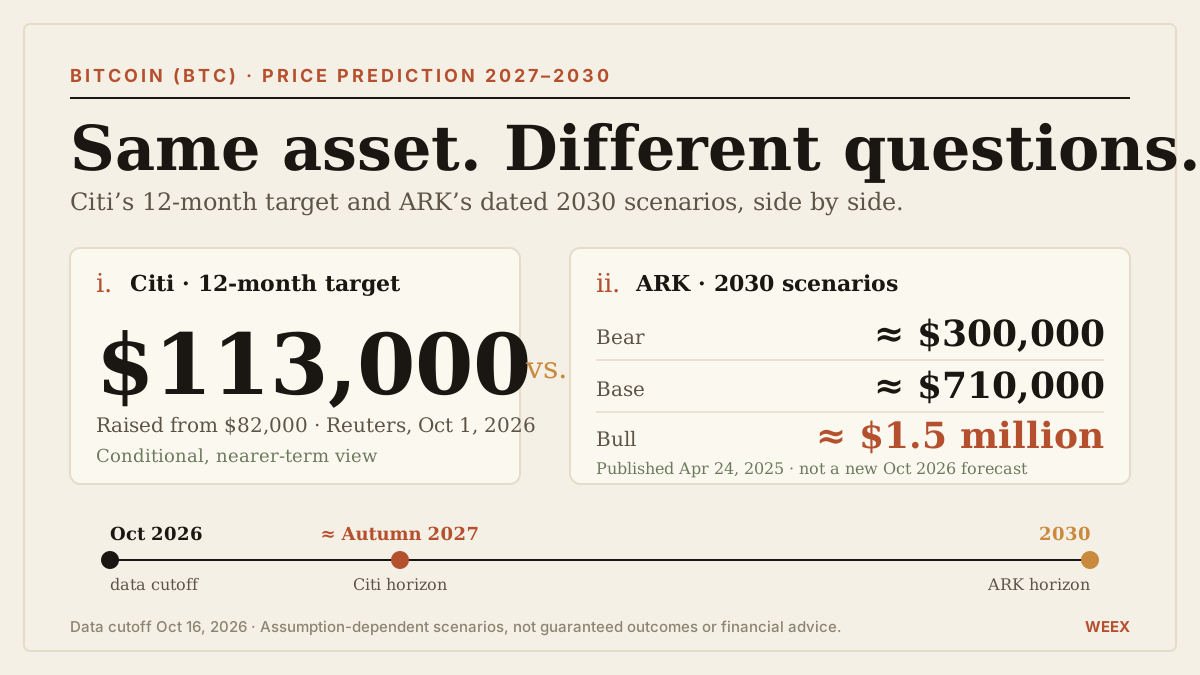
Bitcoin (BTC) Price Prediction 2027–2030: Citi’s $113,000 Target vs. Cathie Wood’s ARK Scenarios
Bitcoin price prediction for 2027–2030: compare Citi’s $113,000 target with ARK’s dated scenarios, demand assumptions, valuation math and key risks.
Arkham reports 35 million labels for Robinhood Chain tracking
El Salvador’s National Bitcoin Office Hosts Five November Events Led By Herbert And Keiser
Solana sets Oct. 21 Alpenglow upgrade with 150ms finality target
Former Fifth Largest SOL Treasury Company Undergoes Radical Transformation, Liquidates SOL Holdings
NEAR targets protocol security after $112 AI proof-generation run
Rome Protocol details Solana EVM access as lending demos run on testnet


