
How to systematically track high-performing addresses on Polymarket?

Original Title: How To Find 100X Insider Polymarket Wallets To Cop
Original Author: Aleiah, Polymarket Content Creator
Original Translation: Asher, Odaily Planet Daily
An address on Polymarket rolled $35,000 to $442,000, achieving a 12.6x return. Notably, the position was established hours before a major market move, with the trade mostly cashed out before news spread to mainstream channels. This was not an isolated incident, as three addresses front-ran the “Venezuela Raid” political event, collectively profiting $630,000 before the news went public.
If this occurred in traditional financial markets, people might easily think of insider trading. However, in a prediction market, all fund flows and position changes are recorded on a public blockchain, with no hidden accounts or off-book deals.
Public does not mean no gap. The key is not whether you can see the trade, but whether you can read a truly informative signal from a massive amount of data.
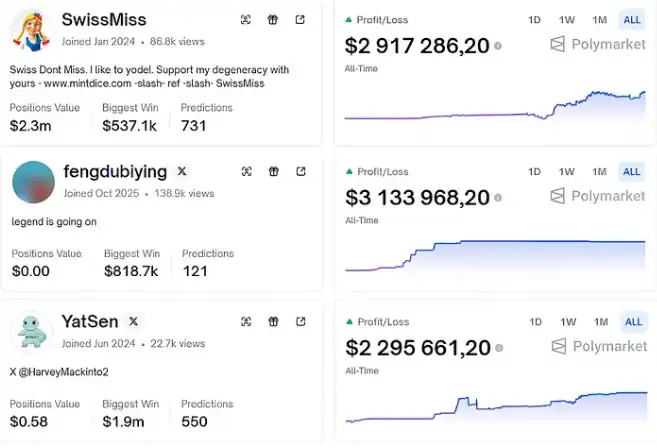
Every Transaction on Polymarket is Public Data
Many prediction market participants still view Polymarket as a traditional betting platform: watching odds, picking sides, and betting on outcomes. However, Polymarket's underlying structure is entirely different from DraftKings or regular sports betting. All trades occur on-chain, with fund flows, position sizes, entry and exit points all publicly visible. The operational paths of those who make the most accurate judgments and the most timely moves are not hindsight speculations but real-time, on-chain records.
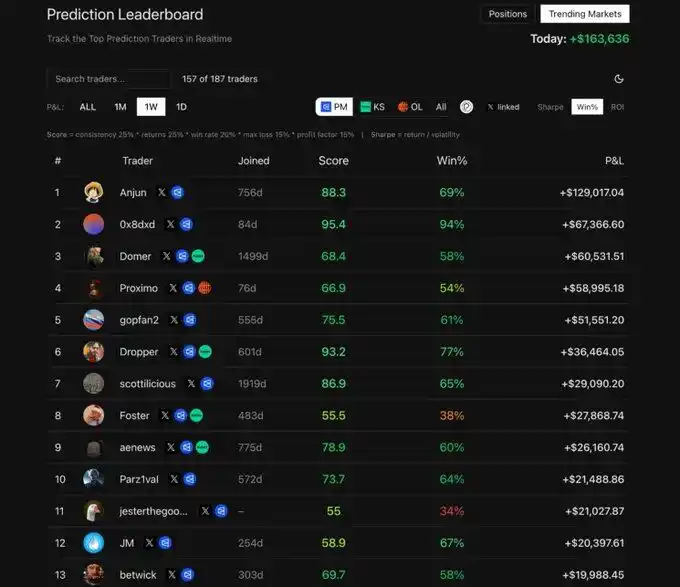
Polymarket's API is also open. Transaction records, market data, historical trades—anyone can directly access these, with no permission barriers.
Therefore, the gap lies not in who can see the data but in who can derive meaning from it. On-chain information is public, but what truly holds value is the wallets worth tracking continuously and the ability to identify their behavioral changes before prices fully reflect them.
What are the typical characteristics of a true "Insider Address"?
It is important to emphasize that not all profitable wallets indicate insider information. Some traders have solid research capabilities, while others rely on quantitative models and algorithmic advantages. However, when profits are repeatedly overlaid with specific behavioral patterns, certain structural features different from mere "luck" can be observed.
· Category 1: Combination of New Address and Abnormally Large Bet
A wallet that was created just a few days ago with very few transactions suddenly pouring a large amount of funds into a low-liquidity niche market is not a common occurrence. Especially in the absence of a public catalyst, large concentrated positions often carry stronger informational meaning.
· Category 2: Highly Vertical Trading Domain
Some addresses do not operate across markets but instead focus intensively on a specific niche and maintain a stable and significant win rate within that domain. They do not diversify into multiple sectors such as crypto prices, elections, sports, etc., but rather concentrate on a single theme, making more decisive position decisions.
· Category 3: Unusual Changes in Position Size
When an address that has been making medium-sized bets for a long time suddenly significantly increases its position in a market, this behavior often implies a change in conviction strength. Position size is itself an attitude, and a sudden change in scale usually reflects an upgrade in information or belief.
· Category 4: Overly Precise Timing Selection
An occasional early positioning could be attributed to coincidence, but if an address repeatedly establishes positions hours before major news is announced and the direction is highly consistent, this kind of timing advantage is difficult to simply attribute to luck. Once is chance, but multiple times are more likely to demonstrate an information edge.
How to systematically screen for potential "Information Advantage Addresses"
· Step 1: Analyze Polymarket Leaderboard Performance
You can start by looking at the Polymarket Analytics leaderboard (link: https://polymarketanalytics.com/traders), sorting by 30-day P&L, and using recent stable profit performance as the first filtering criterion. Focus on wallets that have been consistently profitable for the past 30 days, with a win rate above 55%, and a total profit significantly higher than total losses. Additionally, ensure that their trades are focused on markets with genuine liquidity, not low-volume prediction events with no participants.
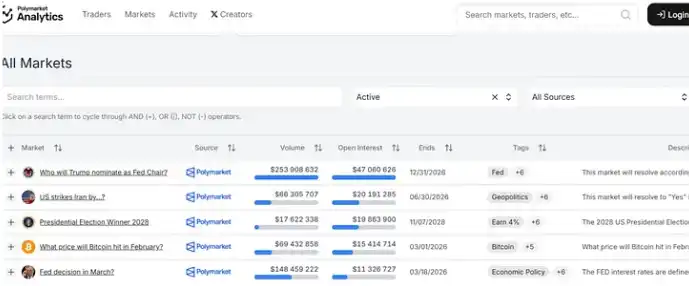
The goal of this stage is not to directly determine whether it possesses an information advantage, but to establish an observation list with sustainable profitability. A stable profit record is the foundation for subsequent behavioral analysis.
· Step Two: Analyze Positioning in Specific Events
After completing the initial screening, you can further delve into specific trading events. Enter the prediction market with active trading to view the Top Holders list for that event. Polymarket will publicly display the addresses with the largest current positions, as these large positions often represent stronger judgment.
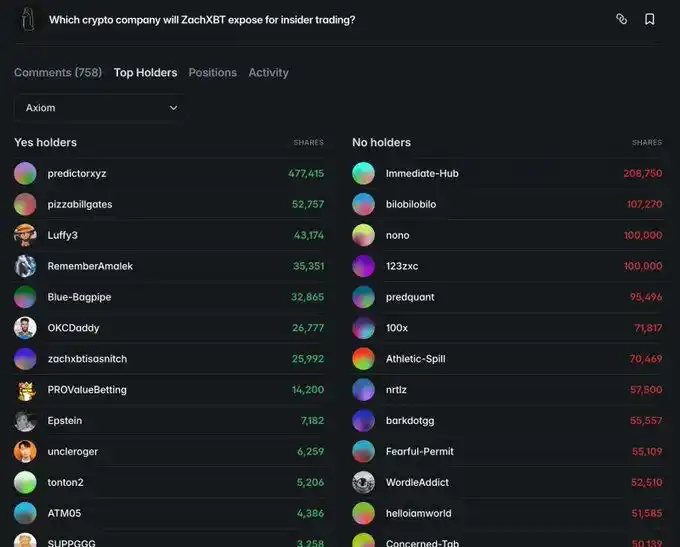
The key is not whether an address hits a large position in a single instance, but whether its behavior is consistent. If a wallet repeatedly appears in the top holder list for multiple significant events, and these positions were established before the market was fully priced, then this recurring appearance itself serves as a signal.
A single lucky hit may be just a coincidence, but consistently establishing large positions early on, with a consistent direction and validated results, often signifies that its judgment system has a stable advantage.
· Step Three: Analyze Trading Behavior and Entry Points
After identifying candidate addresses, further review their on-chain transaction history, with a focus on entry points, position structures, and holding patterns.
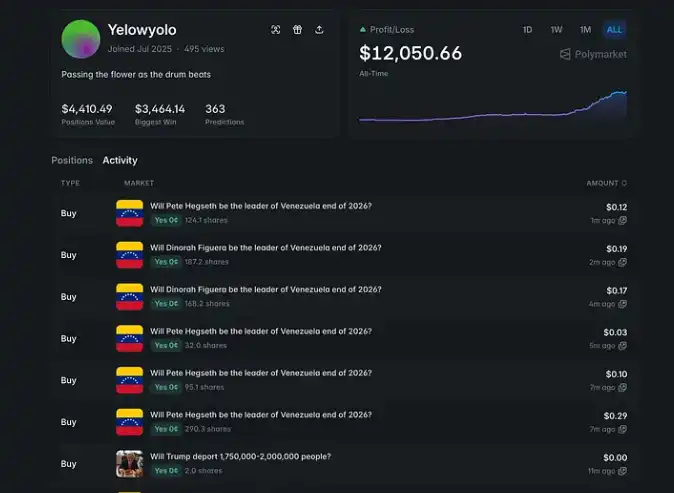
First, observe the entry time. If the purchase occurs a few hours before official news release, and this pattern repeats frequently, the time advantage itself becomes an important variable; entering after media coverage is more likely to be mere information chasing.
Second, analyze the position accumulation method. Seasoned traders typically accumulate positions gradually in batches, while wallets with strong information judgment often rapidly concentrate their positions in a short period because their window of opportunity is limited.
Furthermore, focus on the holding period. Some high-quality addresses choose to exit during the mid-stage of market hype rather than waiting for the extreme volatility at the end, indicating their goal is to capture the main trend rather than seek marginal profits.
Lastly, observe their trading scope. Addresses highly vertically integrated and long-term focused on a single niche are more likely to form a stable information advantage; addresses frequently operating across different sectors are more likely to rely on market sentiment rather than specific domain judgments.
Advanced Address Tracing Strategy
After mastering the basic filtering methods, the real difference is made by further breaking down the details of fund behavior.
First, it is necessary to focus on off-chain behavior, not just the time of entry. An address with information advantage often not only positions ahead of time but also actively reduces exposure before a potential downturn. When a large address that has held a stable long-term position suddenly significantly reduces its holdings without any obvious catalyst, the information content is usually higher than the initial buy behavior. Especially when the reduction reaches a significant proportion, this change itself is a signal.
Second, wallet clustering analysis can be performed using on-chain data. The relationship between addresses is not entirely untraceable. The same source of funds, similar gas usage patterns, and transactions occurring in quick succession may reveal relationships between addresses. Many seemingly "brand new" accounts can often be traced back to a long-active old address through 2 to 3 fund transfers. Tracking along the fund flow path helps identify new potential high-quality accounts before the market takes notice.
Furthermore, attention should be paid to abnormal volume changes in illiquid markets. If a market with relatively small daily trading volume suddenly experiences a significant inflow of funds without public news, this structural surge in volume often indicates that some participants in the market have acted early. Analyzing specific addresses that drive changes in trading volume can help build a new watchlist.
Lastly, on-chain behavior can be cross-verified with external public information. The so-called "Pizza Index" once speculated on potential military actions through abnormal changes in pizza orders around the Pentagon. Similarly, flight tracking data, social media activities of key figures, public schedule adjustments, and other information can provide corroboration or reverse validation for on-chain position behavior. The linkage between on-chain fund flows and real-world signals often enhances the reliability of assessments.
You may also like

How much longer can Ethereum's last big buyer hold on?

The pricing controversy of Trade.xyz exposes the fatal weakness of Pre-IPO perpetual contracts

World Cup 2026 Coming – WEEX Celebrates with $1M Prize Pool & Michael Owen Live

Galaxy in-depth report: Is Solana still worth paying attention to?
Young people in South Korea make a "final effort" in the epic bull market

Dialogue with OmenX Founder: Why does the prediction market need an evolution from "spot" to "derivatives"?
When the P2P illicit funds from ten years ago turned into 60,000 bitcoins

Morning News | CME Group launches Nasdaq Cryptocurrency Index futures; Asset management giant Janus Henderson strategically invests in Ethena
Why did Oracle deliver the strongest financial report in history, yet its stock price fell?

Bitcoin Layer 2 Network Botanix: Why Did We Choose to Dissolve?

Morning Report | OpenAI has submitted an S-1 registration statement draft to the U.S. SEC; Morpho completes $175 million financing

Galaxy Deep Research Report: How Hyperliquid's HIP-4 Upgrade Changes the Landscape of Prediction Markets?

Latest research from 13 top universities including Cornell University: The current state, challenges, and misconceptions of the fusion of Crypto and AI
Deconstructing Anthropic: The Best AI Company, Possibly Also a Type of Organizational Invention

Every exchange is a "Universal Exchange."

The counterattack of traditional finance: Alliance chains are quietly reviving
Pantera Capital Partner: How Tokenization is Restructuring the Private Equity and Early Investment Ecosystem?

Mastercard Launches Agent Pay for AI, Plans to Record AI Agent Payment Authorizations on Polygon
Mastercard launched Agent Pay for AI, a new payment protocol designed to help AI agents make small payments such as pay-per-use access to data and APIs. The system plans to record human-granted AI agent permissions on Polygon, focusing on verifiable authorization, identity, and payment controls.
How much longer can Ethereum's last big buyer hold on?
The pricing controversy of Trade.xyz exposes the fatal weakness of Pre-IPO perpetual contracts
World Cup 2026 Coming – WEEX Celebrates with $1M Prize Pool & Michael Owen Live
Galaxy in-depth report: Is Solana still worth paying attention to?
Young people in South Korea make a "final effort" in the epic bull market
Dialogue with OmenX Founder: Why does the prediction market need an evolution from "spot" to "derivatives"?


