
- Buy Crypto
- Markets
 Futures
- Spot
- Copy Trade
- Earn
- More
Hyperliquid, the Next Decentralized Exchange Giant Beyond Solana?

Original Author: @0xlykt, crypto writer
Original Translation: zhouzhou, BlockBeats
Editor's Note: Hyperliquid is the only perp dex that can compete with CEX, occupying a leading position in the market with outstanding liquidity, low fees, and organic growth. Most of the trading fees flow into the Treasury Fund, used for HYPE buybacks to give it value support. There is no VC involvement, and the team is self-funded. By combining HyperCore with HyperEVM, it has achieved an efficient, bridge-free on-chain financial system. It supports spot trading and plans to expand margin features. Builder Codes enable projects to access liquidity at zero cost.
The following is the original content (reorganized for easier comprehension):
The following content will delve into why I am extremely bullish on Hyperliquid in the long term, its ecosystem, and HYPE, including some key points that are easily overlooked.
Perpetual Contract DEX
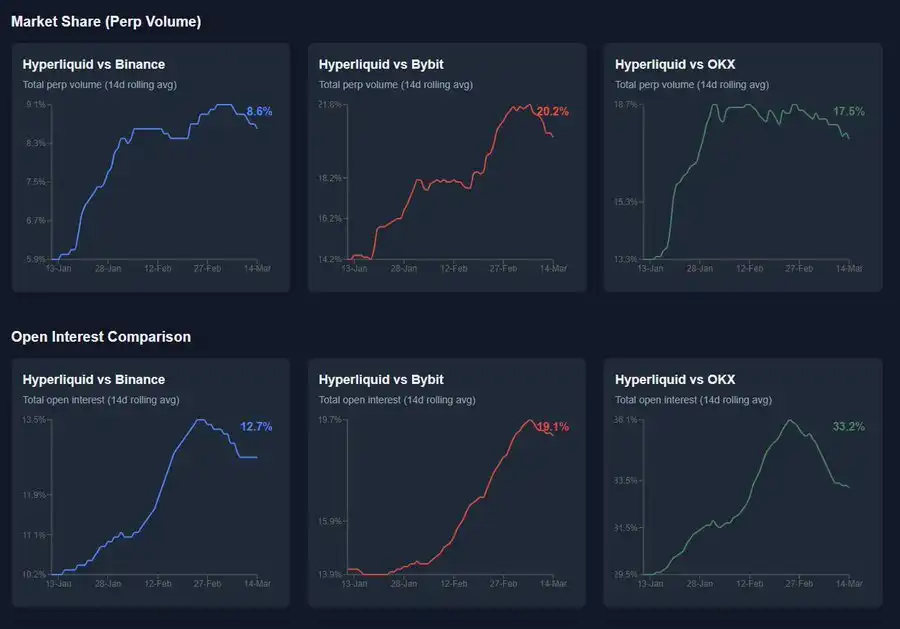
Hyperliquid has proven to be the only perpetual contract DEX that can compete with centralized exchanges in trading volume and open interest, completely dominating other similar DEXs in market share. This dominant position is mainly attributed to several reasons:
· Top-tier liquidity and execution efficiency. Other perpetual contract DEXs commonly face issues such as insufficient order book liquidity, limited tradable assets, lack of advanced order types, and occasional latency problems. Hyperliquid also experienced these issues in its early days but swiftly resolved them, maintaining a lead ever since.
· Lower transaction fees compared to CEX. Hyperliquid boasts the lowest fees in futures trading (maker 0.035%, taker 0.01%, with fee rates decreasing as volume increases), outperforming all major CEXs.
· Relying on organic growth rather than short-term capital. Unlike other perpetual contract DEXs where data plummeted significantly after token generation events, user activity on Hyperliquid has continued to grow steadily after the HYPE TGE.

Assistance Fund
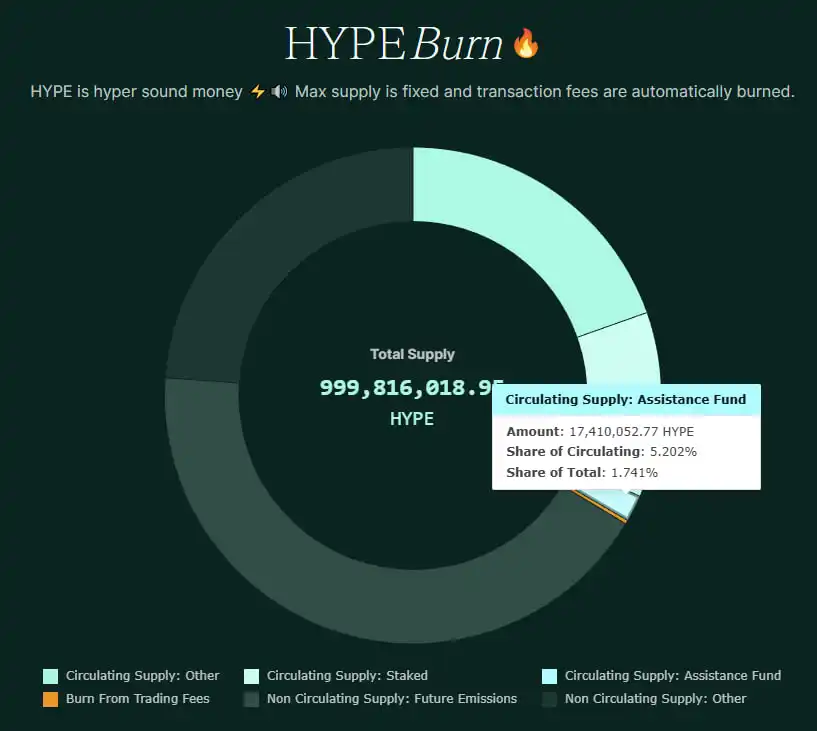
Nearly all transaction fees on Hyperliquid flow into the Assistance Fund (AF) (the rest going to HLP) and are used to buy back HYPE on the open market. Currently, the AF holds 5.2% of the circulating supply.
This allows exchange revenues to be directly fed back to HYPE holders. Most cryptocurrency project tokens have virtually no value proposition (there is no one buying the token for governance needs), while the Assistance Fund provides price support to HYPE by becoming a buyer not affected by price.
We can build a valuation model for HYPE based on this portion of revenue, and from the perspective of a traditional fintech giant, the token is actually undervalued.
No Venture Capital Participation
Hyperliquid Labs is entirely self-funded. HYPE's TGE was not allocated to liquidity providers, private investors, or CEX. Core contributors' tokens are locked until late November, with most unlocking by 2027 to 2028.
Venture capitalists will eventually sell off because they need to abide by investment agreements; on the other hand, core contributors have no need to sell, especially when they are already wealthy and did not require outside funding to build Hyperliquid.
HyperCore + HyperEVM Synergy
This is a very critical advantage—In the realm of on-chain finance, no other blockchain has such a well-thought-out design as Hyperliquid.
HyperCore consists of high-performance native components, including perpetual contracts and spot order books, staking, oracles, multisig, etc. HyperEVM is a general-world computer that allows developers to deploy code that interacts with both HyperEVM and HyperCore. Together, they form a composable state secured by HyperBFT consensus (requiring no cross-chain bridge, proofs, or trusted signers, making it more secure than the Ethereum ecosystem).
Here are two examples of how this design is superior to existing alternatives:
Example 1: Decentralized Asset Issuance and Trading
Project ABC deploys the ABC token contract on HyperEVM and lists it on HyperCore's spot market. The token contract on HyperCore and HyperEVM can be seamlessly linked, allowing users to transfer their ABC balance to HyperCore for order book trading.
CEX Comparison:
· Fully decentralized, no need to pay CEX listing fees.
· No cross-chain bridge risk, HyperCore and HyperEVM share the same state, while CEX requires interaction through wallets that may be vulnerable to hacks (e.g., Bybit recently hacked for over $1 billion).
Example 2: More Efficient Liquidation Mechanism
A certain lending protocol accepts HYPE as collateral and disburses USDC to the borrower. To determine the liquidation threshold, the lending smart contract can directly read the HYPE price from the HyperCore order book (using "precompile read").
If the borrower's HYPE position needs to be liquidated, the smart contract can directly sell HYPE on the HyperCore order book for USDC (using "precompile write"). Compared to Ethereum, Solana, and other on-chain AMM-based liquidation methods, the order book model provides a more efficient liquidation experience.
Builder Codes
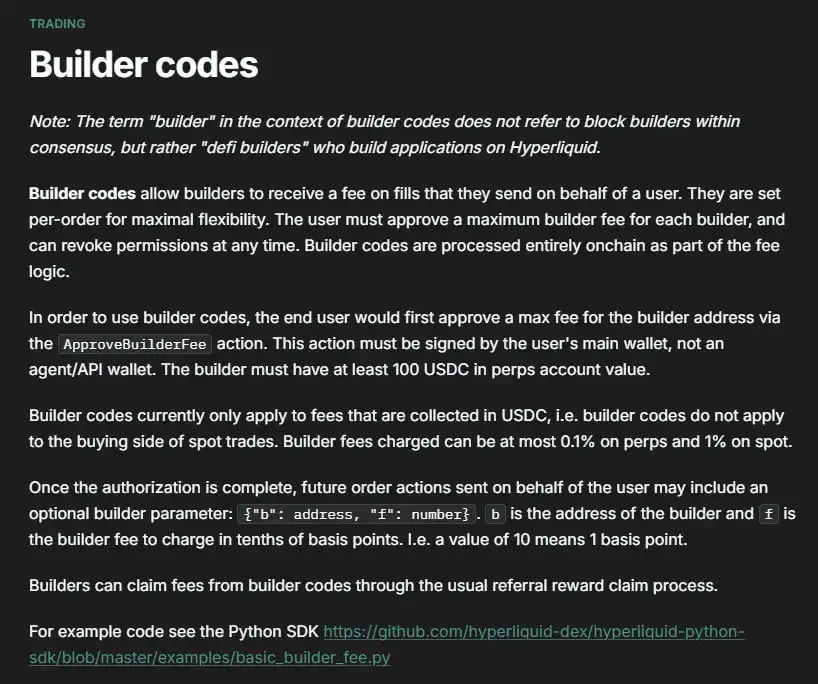
Builder Codes may be one of the most overlooked highlights of Hyperliquid. You may have heard of @pvp_dot_trade, but did you know they are using Builder Codes?
Builder Codes allow projects to utilize Hyperliquid's infrastructure and liquidity at zero cost. Drawing a parallel to the Web2 space, their role is similar to what AWS is to computing resources, but here it is to support liquidity.
Spot Token Trading
Hyperliquid is the only perp dex supporting spot trading of mainstream assets (currently supporting BTC, ETH, and upcoming SOL). This is very convenient for traders, for example:
· Wanting to trade BTC but avoiding funding fees.
· Engaging in basis trading on the same platform (going long on spot BTC, short on perpetual BTC).
Currently, the only feature Hyperliquid lacks compared to CEX is the ability to use spot assets like BTC or HYPE as collateral (currently only supporting USDC). However, since mainstream CEX platforms offer this feature, it can be anticipated that Hyperliquid will also incorporate it in the future.
Devoted Community and Developers
Hyperliquid boasts one of the most devoted (some might say fanatical) communities in crypto history. This enthusiasm partly stems from the HYPE TGE being the largest airdrop in crypto history, but more importantly, many supporters have seen something different in this team—they are truly focused on building a quality product rather than just extracting capital, which is why the community is so steadfast.
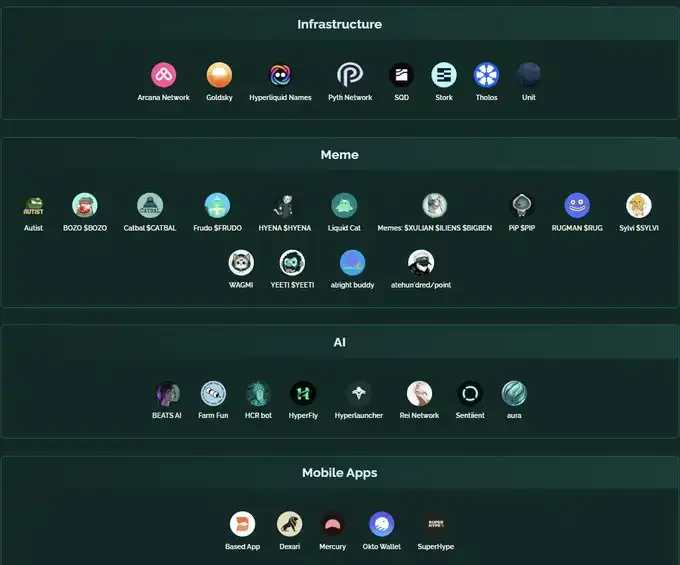
Additionally, Hyperliquid has attracted a group of active developers, with most projects being natively built on HyperCore or HyperEVM rather than cross-chain from other networks. Currently, there are not many projects live on HyperEVM as many core features are yet to be fully rolled out. However, once HyperEVM moves beyond the "alpha" stage, we will see a plethora of projects migrating from testnet to mainnet.
Hyperliquid is the next Solana, or even stronger.
You may also like

WEEX P2P update: Country/region restrictions for ad posting
To improve ad security and matching accuracy, WEEX P2P now allows advertisers to restrict who can trade with their ads based on country or region. Advertisers can select preferred counterparty locations for a safer, smoother trading experience.
I. Overview
When publishing P2P ads, advertisers can now set the following:
Allow only counterparties from selected countries or regions to trade with your ads.
With this feature, you can:
Target specific user groups more precisely.Reduce cross-region trading risks.Improve order matching quality.
II. Applicable scenarios
The following are some common scenarios:
Restrict payment methods: Limit orders to users in your country using supported local banks or wallets.Risk control: Avoid trading with users from high-risk regions.Operational strategy: Tailor ads to specific markets.
III. How to get started
On the ad posting page, find "Trading requirements":
Select "Trade with users from selected countries or regions only".Then select the countries or regions to add to the allowlist.Use the search box to quickly find a country or region.Once your settings are complete, submit the ad to apply the restrictions.
When an advertiser enables the "Country/Region Restriction" feature, users who do not meet the criteria will be blocked when placing an order and will see the following prompt:
If you encounter this issue when placing an order as a regular user, try the following solutions.
Choose another ad: Select ads that do not restrict your country/region, or ads that allow users from your location.Show local ads only: Prioritize ads available in the same country as your identity verification.
IV. Benefits
Compared with ads without country/region restrictions, this feature provides the following improvements.
Aspect
Improvement
Trading security
Reduces abnormal orders and fraud risk
Conversion efficiency
Matches ads with more relevant users
Order completion rate
Reduces failures caused by incompatible payment methods
V. FAQ
Q1: Why are some users not able to place orders on my ad?
A1: Their country or region may not be included in your allowlist.
Q2: Can I select multiple countries or regions when setting the restriction?
A2: Yes, multiple selections are supported.
Q3: Can I edit my published ads?
A3: Yes. You can edit your ad in the "My Ads" list. Changes will take effect immediately after saving.

What are the key highlights of this year's Ethereum's most important upgrade, the Glamsterdam upgrade?

March 6 Key Market Update You Can't Miss! | Alpha Morning Report

Sell Nvidia, Buy Power Plant: 27-Year-Old AI Investor Earns $5 Billion in One Year
The $24 Million Heist Behind It: The Most Dangerous Vulnerability in the Crypto World is Actually Human

Justin Sun Lawsuit Dismissed, BlackRock Bullish on Tokenization, What Is the English-Speaking Community Paying Attention To?

Morning News | NYSE parent company invests in OKX; Morgan Stanley provides $500 million loan to Core Scientific; Western Union partners with Crossmint to launch stablecoin USDPT

These former crypto builders have transitioned to the hottest AI projects globally

Ethereum Overhaul 2026 Blueprint, this time to abandon "gradualism"

What Is OpenClaw? How AI Agents Could Change Crypto Exchange Trading
OpenClaw is a rapidly growing open-source AI agent that can autonomously execute tasks and interact with software, including connecting to crypto exchanges through APIs to analyze markets and automate trading strategies. While this creates new opportunities for smarter trading, it also introduces security and operational risks. Through this article, WEEX aims to help users better understand the potential and risks of AI trading agents so they can explore new technologies while trading more safely and responsibly.
Ethereum 2029 Strawmap Guide: Ultra-Fast Consensus, Native Privacy, and the "Acceleration Variables" Brought by AI

Altcoin ETF Surge: SOL and XRP Inflows Total $23 Million as Institutions Diversify
Key Takeaways Institutional interest in altcoin ETFs is expanding, with SOL and XRP showing significant inflows on March…
Vitalik Drops Ethereum Endgame Bombshell: ETH USD to $3,000?
Key Takeaways Vitalik Buterin introduces the “Sanctuary Tech” manifesto to address Ethereum’s non-financial limitations. A current lack of…
Exclusive: Yuliya Barabash Predicts the Most Regulated Could Be the Biggest Crypto Winners
Key Takeaways The aftermath of FTX and Celsius collapses has ushered a new regulatory era, reshaping the crypto…

iPhone Crypto Wallets Under Threat from State-Grade Malware
Key Takeaways: The Coruna exploit kit exploits 23 iOS vulnerabilities, threatening iPhone users’ crypto wallets. Initially state-level surveillance,…

Bitcoin Nears Two-Year ‘Make-or-Break’ Resistance: Future Implications
Key Takeaways Bitcoin’s price is approaching key resistance levels around $73,000, observed for the first time since early…
Bitcoin Price Prediction: Analyst Says $220,000 BTC Is Coming — But Only After This Happens
Key Takeaways: Bitcoin may experience a significant drop before the next major rally begins, potentially revisiting the $50,000…

Solana Price Outlook: All Eyes Focused on $95 — Could This Trigger New SOL Highs?
Key Takeaways Solana’s price is approaching a pivotal $95 mark, which may indicate potential support or resistance for…
WEEX P2P update: Country/region restrictions for ad posting
To improve ad security and matching accuracy, WEEX P2P now allows advertisers to restrict who can trade with their ads based on country or region. Advertisers can select preferred counterparty locations for a safer, smoother trading experience.
I. Overview
When publishing P2P ads, advertisers can now set the following:
Allow only counterparties from selected countries or regions to trade with your ads.
With this feature, you can:
Target specific user groups more precisely.Reduce cross-region trading risks.Improve order matching quality.
II. Applicable scenarios
The following are some common scenarios:
Restrict payment methods: Limit orders to users in your country using supported local banks or wallets.Risk control: Avoid trading with users from high-risk regions.Operational strategy: Tailor ads to specific markets.
III. How to get started
On the ad posting page, find "Trading requirements":
Select "Trade with users from selected countries or regions only".Then select the countries or regions to add to the allowlist.Use the search box to quickly find a country or region.Once your settings are complete, submit the ad to apply the restrictions.
When an advertiser enables the "Country/Region Restriction" feature, users who do not meet the criteria will be blocked when placing an order and will see the following prompt:
If you encounter this issue when placing an order as a regular user, try the following solutions.
Choose another ad: Select ads that do not restrict your country/region, or ads that allow users from your location.Show local ads only: Prioritize ads available in the same country as your identity verification.
IV. Benefits
Compared with ads without country/region restrictions, this feature provides the following improvements.
Aspect
Improvement
Trading security
Reduces abnormal orders and fraud risk
Conversion efficiency
Matches ads with more relevant users
Order completion rate
Reduces failures caused by incompatible payment methods
V. FAQ
Q1: Why are some users not able to place orders on my ad?
A1: Their country or region may not be included in your allowlist.
Q2: Can I select multiple countries or regions when setting the restriction?
A2: Yes, multiple selections are supported.
Q3: Can I edit my published ads?
A3: Yes. You can edit your ad in the "My Ads" list. Changes will take effect immediately after saving.


 App
App