
Is OKX's $25 Billion Valuation Really Justified?




The parent company of the New York Stock Exchange, ICE (Intercontinental Exchange), has recently shown much greater interest in cryptocurrency than in previous years. First, it invested $2 billion in Polymarket, pushing the leading prediction market's valuation to $90 billion. It then quickly invested in the cryptocurrency exchange platform OKX, raising the valuation of this well-known platform in the Chinese-speaking region to around $25 billion.
OKX is about to be listed in the U.S., which is no longer news. ICE's investment, combined with the upcoming U.S. listing, as Fortune puts it, is transforming OKX from an East Asian offshore trading platform to a globally compliant hub operating in the United States.
In simple terms, the United States will be OKX's new home.
What's interesting about this is that the United States, a market that was virtually blank for the world's largest exchange platform, Binance, has now seen several giants gearing up to make a big impact.
Coinbase, the current leading U.S. exchange platform, with BlackRock's support, has a CEO who is tough enough to challenge the entire industry.
Kraken, the second oldest compliant trading platform, is rumored to be going public in the first quarter.
Upbit is also about to be listed in the U.S., with strong earning potential. After being robbed of $36 million, it could recover the amount in just two weeks.
Of course, there are also already listed but relatively low-profile platforms like Gemini, Bullish, and others, as well as the upcoming listing of OKX.
So, is a $25 billion valuation expensive?
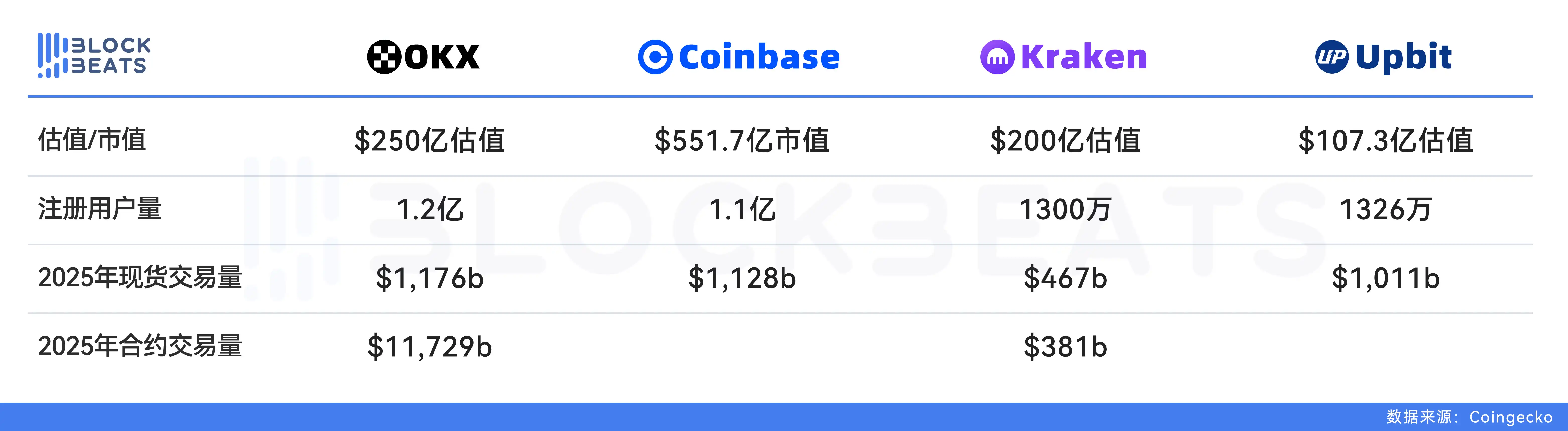
According to BlockBeats' analysis of exchange platforms in 2025, OKX's $25 billion valuation doesn't seem expensive.
Coinbase has a spot trading volume similar to OKX but almost no futures trading volume, with a market cap of $55 billion, double that of OKX.
Kraken is lagging behind OKX in both spot and futures trading volumes, with a $20 billion valuation, only 20% lower than OKX's valuation; while Upbit, despite being South Korea's largest, lacks tether-usdt-257">USDT">a futures section, and its earning potential seems far less than OKX's. Upbit has a $10.7 billion valuation, making OKX's valuation more than double that of Upbit's.
Robinhood has 23 million users, but the disclosed Crypto section's trading volume for 2025 is only $82 billion, making it incomparable.
Apparently, looking at the data, 250 billion is underestimated, considering the publicly available user count. OKX is already the largest in terms of users, and this is basically without any U.S. users yet. Considering the user count of Coinbase and Kraken, OKX theoretically has tens of millions of new users to tap into.
This means that the U.S. stock market is about to welcome a user base that will be twice that of Coinbase, with an overall trading volume much larger than Coinbase, yet valued at only half of Coinbase's trading platform.
The listing time for OKX is currently unknown. Based on Polymarket, it seems unlikely to list this year. There have been some rumors suggesting that OKX's listing time might be in 2028, hopefully a year much more promising for cryptocurrency than the present.
The hopefulness depends on the narrative, which is also what ICE values in this investment. Reports indicate that this investment aims to drive the development of blockchain-based stock trading, in other words, stock tokenization.
OKX's founder and CEO, Star, shares the same sentiment. He mentioned that OKX plans to provide its global user base of over 1.2 billion with access to ICE's U.S. futures market and New York Stock Exchange (NYSE) tokenized stock market opportunities, exploring a path for the convergence of traditional financial markets and digital asset infrastructure within a compliant framework.
The integration of Tradfi and Crypto is no longer a question of possibility but rather a question of the extent of integration. There was once a platform that saw this trend a few years ago and envisioned that the ultimate competitor in the future must be Nasdaq. Thus, they aimed to create an on-chain Nasdaq, reaching a valuation of 32 billion USD. Unfortunately, they took a wrong step. Nevertheless, an on-chain Nasdaq is Crypto's inevitable path, and now it is a race to see who will secure the leading position in this new narrative.
OKX's growth journey certainly has had many twists and turns, but it remains a great story.
Still, he is a Chinese entrepreneur who has just turned 41 this year, founding the company in 2013, undergoing three rebranding efforts, expanding the business to be regulated by multiple countries, and having to pay a $500 million fine to the U.S. Department of Justice, ultimately culminating in a successful listing in the U.S.
You may also like

Morning News | CME Group launches Nasdaq Cryptocurrency Index futures; Asset management giant Janus Henderson strategically invests in Ethena

Why did Oracle deliver the strongest financial report in history, yet its stock price fell?

Bitcoin Layer 2 Network Botanix: Why Did We Choose to Dissolve?

Morning Report | OpenAI has submitted an S-1 registration statement draft to the U.S. SEC; Morpho completes $175 million financing

Galaxy Deep Research Report: How Hyperliquid's HIP-4 Upgrade Changes the Landscape of Prediction Markets?

Latest research from 13 top universities including Cornell University: The current state, challenges, and misconceptions of the fusion of Crypto and AI
Deconstructing Anthropic: The Best AI Company, Possibly Also a Type of Organizational Invention

Every exchange is a "Universal Exchange."

The counterattack of traditional finance: Alliance chains are quietly reviving
Pantera Capital Partner: How Tokenization is Restructuring the Private Equity and Early Investment Ecosystem?

Mastercard Launches Agent Pay for AI, Plans to Record AI Agent Payment Authorizations on Polygon
Mastercard launched Agent Pay for AI, a new payment protocol designed to help AI agents make small payments such as pay-per-use access to data and APIs. The system plans to record human-granted AI agent permissions on Polygon, focusing on verifiable authorization, identity, and payment controls.

Curve Deploys Llamalend v2 on Optimism With 250,000 OP Incentives
Curve launched Llamalend v2 on Optimism with 250,000 OP incentives from the Optimism Foundation. The upgrade expands Llamalend beyond its earlier crvUSD-focused model, adding broader collateral support, LlamaRisk market reviews, and the ability to use Curve LP tokens as collateral.

Raydium Old Liquidity Pool Reportedly Exploited, With $1.34 Million Moved to Ethereum and Tornado Cash
An old Raydium liquidity pool was reportedly exploited for around $1.34 million in USDC, RAY, and wSOL, with the stolen funds bridged to Ethereum and deposited into Tornado Cash. The incident highlights the tail risks of legacy DeFi pools, old contracts, and cross-chain fund laundering paths.
Kalshi Executive Challenges “SBF Backed AI Unicorns” Narrative, Says Leopold Aschenbrenner Was Key Figure
Kalshi executive John Wang questioned the “SBF backed AI unicorns” narrative, saying Leopold Aschenbrenner was the key figure behind major AI investment decisions.

New York Proposes Stricter Stablecoin Issuer Rules Aligned With Federal GENIUS Act
NYDFS proposed stricter stablecoin issuer rules aligned with the GENIUS Act, covering reserves, custody, redemption timelines, audits, and capital buffers.

CryptoQuant Says Bitcoin Profitable Supply Is Near 45% Pressure Zone as On-Chain Data Points to Market Repricing
CryptoQuant said Bitcoin’s profitable supply is nearing the 45% pressure zone, signaling rising market stress, unrealized losses, and a possible on-chain repricing phase.

Bitcoin Falls Below 200-Week Moving Average as On-Chain Data Shows Over Half of Supply in Loss
Bitcoin dropped below its 200-week moving average as on-chain data showed over 50% of circulating supply is now in loss, signaling rising market stress.

CFTC Reportedly Plans New Prediction Market Rules Focused on Manipulation Risk and Public Interest Review
The CFTC is reportedly preparing new prediction market rules focused on manipulation risk, public interest review, and retail trader protections.
Morning News | CME Group launches Nasdaq Cryptocurrency Index futures; Asset management giant Janus Henderson strategically invests in Ethena
Why did Oracle deliver the strongest financial report in history, yet its stock price fell?
Bitcoin Layer 2 Network Botanix: Why Did We Choose to Dissolve?
Morning Report | OpenAI has submitted an S-1 registration statement draft to the U.S. SEC; Morpho completes $175 million financing
Galaxy Deep Research Report: How Hyperliquid's HIP-4 Upgrade Changes the Landscape of Prediction Markets?
Latest research from 13 top universities including Cornell University: The current state, challenges, and misconceptions of the fusion of Crypto and AI


