
- Buy Crypto
- Markets
 Futures
- Spot
- Copy Trade
- Earn
- More
JUP Staking Event + Coinbase Listing Anticipation, Will There Be an Opportunity to Profit from HumidiFi's Public Sale Tonight?

Original Article Title: "Coinbase Pre-listing, Dark Pool HumidiFi Public Sale Tonight, Is There Money to Be Made This Time?"
Original Article Author: Azuma, Odaily Planet Daily
Tonight, the Solana ecosystem dark pool DEX project HumidiFi will officially launch its public sale on the newly introduced launchpad on Jupiter. The public sale will be conducted in three rounds: the first two rounds are exclusive to HumidiFi community whitelist addresses and JUP staking addresses, with a Fully Diluted Valuation (FDV) of $50 million; the final round is open to the public with an FDV of $69 million.
HumidiFi Positioning
HumidiFi's self-positioning is as a liquidity engine in the Internet Capital Market (i.e., Solana's self-positioning).
Distinct from traditional automated market makers (AMMs), HumidiFi is a "professional market maker AMM" (prop AMM) that combines on-chain execution with institutional-grade market-making logic to achieve narrower spreads, deeper liquidity, and execution quality surpassing DEX and CEX competitors.
Specifically, HumidiFi addresses several issues persistently plaguing the traditional AMM model by introducing an active liquidity framework:
· Predictive Pricing: Quotes are generated based on real-time market data and internal risk metrics, rather than solely relying on formulaic curves;
· Dynamic Inventory Management: Continuously adjust risk exposure to mitigate stale quote and mispricing risks, maximizing capital efficiency;
· On-chain Settlement, Off-chain Intelligence: Complex computations are performed off-chain, while asset custody, settlement, and accounting are entirely retained on the Solana blockchain;
· Retail/User-First: Distinguishing retail users from arbitrage or information advantage bots to provide the former with better spreads and lower slippage.
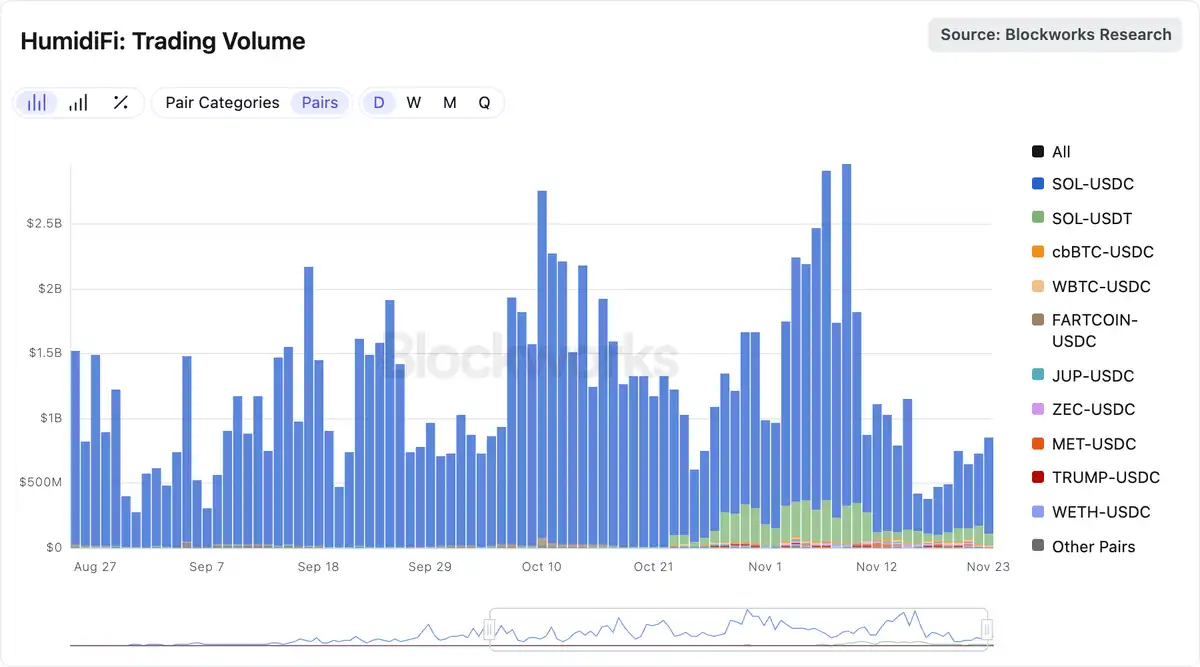
Currently, HumidiFi has become the largest decentralized exchange (DEX) by actual trading volume on Solana's blockchain, processing daily transaction volumes exceeding $1 billion—representing approximately 35% of all Solana on-chain spot DEX trading activity, with about 4% of Solana's daily revenue stemming from these transactions.
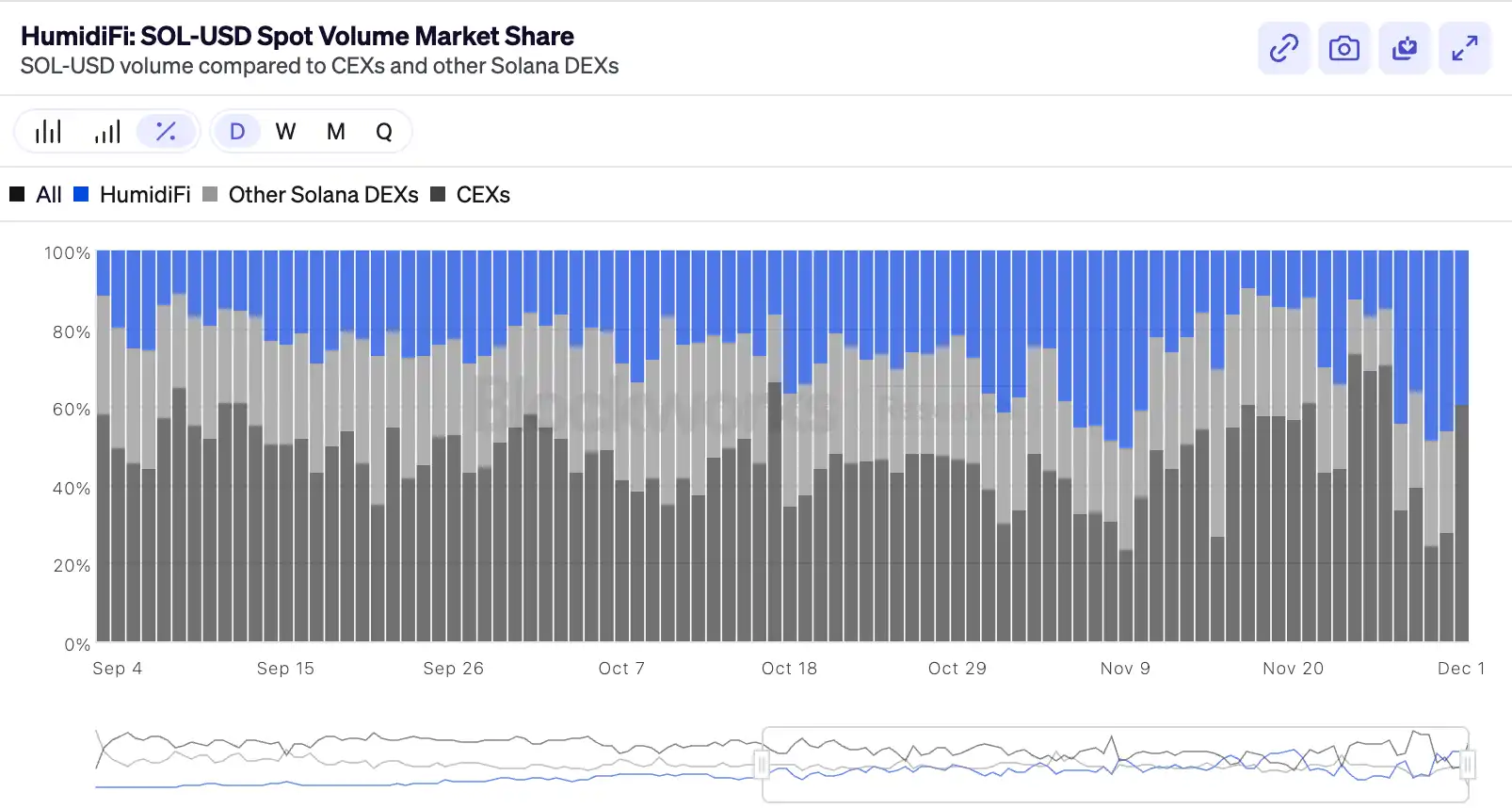
Blockworks data analyst Sharples gave an even more exaggerated figure—HumidiFi settles around 30-40% of the global SOL-USD spot trading volume, with recent SOL-USD weekly spot trading volume exceeding that of Binance. Currently, around 95% of HumidiFi's spot trading volume comes from SOL-USD, but it has recently begun expanding to BTC, ETH, and ZEC.
Tokenomics
Yesterday, HumidiFi officially unveiled the tokenomics of its WET token. The total WET token supply is 1 billion, distributed as follows:
· 10% allocated to a presale event on the Jupiter DFT platform, with no lockup restriction;
· 40% allocated to the foundation, with 8% unlocked at TGE and the remaining portion unlocked in stages over 24 months, unlocking every 6 months;
· 25% allocated to the ecosystem, with 5% unlocked at TGE and the rest unlocked in stages over 24 months, unlocking every 6 months;
· 25% allocated to the team (Labs), with no token unlock at TGE and subsequently unlocked in stages over 24 months, unlocking every 6 months.
Within the most notable 10% presale allocation, 6% will be allocated to the whitelist targeting the HumidiFi ecosystem (including HumidiFi users, active and contributing HumidiFi participants, and HumidiFi Discord community members), 2% will be allocated to JUP stakers, 2% will be allocated to public sale.
Initial Listing Rules and Benefit Assessment
As early as the end of October, Jupiter had already confirmed that the first project on its new launchpad DTF would be HumidiFi. From a data perspective, HumidiFi is deeply intertwined with Jupiter—over 90% of HumidiFi's order flow comes from Jupiter, making the former the primary order execution path for the latter.
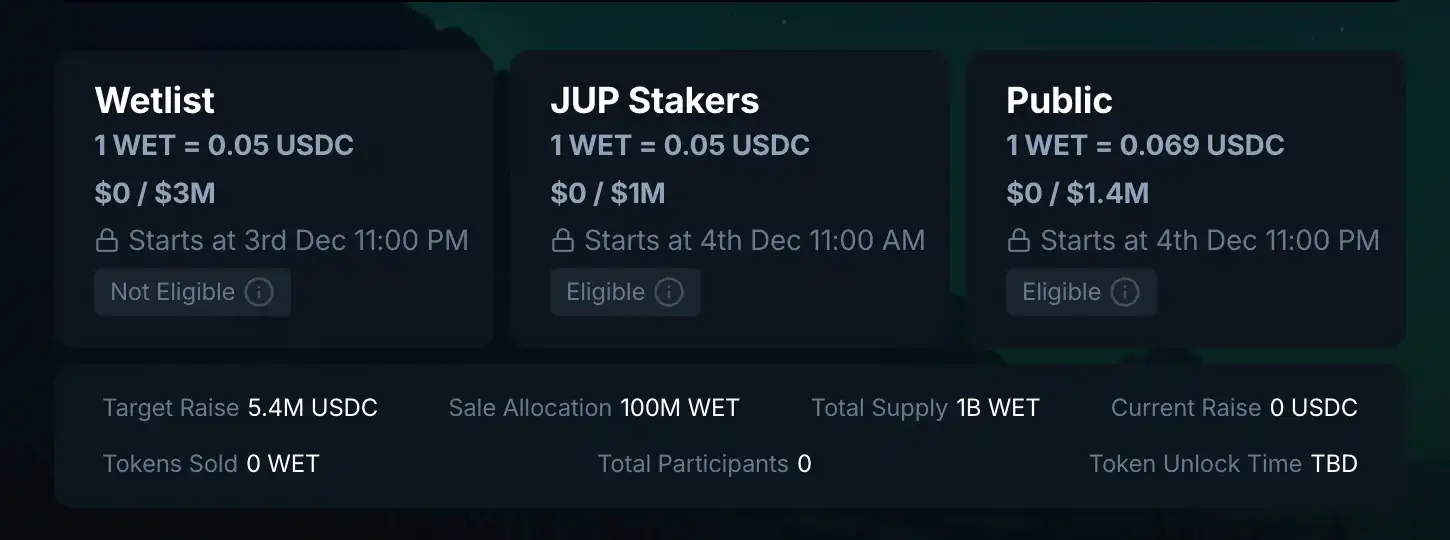
This morning, Jupiter has opened the exclusive interface for this public sale. As shown in the image below, the public sale will be conducted in three rounds, and users can connect their wallet address to check if they qualify for each round.
· Whitelist Round (opens tonight at 11:00 PM UTC): FDV valued at $50 million (1 WET = 0.05 USDC), aiming to raise $3 million with an first-come, first-served allocation.
· JUP Staking User Round (opens tomorrow morning at 11:00 AM UTC): FDV valued at $50 million (1 WET = 0.05 USDC), aiming to raise $1 million with a first-come, first-served allocation.
· Public Round (opens tomorrow night at 11:00 PM UTC): FDV valued at $69 million (1 WET = 0.069 USDC), aiming to raise $1.4 million with a first-come, first-served allocation.
This morning, Coinbase announced the addition of Humidifi (WET) to its listing roadmap, which may benefit the price trend after WET is listed.
Overall, compared to the project's current data performance and community discussion, the valuation of Humidifi in this public sale is not considered high, and there should be room for appreciation. Additionally, this public sale does not impose lock-up restrictions, so there is no issue of fund immobilization, making it relatively more favorable to participate. However, the overall allocation of this public sale is not considered high, and due to the first-come, first-served mechanism, there is expected to be significant competition—rather than whether it's worth participating, the real question might be whether you can secure an allocation.
Original Article Link
You may also like

50 million USDT exchanged for 35,000 USD AAVE: How did the disaster happen? Who should we blame?

The Cryptographic Past of the Middle East

Resolving the Intergenerational Prisoner's Dilemma: The Inevitable Path of Nomadic Capital Bitcoin

Who Will Control AI? Why Decentralized AI May Be the Only Alternative to Government and Big Tech
AI has become critical infrastructure, and governments and corporations are competing to control it. Centralized development and regulation are entrenching existing power structures. The Web3 community is building a decentralized alternative — distributed compute, token incentives, and community governance — before that window closes.

Vitalik wrote a proposal teaching you how to secretly use AI large models

On the eve of the explosion of on-chain options

WEEX AI Hackathon: How Did This AI Trading Winner Succeed?
A self-taught AI trading enthusiast achieved top-10 results at the WEEX AI Hackathon. Learn about the mindset, AI tools, and lessons behind this impressive performance.

One Balance to Rule Them All: Gravitas' On-Chain Prime Broker Ambition

That person who cashed out at the NFT peak is now selling a new shovel in the OpenClaw craze

Inter-generational Prisoner's Dilemma Resolution: The Nomadic Capital and Bitcoin's Inevitable Path

Upstream and downstream are starting to fight, all for the sake of everyone being able to "Lobster"

Circle and Mastercard Announce Partnership, the Next Stage for the Crypto Industry Belongs to Payments

From 5 Mao per kWh of Chinese electricity to a $45 API export: Tokens are rewriting currency units

Why is OpenAI playing catch-up to Claude Code instead?

Vitalik wrote a proposal teaching you how to secretly use AI large models

The doubling of Circle's stock price and the paradigm shift of stablecoins

Key Market Information Discrepancy on March 13th - A Must-See! | Alpha Morning Report

On-Chain Options Explosion.ActionEvent
50 million USDT exchanged for 35,000 USD AAVE: How did the disaster happen? Who should we blame?
The Cryptographic Past of the Middle East
Resolving the Intergenerational Prisoner's Dilemma: The Inevitable Path of Nomadic Capital Bitcoin
Who Will Control AI? Why Decentralized AI May Be the Only Alternative to Government and Big Tech
AI has become critical infrastructure, and governments and corporations are competing to control it. Centralized development and regulation are entrenching existing power structures. The Web3 community is building a decentralized alternative — distributed compute, token incentives, and community governance — before that window closes.


 App
App