
Milestone AI-driven Layoff, a 50% Reduction in Force, Resulting in Unquestionable Capital Market Approval

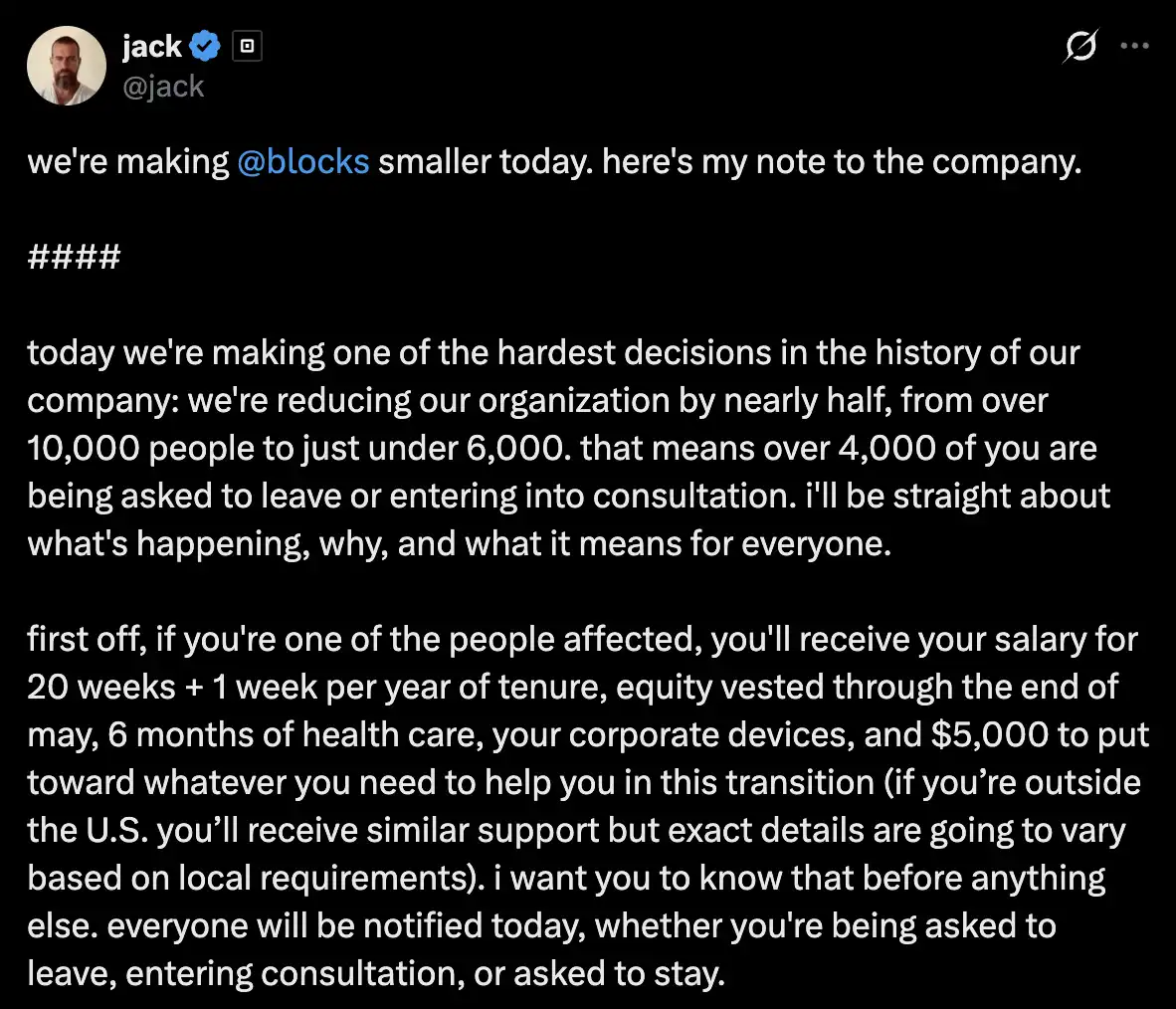
Last night, Jack Dorsey, the founder of the American payment company Block and also the original founder of Twitter acquired by Musk, released a company-wide email that shook Silicon Valley.
A 50% reduction in workforce, transforming a company of over ten thousand people into fewer than six thousand in an instant. However, unlike Musk's swift actions, Dorsey provided an extremely generous compensation package — starting with a 20-week salary, six months of health insurance, and even a $5000 "transition allowance."
He even requested that the Slack channel remain open until Thursday night so that departing employees could say goodbye gracefully.
However, the capital market never believes in tears, only in efficiency.
Almost at the same time as the company-wide email was released, Block's stock price soared. Wall Street's logic is simple yet ruthless, and the market's enthusiastic feedback told this former Twitter founder: you did something extremely right, yet extremely cruel.
The core of Block's layoffs is a internal AI tool they call "Goose."
If Klarna's layoffs in 2024 targeted customer service, and Dell's layoffs in 2025 targeted sales, then Block's earthquake in 2026 directly shattered the careers of engineers and project managers.
According to leaked technical details, Goose's "dimensionality reduction" impact on traditional corporate positions is reflected in three hardcore dimensions:
First, for coders, a traditional AI assistant could only write code snippets. But Goose has "global read-write access" to Block's massive legacy codebase.
In the past, modifying a cross-border payment interface required alignment among the payment, risk control, and clearing departments, with 5-8 engineers struggling for two weeks. With Goose, input natural language, Goose automatically scans all microservices, identifies dependency conflicts, and directly generates a Pull Request. Those mid-level engineers responsible for "interface alignment" instantly lost their value.
Next is operations. Block's payment business requires 24/7 uninterrupted service. Previously, this required a large-scale operations team working in shifts. Now, Goose can analyze logs 10 times faster than humans, autonomously perform rollbacks or scaling. It's basically the "unmanned" operations mentioned in Dorsey's email.
The most tragic impact was on project managers. Dorsey detests "communicating just for the sake of communicating." Those in intermediary roles translating between customer requirements and development tasks had their jobs taken over by Goose.
Block's recent layoff can essentially be defined as a milestone event for the AI industry in 2026.
Prior to this, people's perception of AI was still at the "tool" stage—enhancing personal efficiency, allowing one person to do the work of two. However, Block's case proves that AI truly changes a company's organizational structure. More cruelly, it provided tech giants with the perfect "fig leaf."
Turning back the clock to 2020 to 2022, amidst the frenzy of the zero interest rate era, Silicon Valley once fell into an irrational "hoarding talent race." At the end of 2019, Block's total number of employees was less than 4,000, but during the following three-year frenzy, this number skyrocketed to over 12,000, expanding threefold. While blindly expanding its workforce, Dorsey also defiantly spent nearly $300 million to acquire the streaming platform Tidal, which had no relevance to its core financial business.
As the tide receded, the bloated figure became the tech giants' heaviest shackle. How to cut off these historical burdens while not exposing a strategic failure in the capital market? The answer is to tell a cost-reduction and efficiency-improvement story with AI. The departure of these 4,000 employees not only once and for all bought out the "organizational debt" but also means that Block will directly save nearly $1 billion in annual operating expenses. After the big clean-up, the remaining 6,000 employees will support the company's massive annual revenue of over $22 billion, with annual revenue per employee soaring to over $3.5 million. This is a seductive model that even Wall Street cannot resist.
Packaging violent layoffs as an "AI-embracing organizational restructuring" not only conceals management's past oversight of blind expansion but also allows the company to naturally transform into a pioneer of the new era. Wall Street does not need to investigate what mistakes were made in the past; as long as they see that the saved $1 billion can directly translate into the next quarter's net profit expectations, that is enough to send the stock price soaring by 24%.
As Cobo's founder Fish God said: "What AI truly changes is not the enhancement of human skills but the transformation of a company's organizational structure."
From blind expansion and strategic redundancy during the pandemic to a small-scale test of marketing and customer service in early February, to now a "50% cut" in the core technical layer with the help of Goose, Block has completely undergone a power transition: from a "labor-intensive internet company" to a "native AI logic company," undergoing a brutal paradigm shift.
You may also like

Cryptocurrency market makers collectively seek change as it becomes increasingly difficult to make money

a16z Crypto Partner: Cash flow is the moat

Citibank releases "2030 Asset Tokenization Market Outlook": 6 major trends may create a $8.2 trillion market

The trillion-dollar valuation test: Are the three major super IPOs a celebration for tech stocks or a nightmare for the crypto market?

Morning Report | Digital Asset completes $355 million financing led by a16z Crypto; Meta completes operational separation from Manus

Morning News | CME Group launches Nasdaq Cryptocurrency Index futures; Asset management giant Janus Henderson strategically invests in Ethena

Bitcoin Layer 2 Network Botanix: Why Did We Choose to Dissolve?

Why did Oracle deliver the strongest financial report in history, yet its stock price fell?
When the P2P illicit funds from ten years ago turned into 60,000 bitcoins

Dialogue with OmenX Founder: Why does the prediction market need an evolution from "spot" to "derivatives"?
Galaxy in-depth report: Is Solana still worth paying attention to?

Young people in South Korea make a "final effort" in the epic bull market
The pricing controversy of Trade.xyz exposes the fatal weakness of Pre-IPO perpetual contracts
How much longer can Ethereum's last big buyer hold on?

World Cup 2026 Coming – WEEX Celebrates with $1M Prize Pool & Michael Owen Live

Morning Report | OpenAI has submitted an S-1 registration statement draft to the U.S. SEC; Morpho completes $175 million financing

Galaxy Deep Research Report: How Hyperliquid's HIP-4 Upgrade Changes the Landscape of Prediction Markets?

Latest research from 13 top universities including Cornell University: The current state, challenges, and misconceptions of the fusion of Crypto and AI
Cryptocurrency market makers collectively seek change as it becomes increasingly difficult to make money
a16z Crypto Partner: Cash flow is the moat
Citibank releases "2030 Asset Tokenization Market Outlook": 6 major trends may create a $8.2 trillion market
The trillion-dollar valuation test: Are the three major super IPOs a celebration for tech stocks or a nightmare for the crypto market?
Morning Report | Digital Asset completes $355 million financing led by a16z Crypto; Meta completes operational separation from Manus
Morning News | CME Group launches Nasdaq Cryptocurrency Index futures; Asset management giant Janus Henderson strategically invests in Ethena

Popular coins
Latest Crypto News


