

「Prediction Market Leader Stock」 Kalshi Surges Over 20% in Pre-market Trading, Is it Still a Buy?


Original Title: "Kalshi Pre-Market Stock Price Surges, Is It Still a Good Time to Buy?"
Original Author: Wenser, Odaily Planet Daily
The size and trading volume of the prediction market continue to grow rapidly. IPO pre-market of top platforms such as Kalshi and Polymarket has also attracted certain market attention and liquidity. According to PreStocks platform data, Kalshi's pre-market stock price has surged by 21.7% in the past 30 days, far exceeding the one-month increase of mainstream coins such as BTC and ETH.
Before the IPO cake is served, the Pre-IPO sector may be a battleground suitable for more people to participate early. In this article, Odaily Planet Daily will analyze from the perspectives of industry track, platform data, and capital valuation whether it is worth doubling down on the prediction market stock pre-market.
"Prediction Market Still Has 100x Upside Potential" Behind the Judgment: Total Trading Volume to Exceed $50 Billion by 2025
In August last year, 1confirmation founder Nick Tomaino boldly stated that "the prediction market's trading volume will increase by 100 times."
At that time, the "prediction market giants" Polymarket and Kalshi had not yet received financing of over $1 billion, and the valuation was far from the tens of billions of dollars scale. The overall trading volume of the prediction market in July was less than $2 billion, nearly halving compared to the historical peak in October 2024, which exceeded $4 billion. The judgment of 100x growth potential seemed like a baseless talk.
However, in October 2025, Polymarket announced a $2 billion investment from the NYSE parent company ICE Group, with a valuation soaring to $9 billion, and then sought a new round of financing in the range of $12 billion to $15 billion; Kalshi completed two rounds of financing between October and December, with the latest round reaching $1 billion, a valuation skyrocketing to $11 billion, led by Paradigm, with participation from Sequoia, a16z, Meritech Capital, IVP, ARK Invest, Anthos Capital, CapitalG, and Y Combinator, among others.
Behind the frenzy of capital lies the rapid development of the booming prediction market.
According to data related to our previously published "2025 Prediction Market Review: Total Trading Volume Exceeds $50 Billion, Duopoly Market Share Exceeds 97.5%" article:
1. In September 2025, the total trading volume of Kalshi and Polymarket reached $1.44 billion;
2. In October 2025, the prediction market trading volume reached $8.7 billion, with Kalshi leading and Polymarket following;
3. In November 2025, the total trading volume of Kalshi and Polymarket approached $10 billion, with Kalshi's trading volume reaching $5.8 billion, a month-on-month growth of 32%; Polymarket's trading volume reached $3.74 billion, a month-on-month growth of 23.8%.
4. In December 2025, analyst Patrick Scott wrote that in November 2025, the trading volume of the prediction market exceeded $13 billion, more than three times the trading volume during the peak of the 2024 election.
So far, in just a few months, the overall monthly trading volume of the prediction market has increased by about 6 times. Looking at this, a 100-fold increase is not out of reach.
After all, a 100-fold increase from $2 billion is only $200 billion. Compared to the total trading volume of over $50 billion in the 2025 prediction market, it only needs a 4-fold increase. Behind this rapid growth is the surge of Kalshi, a U.S.-based compliant prediction market platform.
Kalshi Poised to Become the "Leading Stock of the Prediction Market": 2025 Trading Volume Nearly $24 Billion, January Trading Volume Expected to Reach $9 Billion
The reason for emphasizing Kalshi's "compliant identity in the U.S. market" is that based on its various licenses and compliance readiness, the IPO door is easier for Kalshi to open. In addition, as a pioneer prediction market platform founded in 2018 (Note by Odaily: the platform was officially launched in July 2021, slightly later than Polymarket), Kalshi's business growth in recent years has also been remarkable.
Kalshi 2025 Performance Report: Annual Trading Volume of $23.8 Billion, 97 Million Trades
KalshiData previously stated that in 2025, all Kalshi metrics saw record growth.
· In terms of nominal trading volume, the total for the year reached $23.8 billion, a year-over-year increase of 1108%, approximately 12.1 times. In December, a monthly all-time high of $6.38 billion was reached, a weekly all-time high of $1.7 billion in the fourth week of December, and a daily all-time high of $381.7 million on December 21st.
· In terms of number of trades, the total for the year reached 97 million trades, a year-over-year increase of 1680%, approximately 17.8 times. In December, there were 27.67 million trades, 7.6 million trades in the fourth week of December, and 1.5 million trades on December 21st, all reaching all-time highs.
As we entered 2026, Kalshi's business data growth can be described as nothing short of staggering.
Kalshi Business Surge: January 2026 Nominal Trading Volume Expected to Exceed $9 Billion
On December 16, 2025, Kalshi CEO Tarek Mansour announced that with the launch of the Combo feature, the platform reached a historic daily trading volume of $340 million;
On January 12, 2026, the prediction market's daily trading volume surged to around $702 million, setting a new record; of which, Kalshi accounted for approximately $465 million, about two-thirds of the total volume, while Polymarket and Opinion collectively contributed about $100 million in trading volume.
On January 26, KalshiData announced that as of January 23, Kalshi's monthly nominal trading volume was around $6.7 billion, with a daily average trading volume of about $293 million. If this pace is maintained, Kalshi's January nominal trading volume is expected to reach around $9.1 billion.
It is worth mentioning that in October of last year, the overall prediction market trading volume was $8.7 billion, with Kalshi's market share ranging from 45%-55%; now, the monthly trading volume of just the Kalshi platform alone exceeds the total market size at that time. This not only reflects the overall boom of the prediction market but also demonstrates the frightening pace of Kalshi's business growth.
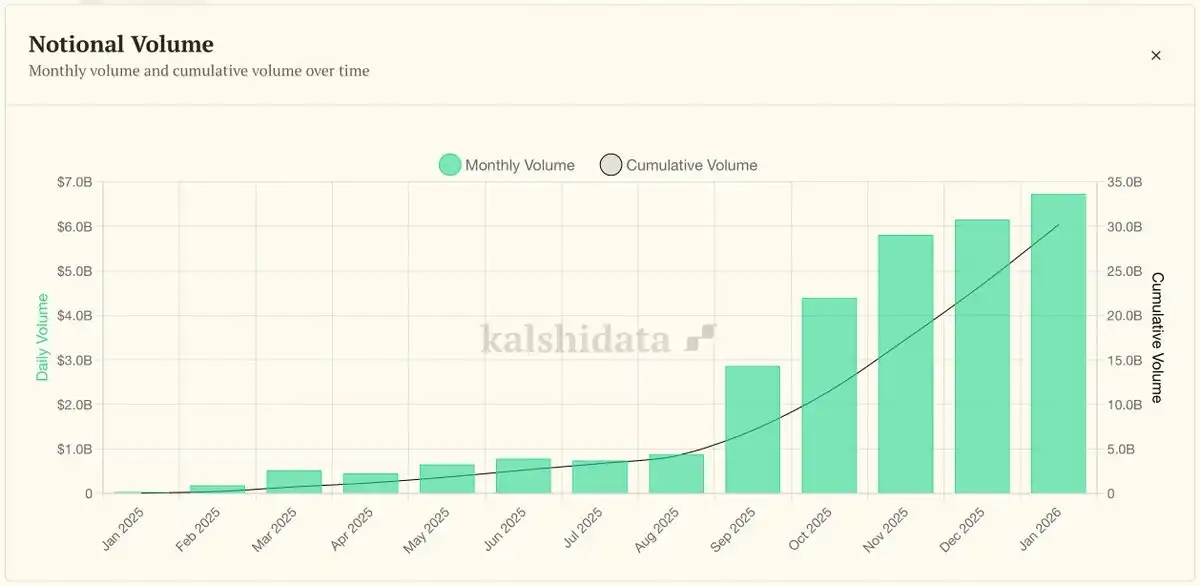
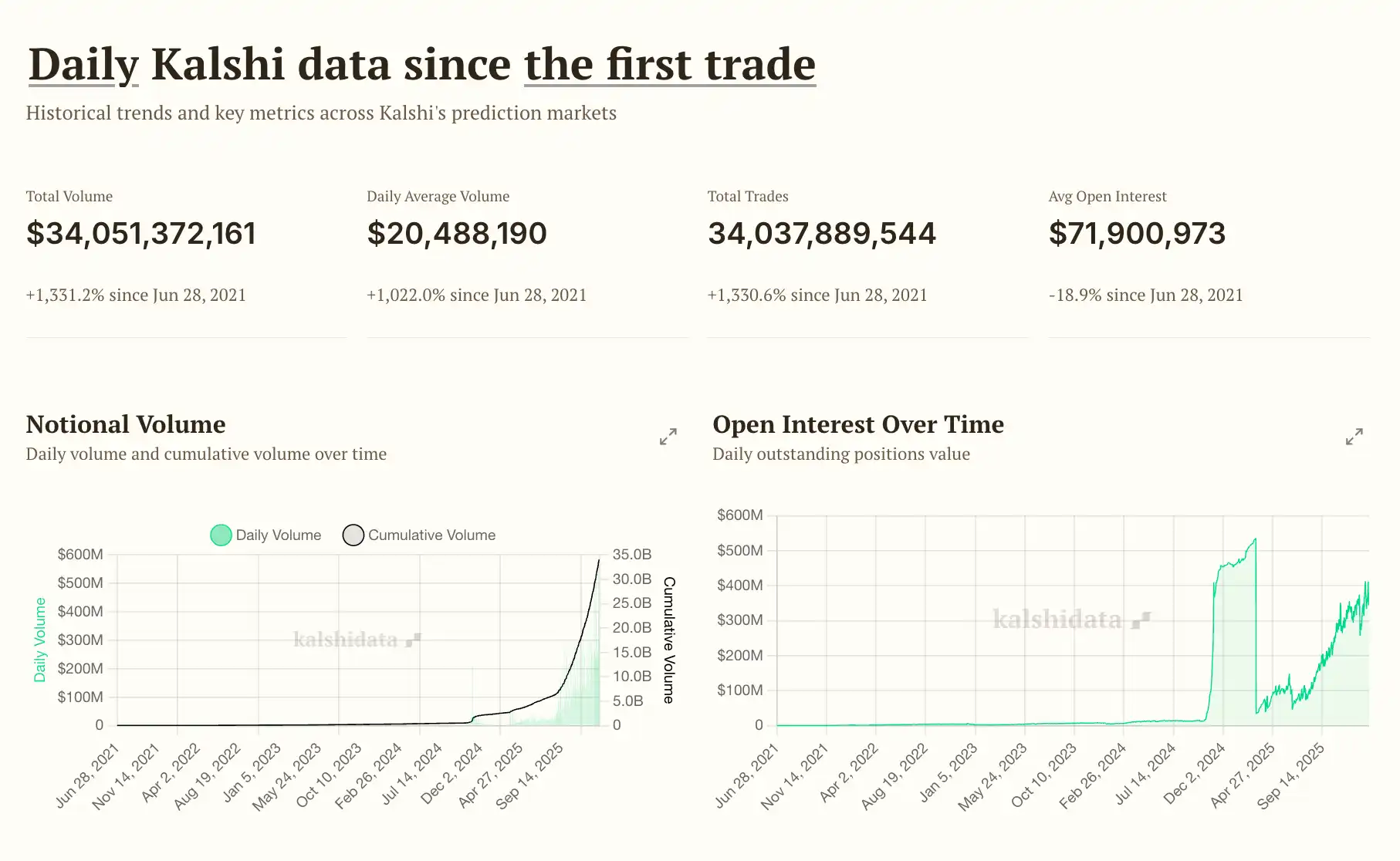
According to data from the KalshiData website, as of January 29, Kalshi's total historical trading volume has exceeded $34.05 billion, with a daily average trading volume of over $20.48 million; and looking at the nominal trading volume's candlestick chart, since September 2025, it has shown almost exponential growth.
Capital Market Pricing Range: Kalshi's Single Stock Price is $300-$450
Finally, as the current market leader in the prediction market space, although the specific timing and number of shares for the Kalshi IPO have not been determined, considering its previous funding news and public statements, an IPO is a sure thing. Currently, there are many differences between the pre-market stock valuations of the two in both the traditional financial markets and the cryptocurrency markets:
The pre-market valuation of Kalshi's stock in the traditional financial markets is relatively low—
· On the Nasdaq Private Market, the price per share of Kalshi is around $307;
· On Hiive, the price per share of Kalshi is around $357.
The pre-market valuation of Kalshi's stock in the cryptocurrency markets, on the other hand, is relatively high—
· On PreStocks, the implied market cap of Kalshi is around $14 billion, with a price per share of around $407;
· On Jarsy, Kalshi's market value is $11 billion, with a price per share of $450.
You may also like

The arrival of the Web 3.0 era: A review of Hong Kong court rulings on digital assets

Track Markets At a Glance: New WEEX Price Widgets for iOS & Android
To streamline your market data access, WEEX has officially launched "Market Watchlist" desktop widgets

The billion-dollar lesson: The focus of DeFi security is shifting from code to operational governance

A Brief Analysis of Stablecoin Licenses and On-Chain Funding
BVNK Founder: Three Stages of Stablecoin Development

The truth about Trump's son's Bitcoin game: he made a staggering $100 million while retail investors lost $500 million

What Is Futures Trading? Hours, Platforms, and How to Start Trade Futures(2026 Guide)
Learn how to start futures trading, understand trading hours, and choose the best futures trading platform. Includes real data, strategies, and ways to maximize returns with rebates.

The Rise of Composable RWA

MAGA Up 350% in 24 Hours, PEPE Up 46% in One Day: Which Memecoins Are Next in 2026?
MAGA +350% in 24hrs. PEPE +46% in one day. RAVE +4,500% then -90%. In 2026's memecoin market, the gains are real. So are the traps? Here's how to tell the difference before you buy.

RCD Espanyol vs Real Madrid: Can the Pericos Delay the Inevitable?
RCD Espanyol vs Real Madrid lineups, standings, and stats for May 3, 2026. Real Madrid visits RCDE Stadium as Barcelona closes in on the LALIGA title. Full preview inside.
MegaETH goes live with an FDV exceeding 2 billion USD. Which ecological projects are worth paying attention to?

Dialogue with "Wood Sister" Cathie Wood: The next bull market is about to arrive
Can prediction markets win the competition for perpetual contracts?

Who is trading on Trade.xyz?

Binance quietly placed a bet on a leading large model company

Best Crypto Discord Server 2026: Why Jacob’s Crypto Clan Is Gaining Massive Attention
Jacob’s Crypto Clan has grown into one of the most active crypto Discord communities, with over 45K members and continuing to expand. This rapid growth reflects strong demand for structured trading insights and real-time collaboration.

Tom Lee Buying ETH: Why Wall Street’s Loudest Ethereum Bull Keeps Doubling Down
Tom Lee keeps buying ETH through every dip, every drawdown, and every moment of market doubt. Inside the strategy that's turning Ethereum into a treasury asset — and what it signals for the rest of the market.

Stripe Sessions 2026: AI Agent, Global Payments, and Invisible Crypto Infrastructure
The arrival of the Web 3.0 era: A review of Hong Kong court rulings on digital assets
Track Markets At a Glance: New WEEX Price Widgets for iOS & Android
To streamline your market data access, WEEX has officially launched "Market Watchlist" desktop widgets
The billion-dollar lesson: The focus of DeFi security is shifting from code to operational governance
A Brief Analysis of Stablecoin Licenses and On-Chain Funding
BVNK Founder: Three Stages of Stablecoin Development
The truth about Trump's son's Bitcoin game: he made a staggering $100 million while retail investors lost $500 million


