
 Buy Crypto
- Markets
 Futures
- Spot
- Copy Trade
- Earn
- More
Rhythm X Zhihu jointly hold a Web4.0-themed event: When AI Agent Takes Over On-Chain Governance


Most discussions about Web 4.0 are somewhat problematic.
Their question is: Is this the next marketing cycle? Is Web 4.0 another wave of buzzword creation? These questions are not important. There is only one real question: the underlying permission of the internet, shifting from whom to whom?
Putting this question into historical context, the answer has always been quite clear. Web 1.0 was read-only — users were consumers of content, with no write permissions. Web 2.0 granted write permissions — you could post, upload, comment, but the platform owned your data. Web 3.0 granted ownership — assets on-chain, private keys in your hands, the platform unable to seize your wallet.
Each iterative generation has fundamentally been a downward transfer of permission.
Web 4.0 continues along the same logical line, but the transferee has changed. It is not a transfer to users, but a transfer to Agents.
An overlooked structural fact: the entire architecture of the internet has been inherently “human-centric” for a long time.
Web 2.0’s UI/UX was designed for the human cognitive bandwidth — information density, click paths, color contrast, every parameter behind it was an estimation of the human attention limit. Web 3.0’s KYC verification, mnemonic backup, multi-signature approval, is essentially addressing human vulnerabilities to errors and attacks.
The whole system serves the limitations of humans, not their capabilities.
However, in the AI era, this logic begins to break down. When an Agent gains on-chain permissions, it faces the same system designed for humanity, but it does not need a polished UI, password recovery, SMS verification, or even a nap before transaction confirmation.
This is the core contradiction of Web 4.0: an internet infrastructure designed for human cognitive limitations encountering new participants without cognitive limitations. A rebuild is inevitable.
The ongoing rebuild can be observed from two dimensions.
The first dimension is the breakdown of the frontend. Traditionally, a beautiful UI was designed for human visual processing. Agents primarily communicate through APIs and code logic, where the interface is noise, not an entrance. Once the Agent becomes the main protocol interactor, frontend logic shifts from “how to make the user understand” to “how to make the machine read.” This is a paradigm shift that frontend development has never encountered in the past thirty years.
The second dimension is the replacement of the authentication system. Password-based systems assume that the logging-in entity is a human with memory constraints—passwords need to be short enough to remember, yet long enough to be secure. This contradiction has driven the entire password management industry. But the Agent does not need to remember passwords. On-chain signatures can be granted and revoked in real-time, with permission granularity accurate to a single operation. The account system will be gradually replaced, not because it was designed poorly, but because its design premise has become outdated.
The transformation of these two dimensions, summed up in one sentence: the entrance of the Internet will shift from a revolving door designed for humans to an API interface designed for machines.
Within this process of infrastructure rebuilding, there is a specific closed loop that is worth examining separately.
AI has powerful decision-making capabilities, but it inherently lacks two things: an independent payment channel and asset sovereignty.
An Agent can analyze sentiment data from the global gold market in milliseconds and provide the optimal allocation decision—but if it does not have an independent funding account, this decision still needs to be executed by a human. The delay in the execution phase will negate all the advantages accumulated in the analysis phase.
Crypto completes this shortcoming.
Take Hyperliquid, for example: its perpetual contract market for commodities such as gold, silver, and oil operates 24/7. This feature is optional for human traders—positions at three in the morning can be dealt with in the morning. But for an Agent, this is a necessary infrastructure condition because the Agent itself has no concept of sleep; its operation is round-the-clock.
When the Agent takes over the wallet and private keys, it extends from the decision-making layer to the execution layer. AI provides analysis and judgment, Crypto provides settlement infrastructure, and only when combined are they a complete economic entity.
The marginal cost of running an Agent tends toward zero. Its output and transaction execution are round-the-clock. For DeFi protocols, this is an unprecedented ideal counterparty—not emotional, does not forget, does not miss the optimal execution window because of daytime meetings.
This is the true narrative of Crypto × AI: not a combination of two buzzwords, but complementary infrastructures coming together at the same time.
Here is perhaps an imperfect example.
In 1908, the Ford Model T began mass production. In the initial years, the mainstream opinion in the commentary world was that the automobile was an upgraded version of the horse carriage, a toy for the wealthy. No one foresaw that the automobile would rewrite the spatial logic of entire cities, give rise to a chain of gas stations, disrupt railway passenger services, and transform Detroit into a global manufacturing hub.
The key point overlooked was not the automobile itself, but how the automobile altered the entire society's spatiotemporal cost function.
The structural significance of Web 4.0 is similar to this. The surface-level questions—such as which products will boom and which protocols will succeed—are akin to the Model T era's "which car model will sell well." The real proposition is: as Agents become the primary on-chain actors, scaling and concurrency exponentially surpass human capabilities, in what dimension will the economic system's rules undergo a shift?
Based on this logic, BlockBeats and Zhihu will jointly host an event in Hong Kong on April 21 with the theme "Decoding Web 4.0: When AI Agents Take Over On-chain Permissions", seeking some certainty in the face of entirely new propositions.
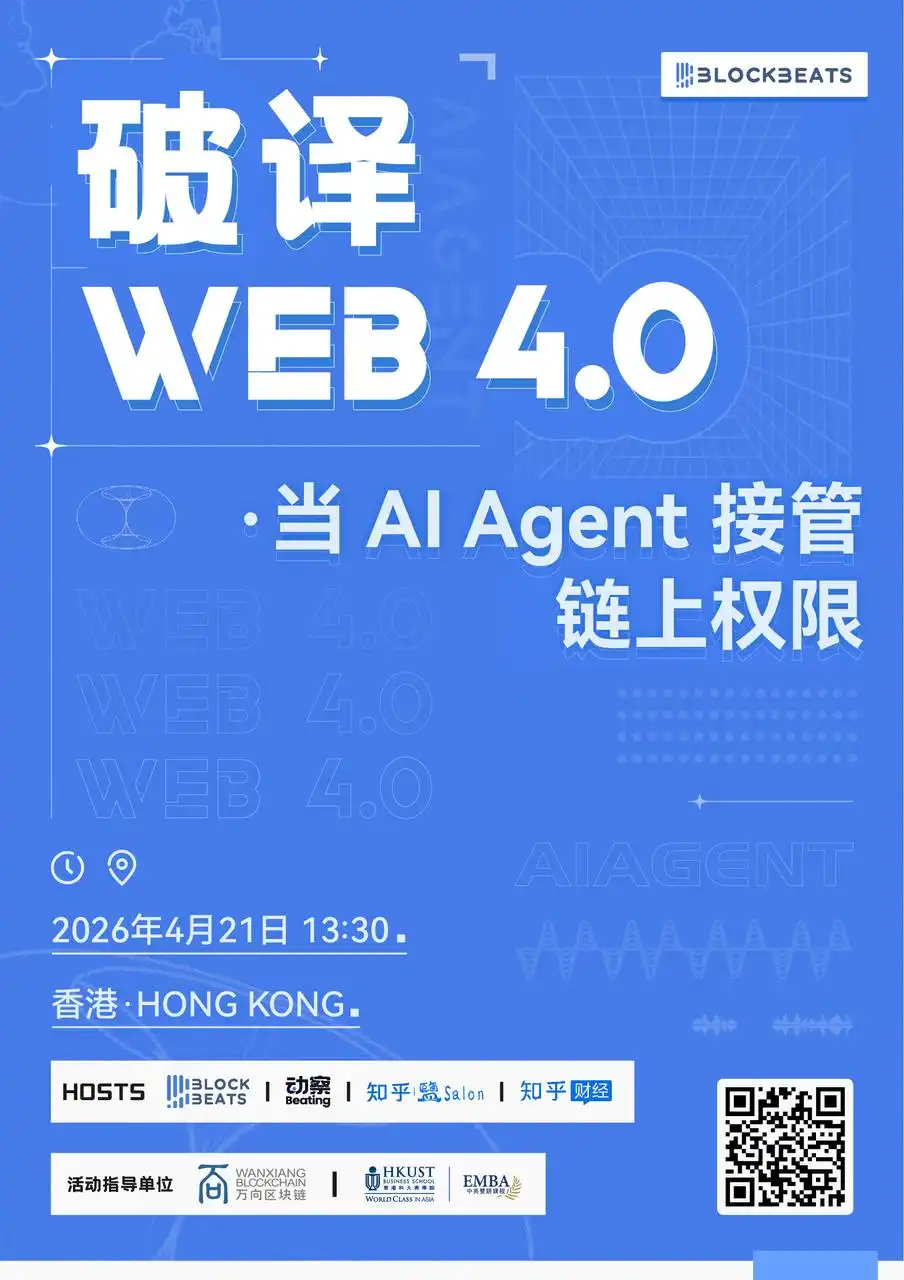
You can scan the QR code to sign up
At this event supported by Wanxiang Blockchain and the Hong Kong University of Science and Technology Business School, top industry leaders will share their unique perspectives. We will discuss the potential of the "Agent Autonomous Economy," the necessity of on-chain automation, and the entirely new financial models brought by Agents.
We have also invited high-quality Skills teams in fields like transactional finance and reshaping payment habits. As the flow of funds is a top priority, everyone aims to have Agents make money. These Skills Demos will showcase the cutting-edge financial transformations that can potentially change our lifestyle habits and perceptions.
Registration is now open. Feel free to scan the QR code on the poster to sign up and learn more about the event (or click the registration link: https://luma.com/r3h4eqkv). We hope the insights from industry leaders will inspire critical thinking. In this era of online anxiety and offline turmoil, let's gain a bit of direction.
For event cooperation, please add WeChat: x18038189105, Tg: @Nokikooo
You may also like

Why can this institution still grow by 150% when the scale of leading crypto VCs has shrunk significantly?

Anthropic's $1 trillion, compared to DeepSeek's $100 billion

Geopolitical Risk Persists, Is Bitcoin Becoming a Key Barometer?

Annualized 11.5%, Wall Street Buzzing: Is MicroStrategy's STRC Bitcoin's Savior or Destroyer?

An Obscure Open Source AI Tool Alerted on Kelp DAO's $292 million Bug 12 Days Ago

Mixin has launched USTD-margined perpetual contracts, bringing derivative trading into the chat scene.
The privacy-focused crypto wallet Mixin announced today the launch of its U-based perpetual contract (a derivative priced in USDT). Unlike traditional exchanges, Mixin has taken a new approach by "liberating" derivative trading from isolated matching engines and embedding it into the instant messaging environment.
Users can directly open positions within the app with leverage of up to 200x, while sharing positions, discussing strategies, and copy trading within private communities. Trading, social interaction, and asset management are integrated into the same interface.
Based on its non-custodial architecture, Mixin has eliminated friction from the traditional onboarding process, allowing users to participate in perpetual contract trading without identity verification.
The trading process has been streamlined into five steps:
· Choose the trading asset
· Select long or short
· Input position size and leverage
· Confirm order details
· Confirm and open the position
The interface provides real-time visualization of price, position, and profit and loss (PnL), allowing users to complete trades without switching between multiple modules.
Mixin has directly integrated social features into the derivative trading environment. Users can create private trading communities and interact around real-time positions:
· End-to-end encrypted private groups supporting up to 1024 members
· End-to-end encrypted voice communication
· One-click position sharing
· One-click trade copying
On the execution side, Mixin aggregates liquidity from multiple sources and accesses decentralized protocol and external market liquidity through a unified trading interface.
By combining social interaction with trade execution, Mixin enables users to collaborate, share, and execute trading strategies instantly within the same environment.
Mixin has also introduced a referral incentive system based on trading behavior:
· Users can join with an invite code
· Up to 60% of trading fees as referral rewards
· Incentive mechanism designed for long-term, sustainable earnings
This model aims to drive user-driven network expansion and organic growth.
Mixin's derivative transactions are built on top of its existing self-custody wallet infrastructure, with core features including:
· Separation of transaction account and asset storage
· User full control over assets
· Platform does not custody user funds
· Built-in privacy mechanisms to reduce data exposure
The system aims to strike a balance between transaction efficiency, asset security, and privacy protection.
Against the background of perpetual contracts becoming a mainstream trading tool, Mixin is exploring a different development direction by lowering barriers, enhancing social and privacy attributes.
The platform does not only view transactions as execution actions but positions them as a networked activity: transactions have social attributes, strategies can be shared, and relationships between individuals also become part of the financial system.
Mixin's design is based on a user-initiated, user-controlled model. The platform neither custodies assets nor executes transactions on behalf of users.
This model aligns with a statement issued by the U.S. Securities and Exchange Commission (SEC) on April 13, 2026, titled "Staff Statement on Whether Partial User Interface Used in Preparing Cryptocurrency Securities Transactions May Require Broker-Dealer Registration."
The statement indicates that, under the premise where transactions are entirely initiated and controlled by users, non-custodial service providers that offer neutral interfaces may not need to register as broker-dealers or exchanges.
Mixin is a decentralized, self-custodial privacy wallet designed to provide secure and efficient digital asset management services.
Its core capabilities include:
· Aggregation: integrating multi-chain assets and routing between different transaction paths to simplify user operations
· High liquidity access: connecting to various liquidity sources, including decentralized protocols and external markets
· Decentralization: achieving full user control over assets without relying on custodial intermediaries
· Privacy protection: safeguarding assets and data through MPC, CryptoNote, and end-to-end encrypted communication
Mixin has been in operation for over 8 years, supporting over 40 blockchains and more than 10,000 assets, with a global user base exceeding 10 million and an on-chain self-custodied asset scale of over $1 billion.

$600 million stolen in 20 days, ushering in the era of AI hackers in the crypto world
Vitalik's 2026 Hong Kong Web3 Summit Speech: Ethereum's Ultimate Vision as the "World Computer" and Future Roadmap
On the same day Aave introduced rsETH, why did Spark decide to exit?
Full Post-Mortem of the KelpDAO Incident: Why Did Aave, Which Was Not Compromised, End Up in Crisis Situation?

After a $290 million DeFi liquidation, is the security promise still there?
ZachXBT's post ignites RAVE nearing zero, what is the truth behind the insider control?

Vitalik 2026 Hong Kong Web3 Carnival Speech Transcript: We do not compete on speed; security and decentralization are the core
In-depth Analysis of RAVE Events: Short Squeeze, Crash, and Quantitative Financial Models of Liquidity Manipulation

Eve of Ceasefire, US Military Fires on Iranian Vessel | Rewire News Morning Brief

Figma's stock price drops over 7%, will Claude Design be the terminator?

Plunge by 10% Followed by Rebound, Weekend Oil Market Watch

SpaceX Mascot ASTEROID Fast Track $170 million, Stemming from an Unfinished Space Dream
Why can this institution still grow by 150% when the scale of leading crypto VCs has shrunk significantly?
Anthropic's $1 trillion, compared to DeepSeek's $100 billion
Geopolitical Risk Persists, Is Bitcoin Becoming a Key Barometer?
Annualized 11.5%, Wall Street Buzzing: Is MicroStrategy's STRC Bitcoin's Savior or Destroyer?
An Obscure Open Source AI Tool Alerted on Kelp DAO's $292 million Bug 12 Days Ago
Mixin has launched USTD-margined perpetual contracts, bringing derivative trading into the chat scene.
The privacy-focused crypto wallet Mixin announced today the launch of its U-based perpetual contract (a derivative priced in USDT). Unlike traditional exchanges, Mixin has taken a new approach by "liberating" derivative trading from isolated matching engines and embedding it into the instant messaging environment.
Users can directly open positions within the app with leverage of up to 200x, while sharing positions, discussing strategies, and copy trading within private communities. Trading, social interaction, and asset management are integrated into the same interface.
Based on its non-custodial architecture, Mixin has eliminated friction from the traditional onboarding process, allowing users to participate in perpetual contract trading without identity verification.
The trading process has been streamlined into five steps:
· Choose the trading asset
· Select long or short
· Input position size and leverage
· Confirm order details
· Confirm and open the position
The interface provides real-time visualization of price, position, and profit and loss (PnL), allowing users to complete trades without switching between multiple modules.
Mixin has directly integrated social features into the derivative trading environment. Users can create private trading communities and interact around real-time positions:
· End-to-end encrypted private groups supporting up to 1024 members
· End-to-end encrypted voice communication
· One-click position sharing
· One-click trade copying
On the execution side, Mixin aggregates liquidity from multiple sources and accesses decentralized protocol and external market liquidity through a unified trading interface.
By combining social interaction with trade execution, Mixin enables users to collaborate, share, and execute trading strategies instantly within the same environment.
Mixin has also introduced a referral incentive system based on trading behavior:
· Users can join with an invite code
· Up to 60% of trading fees as referral rewards
· Incentive mechanism designed for long-term, sustainable earnings
This model aims to drive user-driven network expansion and organic growth.
Mixin's derivative transactions are built on top of its existing self-custody wallet infrastructure, with core features including:
· Separation of transaction account and asset storage
· User full control over assets
· Platform does not custody user funds
· Built-in privacy mechanisms to reduce data exposure
The system aims to strike a balance between transaction efficiency, asset security, and privacy protection.
Against the background of perpetual contracts becoming a mainstream trading tool, Mixin is exploring a different development direction by lowering barriers, enhancing social and privacy attributes.
The platform does not only view transactions as execution actions but positions them as a networked activity: transactions have social attributes, strategies can be shared, and relationships between individuals also become part of the financial system.
Mixin's design is based on a user-initiated, user-controlled model. The platform neither custodies assets nor executes transactions on behalf of users.
This model aligns with a statement issued by the U.S. Securities and Exchange Commission (SEC) on April 13, 2026, titled "Staff Statement on Whether Partial User Interface Used in Preparing Cryptocurrency Securities Transactions May Require Broker-Dealer Registration."
The statement indicates that, under the premise where transactions are entirely initiated and controlled by users, non-custodial service providers that offer neutral interfaces may not need to register as broker-dealers or exchanges.
Mixin is a decentralized, self-custodial privacy wallet designed to provide secure and efficient digital asset management services.
Its core capabilities include:
· Aggregation: integrating multi-chain assets and routing between different transaction paths to simplify user operations
· High liquidity access: connecting to various liquidity sources, including decentralized protocols and external markets
· Decentralization: achieving full user control over assets without relying on custodial intermediaries
· Privacy protection: safeguarding assets and data through MPC, CryptoNote, and end-to-end encrypted communication
Mixin has been in operation for over 8 years, supporting over 40 blockchains and more than 10,000 assets, with a global user base exceeding 10 million and an on-chain self-custodied asset scale of over $1 billion.



 App
App