
The Israeli military is hunting a mole on Polymarket

Original Title: "Israeli Military, Hunting Mole on Polymarket"
Original Author: Azuma, Odaily Planet Daily
The unfair competitive advantage brought by insider information has always been a controversial focus on prediction markets like Polymarket.
Prior to the US military's capture of Venezuelan President Maduro, unusual activity in related events on Polymarket resulted in early odds movement (see "When War Is Settled Before the News: How Prediction Markets 'Priced' Maduro's Arrest 6 Days Early"), and if that suspected insider behavior could still be rationalized by the "pizza index" fluctuation, then this time, with a mole on Polymarket, it can be said to have been definitively confirmed.
Israeli Military's Internal "Ghost" Hunt
On February 12, Israel's largest English-language newspaper, The Jerusalem Post, reported that a civilian and an Israel Defense Forces (IDF) reservist were charged on Monday by a Tel Aviv court, accusing both of using confidential military information to place bets on Polymarket for profit. The court revealed on Thursday that Israeli authorities believe this behavior posed a serious operational security risk during wartime.
According to a statement released by the prosecution with approval, the suspects were arrested in a joint operation involving the Shin Bet, the security agency under the Ministry of Defense, and the Israeli police. Investigators suspect that some reservists were using confidential information they had access to through their military duties to bet on the timing of military operations and profit from it.
Following the above investigation, the prosecution stated that evidence of misconduct by the civilian and the reservist has been obtained, and therefore, they have decided to prosecute both on charges of "serious security offenses," as well as bribery and obstruction of justice. At the same time, the prosecution requested that the suspects be detained until the end of the trial.
In addition to the information already disclosed, more details of the case are still legally restricted, including the identities of the defendants, specific betting content, and the suspected information exchange.
Mole Behavior Tracing
While we cannot ascertain the true identity and account information of this mole, the X community had long identified an account on Polymarket with behavior that was conspicuously abnormal. The Jerusalem Post also posted a profit screenshot of this account in its report.
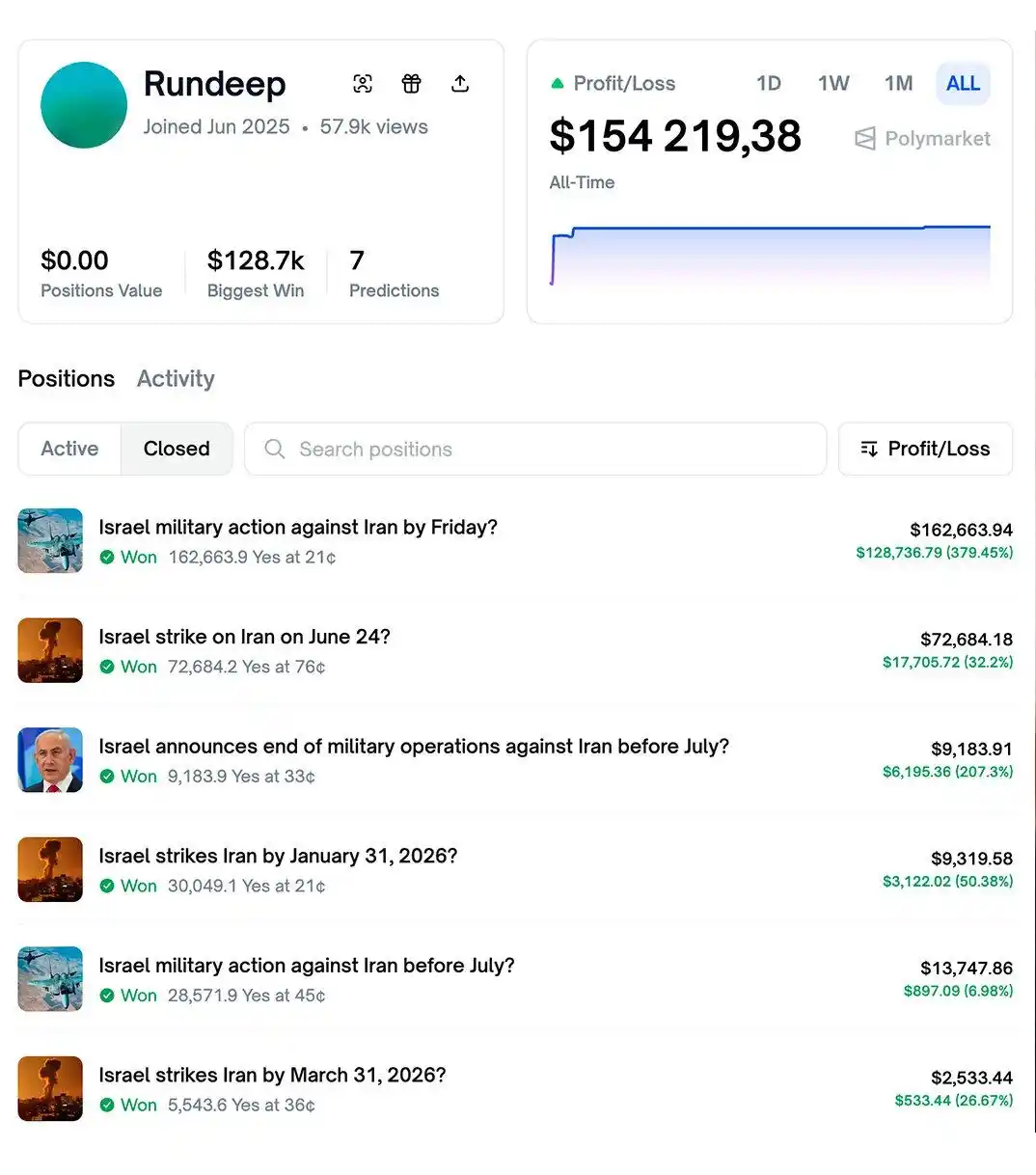
As shown in the above image, a user named Rundeep entered Polymarket in June 2025 and achieved a 100% win rate in six prediction markets related to Israeli military actions, with five of them executed at probabilities below 50%, ultimately earning over $150,000.

It is worth mentioning that an investigation by Odaily found that besides this "six for six" on Polymarket, Rundeep had only one failure, which was not related to Israel directly but was about "whether the US military would take action against Iran before Saturday (June 21, 2025)"... It seems that even allied intelligence is not always reliable.
The Real Backfire of Prediction Markets, A Chilling Thought
Due to Polymarket's open and permissionless nature, anyone can freely place bets on the platform, which objectively provides a more convenient channel for "information monetization" for those with intelligence advantages. Driven by self-interest, individuals with unequal information access find it hard to resist temptation, inevitably leading to insider trading for profit.
If such events occurred in conventional fields like sports and entertainment, the impact would be relatively manageable. However, when such incidents take place in sensitive areas such as politics or even warfare, one can only imagine the chilling consequences of similar insider betting events.
Using this article as an example, if opposing forces speculated on the direction of Israeli actions through insider betting on Polymarket before the operation, could it have a significant impact on the subsequent developments of the situation? While many may find it challenging to empathize with Israel, in reality, such events could happen to any entity.
In traditional gambling sectors, public affairs such as political elections, legislative outcomes, and wars are usually subject to explicit restrictions. Whether prediction markets will face similar regulatory constraints in the future may lead to a long-term regulatory tug-of-war.
You may also like

The U.S. government prohibits foreigners from using Fable 5, Anthropic issues a rebuttal

The other side of Musk's trillion-dollar fortune: 85% cannot be sold

Citibank releases "2030 Asset Tokenization Market Outlook": 6 major trends may create a $8.2 trillion market

The trillion-dollar valuation test: Are the three major super IPOs a celebration for tech stocks or a nightmare for the crypto market?

Morning Report | Digital Asset completes $355 million financing led by a16z Crypto; Meta completes operational separation from Manus

a16z Crypto Partner: Cash flow is the moat

Cryptocurrency market makers collectively seek change as it becomes increasingly difficult to make money

How TradeXYZ, xStocks, and Alpaca break down the SpaceX IPO into three different strategies

$75 billion in risk asset redistribution: How will SpaceX's IPO affect U.S. stocks and Bitcoin?

Why Is BlackRock Investing $5 Billion in the SpaceX IPO?
Morning News | CME Group launches Nasdaq Cryptocurrency Index futures; Asset management giant Janus Henderson strategically invests in Ethena

Bitcoin Layer 2 Network Botanix: Why Did We Choose to Dissolve?

Why did Oracle deliver the strongest financial report in history, yet its stock price fell?
When the P2P illicit funds from ten years ago turned into 60,000 bitcoins
Dialogue with OmenX Founder: Why does the prediction market need an evolution from "spot" to "derivatives"?
Galaxy in-depth report: Is Solana still worth paying attention to?
Young people in South Korea make a "final effort" in the epic bull market
The pricing controversy of Trade.xyz exposes the fatal weakness of Pre-IPO perpetual contracts
The U.S. government prohibits foreigners from using Fable 5, Anthropic issues a rebuttal
The other side of Musk's trillion-dollar fortune: 85% cannot be sold
Citibank releases "2030 Asset Tokenization Market Outlook": 6 major trends may create a $8.2 trillion market
The trillion-dollar valuation test: Are the three major super IPOs a celebration for tech stocks or a nightmare for the crypto market?
Morning Report | Digital Asset completes $355 million financing led by a16z Crypto; Meta completes operational separation from Manus
a16z Crypto Partner: Cash flow is the moat


