

The Secret Whale Behind Gold's Surge: "Crypto's Money Printer" Tether Has Stockpiled 140 Tons

Original Title: "The Secret Whale Behind the Surge in Gold: This Billion-Dollar Annual Revenue Crypto Institution Has Accumulated 140 Tons of Gold"
Original Author: Nancy, PANews
Gold is going crazy. In less than a month since the beginning of the year, funds from all sides have been frantically pouring in, pushing the price of gold to repeatedly hit new all-time highs.
In this precious metal frenzy, an "invisible whale" unexpectedly entered the scene. Stablecoin giant Tether has quietly held 140 tons of gold reserves.
Holding 140 Tons of Gold, Aiming to Become the World's Largest Gold Central Bank
Tether, a company with a "gold mine," is becoming a major player in the gold market.
"We will soon be one of the world's largest 'gold central banks.'" Paolo Ardoino, CEO of Tether, recently said in an interview with Bloomberg, not hiding his ambition.
This is not just talk. As of now, Tether has accumulated about 140 tons of physical gold, valued at approximately $23 billion at the current price. Typically, Tether purchases directly from Swiss refineries and top global financial institutions, with large metal orders often taking several months to be delivered. The gold, upon arrival, is stored in a Swiss nuclear bunker built during the Cold War, with multiple thick steel doors layer by layer protected, and Switzerland has a world-class secrecy system.
In terms of scale, Tether has become the world's largest known holder of physical gold outside the banking system and countries, ranking among the top 30 gold holders globally, with holdings surpassing several countries such as Greece, Qatar, and Australia.
Although Tether began laying out gold assets many years ago, the massive entry occurred in 2025. In just the past year, Tether bought over 70 tons of gold, becoming one of the top three global gold buyers this year. The purchase scale not only exceeds nearly all single central banks except the Polish central bank but also surpasses many large gold ETFs.
It can be said that Tether is also a significant driver of this year's gold price surge.
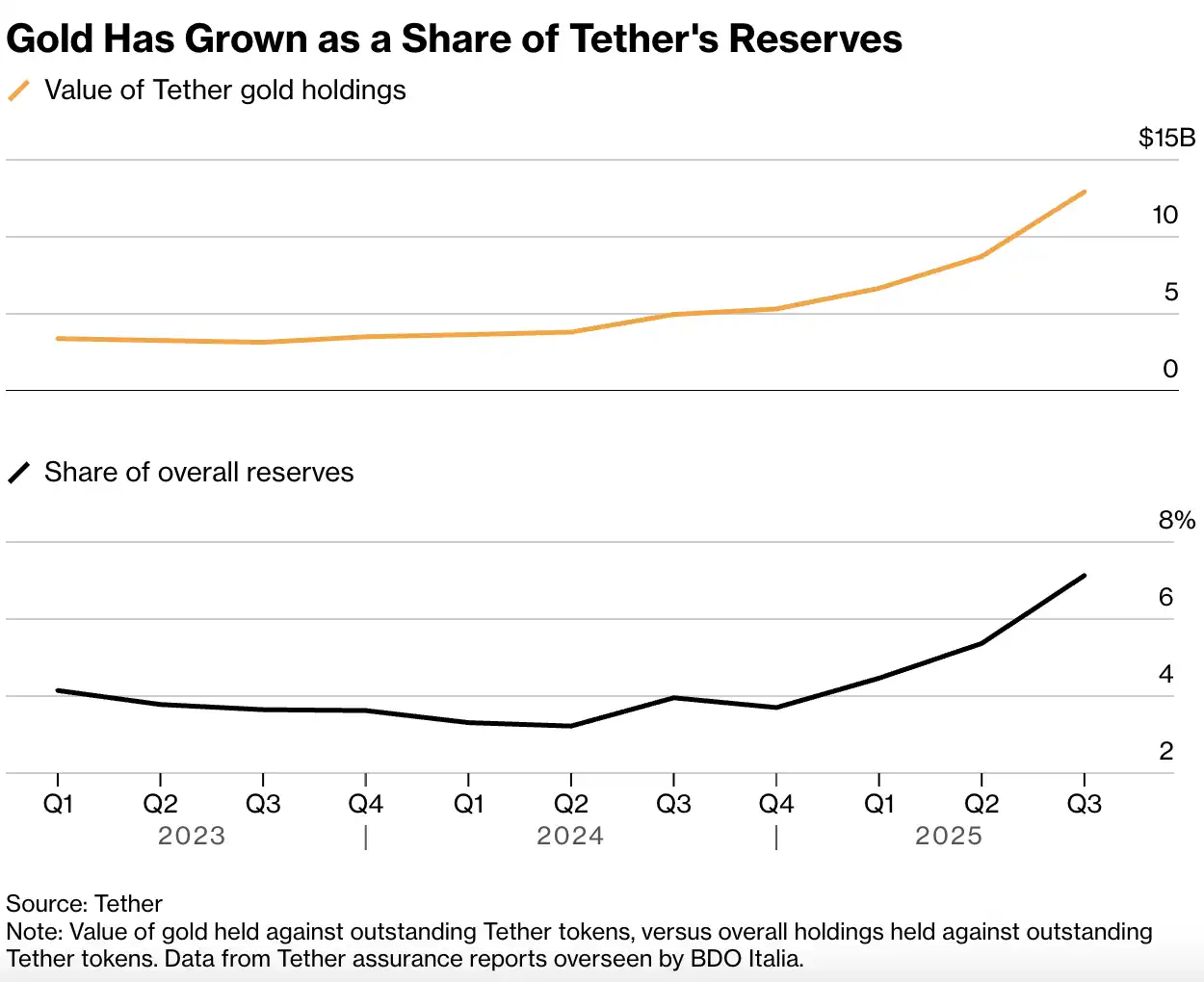
According to Ardoino, Tether's current gold purchase rate is about 1 to 2 tons per week, and they plan to maintain this pace in the coming months, "perhaps slowing down, but we will evaluate gold demand quarterly."
But Tether's ambition goes beyond just hoarding gold. In an interview with Bloomberg, Ardoino stated that Tether is assessing the market and potential trading strategies, planning to capture arbitrage opportunities through active trading of its gold reserves. At the same time, the company is working on building the "world's best gold trading hall," aiming to establish a stable, long-term gold acquisition channel and compete with leading global precious metal market banks such as JPMorgan Chase and HSBC.
To achieve this, Tether made a high-profile move last year by bringing on board two heavyweight trading veterans, former HSBC Global Head of Metal Trading Vincent Domien, and European, Middle Eastern, and African Region Precious Metal Procurement Head Mathew O'Neill, specifically tasked with expanding its gold business footprint.
Upstream in the supply chain, Tether has also begun to position itself with cash capabilities. Tether has acquired stakes in several Canadian mid-tier gold mining royalty companies, including Elemental Royalty, Metalla Royalty & Streaming, Versamet Royalties, and Gold Royalty, among others, securing future production capacity and revenue share through equity investments.
On the financial product front, Tether launched the gold-backed stablecoin Tether Gold (XAU₮) as early as 2020. By the end of last year, this token was backed by 16.2 tons of physical gold. Recently, Tether also introduced Scudo, a new denomination of XAU₮, with each Scudo representing one-thousandth of a troy ounce of gold, aiming to make gold a more user-friendly payment method.
According to CoinGecko data, as of January 28th, the circulating market capitalization of XAU₮ has reached $2.7 billion, growing by approximately 91.3% in the past year, holding a 49.5% market share in the tokenized gold race, firmly securing the top spot.
From physical gold hoarding to supply chain layout, and then to financial product innovation, this gold enthusiast's large-scale investment has even led traditional commodity circle insiders to exclaim "incomprehensible," with some describing Tether as the "strangest company they have ever encountered."
But now, as the price of gold continues to hit new all-time highs, Tether's bet is paying off handsomely.
Earning $15 Billion Annually, Building a War Chest
The confidence behind Tether's frantic gold hoarding comes from a high-speed "printing press."
According to a Fortune report, Tether generated approximately $15 billion in net profit in 2025, a significant increase from the previous year's $13 billion. Despite this billion-dollar profit, the global team supporting it is only about 200 people. Roughly calculated, the per capita profit reaches a staggering $75 million, a level of per capita efficiency that leaves traditional financial giants in the dust.
At the core of this profitability is the fund pool derived from its stablecoin business.
Today, the US dollar stablecoin USDT issued by Tether is the most widely used stablecoin globally, with a user base surpassing 500 million. According to CoinGecko data, as of January 28, 2026, the circulating supply of USDT, the US dollar stablecoin issued by Tether, is close to $187 billion, firmly holding the top spot in the stablecoin race. Trading activity is similarly leading. Artemis Analytics data shows that in 2025, the total stablecoin trading volume grew by 72% to $33 trillion, with USDT contributing $13.3 trillion, accounting for over 33%.
Building on this foundation, Tether is further expanding the scale of its fund pool through compliance.
On January 27, Tether officially launched the US-regulated stablecoin USAT, issued by Anchorage Digital Bank, the first US federally regulated stablecoin issuer, with Cantor Fitzgerald serving as the designated reserve custodian and preferred primary dealer, and former White House advisor Bo Hines appointed as CEO. This is seen as a key step for Tether to fully enter the US domestic market.
Meanwhile, Tether, through investments in platforms like Rumble, is attempting to integrate the USAT business into the traffic ecosystem to quickly reach 100 million US users and has set a goal of reaching a market capitalization of $1 trillion within five years. If successful, USAT could become the first true competitor to USDC in the US market.
After obtaining nearly zero-cost liabilities, Tether easily captures the interest rate spread through high liquidity and low-risk asset allocation.
Among these, US Treasury interest is Tether's core source of income. In a high-interest rate cycle, US Treasury interest directly enhances Tether's profitability. Currently, Tether holds approximately $135 billion in US Treasury bonds, surpassing sovereign nations such as South Korea, making it the 17th largest holder of US Treasury bonds globally.
Meanwhile, Tether is also a big player in the Bitcoin space. Since 2023, Tether has been using up to 15% of its monthly profit for Bitcoin dollar-cost averaging. The current holding has exceeded 96,000 BTC, making it one of the world's largest Bitcoin institutional holders, with an average cost of around $51,000, well below the current market price. In the Bitcoin ecosystem, Tether has also built its own mining farms, invested in mining companies, and ventured into DeFi (Decentralized Finance), continuously expanding its industry influence. There have even been overseas conspiracy theories about Tether being the "Invisible Hand" behind Bitcoin's price movements.
Furthermore, to unlock more potential gains, Tether has adopted a massive token distribution model in recent years, with investments branching out into satellite communications, AI data centers, agriculture, telecommunications, and media.
Thus, an arbitrage machine spanning the traditional financial and crypto worlds has gradually taken shape, constantly providing Tether with capital ammunition and becoming a key chip in its large-scale bets.
You may also like

The arrival of the Web 3.0 era: A review of Hong Kong court rulings on digital assets

Track Markets At a Glance: New WEEX Price Widgets for iOS & Android
To streamline your market data access, WEEX has officially launched "Market Watchlist" desktop widgets

The billion-dollar lesson: The focus of DeFi security is shifting from code to operational governance

A Brief Analysis of Stablecoin Licenses and On-Chain Funding
BVNK Founder: Three Stages of Stablecoin Development

The truth about Trump's son's Bitcoin game: he made a staggering $100 million while retail investors lost $500 million

What Is Futures Trading? Hours, Platforms, and How to Start Trade Futures(2026 Guide)
Learn how to start futures trading, understand trading hours, and choose the best futures trading platform. Includes real data, strategies, and ways to maximize returns with rebates.

The Rise of Composable RWA

MAGA Up 350% in 24 Hours, PEPE Up 46% in One Day: Which Memecoins Are Next in 2026?
MAGA +350% in 24hrs. PEPE +46% in one day. RAVE +4,500% then -90%. In 2026's memecoin market, the gains are real. So are the traps? Here's how to tell the difference before you buy.

RCD Espanyol vs Real Madrid: Can the Pericos Delay the Inevitable?
RCD Espanyol vs Real Madrid lineups, standings, and stats for May 3, 2026. Real Madrid visits RCDE Stadium as Barcelona closes in on the LALIGA title. Full preview inside.
MegaETH goes live with an FDV exceeding 2 billion USD. Which ecological projects are worth paying attention to?

Dialogue with "Wood Sister" Cathie Wood: The next bull market is about to arrive
Can prediction markets win the competition for perpetual contracts?

Who is trading on Trade.xyz?

Binance quietly placed a bet on a leading large model company

Best Crypto Discord Server 2026: Why Jacob’s Crypto Clan Is Gaining Massive Attention
Jacob’s Crypto Clan has grown into one of the most active crypto Discord communities, with over 45K members and continuing to expand. This rapid growth reflects strong demand for structured trading insights and real-time collaboration.

Tom Lee Buying ETH: Why Wall Street’s Loudest Ethereum Bull Keeps Doubling Down
Tom Lee keeps buying ETH through every dip, every drawdown, and every moment of market doubt. Inside the strategy that's turning Ethereum into a treasury asset — and what it signals for the rest of the market.

Stripe Sessions 2026: AI Agent, Global Payments, and Invisible Crypto Infrastructure
The arrival of the Web 3.0 era: A review of Hong Kong court rulings on digital assets
Track Markets At a Glance: New WEEX Price Widgets for iOS & Android
To streamline your market data access, WEEX has officially launched "Market Watchlist" desktop widgets
The billion-dollar lesson: The focus of DeFi security is shifting from code to operational governance
A Brief Analysis of Stablecoin Licenses and On-Chain Funding
BVNK Founder: Three Stages of Stablecoin Development
The truth about Trump's son's Bitcoin game: he made a staggering $100 million while retail investors lost $500 million

Popular coins
Latest Crypto News


