
- Buy Crypto
- Markets
 Futures
- Spot
- Copy Trade
- Earn
- More
The Wuxi Court in China Discloses "Virtual Dollar" Investment Case: An Investment of 80,000 RMB Only Converted to 0.1 RMB for Withdrawal

BlockBeats News, September 7th. The Intermediate People's Court of Wuxi City, Jiangsu Province, China, disclosed a dismissed case involving investment in "virtual US dollars." An overseas exchange platform, A, publicly advertised "around 7% monthly returns," claiming that users could view their earnings in the platform account and withdraw funds at any time. Subsequently, Zhou Ming entrusted Wang Hao to purchase foreign exchange assets on Platform A and transferred 84,350 yuan to him. On the same day, Wang Hao transferred the 13,000 yuan worth of platform US dollars exchanged by Zhou Ming into Zhou Ming's platform account. Unexpectedly, Platform A suddenly collapsed, and the 13,000 US dollars in Zhou Ming's account could only be cashed out as 0.1 yuan in Chinese currency. In an attempt to recover the loss, Zhou Ming filed a lawsuit with the court, demanding that Wang Hao return his principal of 84,350 yuan and pay the corresponding fund occupation fee.
The court, after hearing the case, held that Zhou Ming's entrustment of Wang Hao to exchange Platform A's virtual US dollars was his autonomous investment decision. There was no entrusted financial management contract between Zhou Ming and Wang Hao. The loss of funds in Zhou Ming's Platform A account was due to his own investment behavior. In this case, when Zhou Ming invested on an overseas platform, he did not complete the required registration procedures, making that investment behavior not protected by Chinese law. Zhou Ming must bear the corresponding investment risks on his own, so the court dismissed Zhou Ming's lawsuit.
You may also like

Particle Founder: The entrepreneurial insights I have gained the most from in the past year

Huang Renxun's latest podcast transcript: The future of Nvidia, the development of embodied intelligence and agents, the explosion of inference demand, and the public relations crisis of artificial intelligence

OKX Ventures Research Report: AI Agent Economic Infrastructure Research Report (Part 1)

The migration of settlement rights: B18 and the institutional starting point of on-chain banks

From Tencent and Circle: Looking at the Simple and Difficult Questions of Investment

The second half of stablecoins no longer belongs to the crypto circle

Cursor "Shell" Kimi Controversy Reversed: From Copyright Infringement Allegations to Authorized Collaboration, China's Open Source Model Once Again Becomes a Global AI Foundation

The Real Reason Tokens Don't Sell: 90% of Crypto Projects Overlook Investor Relations

Is the income of pump.fun real, earning a million dollars a day despite the market downturn?

The real reason why tokens are not selling: 90% of crypto projects neglect investor relations

Who is the true winner of the "Tokenization" narrative?

Moss: The Era of AI-Traded by Anyone | Project Introduction

Chip Smuggling Case Exposes Regulatory Loophole | Rewire News Evening Update

How a Structured AI Crypto Trading Bot Won at the WEEX Hackathon
Ritmex demonstrates how disciplined risk control and structured signals can make an AI crypto trading bot more stable and reliable on WEEX, highlighting the importance of combining execution discipline with scalable AI trading systems.

Old Indicator Fails, Three Major New Signals Emerge: BTC True Bottom May Still Be Below $60K

Meeting OpenClaw Founder at a Hackathon: What Else Can Lobsters Do?
Huang Renxun's Latest Podcast Transcript: NVIDIA's Future, Embodied Intelligence and Agent Development, Soaring Demand for Inferencing, and AI's PR Crisis
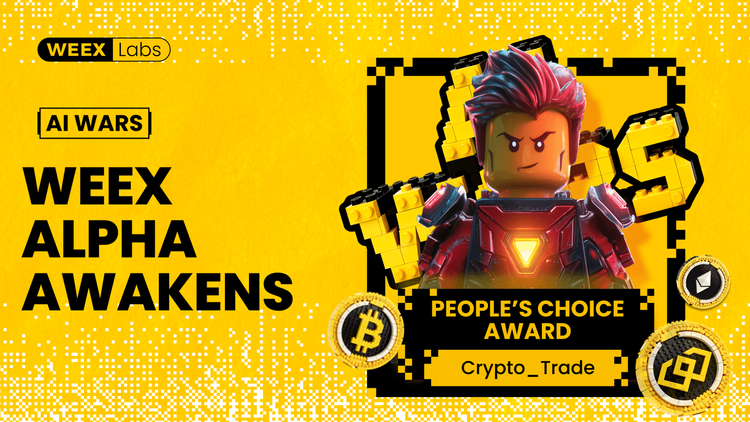
How a Structured AI Crypto Trading Bot Won at the WEEX Hackathon
Crypto_Trade shows how structured inputs and controlled adaptability can build a more stable and reliable AI crypto trading bot within the WEEX AI Trading Hackathon, highlighting a practical path toward scalable AI trading systems.


 App
App