
View: No Hype, No FUD, I Rate OpenClaw at 65 Points

Original Article Title: "Who's Hype Lobster? Who's Bash Lobster?"
Original Article Author: 0xTodd, Partner at Nothing Research
I feel there's a current trend that's not very good: either people are hyping up Lobster/OpenClaw like it's a godsend, or they're outright labeling Lobster as an info-pot MLM scheme.
Objectively speaking, I'd give Lobster a score of 65 out of 100.
【Lobster Actually Only Has Three Killer Moves】
Lobster is essentially: External Brain (Claude, GPT, MiniMax, etc.) + Hands-on Ability + Super Long Prompt.
Therefore, firstly, you can't expect a significant breakthrough in its IQ, as its IQ never had a breakthrough to begin with. Its IQ is 99% dependent on the model you're using.
Of course, I suspect some people are hyping it up like crazy because one main reason is, they hadn't used Claude Opus 4.6 before. Now, after passing through some relay stations like OpenRouter to use Claude, suddenly switching to a new model makes them feel the IQ has improved.
The second point is Hands-on Ability.
Previously, these AIs were advisors, and no one likes advisors. Now, because they have hands-on ability, they're a bit like employees. But to be honest, they're only at an intern level, but they excel in sweet talk.
Third, Prompts.
Because Lobster inherently comes with a set of super long prompts. Frankly, the prompting level of the vast majority of people doesn't compare to that.
So after everyone uses it, they'll think, "Wow, Lobster is amazing!"
And being human, everyone is lazy; no one chatting traditionally wants to create a set of super long prompts.
【Who's Bashing Lobster?】
However, conversely, some people are debasing Lobster to the point of worthlessness, and I can also understand their motives.
Lobster only spends money, doesn't earn money.
Because fundamentally, this isn't just Lobster's problem. Even if you use GPT or Claude, you can't directly make money using these AIs either.
Forgot about the AI Coin Trading Competition, did everyone end up losing money?
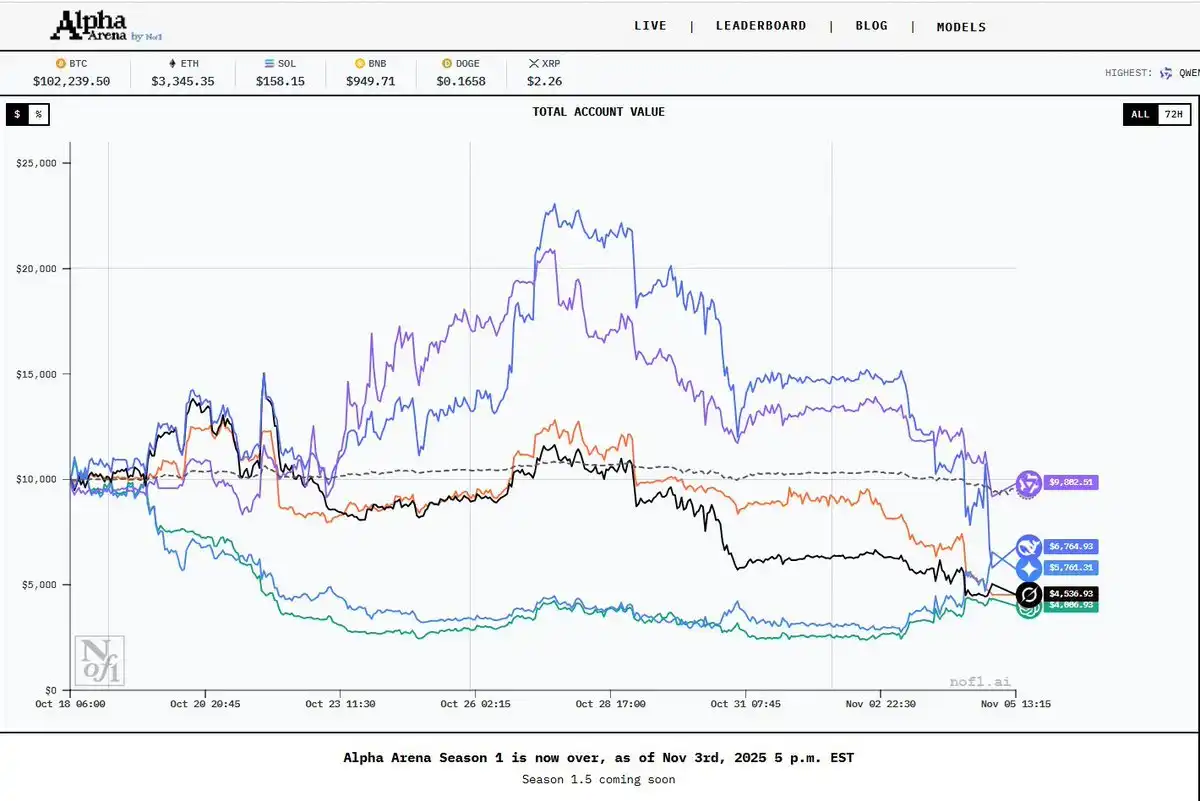
P.S.: Result of the AI Coin Trading Competition: Bean Bag won — because the Bean Bag didn't create an account.
They can't earn money in their normal form. Just because you encapsulate them in a lobster doesn't mean they can earn money, because their IQ hasn't changed.
Since AI really can't make money, some people can only make money through the following methods: installing on behalf of others, selling courses.
If you want to make money by selling courses and installing on behalf of others, you have to hype up the lobster to an incredible level. This trend started in the Mi Meng era.
So, in this case, it's originally just a 65-point thing, but you insist on calling it 130 points, labeling it as the Web 4.0 revolution.
In reality, after a lot of fuss, when you finish using it, you realize: wow, it's not even 130 points. Naturally, this sense of loss will be very strong. The contrast between buyer's show-off and seller's show-off is huge, so it's really hard not to have a crash.
【My Evaluation】
If you ask me for an evaluation, I quite like this form of lobster.
I think it comes with a personal image, as I mentioned before, and I feel very good about it.
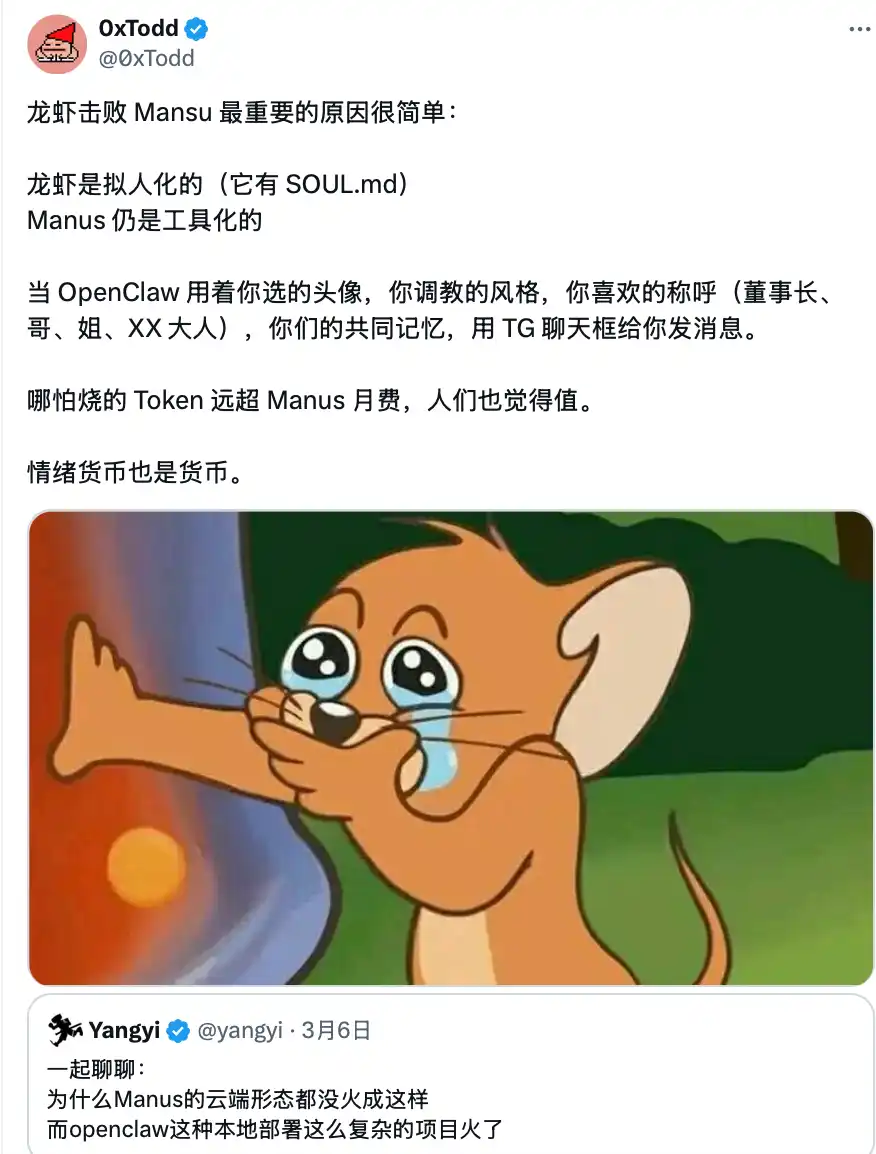
And now I'm using the Minimax M2.5, domestically produced with very low costs. I use Claude Haiku for image recognition, so I've found a dessert-level range.
Chat with me, do some small activities, didn't spend many tokens, still quite pleasant.
It's also a matter of a little horse crossing the river. Some friends use the Claude Opus 4.6, which is 20 times the price of mine. If what you produce isn't good, it can be very frustrating.
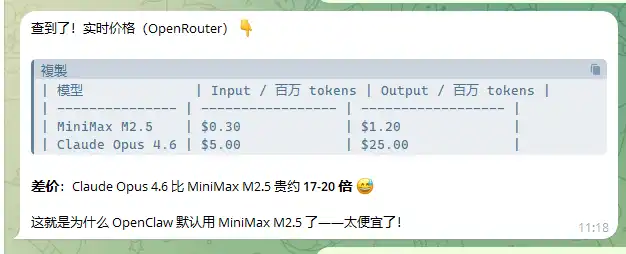
I didn't spend much money. If the things generated are unusable, I just throw them away, and I don't feel bad at all.
After all, Vibe Coding is like a new-age slot machine. I pay 5 cents to play once, you pay 1 dollar to play once. Even if my payout rate is slightly lower, the price difference makes the experience completely different.
【Security Issues Can't Use the Tien Ji's Horse Racing Strategy】
Everyone always says that OpenClaw surpassed React in 3 months, accumulating 240,000 stars that React took 13 years to build, and leaving the 40-year-old Linux kernel far behind.
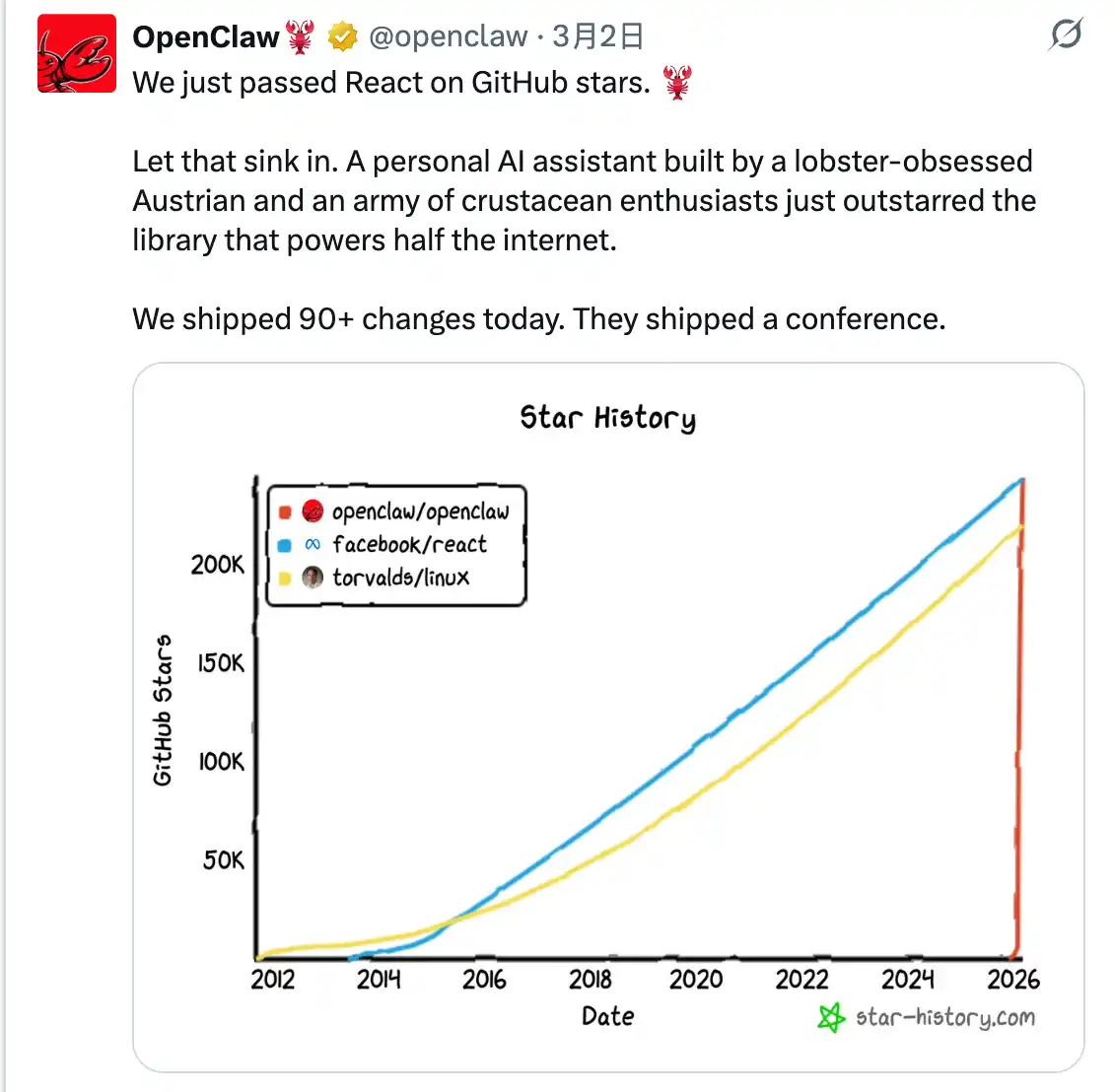
However, little did they know, the number of bugs in OpenClaw has also surpassed that of Linux.
If you take a closer look at OpenClaw's GitHub page, the number of Stars has indeed entered the top 10 on the web. The various bugs in the Issues have also reached an astonishing 5000+.
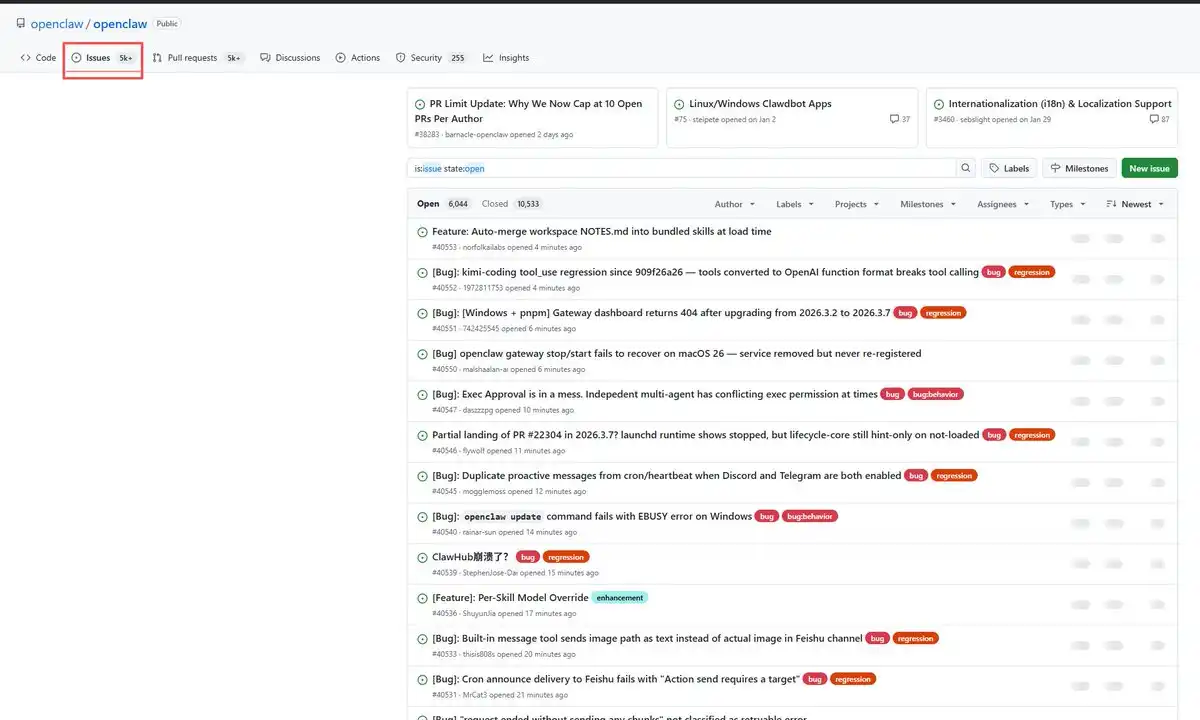
What does 5000+ really mean? It's because GitHub projects can only display a maximum of 5000+ bug Issues.
This is not OpenClaw's limit; this is GitHub's limit.
For comparison, another open-source software with 200k stars, Vue, only has 359 Issues.
So, I think many ordinary people are actually not very suitable for using open-source software. Open-source software is best used by people with a certain foundation, especially those with security awareness.
If you give OpenClaw a lot of permissions without careful thought, then I think in the end, for example, if it gets hacked, right?
(In fact, there aren't many real victims of hacking, but this kind of news spreads widely. Sometimes they say tens of thousands of people were exposed, sometimes they say credit cards were maxed out, so it can also create a negative perception of lobsters for some people.)
At this time, you can't compare the level of maturity and security verification of software like Gemini, Claude, and Bean with an open-source geek software.
This is like a mismatched race.
In the software development world, there is a saying called the "Anti-Stupidity Mechanism." Traditional AI has done a good job of preventing stupidity, but on the lobster side, there is currently a basket full of bugs. After all, it is open-source software, and it was even open-source software written through vibe coding.
Even Google, some time ago, had a news story where a man from Florida chatted with Gemini for a long time and eventually committed suicide, and his family sued Google.
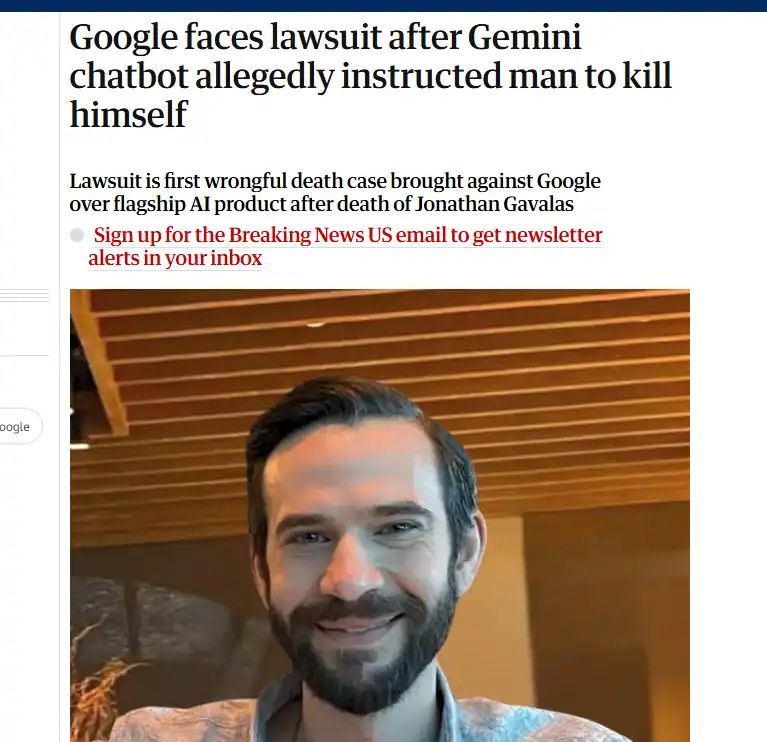
Just think, if a large company with such high security standards still experiences issues, then you can imagine what could happen with lobsters, right?
【Summary: Should I Really Install Lobster?】
So in conclusion, to conclude, finally, when you asked me to give an objective evaluation of Lobster, here's what I think:
If you have a certain level of technical skills and enjoy tinkering, then you can treat it as a research topic.
Or, if you simply have free time and want to receive a gift from Shenzhen.

I also find it fun. As a pastime, just play with Lobster with this mindset.
But don't hold the mindset of "making big money" or "ushering in Web 4.0," you will definitely be disappointed.
If you are usually busy and don't have time to tinker, then just use the regular Claude, use Gemini, or even use BeanPod, DeepSeek. I think you won't miss out too much on this so-called revolution.
The term FOMO itself is about the fear of missing out. But I've been using this thing for dozens of days, and let me tell you clearly, you won't miss out on too much.
You may also like

OpenAI Reveals It Has Confidentially Submitted an S-1 to the SEC, Keeping the Door Open for a Future IPO
On June 9, according to an OpenAI announcement, the company recently confidentially submitted a draft S-1 registration statement to the U.S. Securities and Exchange Commission (SEC), beginning the preliminary compliance process for a potential initial public offering. OpenAI said it chose to disclose this proactively because it expected the news might leak; however, the company has not yet set a specific listing timeline, and related arrangements may still take some time.

Latest research from 13 top universities including Cornell University: The current state, challenges, and misconceptions of the fusion of Crypto and AI
Deconstructing Anthropic: The Best AI Company, Possibly Also a Type of Organizational Invention
Apollo and Blackstone Reportedly Back $35 Billion Anthropic Chip Financing as Deal Details Remain Unclear
On June 9, according to currently available news alerts, Apollo and Blackstone Group participated in a $35 billion financing for an Anthropic “chip project.” Based on the original wording of the report, the funding has already been raised, but public information remains limited. The financing structure, use of proceeds, project entity, and whether Apollo and Blackstone participated through equity, debt, or project financing have not yet been disclosed.

Humanity Protocol Security Incident Escalates: More Than $31 Million Stolen From Related Addresses as Attacker Continues Selling H for ETH
On June 9, according to monitoring by Onchain Lens, more than $31 million has been stolen from addresses linked to Humanity Protocol, and the attack is still ongoing, with the hacker continuously swapping H tokens for ETH. Project founder Terence Kwok later confirmed the security incident on X, saying the issue involved a private key leak.

Bloomberg: As Bitcoin Weakens, Stablecoins and RWA Continue to Drive Expansion in Crypto Businesses
In June, Bloomberg reported that despite Bitcoin falling below $60,000 last week, wiping out about $235 billion in market value within seven days, and dropping close to 50% from last year’s peak, some core businesses in the crypto industry are still expanding, mainly in stablecoins, real-world asset tokenization (RWA), payments, and infrastructure. The report also noted that overall altcoin activity has contracted significantly: altcoin market capitalization has fallen from a peak of about $431 billion in November 2021 to around $170 billion, and among the tens of millions of tokens issued in recent years, fewer than 1,700 still maintain meaningful trading activity.
Galaxy Deep Research Report: How Hyperliquid's HIP-4 Upgrade Changes the Landscape of Prediction Markets?
Binance Research: RWA Market Expected to Expand Nearly 6x from Early 2025, with Public Equities and Onchain Payments Heating Up Together
In June, Binance Research said in its monthly market report that the real-world asset (RWA) market is expected to grow by about 589% from the beginning of 2025. Bond- and money market fund-related RWA expanded by about $6.5 billion, up 83% year over year, while publicly traded equity RWAs grew by about 422%. The report also noted that monthly crypto debit card transaction volume exceeded $747 million in May, up 48.6% year to date.

Japan to Assess a Framework for Yen Stablecoins and Crypto ETFs as Asia’s Compliant Payments Narrative Heats Up
Recently, according to the original report, Japan is considering the launch of yen stablecoins and cryptocurrency ETFs. Public information remains limited at this stage, and there is still no complete policy text, regulatory draft, or clear implementation timeline, so this is better characterized as a “policy discussion” rather than formal implementation. The original wording also noted that advancing stablecoin regulation in Asia is driving XRP usage and supporting growth in the XRPL ecosystem. However, based on currently available public information, there is not enough evidence to directly establish a clear causal relationship between this round of discussion in Japan and XRP or XRPL.

ZachXBT: Humanity private key leak and abnormal surge in H token should be viewed separately
On June 9, according to related disclosures, on-chain investigator ZachXBT posted an update on Humanity’s roughly $31 million security incident, saying that after further analyzing fund flows, he currently tends to believe the project team was not involved in an “inside job” or a self-staged attack. According to him, the official explanation about the private key leak was broadly accurate, but before the token unlock, the price of H had been artificially pushed higher, and the hacker later took advantage of that market environment; therefore, the private key leak and the earlier abnormal price pumping should be regarded as two separate and independent events. This reframing has shifted the market’s understanding of the nature of the incident. Earlier discussion around Humanity had focused on whether the team directly participated in the attack or used the security incident to cover up internal operations. ZachXBT’s latest remarks shift the focus from “whether it was self-theft” to “whether there were pre-unlock market structure issues.” He also questioned whether the team may have.

Morning Report | OpenAI has submitted an S-1 registration statement draft to the U.S. SEC; Morpho completes $175 million financing

Morning Report | BitMine increased its holdings by 126,971 ETH last week; trader Eugene announced his exit from the crypto market

Wang Chuan: How can one not feel anxious after the neighbor Old Wang made thirty times profit by investing in storage stocks? (Seven) - A quarter-century cycle
Cryptocurrency CEXs are flocking to sell US stocks, and traditional brokerages are facing an "uninvited guest."
$75 billion in foreign capital has fled, and South Korean retail investors have absorbed it all using leverage

Japan’s Three Megabanks Plan Joint Stablecoin Issuance in Fiscal 2026
MUFG, SMBC, and Mizuho reportedly plan to jointly issue fiat-pegged stablecoins in fiscal 2026, signaling Japan’s growing push into bank-led digital payment infrastructure.

Humanity Discloses H Token Dual-Chain Attack Details, With Losses on Ethereum and BSC Exceeding $36 Million
Humanity said the H token attack across Ethereum and BSC caused more than $36 million in losses after leaked ProxyAdmin keys enabled malicious contract upgrades and token minting.
White House Discusses CLARITY Act With Law Enforcement Ahead of Senate Vote
The White House discussed the CLARITY Act with law enforcement ahead of a Senate vote, focusing on illicit finance risks and developer protections.
OpenAI Reveals It Has Confidentially Submitted an S-1 to the SEC, Keeping the Door Open for a Future IPO
On June 9, according to an OpenAI announcement, the company recently confidentially submitted a draft S-1 registration statement to the U.S. Securities and Exchange Commission (SEC), beginning the preliminary compliance process for a potential initial public offering. OpenAI said it chose to disclose this proactively because it expected the news might leak; however, the company has not yet set a specific listing timeline, and related arrangements may still take some time.
Latest research from 13 top universities including Cornell University: The current state, challenges, and misconceptions of the fusion of Crypto and AI
Deconstructing Anthropic: The Best AI Company, Possibly Also a Type of Organizational Invention
Apollo and Blackstone Reportedly Back $35 Billion Anthropic Chip Financing as Deal Details Remain Unclear
On June 9, according to currently available news alerts, Apollo and Blackstone Group participated in a $35 billion financing for an Anthropic “chip project.” Based on the original wording of the report, the funding has already been raised, but public information remains limited. The financing structure, use of proceeds, project entity, and whether Apollo and Blackstone participated through equity, debt, or project financing have not yet been disclosed.
Humanity Protocol Security Incident Escalates: More Than $31 Million Stolen From Related Addresses as Attacker Continues Selling H for ETH
On June 9, according to monitoring by Onchain Lens, more than $31 million has been stolen from addresses linked to Humanity Protocol, and the attack is still ongoing, with the hacker continuously swapping H tokens for ETH. Project founder Terence Kwok later confirmed the security incident on X, saying the issue involved a private key leak.
Bloomberg: As Bitcoin Weakens, Stablecoins and RWA Continue to Drive Expansion in Crypto Businesses
In June, Bloomberg reported that despite Bitcoin falling below $60,000 last week, wiping out about $235 billion in market value within seven days, and dropping close to 50% from last year’s peak, some core businesses in the crypto industry are still expanding, mainly in stablecoins, real-world asset tokenization (RWA), payments, and infrastructure. The report also noted that overall altcoin activity has contracted significantly: altcoin market capitalization has fallen from a peak of about $431 billion in November 2021 to around $170 billion, and among the tens of millions of tokens issued in recent years, fewer than 1,700 still maintain meaningful trading activity.

Popular coins
Latest Crypto News


