
Will Not Messing with OpenClaw Lead to Obsolescence in the AI Era? | Lobster Fuss Summit

Let's start with the important stuff: we have partnered with Zhihu and will be holding an offline event in Beijing this weekend focused on OpenClaw. Of course, we will also help you install OpenClaw on-site.
Registration Link: https://luma.com/h46z65cy
We hope those who are interested will sign up first before coming back to read this post.
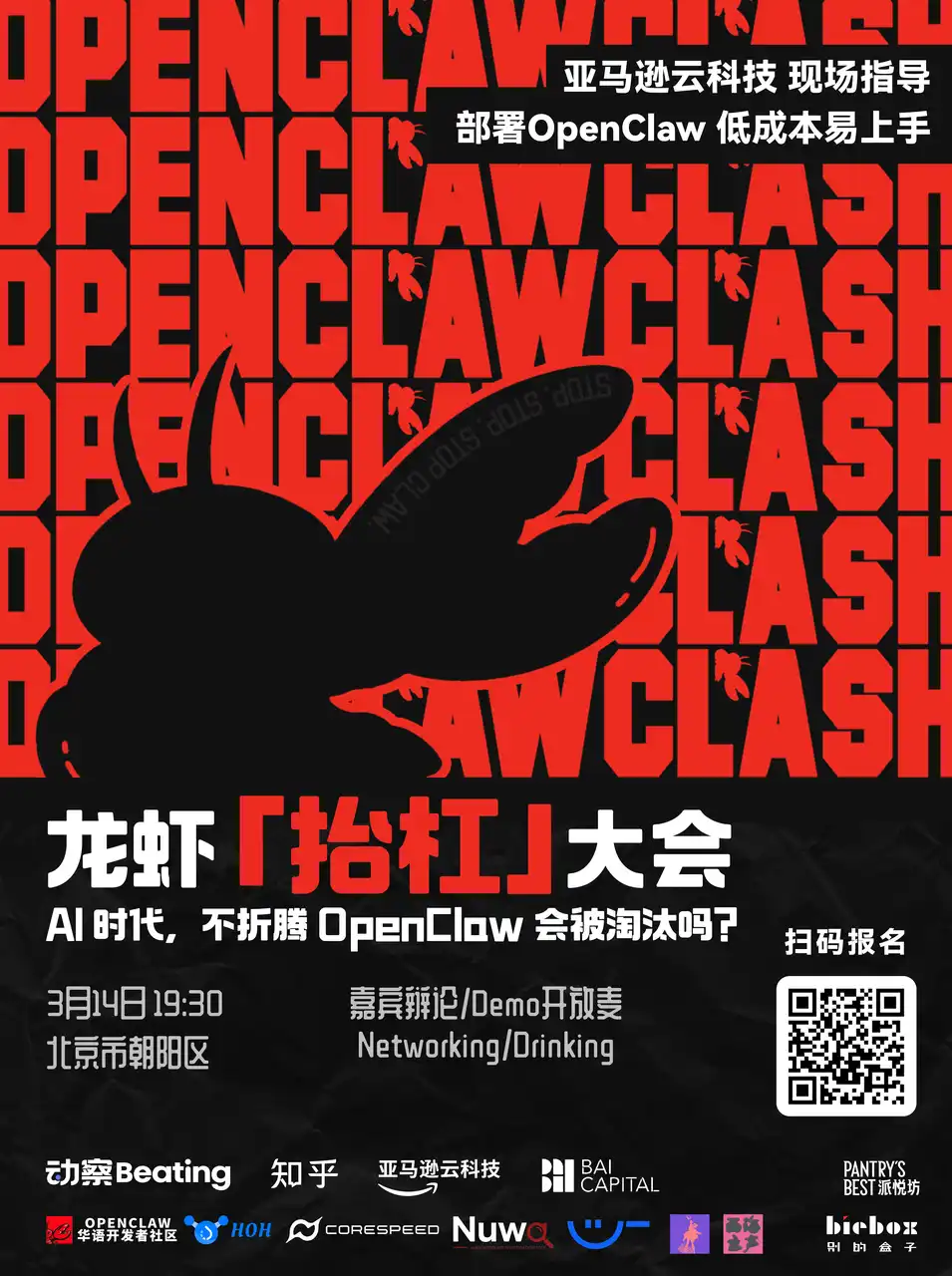
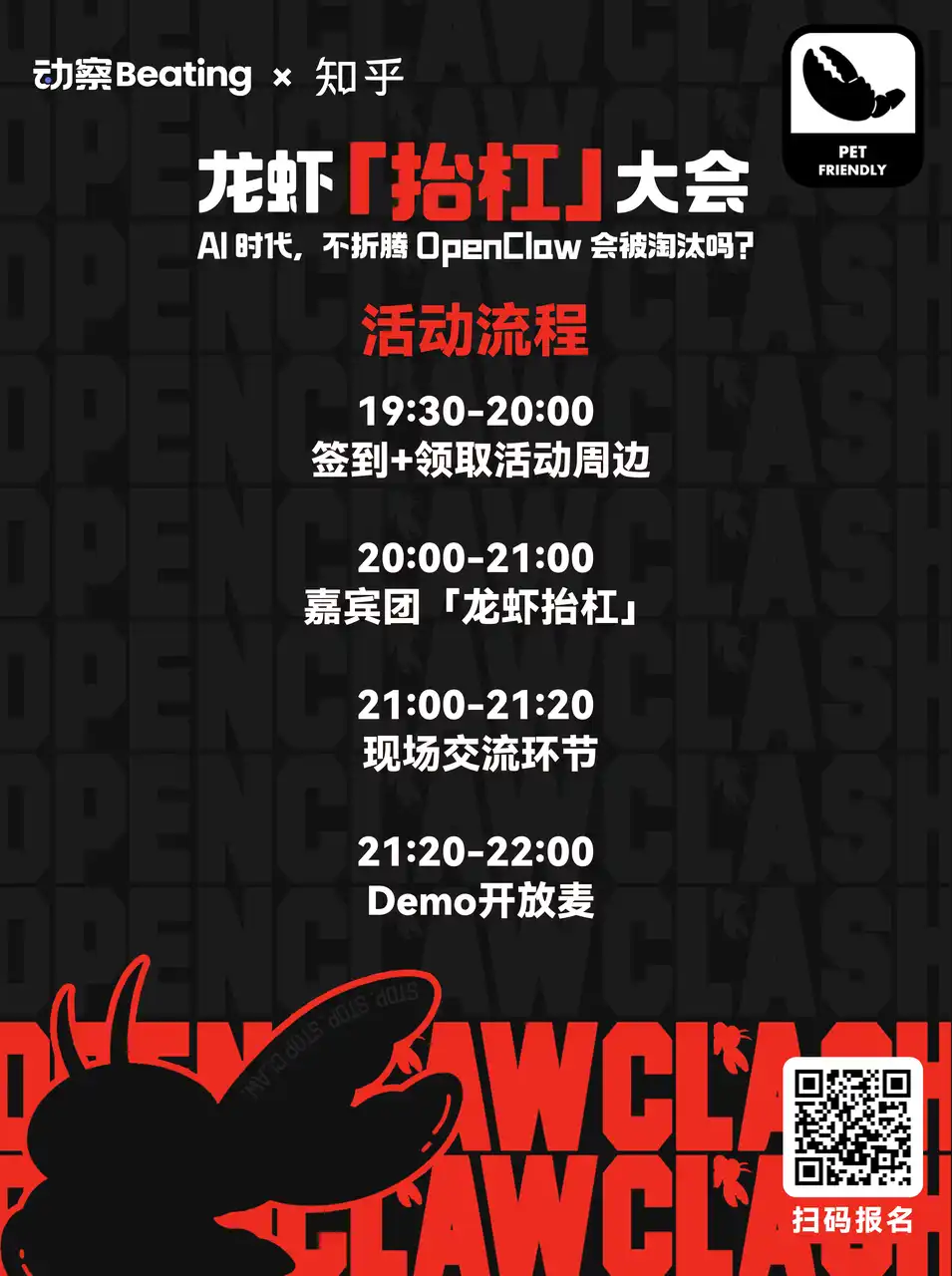
On March 14, we will be holding an "AI Debate Summit" in Beijing Chaoyang District. Instead of a simple one-way lecture, we have invited some outspoken guests to discuss this somewhat anxiety-inducing topic together. We welcome those who are willing to sit down and seriously consider this matter to join us.
Why Are We Holding This Event
There's something that, once it appears, you can't pretend it doesn't exist.
You can choose not to use it, you can say it's not mature yet, but you will see more and more people starting to use it. You can say "let's wait and see," but by the time you make up your mind, people around you have already sent three emails, written two reports, and developed an app using it.
This thing is OpenClaw.
OpenClaw is just a name, an entry point, a moment when many people truly feel "AI is starting to act on my behalf." Before it, AI was something you asked questions and it gave you answers, essentially you were still in control. But after it, you just need to give it a task, and it will find a way to accomplish it on its own. How many steps it took, how many decisions it made in between, you may not necessarily know, and you don't need to know.
From "help me think" to "help me do," what lies in between is not just a technological step, but a whole set of questions about "who am I, what am I doing, and whose responsibility is it." When AI was still just a chatbot, you could set these questions aside. But now, as it starts working for you, you have to think about them.
This is not the first time we have faced this situation.
Every now and then, something appears that makes you feel like the way the world operates has changed, and you haven't quite figured out what the new rules are. It was the same when the Internet came, and it was the same when smartphones came. Every time, some people say "this time is different," and every time, some people say "it's not a big deal."
Interestingly, these two groups of people often don't have a clear right or wrong.
So we want to set up a stage for these two groups of people to sit together, speak face to face, and confront each other. Not to determine a winner, but because the issue itself deserves serious consideration, not the kind of casual engagement seen in social media likes and article shares, but a face-to-face, interactive, and rebuttable kind of seriousness.
This topic doesn't just belong to the tech community. It also belongs to those who use AI to create music, those wondering if their jobs are at risk, and those who are curious but haven't yet formed a clear opinion. The arrival of the Agent era is a technological event, but also a cultural event, a question about the relationship between humans and tools, humans and efficiency, and humans and meaning.
The "Lobster Claw Debate" is one such place.
What Kind of Event Will This Be
If the question of "why hold this event" is due to the collective anxiety brought about by technology, then "how to conduct it" is our response to this anxiety.
To be honest, in the early stages of event preparation, we debated for a long time about the format of the event. We noticed that many recent events have been organized around tech enthusiasts and developers, inviting them to share the evolution of underlying architectures, the iteration of parameter models, with an audience of similarly knowledgeable professionals taking notes, trying to seize every potential trend.
Such hardcore technical discussions are certainly essential, but they seem unable to address a more common issue: what does AI really mean for those who don't code, don't train large models, but are genuinely caught up in this technological wave?
Movement Insight's mission has never been to explain the logic of code but to try to break down how technology reshapes our lives. We hope to create a more inclusive space, letting AI descend from its pedestal, enter the realm of daily life, and become part of every individual swept up in the era.
Therefore, we didn't limit our focus to the tech community but invited insiders from various industries, choosing a slightly sharp, even somewhat painful topic: In the AI era, will not engaging in Openclaw lead to obsolescence?
The reason we want to use a debate format is that we believe one-way indoctrination will only create information silos, and clashes of viewpoints can stimulate real thinking. We don't want bland correctness; we want to hear the most genuine anxieties, sharpest rebuttals, and deepest logical confrontations. Perhaps in a single "debate" moment, your understanding of the world will be completely restructured.
We've brought together some opinionated individuals — those involved in AI, investment, AI-driven content creation, and researching the matter — to present their genuine assessments, rather than spouting the cliché phrases of "the future is already here, embrace change."
We want to hear them discuss: What exactly is OpenClaw? Is it a groundbreaking infrastructure that will become obsolete if not explored? Or is it just another hype cycle that will cause anxiety for three months and then fade into obscurity?
We must be prepared to accept both answers. However, before we reach a conclusion, feel free to engage in a debate.
But the spotlight of this event is not solely on the stage guests. Apart from the guest debates, we will also hand the microphone to everyone present. You can directly ask the guests questions, even challenge their views. In the subsequent "Open Mic" session, you can share your interesting AI experiments or simply express your confusion and bewilderment in this rapidly evolving world.
Due to the limited time of the live event, friends interested in the Open Mic session can choose to participate during registration to help us estimate the number of presentations. However, we cannot guarantee that all registered friends will have a speaking slot. It will be first come, first served on-site.
If you haven't yet raised your own lobster, feel free to bring your laptop to the event, where Amazon Web Services professionals will guide you through deploying your own OpenClaw.
The world is changing so rapidly that no one dares to claim they "understand" it. In that case, why don't we sit down, let our guard down, and engage in a lively debate to measure the boundaries of this new world.
About InnoBeat
In this era filled with algorithms and "quick and easy" information, persisting with in-depth content sounds like stubbornness. However, since our founding in August last year, InnoBeat has gradually gathered a group of reader friends through this persistence.
Initially, we focused on the undercurrents of financial technology. As the gears of technological revolution turned faster, we realized that the old order was collapsing, and a new landscape was being redrawn. If finance is the society's bloodstream, then technology is the force reshaping its bones.
We see that the previous generation of internet giants, if not at the AI table, will only become a backdrop in the era's narrative; we see the new overlords rising steadily on the staircase of large models; more importantly, we witness capital, technology, and ambition swiftly redistributing the world's resources and discourse at an unprecedented pace.
What Dōngchái wants to do is to become a trustworthy mirror in this chaotic era of spiraling changes, capturing these profound transformations.
But recording is just the first step. What we aspire to is for Dōngchái to not only be a content platform but also a community. In the future, we will continue to launch more unconventional offline events like the "Lobster Wrestling Summit," building a space for youthful, forward-thinking, and highly tasteful exchanges.
Here, there is no authority, only perspectives. You are welcome to join us, bringing your curiosity and insights, as we co-create together.
You may also like

CFTC Reportedly Plans New Prediction Market Rules Focused on Manipulation Risk and Public Interest Review
The CFTC is reportedly preparing new prediction market rules focused on manipulation risk, public interest review, and retail trader protections.

Meet the new WEEX trial fund—your gateway to greater profits

WEEX Labs Lands at Dutch Blockchain Week: A Disruptive Crypto × AI Conversation Sets Sail in Amsterdam

SK Hynix Reportedly Plans U.S. ADR Listing as Early as August, With SEC Approval Possible in Late June
SK Hynix may pursue a U.S. ADR listing as early as August, with SEC approval reportedly possible in late June amid strong AI chip supply chain demand.

SpaceX vs Tesla vs xAI: Which Elon Musk Trade Has the Biggest Upside in 2026?
OpenAI Reveals It Has Confidentially Submitted an S-1 to the SEC, Keeping the Door Open for a Future IPO
On June 9, according to an OpenAI announcement, the company recently confidentially submitted a draft S-1 registration statement to the U.S. Securities and Exchange Commission (SEC), beginning the preliminary compliance process for a potential initial public offering. OpenAI said it chose to disclose this proactively because it expected the news might leak; however, the company has not yet set a specific listing timeline, and related arrangements may still take some time.

Latest research from 13 top universities including Cornell University: The current state, challenges, and misconceptions of the fusion of Crypto and AI
Deconstructing Anthropic: The Best AI Company, Possibly Also a Type of Organizational Invention
Apollo and Blackstone Reportedly Back $35 Billion Anthropic Chip Financing as Deal Details Remain Unclear
On June 9, according to currently available news alerts, Apollo and Blackstone Group participated in a $35 billion financing for an Anthropic “chip project.” Based on the original wording of the report, the funding has already been raised, but public information remains limited. The financing structure, use of proceeds, project entity, and whether Apollo and Blackstone participated through equity, debt, or project financing have not yet been disclosed.

Humanity Protocol Security Incident Escalates: More Than $31 Million Stolen From Related Addresses as Attacker Continues Selling H for ETH
On June 9, according to monitoring by Onchain Lens, more than $31 million has been stolen from addresses linked to Humanity Protocol, and the attack is still ongoing, with the hacker continuously swapping H tokens for ETH. Project founder Terence Kwok later confirmed the security incident on X, saying the issue involved a private key leak.

Bloomberg: As Bitcoin Weakens, Stablecoins and RWA Continue to Drive Expansion in Crypto Businesses
In June, Bloomberg reported that despite Bitcoin falling below $60,000 last week, wiping out about $235 billion in market value within seven days, and dropping close to 50% from last year’s peak, some core businesses in the crypto industry are still expanding, mainly in stablecoins, real-world asset tokenization (RWA), payments, and infrastructure. The report also noted that overall altcoin activity has contracted significantly: altcoin market capitalization has fallen from a peak of about $431 billion in November 2021 to around $170 billion, and among the tens of millions of tokens issued in recent years, fewer than 1,700 still maintain meaningful trading activity.

Galaxy Deep Research Report: How Hyperliquid's HIP-4 Upgrade Changes the Landscape of Prediction Markets?
Binance Research: RWA Market Expected to Expand Nearly 6x from Early 2025, with Public Equities and Onchain Payments Heating Up Together
In June, Binance Research said in its monthly market report that the real-world asset (RWA) market is expected to grow by about 589% from the beginning of 2025. Bond- and money market fund-related RWA expanded by about $6.5 billion, up 83% year over year, while publicly traded equity RWAs grew by about 422%. The report also noted that monthly crypto debit card transaction volume exceeded $747 million in May, up 48.6% year to date.

Japan to Assess a Framework for Yen Stablecoins and Crypto ETFs as Asia’s Compliant Payments Narrative Heats Up
Recently, according to the original report, Japan is considering the launch of yen stablecoins and cryptocurrency ETFs. Public information remains limited at this stage, and there is still no complete policy text, regulatory draft, or clear implementation timeline, so this is better characterized as a “policy discussion” rather than formal implementation. The original wording also noted that advancing stablecoin regulation in Asia is driving XRP usage and supporting growth in the XRPL ecosystem. However, based on currently available public information, there is not enough evidence to directly establish a clear causal relationship between this round of discussion in Japan and XRP or XRPL.

ZachXBT: Humanity private key leak and abnormal surge in H token should be viewed separately
On June 9, according to related disclosures, on-chain investigator ZachXBT posted an update on Humanity’s roughly $31 million security incident, saying that after further analyzing fund flows, he currently tends to believe the project team was not involved in an “inside job” or a self-staged attack. According to him, the official explanation about the private key leak was broadly accurate, but before the token unlock, the price of H had been artificially pushed higher, and the hacker later took advantage of that market environment; therefore, the private key leak and the earlier abnormal price pumping should be regarded as two separate and independent events. This reframing has shifted the market’s understanding of the nature of the incident. Earlier discussion around Humanity had focused on whether the team directly participated in the attack or used the security incident to cover up internal operations. ZachXBT’s latest remarks shift the focus from “whether it was self-theft” to “whether there were pre-unlock market structure issues.” He also questioned whether the team may have.

Morning Report | OpenAI has submitted an S-1 registration statement draft to the U.S. SEC; Morpho completes $175 million financing

Morning Report | BitMine increased its holdings by 126,971 ETH last week; trader Eugene announced his exit from the crypto market

Wang Chuan: How can one not feel anxious after the neighbor Old Wang made thirty times profit by investing in storage stocks? (Seven) - A quarter-century cycle
CFTC Reportedly Plans New Prediction Market Rules Focused on Manipulation Risk and Public Interest Review
The CFTC is reportedly preparing new prediction market rules focused on manipulation risk, public interest review, and retail trader protections.
Meet the new WEEX trial fund—your gateway to greater profits
WEEX Labs Lands at Dutch Blockchain Week: A Disruptive Crypto × AI Conversation Sets Sail in Amsterdam
SK Hynix Reportedly Plans U.S. ADR Listing as Early as August, With SEC Approval Possible in Late June
SK Hynix may pursue a U.S. ADR listing as early as August, with SEC approval reportedly possible in late June amid strong AI chip supply chain demand.
SpaceX vs Tesla vs xAI: Which Elon Musk Trade Has the Biggest Upside in 2026?
OpenAI Reveals It Has Confidentially Submitted an S-1 to the SEC, Keeping the Door Open for a Future IPO
On June 9, according to an OpenAI announcement, the company recently confidentially submitted a draft S-1 registration statement to the U.S. Securities and Exchange Commission (SEC), beginning the preliminary compliance process for a potential initial public offering. OpenAI said it chose to disclose this proactively because it expected the news might leak; however, the company has not yet set a specific listing timeline, and related arrangements may still take some time.


