
Samsung Stock Down 38% From Its Peak: What the Selloff Means

 Prefer us on Google
Samsung stock has lost roughly 38% from its June record high while the company was printing the largest quarterly operating profit in technology history. That gap between the earnings and the tape is the whole story, and it is not resolved yet.
Samsung Electronics (KRX: 005930) traded around ₩231,000 in the August 6–7, 2026 sessions, against an intraday record of ₩374,500 set on June 19, 2026. The stock is still up sharply over twelve months — the 52-week range runs from ₩67,500 to ₩374,500 — but anyone who bought the AI-memory story in June is now sitting on a large loss. What follows is the drawdown in numbers, why it happened, what the valuation actually implies, and how traders are getting exposure without a Korean brokerage account.
Samsung Stock Price Now: The August 6 Selloff in Numbers
The most violent day was August 6, 2026. Samsung fell 5.69% to ₩231,500 as the KOSPI dropped 4.37% and triggered a sidecar suspension. SK Hynix fell 8.27% to ₩1.53 million in the same session. The proximate trigger came from the US overnight: SanDisk guided fiscal Q1 2027 revenue to a midpoint near $10.55 billion against roughly $10.8 billion expected, and the resulting selloff in Western Digital and its peers spilled straight into Asian memory names.
Here is the drawdown mapped against the news that caused it.
| Date (2026) | What happened | 005930 level | From the June peak |
|---|---|---|---|
| Jun 19 | Intraday record high on AI-memory demand | ₩374,500 | — |
| Jul 7–8 | Preliminary Q2 record profit; shares fall anyway | ~₩318,000 | −15% |
| Jul 30 | Full Q2 results fail to lift the market | — | — |
| Aug 6 | SanDisk guidance miss; KOSPI −4.37%, sidecar triggered | ₩231,500 | −38% |
| Aug 6–7 | Stock stabilises near the lows | ~₩231,000 | −38% |
Sources: Korea Exchange market data and company disclosures, as of August 7, 2026. Market capitalisation stood near ₩1,470 trillion with a dividend yield of about 0.65%.
The earnings context makes the move stranger. Samsung's preliminary Q2 2026 figures showed operating profit of roughly ₩89.4 trillion on revenue near ₩171 trillion — around a 19-fold increase year over year, and on those numbers the highest quarterly operating profit any technology company has reported. The stock has fallen 38% since the quarter that produced it.
Why Samsung Stock Fell 38% From Its June Record High
Three things happened at once, and only one of them is about Samsung.
The good news was already in the price. The stock rose more than 190% over twelve months into the June peak. When a company delivers a 19-fold profit increase, the question immediately becomes what it does for an encore. A beat becomes an exit, not an entry.
Leverage unwound. Korean retail investors financed a meaningful share of the semiconductor rally on margin. When prices fell, brokers force-closed losing positions, which pushed prices lower, which forced more closes. Samsung fell as much as 14% intraday during one leg of that unwind before recovering to close down about 5%. This is the part of the decline with no fundamental content — it is plumbing.
The cycle question got louder. Samsung, SK Hynix and Micron are all expanding capacity at the same time. KB Securities models DRAM prices up 148% year over year in 2026 and NAND up 111%, with supply staying tight into 2027 and new capacity arriving in volume around 2028. The bear case is not that demand disappears; it is that the industry solves its own shortage on schedule, and memory has never once ended a boom gently.
The more useful framing: Samsung is no longer a diversified electronics conglomerate in the market's eyes. It is a levered claim on DRAM and HBM pricing that happens to also sell phones. That is why a US flash-memory company's guidance can knock 5% off a Korean stock in one session.
Is Samsung Stock Cheap at 3.5x Forward Earnings?
After the drawdown, Goldman Sachs and JPMorgan both kept buy ratings, noting that forward P/E ratios of roughly 3.5x–3.6x look detached from fundamentals. On 2026 operating profit estimates that have been lifted toward ₩220 trillion, that multiple is real arithmetic, not a typo.
It is also exactly what a peak-cycle semiconductor stock is supposed to look like. Memory names trade at their lowest multiples when earnings are highest, because the market is discounting the earnings coming down, not going up. A 3.5x forward P/E is a signal that the market assigns low confidence to the E, not that the P is a bargain. The honest version of the bull case is not "it is cheap" — it is "the market is discounting a cycle turn that arrives later, or milder, than consensus assumes."
Samsung Stock Price Targets Range From ₩210,000 to ₩725,000
The analyst dispersion is the most revealing dataset on this stock right now. The consensus 12-month target sits near ₩468,000, but the range behind that average is extraordinary.
| Estimate | Level | Implied vs ~₩231,000 |
|---|---|---|
| Street high | ₩725,000 | +214% |
| Frequently cited high target | ₩480,000 | +108% |
| Mean 12-month target | ~₩468,000 | +103% |
| Street low | ₩210,000 | −9% |
Sources: aggregated sell-side 12-month targets as of August 2026.
A 3.5x spread between the highest and lowest target on a $1 trillion-class company is not normal, and it should be read as a warning rather than an opportunity. It means the analyst community has no shared view on when the memory cycle peaks. Anyone quoting the ₩468,000 mean as a forecast is quoting the midpoint of a genuine disagreement. Note also that the low target sits below the current price — a real analyst somewhere thinks this is still not the bottom.
How to Trade Samsung Stock With USDT on WEEX
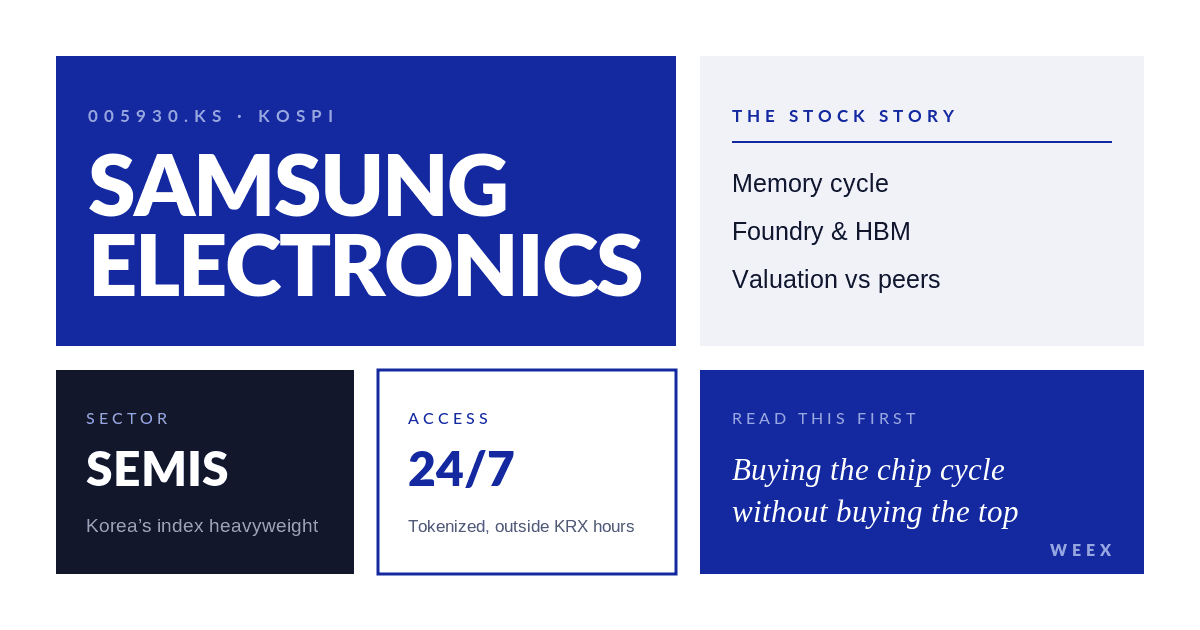
Samsung's ordinary shares sit on the Korea Exchange with no US listing and no standard ADR, which is why access is the single most common obstacle for overseas buyers. The conventional routes — an international broker with KRX access, the London and Luxembourg GDRs (SMSN, SMSEL), or the thin US OTC line SSNLF — are covered in detail in WEEX's guide to how to buy Samsung stock from outside Korea.
The crypto-native route is a USDT-margined perpetual. WEEX lists a SAMSUNG-USDT perpetual contract that tracks the share price and trades continuously, including while the Korea Exchange is closed.
| SAMSUNG-USDT perpetual | Detail (as of August 10, 2026) |
|---|---|
| Contract | SAMSUNGUSDT, USDT-margined perpetual |
| Last price | 165.07 USDT |
| Max leverage | Up to 50× |
| Trading hours | 24/7, including KRX holidays and weekends |
| Settlement | USDT; funding paid periodically |
| What you own | Price exposure only — no shares, no dividend, no vote |
One detail worth doing the arithmetic on: at 165.07 USDT against a ₩231,000 share price, the contract is priced off an implied KRW/USD rate of roughly 1,399. That means a USDT-margined position carries two exposures, not one. If the won weakens against the dollar while the Korean share price is flat, the dollar-quoted contract falls — and traders who only watched the KRX chart will not understand why their position moved. This is the most common avoidable mistake on foreign-listed perpetuals.
Two more cautions. A perpetual is a derivative, not equity: WEEX's explainer on how tokenized stocks and their custody models work sets out where economic exposure ends and legal ownership begins. And 50× leverage on an asset that has moved 5–8% in single sessions this month is a liquidation event waiting for a date — the August 6 intraday low was roughly 14% below the prior close, which wipes out anything above about 7× with no stop.
What Comes Next for Samsung Stock
The near-term catalysts are specific and dated: quarterly DRAM and HBM contract pricing, Samsung's HBM4 qualification progress with Nvidia, and any guidance revision on second-half memory pricing. None of them are about the phone business.
For traders, the practical read is that Samsung stock now behaves like a high-beta cyclical with a mega-cap's market capitalisation. It fell 38% in seven weeks while its fundamentals set records, which tells you that positioning and cycle expectations — not earnings — are setting the price. Size positions for that, whether you are holding GDRs or a leveraged perpetual.
FAQ
1. Why is Samsung stock down if profits hit a record?
The market had already priced in a strong quarter and moved on to the next one. A leveraged retail unwind forced additional selling, and a guidance miss at SanDisk on August 6, 2026 revived concerns that the memory cycle peaks in 2027 as new capacity arrives.
2. How far has Samsung stock fallen from its high?
About 38%, from an intraday record of ₩374,500 on June 19, 2026 to roughly ₩231,000 in the August 6–7 sessions.
3. What is the ticker for Samsung stock?
The primary listing is 005930 on the Korea Exchange. The US OTC line is SSNLF, and the GDRs trade as SMSN in London and SMSEL in Luxembourg. There is no standard US ADR.
4. Is Samsung stock cheap at a 3.5x forward P/E?
That multiple reflects peak-cycle earnings, which is normal for memory stocks at a top. A low forward P/E here signals doubt about the earnings estimate rather than an obvious discount, and analyst targets range from ₩210,000 to ₩725,000 — a genuine disagreement, not a consensus buy.
5. Can I trade Samsung stock with crypto?
WEEX lists a USDT-margined SAMSUNG-USDT perpetual that trades 24/7 with up to 50× leverage. It gives price exposure only — no share ownership, dividends or voting rights — and availability varies by region.
6. Does the USDT perpetual carry currency risk?
Yes. The contract is dollar-quoted against a won-denominated share price, so won weakness reduces the contract price even if the KRX quote is unchanged.
Risk Warning
Samsung stock and every instrument that tracks it can lose value quickly. Samsung's earnings are tied to the memory cycle, so DRAM, NAND and HBM pricing, industry capex, Chinese competition, currency moves and global demand can all swing the share price sharply — the stock has already fallen roughly 38% from its June 2026 peak and moved more than 5% in single sessions this month. Overseas access routes add their own frictions: the SSNLF OTC line is thinly traded with wide spreads, GDRs carry currency exposure, and USDT-margined perpetuals involve leverage, funding costs, liquidation risk, slippage, counterparty and custody risk, plus an implicit KRW/USD exposure. Leveraged positions can be closed out in minutes during a volatile session. Confirm what is legally available in your region, and never trade with funds you cannot afford to lose.
This content is provided for general informational purposes only and doesn't constitute financial, investment, legal, or tax advice. Any events, rewards, online promotions, or related information mentioned herein should not be considered a recommendation, solicitation, or invitation to purchase, sell, trade, or otherwise deal in any crypto assets. Crypto assets are highly volatile and may result in loss. The availability of WEEX services, products, and related events may vary by region. You are responsible for ensuring that your participation is in accordance with applicable local laws and regulations.
You may also like

Jensen Huang Stock Advice: What He Said and What It Returned

Gold Price Today: Why Tokenized Gold Quotes a Different Number

SK Hynix Stock in Korea: The 52% Drawdown and How to Buy It Now

Warren Buffett Berkshire Stock Transfer: The $147B Supply Math
KGHM Stock Forum: Copper, Silver, and the Argument the Thread Keeps Getting Backwards
Gold Forum: Where the Polish Discussion Actually Happens — and the Question It Argues About Most
JSW Stock Forum: What the Threads Are Actually Arguing About — and What They Cannot Tell You
What Is Polymarket and How Does It Work?

What Is Phantom Wallet? How to Install the Official Version Safely and Use It

What Is the Crypto Fear and Greed Index? Components, Scale and Limits
What Is Robinhood Chain? How to Add the Network to MetaMask Safely
Is Zero Knowledge Technology Actually Ready for Everyday Use?
zk-SNARK vs zk-STARK: What's the Difference?
How Zero Knowledge Proofs Are Used in Blockchain Today
What Is Zero Knowledge Proof? A Beginner's Guide
Is PGP Still Secure in 2026?
PGP vs End-to-End Encryption: What's the Difference?
Roblox Stock Price Prediction 2026-2027: Can RBLX Recover After Pulling Full-Year Guidance?
Is RBLX Stock a Buy After Falling 74% From Its All-Time High?
Roblox Stock Falls 29% on Its Worst Day Ever: What the Bookings Miss and Pulled Guidance Actually Mean
Marvell Stock Jumps 13% on AI Memory Infrastructure Upgrades: What the New Portfolio Actually Changes

Opendoor Stock Price Prediction 2026-2027: Can OPEN Reach the $4.95 Analyst Target After the Q2 Turnaround?
Opendoor Stock Q2 2026: What Everything Is Up and Costs Are Down Actually Means for OPEN
Apple Stock and the China $280 Downgrade: What a Chinese Firm Cutting Apple to Hold Actually Signals
STONKBROKER Token: What You Actually Own Without a StonkBrokers NFT
Apple Stock Is Adding Android Phones to Trade-In: What the Strategy Shift Actually Means for iPhone Growth
Apple Stock and the OpenAI Lawsuit: What OpenAI Calling Apple's Case Careless and Aggressive Actually Means for AAPL
XST Coin and the Solana AI Narrative: Why Low-Cap AI Tokens Are Outperforming in August 2026
Should You Buy XST Coin at $0.020? What Changed Since the $0.007 Entry
XST Coin Is Up 188% in One Week: What Is Actually Driving the XSolut Rally
Jensen Huang Stock Advice: What He Said and What It Returned
Gold Price Today: Why Tokenized Gold Quotes a Different Number
SK Hynix Stock in Korea: The 52% Drawdown and How to Buy It Now
Warren Buffett Berkshire Stock Transfer: The $147B Supply Math
KGHM Stock Forum: Copper, Silver, and the Argument the Thread Keeps Getting Backwards
Gold Forum: Where the Polish Discussion Actually Happens — and the Question It Argues About Most


