
Warren Buffett Berkshire Stock Transfer: The $147B Supply Math

 Prefer us on Google
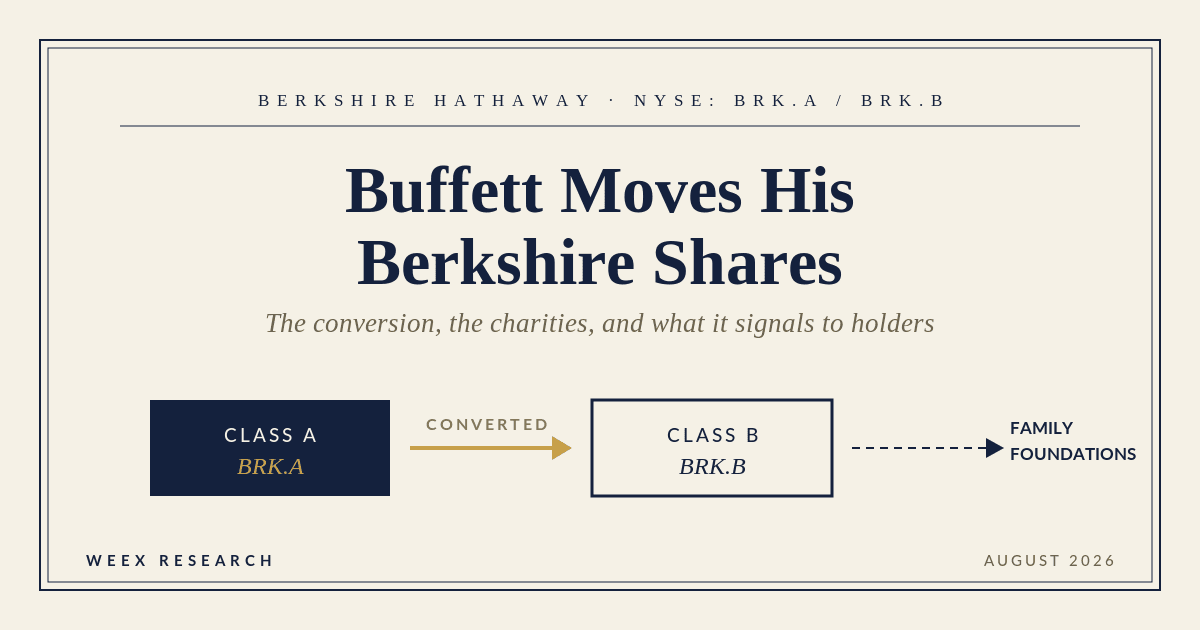
On July 14, 2026, Warren Buffett converted 8,000 Berkshire Hathaway Class A shares into 12 million Class B shares and gave all 12 million away. The press release ran to about 300 words. The mechanics buried inside it matter more than the headline number, because this single Berkshire stock transfer permanently erased 85% of the voting weight attached to those shares — and it was only the first of roughly eight more rounds scheduled to run through the end of 2034.
Most coverage framed it as a philanthropy story. Read as a market-structure event, the Warren Buffett Berkshire stock transfer is a slow, telegraphed release of about $147 billion in stock into hands that are legally required to spend it.
What Buffett's Berkshire Stock Transfer Moved on July 14
Berkshire's own release is the primary source, and it is unusually precise. Buffett converted 8,000 Class A shares into 12,000,000 Class B shares, then donated all of them to four foundations. The Bill & Melinda Gates Foundation, which had received the bulk of every mid-year gift since 2006, received nothing.
| Item | Detail (per Berkshire release, July 14, 2026) |
|---|---|
| Converted | 8,000 Class A → 12,000,000 Class B |
| Susan Thompson Buffett Foundation | 9,000,000 Class B shares |
| Sherwood Foundation | 1,000,000 Class B shares |
| Howard G. Buffett Foundation | 1,000,000 Class B shares |
| NoVo Foundation | 1,000,000 Class B shares |
| Gates Foundation | 0 — first exclusion in 20 years |
| Buffett's holding after | 188,290 Class A + 1,162 Class B |
| Stated deadline | Dispose of all remaining shares by Dec 31, 2034 |
At the roughly $490 Class B price on the announcement date, the gift was worth about $5.9 billion. What is left is the more interesting number. Buffett's 188,290 Class A shares convert to 282,435,000 Class B equivalents; add the 1,162 Class B he still holds and the block is 282,436,162 B-equivalent shares. Against BRK.B's $520.80 close on August 8, 2026, that is roughly $147.1 billion, or about 13.1% of Berkshire's ~2.157 billion B-equivalent shares outstanding.
Buffett has said he wants his three children to finish the job by December 31, 2034. Eight more annual rounds of a $147 billion block works out to roughly $18 billion a year, before any change in the share price.
How the Class A to Class B Conversion Works
Berkshire's dual-class structure only runs one way. A holder can convert one Class A share into 1,500 Class B shares at any time; Class B can never be converted back. The conversion itself is not a taxable event, which is why Buffett uses it rather than selling A shares on the open market and gifting cash.
The process is not exclusive to Buffett. Shareholders of record convert through EQ Shareowner Services, a division of Equiniti Trust Company, Berkshire's transfer agent, by submitting the certificate with written instructions. Shares held in street name have to be converted by the broker or bank nominee on the holder's behalf.
The reason ordinary holders rarely bother is that the conversion is economically neutral and structurally lossy — which brings us to the part almost nobody prices in.
Every Conversion Destroys 85% of Its Voting Power
This is where the Warren Buffett Berkshire stock transfer stops being a donation story. Class B shares carry 1/1,500th of a Class A share's economic interest but only 1/10,000th of its vote. Convert one, and the economics survive intact while 85% of the voting weight simply disappears.
| Class A block | After conversion to Class B | Change | |
|---|---|---|---|
| Shares | 8,000 | 12,000,000 | — |
| Economic claim | 12,000,000 B-equivalents | 12,000,000 B-equivalents | 0% |
| Relative vote units | 80,000,000 | 12,000,000 | −85% |
Buffett controlled about 30.2% of Berkshire's voting power as of the most recent proxy while holding roughly 13% of the economics. That gap exists only because his stake sits in Class A. Every conversion narrows it, and the narrowing is irreversible — the foundations receive B shares, and B shares cannot be re-concentrated.
Follow the trend line and the destination is clear: by the mid-2030s, the Berkshire that Greg Abel runs will be a company with no controlling shareholder for the first time in six decades. Abel took over as CEO on January 1, 2026, with Buffett staying on as chairman. The practical question is not whether Abel has authority today — Buffett's remaining A block still backs him — but what happens to takeover defenses, board composition, and activist exposure once that block is gone. That is a 2030s problem being created by a 2026 paperwork decision.
-- Price
Does the Berkshire Stock Transfer Create Selling Pressure?
Not much, and the arithmetic explains why. Buffett is not selling; he is transferring ownership. The supply question is whether the recipients sell.
Private foundations must distribute at least 5% of assets each year or face an excise tax, so some liquidation is structural. History cuts both ways here: SEC filings indicate the Gates Foundation sold most of the roughly $47 billion in Berkshire stock it received over two decades. The four family foundations have shown much higher five-year average payout rates — roughly 41% for the Susan Thompson Buffett Foundation, 59% for Howard G. Buffett, and 87% for Sherwood — but they distribute grants, not necessarily by dumping the whole position at once.
The useful exercise is to bound the worst case:
| Scenario input | Figure | Source / basis |
|---|---|---|
| Remaining Buffett stake | 282.4M B-equivalent shares | Berkshire release, July 14, 2026 |
| Distribution window | 8 rounds, through Dec 31, 2034 | Buffett's stated goal |
| Implied shares per year | ~35.3M B shares | 282.4M ÷ 8 |
| As % of shares outstanding | ~1.6% per year | vs 2.157B B-equivalents |
| Spread over 252 trading days | ~140,000 shares/day | 35.3M ÷ 252 |
| As % of BRK.B average daily volume | ~3.2% | vs ~4.37M share ADV |
That 3.2% is a ceiling, not a forecast — it assumes every gifted share is sold immediately and evenly, which no foundation does. Berkshire also confirmed in March 2026 that it had resumed buybacks, which absorbs supply from the other side. A drip worth a few percent of daily volume, pre-announced a decade in advance, is not what moves a $1.1 trillion stock.
What could move it is the narrative around the drip. Retail flow reacts to headlines like "Buffett gives away $6 billion" faster than it reads a transfer agent's paperwork, and those headlines land on a predictable mid-July schedule. That timing is worth knowing if you trade the name.
Why the Gates Foundation Got Nothing This Time
The zero to Gates was the genuine surprise. For 20 years the Gates Foundation was the largest single recipient — 9.43 million Class B shares in the 2025 round alone. In 2026 the entire gift went to Buffett's late wife's foundation and to the three foundations run by his children.
Buffett had already signaled in 2025 that his post-death giving would run through a charitable trust overseen by Howard, Susie, and Peter Buffett rather than through Gates. The July 2026 allocation moved that transition forward while he is still alive to supervise it. Read charitably, it is succession planning for the philanthropy that mirrors the succession planning at Berkshire. Read less charitably — and Fortune and others have made this argument — routing $140 billion through family-controlled foundations keeps both the capital and the influence inside the family for another generation.
Neither reading changes the share-count math. It changes who decides when those shares get sold.
How to Trade Berkshire Exposure Without a Brokerage
Berkshire's structure creates an odd practical problem: BRK.A trades near $780,000 a share, and BRK.B, while accessible at around $520, still sits behind a US-market brokerage account that many traders outside the US cannot easily open.
That gap is why Berkshire has an on-chain shadow. Tokenized US stocks — instruments backed 1:1 by real shares at a third-party custodian — now include a Berkshire Class B product issued on Solana, and stock-linked perpetual futures let traders take a view on the price without touching the underlying equity at all. WEEX TradFi is one route: USDT-margined, 24/7, no separate brokerage account, with leverage on tokenized stocks capped at 50× and a running zero-fee campaign on stocks, gold, and oil.
Here is the honest comparison, because the three are not the same instrument:
| BRK.B on NYSE | Tokenized BRK.B | Stock perps (e.g. on WEEX TradFi) | |
|---|---|---|---|
| What you own | The actual share | A token claim on a custodied share | A contract on the price |
| Voting rights | Yes (1/10,000 of an A vote) | No | No |
| Dividends | Berkshire pays none | n/a | n/a |
| Trading hours | US market hours | 24/7 on-chain | 24/7 |
| Leverage | Margin via broker | None (spot) | Up to 50× |
| Main added risk | — | Issuer + custodian counterparty; thin liquidity | Liquidation, funding costs |
| Access | US brokerage account | Wallet or exchange, geo-restricted | Exchange account, USDT margin |
Note the row that connects back to the rest of this article: tokenized Berkshire carries no voting rights at all. Buffett spent 60 years accumulating votes and is now converting them away at a rate of 85% per transaction; a tokenized holder never had them. If your interest in Berkshire is the compounding machine and the price, that gap is irrelevant. If your thesis depends on who controls the company after 2034, it is the whole point. For the mechanics of placing the trade — pairs, margin, and funding windows — WEEX's walkthrough on how to trade U.S. stocks on WEEX TradFi covers the order flow step by step.
What Actually Matters Here
Rank the three effects of the Warren Buffett Berkshire stock transfer and the order is not the one the headlines imply.
The voting shift is first and largest. It is permanent, it compounds with every conversion, and it will hand Greg Abel a company with a genuinely open shareholder register by the mid-2030s.
The supply effect is second and modest — a ceiling of roughly 3% of daily volume, partially offset by buybacks, and fully telegraphed.
The Gates exclusion is third: significant for the nonprofit sector, close to irrelevant for the share price.
For traders, the practical takeaway is calendar, not thesis. These transfers now arrive on a mid-July schedule with a fixed 2034 endpoint, and the resulting headlines are more volatile than the underlying flow. Whether you hold BRK.B directly, hold it as a tokenized share, or trade the perp, the transfer is a known-quantity event — which is precisely why it tends to be mispriced by anyone reacting to it as news.
FAQ
1. Is Warren Buffett selling his Berkshire stock?
No. He is converting Class A shares into Class B shares and donating them. He receives no proceeds and the conversion is not a taxable event. Any actual selling happens later, at the recipient foundations' discretion.
2. How many Berkshire shares does Warren Buffett still own?
188,290 Class A shares and 1,162 Class B shares as of the July 14, 2026 release — about 282.4 million Class B equivalents, or roughly 13.1% of shares outstanding. At BRK.B's $520.80 close on August 8, 2026, that is about $147 billion.
3. Can I convert Berkshire Class A shares to Class B myself?
Yes, if you hold Class A. One A converts to 1,500 B at any time, and the reverse is impossible. Registered holders go through EQ Shareowner Services; street-name holders have to ask their broker to submit the request.
4. Will Buffett's donations push the Berkshire stock price down?
The upper-bound estimate is roughly 1.6% of shares outstanding per year, or about 3.2% of BRK.B's average daily volume if sold evenly — and that assumes immediate full liquidation, which the family foundations have not signaled. Berkshire's resumed buyback program absorbs supply on the other side.
5. Does buying tokenized Berkshire stock give me shareholder rights?
No. Tokenized equity provides price exposure through a custodied share, not legal ownership. Holders get no voting rights and no direct claim on the company. Stock perpetual futures give even less — they are contracts on price only.
Risk Warning
Crypto assets and tokenized products are highly volatile and may result in partial or total loss of capital. Tokenized equities such as a Berkshire Class B token carry risks that the underlying NYSE-listed share does not: issuer and custodian counterparty risk, redemption friction, thin on-chain liquidity that can widen spreads sharply during US market closures, and geographic restrictions that may block access or force position closure. Stock perpetual futures add leverage and liquidation risk — at 50× a 2% adverse move can wipe out margin — plus recurring funding costs that erode returns on positions held through multiple settlement windows. Weekend and holiday sessions, when the underlying equity market is shut, are typically the thinnest and the most gap-prone. Prices, leverage caps, promotional fee terms, and asset availability change without notice and vary by region. Nothing here is investment advice; verify current product rules on the official page before trading.
This content is provided for general informational purposes only and doesn't constitute financial, investment, legal, or tax advice. Any events, rewards, online promotions, or related information mentioned herein should not be considered a recommendation, solicitation, or invitation to purchase, sell, trade, or otherwise deal in any crypto assets. Crypto assets are highly volatile and may result in loss. The availability of WEEX services, products, and related events may vary by region. You are responsible for ensuring that your participation is in accordance with applicable local laws and regulations.
You may also like

Pump.fun (PUMP) Price Prediction: Attributed Scenarios, Tokenomics and Risks
What Is Janction (JCT)? AI Layer 2, Tokenomics and Risks
What Is Block Street (BSB)? Tokenomics, Listings and the Unified Liquidity Layer
What Is Billions Network (BILL)? The ZK Identity Token, Tokenomics and Outlook
CRWV Stock After Q2: Demand Is Fine, the Interest Bill Isn't
KGHM Stock Forum: Copper, Silver, and the Argument the Thread Keeps Getting Backwards

Cost Basis Gap in Form 1099-DA: How to Avoid an IRS CP2000 Notice
Goldman Sachs CEO Backs Senate Crypto Bill: The Institutional Blueprint for Wall Street On-Chain Liquidity in 2026
How to Buy Netflix Stock: A Guide for International Investors

Austria Crypto Tax 2025: A Complete Guide
Crunch Time for the CLARITY Act: What’s in Store for Crypto?
Austria Crypto Tax 2025: A Complete Guide
What Is Leverage in Trading? How Leverage Ratios Like 5x and 10x Work and What They Do to Your Risk
What Is Leverage Trading? A Beginner’s Guide to Margin, Liquidation and Funding Fees
Is RSI a Good Indicator? How the Relative Strength Index Works, Its Limits and How Traders Use It
CXMT Stock Explained: What Is ChangXin Memory, Why It Fell on October 19 and What to Watch Next
Why Is CoreWeave (CRWV) Stock Falling? Debt, Bond Yields and What Analysts Say
KOSPI Whipsaw Explained: Samsung, SK Hynix and the AI Spending Doubts Behind the Swing
Is Bitget Leaving Russia? What Account Holders Should Check
How to Day Trade Crypto for Beginners: The Math Behind One Trade
Tokenized Stocks List 2026: Issuers, Sectors and What WEEX Lists
Trading Psychology for Beginners: Crypto Traps and Hard Rules
What Is a Bitcoin ETF? How Creation, Custody and Fees Work
What Is Blockchain and How Does It Work? One Transaction, Traced
The Cost of Idle USDT: What Unused Balances Miss Each Year
Flying Tesla Roadster (FTR) Coin: What Is It and What to Check Before Trading a Roadster Memecoin
Tesla Roadster Performance, Thrust and Rocket Trims: Specs, Price and 2028 Production
Cyberleek Token Risks: Memecoins Tied to Leaks, Anonymous Wallets and Why Verification Matters
Staking APR vs Inflation: How Much of Your Crypto Yield Is Real?
CRWV Stock Swings From -9.5% to +5.9%: Why CoreWeave Reversed
Pump.fun (PUMP) Price Prediction: Attributed Scenarios, Tokenomics and Risks
What Is Janction (JCT)? AI Layer 2, Tokenomics and Risks
What Is Block Street (BSB)? Tokenomics, Listings and the Unified Liquidity Layer
What Is Billions Network (BILL)? The ZK Identity Token, Tokenomics and Outlook
CRWV Stock After Q2: Demand Is Fine, the Interest Bill Isn't
KGHM Stock Forum: Copper, Silver, and the Argument the Thread Keeps Getting Backwards
Contents
Popular coins
Latest articles


