
- Buy Crypto
- Markets
 Futures
- Spot
- Copy Trade
- Earn
- More
After the official launch of Uniswap V4, what are some innovative projects worth paying attention to?

Original Article Title: On Uniswap V4, Hooks, Bunni, and Flaunch
Original Article Author: Francesco, Castle Labs Member
Original Article Translation: Ashley, BlockBeats
Editor's Note: The article introduces the innovative features of Uniswap V4, focusing on the modularity of Hooks, which allows developers to customize liquidity pool logic. In addition, the article also discusses the technical advancements brought by V4, such as the Singleton structure, Flash accounting, and native ETH support, as well as several innovative projects built on the V4 platform, showcasing the new opportunities Uniswap V4 brings to the DeFi ecosystem.
The following is the original content (slightly reorganized for better readability):
About Uniswap V4
Uniswap V4 officially launched on January 30, 2025, marking a historic moment for the future of DEX and AMM, with the introduction of Hooks, making Uniswap more modular.
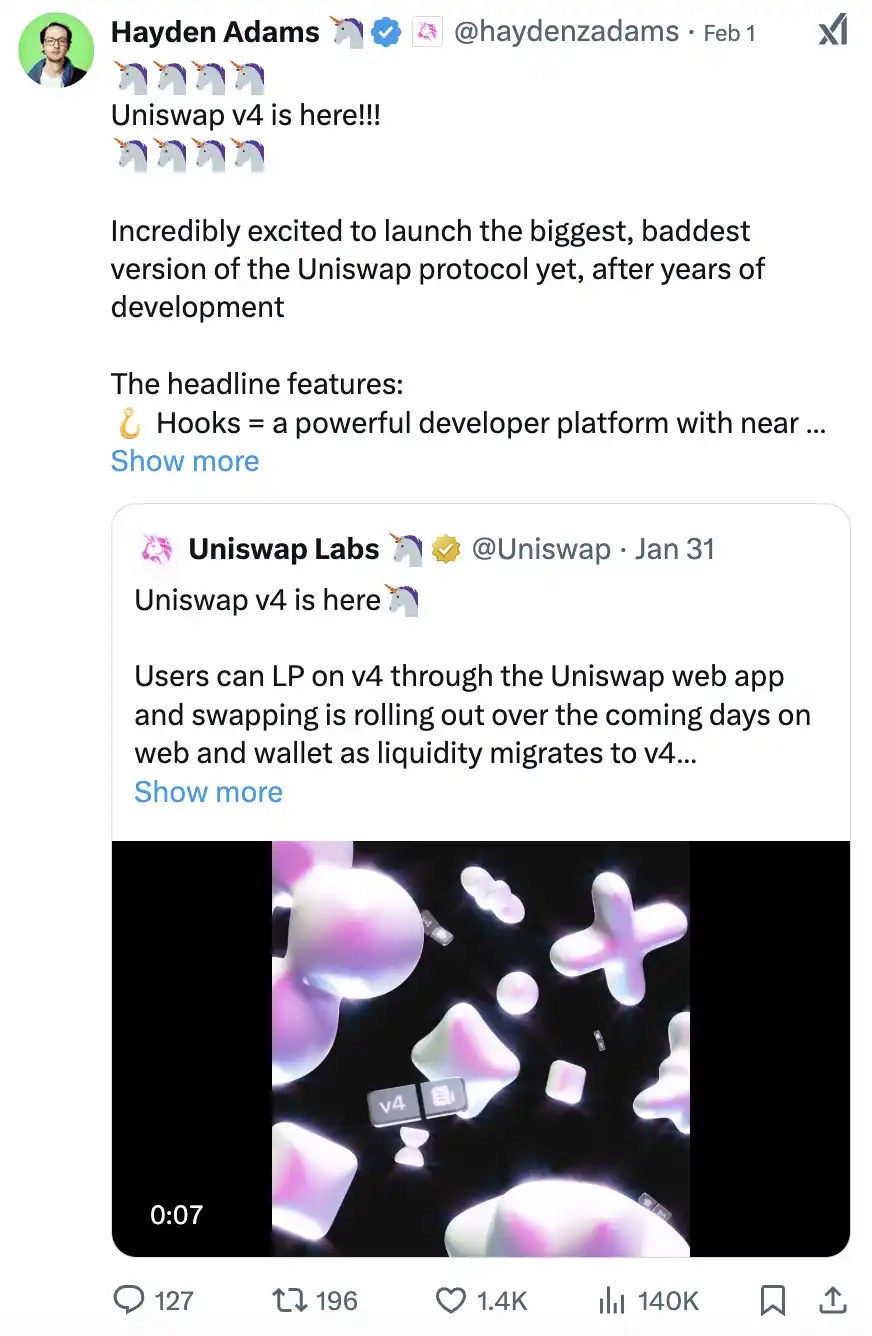
Hooks are the most anticipated development in V4, allowing anyone to create custom logic and plug it into Uniswap as a modular plugin. Before we dive into Hooks, let's take a look at key concepts introduced in Uni V4:
· Singleton Structure
· Flash Accounting
· Native ETH Support
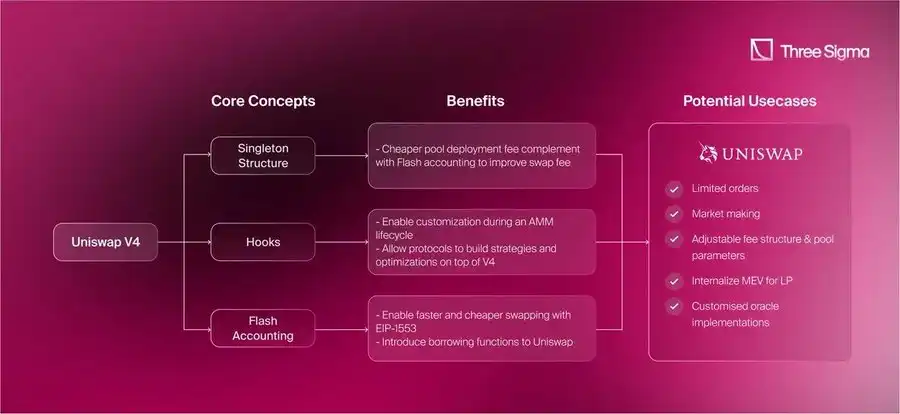
Singleton Contract for Pool Deployment
The Singleton structure impacts the deployment cost of liquidity pools. In Uniswap V4, this cost has been reduced by 99.99%. Singleton also acts as the immutable settlement layer for all pools.
· Previously: Each pool had its own smart contract (factory model)
· V4: All pools are created within the same contract, thus reducing costs
Flash Accounting
With Flash Accounting, anyone can lock their tokens in a pool as long as they don't end up owing any tokens when the lock expires. Using the EIP-1153 standard, users can batch multiple operations in a single transaction, enabling faster and cheaper transactions. EIP-1153 refers to "transient storage," where data is erased at the end of each transaction. This allows for additional information to be included in transactions without increasing storage overhead.
· Legacy (Factory Model): Pools for multiple contracts settle token balances after each operation.
· V4: Singleton and Flash Accounting ensure that a contract maintains balance integrity. Each operation updates the internal balance, and external transfers occur upon lock expiration.
New `take()` and `settle()` functions can be used to borrow or deposit funds into the pool, respectively. By requiring that no tokens are owed to the pool manager or caller at the end of the call, the pool's solvency is ensured.
Hooks
Through Hooks, anyone can launch a liquidity pool with customized and flexible execution logic or new features. Hooks cater to:
· Chains: Driving ecosystem development with added functionality
· Protocols: Enhancing user experience and differentiation
· Developers: Offering new ways to plug applications into Uniswap liquidity
The Uniswap Foundation has already spurred the creation of over 150 new Hooks through direct funding and investments. Ensuring an ample supply of Hooks, especially those that are open-source, production-ready, and adaptable to various use cases, is a core mission of the Foundation. Hooks can autonomously manage generated fees. They can be set as static or dynamic fees and even reallocate all fees to incentivize their usage (e.g., distributed to liquidity providers, users conducting trades, integrated applications, etc.).
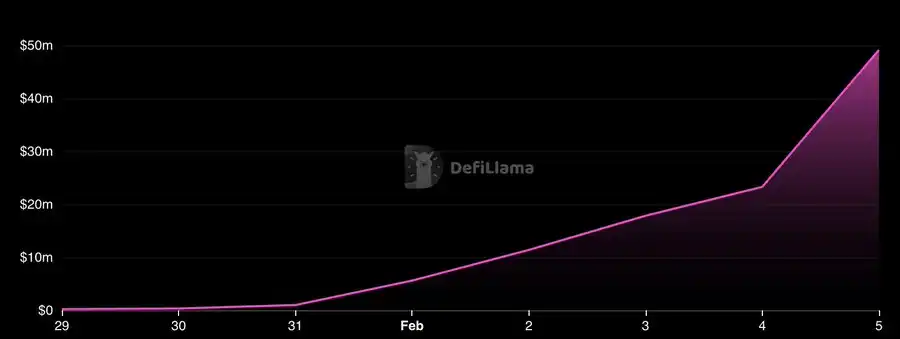
Uniswap V4's Total Value Locked (TVL) has now approached $50 million.
Additional Features
1. Native ETH support has been reintroduced, reducing the exchange cost for ETH pairs by 15%.
· V1: Only ETH pairs
· V2: Due to integration complexity and WETH-induced liquidity fragmentation, ETH has been removed
· V3: WETH
· V4: ETH, WETH
2. Custom Settlement: Developers can introduce new settlement logic using Hooks. Here are some examples:
(1) Introduce a custom fee model: Add fees on LP positions
(2) Create custom curves different from centralized liquidity (e.g., Hooks can replicate the Uniswap V2 constant product market maker)
(3) Interface composability: Hooks adapt to exchange parameters defined by each integrated smart contract
(4) Use ERC-6909 for token settlement, keeping tokens in the contract instead of transferring them
3. Governance does not control fee tiers or tick spacing but can extract a certain proportion from the pool's swap fee
4. Reduce Gas Costs: Through a Singleton and instant settlement model, the Gas cost of liquidity pool deployment has been reduced and other optimizations introduced. For example, the price oracle built into Uni V2-V3 is now redundant (saving oracle fees).
5. Users can also use the donate() function to tip liquidity providers directly from the pool's tokens
The combination of these features means that Uniswap V4 is a more customizable integration with multiple optimization mechanisms, bringing tangible benefits to developers and users:
· Cheaper multi-route exchanges
· Easier integration and customization
· Secure and audited codebase
Star Projects on Uniswap V4
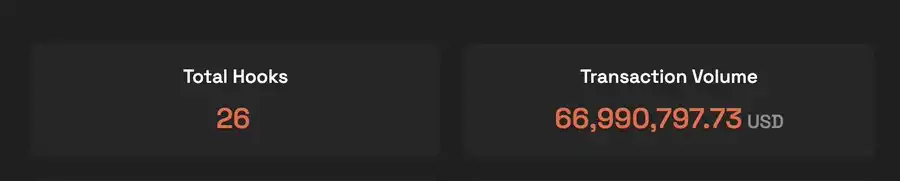
The charm of Hooks is that they allow for permissionless development on Uniswap V4. In just a few days, over 25 external Hooks have been released, with a trading volume exceeding $66 million.
Some of the most interesting projects built on V4 include:
· Bunni
· Flaunch
· Sorella
· Doppler
Bunni @bunny_xyz

Bunni focuses on enhancing LP returns through the following unique features:
1. Liquidity Density Function (LDF) that creates a complex liquidity distribution based on market conditions or strategies
2. Liquidity Shape Transformation: ability to modify liquidity shape at any time without removing positions
3. Automated Position Rebalancing and Automatic Compounding
4. Improved Swapping: maintains the same Gas fee when crossing 'ticks,' enhancing efficiency for large transactions
5. Reinvestment Hook: pools can deposit idle assets into external protocols and earn additional yield
These features encompass most key DeFi protocols:
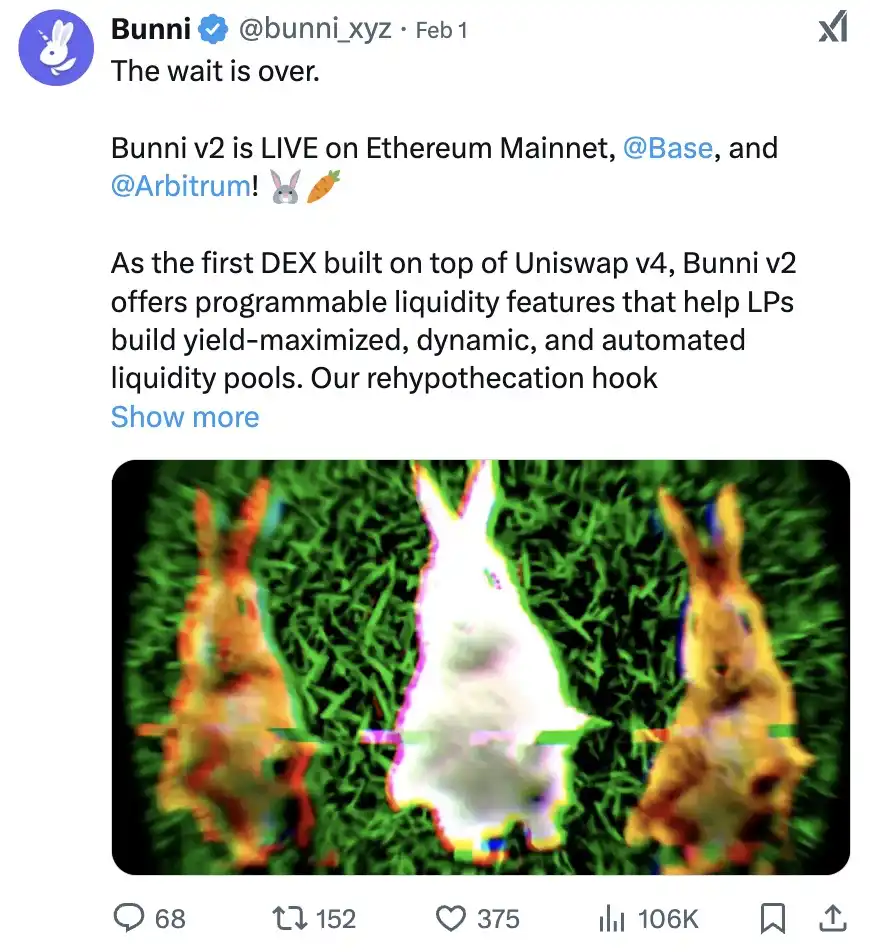
6. Auction Mechanism allowing MEV extraction and fee optimization
7. Fee based on Volatility
Why choose to deploy on Bunni?
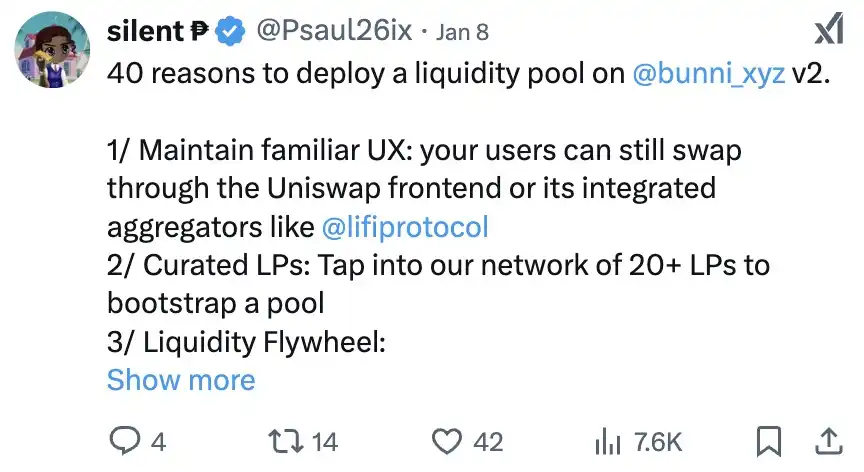
Flaunch @flaunchgg

Flaunch is a launchpad focused on memecoins, integrating multiple sustainability mechanisms:
1. 100% of revenue returned to developers, who can decide the proportion to reward holders. Untaken fees will be used for buybacks.
2. Native integration of an automatic token buyback mechanism (each 0.1 ETH fee generates one buyback).
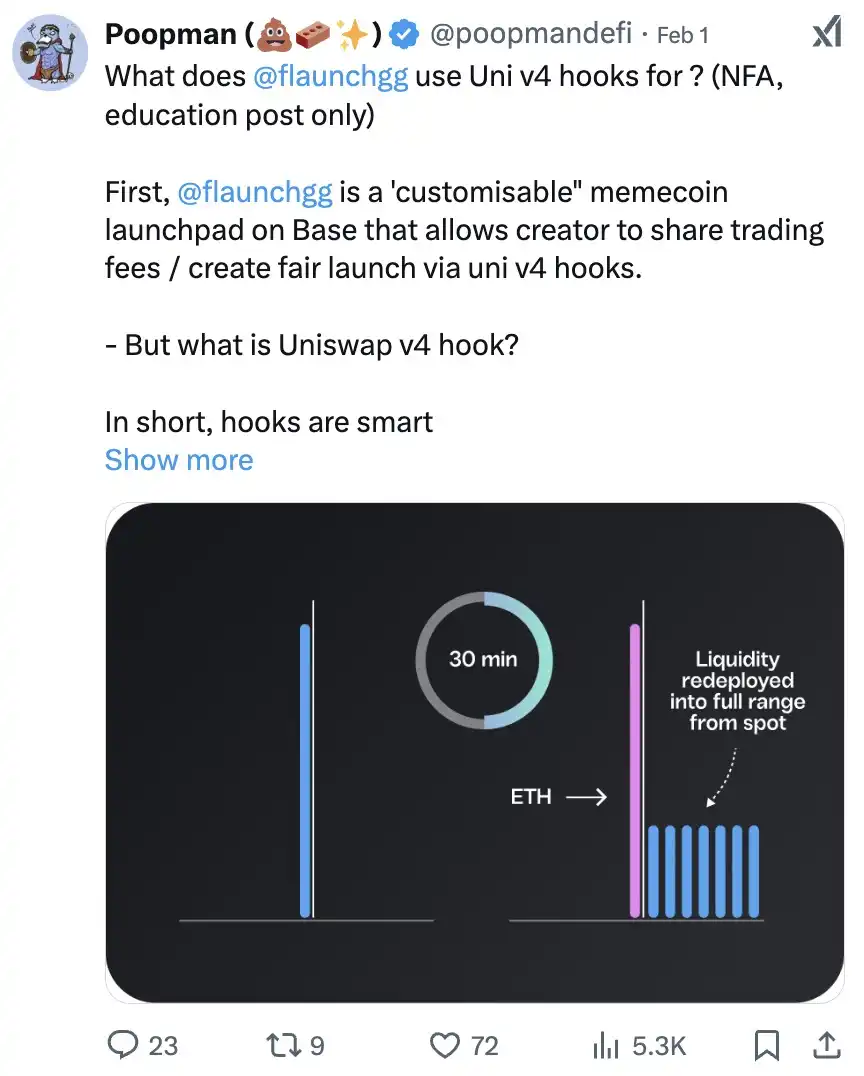
3. Stealth Launch: after launch, token price remains stable for 30 minutes to ensure everyone has the same entry point.
4. Memestream: creators can grant ownership of transaction fee royalties through NFT to any wallet they choose, creating a secondary market for token transaction fee royalties.
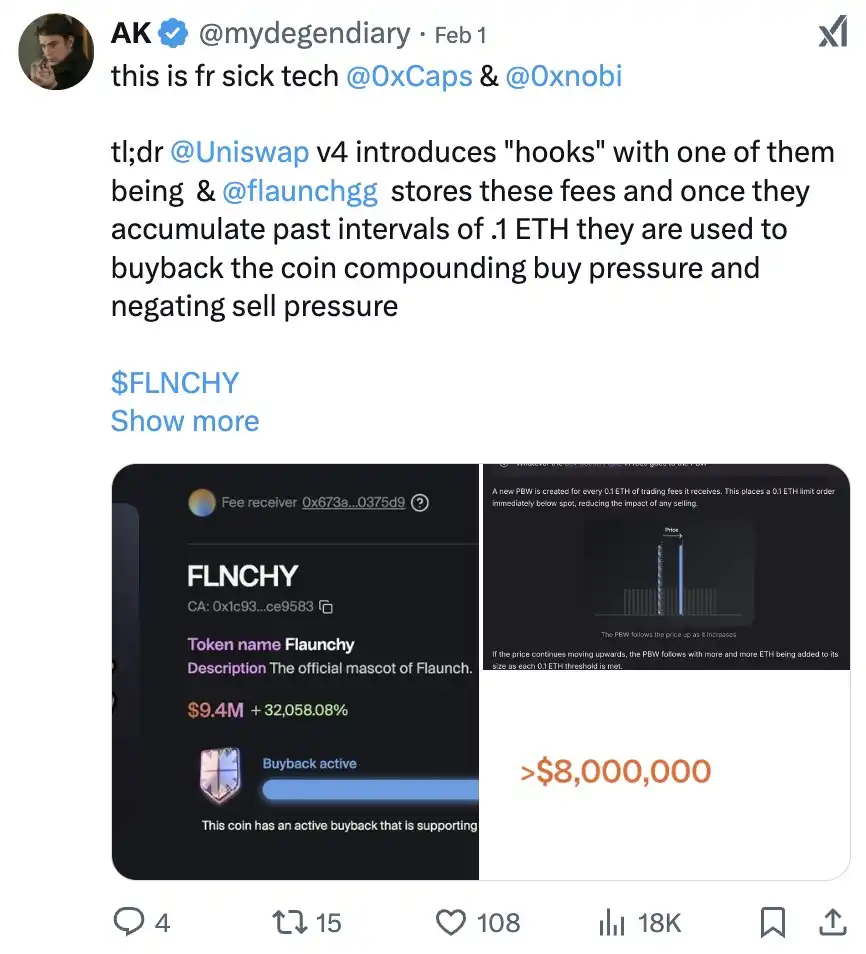
Since launch about a week ago, Flaunch has already refunded over $622,000 in fees.

How to use Uniswap V4's Hooks? Poopman has already explained it very clearly here.
Sorella Labs @SorellaLabs

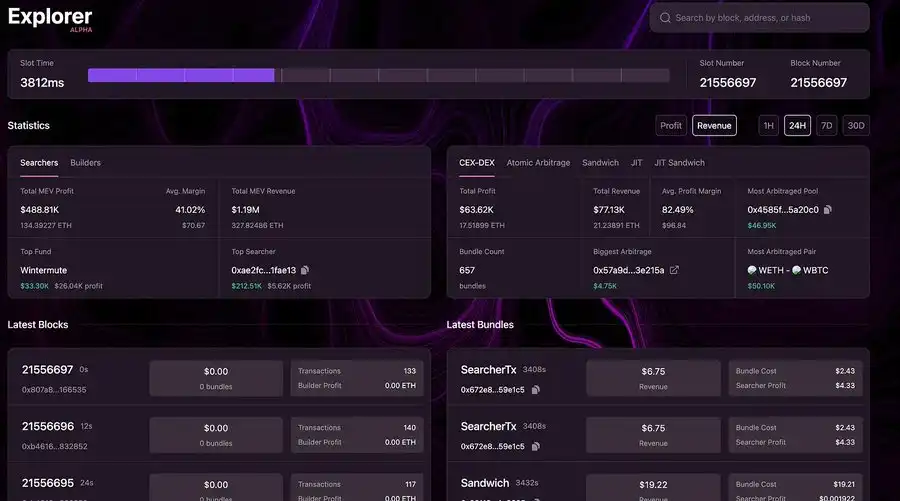
Sorella Labs focuses on providing tools for LPs to address the MEV problem:
1. Blockchain explorer providing MEV information and real-time block stats, including: stats on searchers and builders: MEV revenue and profit, top funds, top searcher MEV events: CEX-DEX arbitrage, sandwich attacks, flashbots, instant trades
2. Real-time dashboard of MEV events: display of mempool and all builders' bids
3. Time-based evolving MEV stats segmented by category
Sorella Labs has also launched Angstrom, a new DEX iteration focused on reducing LP users' MEV loss. The proposed solution of Angstrom enables applications to:
· Ensure fair pricing of transactions: all transactions within a block are executed at the same price, eliminating front-running.
· Allocate rebates from winning bids to LPs to include in-block trades.
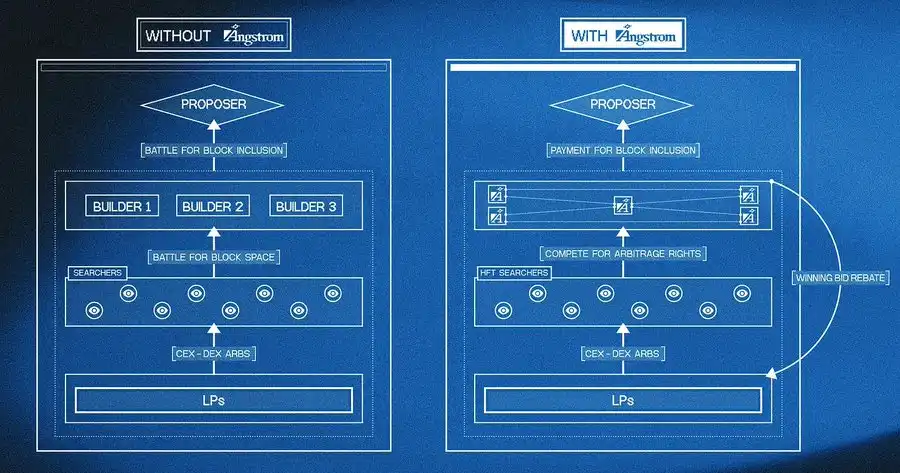
How does Angstrom work?
· MEV auctions take place within the application's mempool.
· Unlike payment for priority, arbitrageurs "must bid directly to the LP to secure the right to arbitrage."
· All transactions are executed equally within the same block, reducing sandwich attacks. Gas fees can be paid in any token.
· Angstrom uses a set of "Staking Validators" network to enforce specific ordering rules through consensus: Validators stake ETH using EigenLayer and ensure rule compliance through slash penalties.
The LP-provided yield is then realized through reduced transaction fees and lowered cost of incentivizing liquidity.
Doppler @whetstonedotcc

Doppler is a protocol focused on enhancing liquidity bootstrapping and price discovery. It introduces the concept of "Liquidity Auctions," executing liquidity bootstrapping within the Hook contract. These intricate operations are fully abstracted through the UI.
The auctions can be:
· Successful: where liquidity is sent to the AMM based on user-defined parameters
· Unsuccessful: where all contributions are refunded
The auctions aim to help projects price liquidity more accurately and minimize the possibility of initiating liquidity at incorrect prices. This process also significantly simplifies integrator challenges, removes the burden of liquidity thinking, allowing teams to focus on other priorities. Additionally, through "Integrator Fees" incentives, it decentralizes integrators, allowing them to set fees they can capture after successfully bootstrapping liquidity.
Doppler has also introduced a second product, Pure Markets, a frontend based on Doppler.
Other Projects
There are several protocols built on Uniswap V4, including:
@ArrakisFinance
@Corkprotocol
@SemanticLayer
Uniswap V4 is expected to inject new vitality into DeFi, bringing many new use cases to the Ethereum ecosystem. This is just the beginning, and with the launch of Uniswap V4, we can continue to expect more innovative Hooks in the coming weeks.
You may also like

March 4th Market Key Intelligence, How Much Did You Miss?

Taking Stock of Crypto's Washington Power Players: Who is Advocating for US Crypto Regulation?

DDC Enterprise Limited Announces 2025 Unaudited Preliminary Financial Performance: Record Revenue Achieved, Bitcoin Treasury Grows to 2183 Coins
On March 4, 2026, DDC Enterprise Limited (NYSE American: DDC) today announced preliminary, unaudited full-year financial performance for the year ended December 31, 2025. The company expects to achieve record revenue and record positive adjusted EBITDA, primarily driven by continued growth in its core consumer food business and overall margin improvement. The final audited financial report is expected to be released in mid-April 2026.
Revenue: Expected to be between $39 million and $41 million, reaching a new company high.
Organic Growth: Excluding the impact of the company's strategic contraction of its U.S. operations, core revenue is expected to grow 11% to 17% year over year.
Gross Profit Margin: Expected to be between 28% and 30%, reflecting continued operational efficiency improvements.
Adjusted EBITDA: The company expects to achieve a positive full-year result in 2025, a significant improvement from a $3.5 million loss in 2024, mainly due to rigorous cost controls and a higher-margin sales mix.
In 2025, DDC's core consumer food business maintained strong operational performance.
The company also disclosed Core Consumer Food Business Adjusted EBITDA, a metric that further excludes costs related to its Bitcoin reserve strategy and non-cash fair value adjustments related to its Bitcoin holdings from adjusted EBITDA to more accurately reflect the core business performance.
In 2025, Core Consumer Food Business Adjusted EBITDA is expected to be between $5.5 million and $6 million.
In the first half of 2025, DDC initiated a long-term Bitcoin accumulation strategy, holding Bitcoin as its primary reserve asset.
As of December 31, 2025: The company holds 1,183 BTC.
As of February 28, 2026: Holdings increased to 2,118 BTC
Today's additional purchase of 65 BTC brings the company's total holdings to 2,183 BTC
DDC Founder, Chairman, and CEO Norma Chu stated, "We are proud to have closed 2025 with record revenue and positive adjusted EBITDA, demonstrating the steady growth of the company's consumer food business and the ongoing improvement in profitability. We are building a disciplined, growth-oriented food platform and strategically allocating capital to Bitcoin assets with a long-term view, aligning with our core beliefs. We believe that this dual-track model of 'Steady Consumer Business + Strategic Bitcoin Reserve' will help DDC create lasting long-term value for shareholders."
For the full year 2025, the company defines "Adjusted EBITDA" (a non-GAAP financial measure) as: Net income / (loss) excluding the following items:· Interest expense· Taxes· Foreign exchange gains/losses· Long-lived asset impairment· Depreciation and amortization· Non-cash fair value changes related to financial instruments (including Bitcoin holdings)· Stock-based compensation
DDC Enterprise Limited (NYSE: DDC) is actively implementing its corporate Bitcoin Treasury strategy while continuing to strengthen its position as a leading global Asian food platform.
The company has established Bitcoin as a core reserve asset and is executing a prudent, long-oriented accumulation strategy. While expanding its portfolio of food brands, DDC is gradually becoming one of the public company pioneers in integrating Bitcoin into its corporate financial architecture.

Uncovering YZi Labs 229 Investment: Over 18% of the portfolio is already inactive, with an average project transparency score of 78

The business of crypto VC is becoming promising

China's AI Compute Power Counterstrike

Global Assets Plunge: Hormuz, Chips, and a South Korean Holiday

Bloomberg has reported twice, Hyperliquid once again in Wall Street's radar

Trump Backs Crypto Bill, SEC Halts Leveraged ETF, What Is the English-Speaking Crypto Community Talking About?

OpenClaw Floods Into Polymarket, Some Making Tens of Thousands Per Month
Understanding Trump's "Warfare Playbook": Ten Signals Investors Must Know

Iranian Missile Heading Toward UAE, Claude Also Within Range
Successive Core Team "Heroes" Depart, Has Aave's DAO Dream Crumbled?

Is This the Year of the Robot? A Deep Dive into Robotics Projects
When AI Takes Over Money: Bitcoin Becomes the "First Choice," Fiat Is Left Out

AI Trading in Live Markets: 4 Lessons From a WEEX Hackathon Top 10 Finalist
AI trading meets real markets. Explore 4 lessons from a WEEX Hackathon Top 10 finalist on surviving volatility, trusting AI models, and building smarter crypto trading systems.

MegaETH Co-founder: 48 Hours After Leaving Dubai, I Reassessed the Entire Crypto Space

Web3 Winter Mass Exodus: Resignations, Closures, Transformations, and Acquisitions
March 4th Market Key Intelligence, How Much Did You Miss?
Taking Stock of Crypto's Washington Power Players: Who is Advocating for US Crypto Regulation?
DDC Enterprise Limited Announces 2025 Unaudited Preliminary Financial Performance: Record Revenue Achieved, Bitcoin Treasury Grows to 2183 Coins
On March 4, 2026, DDC Enterprise Limited (NYSE American: DDC) today announced preliminary, unaudited full-year financial performance for the year ended December 31, 2025. The company expects to achieve record revenue and record positive adjusted EBITDA, primarily driven by continued growth in its core consumer food business and overall margin improvement. The final audited financial report is expected to be released in mid-April 2026.
Revenue: Expected to be between $39 million and $41 million, reaching a new company high.
Organic Growth: Excluding the impact of the company's strategic contraction of its U.S. operations, core revenue is expected to grow 11% to 17% year over year.
Gross Profit Margin: Expected to be between 28% and 30%, reflecting continued operational efficiency improvements.
Adjusted EBITDA: The company expects to achieve a positive full-year result in 2025, a significant improvement from a $3.5 million loss in 2024, mainly due to rigorous cost controls and a higher-margin sales mix.
In 2025, DDC's core consumer food business maintained strong operational performance.
The company also disclosed Core Consumer Food Business Adjusted EBITDA, a metric that further excludes costs related to its Bitcoin reserve strategy and non-cash fair value adjustments related to its Bitcoin holdings from adjusted EBITDA to more accurately reflect the core business performance.
In 2025, Core Consumer Food Business Adjusted EBITDA is expected to be between $5.5 million and $6 million.
In the first half of 2025, DDC initiated a long-term Bitcoin accumulation strategy, holding Bitcoin as its primary reserve asset.
As of December 31, 2025: The company holds 1,183 BTC.
As of February 28, 2026: Holdings increased to 2,118 BTC
Today's additional purchase of 65 BTC brings the company's total holdings to 2,183 BTC
DDC Founder, Chairman, and CEO Norma Chu stated, "We are proud to have closed 2025 with record revenue and positive adjusted EBITDA, demonstrating the steady growth of the company's consumer food business and the ongoing improvement in profitability. We are building a disciplined, growth-oriented food platform and strategically allocating capital to Bitcoin assets with a long-term view, aligning with our core beliefs. We believe that this dual-track model of 'Steady Consumer Business + Strategic Bitcoin Reserve' will help DDC create lasting long-term value for shareholders."
For the full year 2025, the company defines "Adjusted EBITDA" (a non-GAAP financial measure) as: Net income / (loss) excluding the following items:· Interest expense· Taxes· Foreign exchange gains/losses· Long-lived asset impairment· Depreciation and amortization· Non-cash fair value changes related to financial instruments (including Bitcoin holdings)· Stock-based compensation
DDC Enterprise Limited (NYSE: DDC) is actively implementing its corporate Bitcoin Treasury strategy while continuing to strengthen its position as a leading global Asian food platform.
The company has established Bitcoin as a core reserve asset and is executing a prudent, long-oriented accumulation strategy. While expanding its portfolio of food brands, DDC is gradually becoming one of the public company pioneers in integrating Bitcoin into its corporate financial architecture.


 App
App