
- Buy Crypto
- Markets
 Futures
- Spot
- Copy Trade
- Earn
- More
Bankless: Is the On-Chain Development the Key to Unlocking the 300 Billion BTC Sleeping Outside of DeFi?

Original Title: Can Bitcoin Thrive Onchain?
Original Author: Jean-Paul Faraj, Bankless
Original Translation: Bitpush News
Despite holding the top spot in cryptocurrency market cap, Bitcoin's participation in the decentralized finance (DeFi) space is relatively low, sparking a profound discussion about its future role.
For over a decade, Bitcoin has been a cornerstone of the crypto ecosystem—praised for its decentralization, censorship resistance, and provable scarcity. However, despite Bitcoin's dominant market cap and recent resurgence in interest, it still largely stands apart from one of the most vibrant sectors in the crypto space—DeFi.
According to Bitcoin Layers data, only about $30 billion worth of Bitcoin (just 1.875% of its total supply) is being used in DeFi. In contrast, Ethereum has around $50 billion worth of ETH locked in DeFi, approximately 23% of its total supply.
This disparity highlights a core contradiction in today's Bitcoin narrative: while BTC holds significant value, a relatively small amount of BTC is actively being utilized on-chain to provide yield opportunities. This gap is driving an innovation wave around ways to wrap, stake, and other methods to bring Bitcoin into the DeFi economy, unlocking avenues to make BTC an productive capital asset.
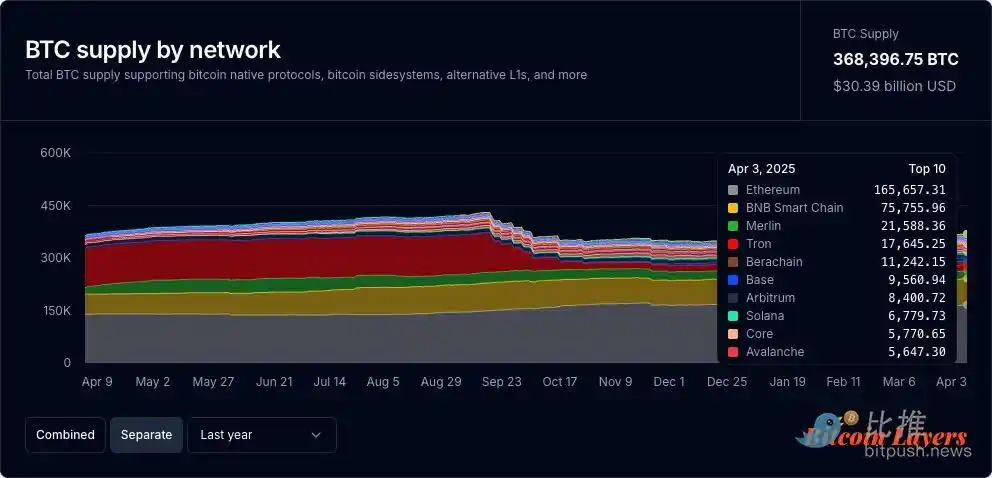
Bitcoin Layers: BTC supply segmented by network, showing all wrapped BTC
Ethereum's DeFi ecosystem has seen the emergence of tools for lending, staking, and trading. In contrast, native Bitcoin still struggles to be effectively utilized, especially for new users. Transaction times are slow, fees are variable and often high, and Bitcoin's architecture lacks the programmability to support applications built on Ethereum.
As the broader cryptocurrency space matures, an important question arises: can Bitcoin meaningfully participate in the on-chain economy? If so, how can we onboard users without requiring ordinary BTC holders to go through a series of bridges, wrapped tokens, and unfamiliar applications to join in?
Issue: Bitcoin's Design and DeFi's Practicality
Bitcoin's underlying architecture was not optimized for the high programmability of today's smart contracts. Its security and decentralization are prioritized through a Proof of Work (PoW) mechanism rather than aiming for complex logic expression—this design choice has made it a reliable store of value tool but has also limited its adaptability in smart contracts and complex DeFi applications. Therefore, native Bitcoin has struggled to integrate into the thriving composable financial ecosystem on chains like Ethereum and Solana.
In the past, we have seen some workarounds:
· Bitcoin Wrapping: Users convert BTC into ERC-20 tokens to access Ethereum-based DeFi. This introduces custody risks as token liquidity may not be transparent and may not always be 1:1 backed by BTC by third-party custodians.
· Bridging Protocols: Cross-chain platforms allow BTC to move into other ecosystems. However, manual bridging introduces friction, complexity, and risk—especially for non-technical users.
· Custodial Platforms: Centralized services like Coinbase offer BTC yields but require users to give up custody and typically pay returns in tokens, stablecoins, or proprietary tokens instead of BTC.
Each option comes with trade-offs that challenge Bitcoin's core principles: security, simplicity, and user sovereignty.
Entry Barrier: Why User Experience Still Matters
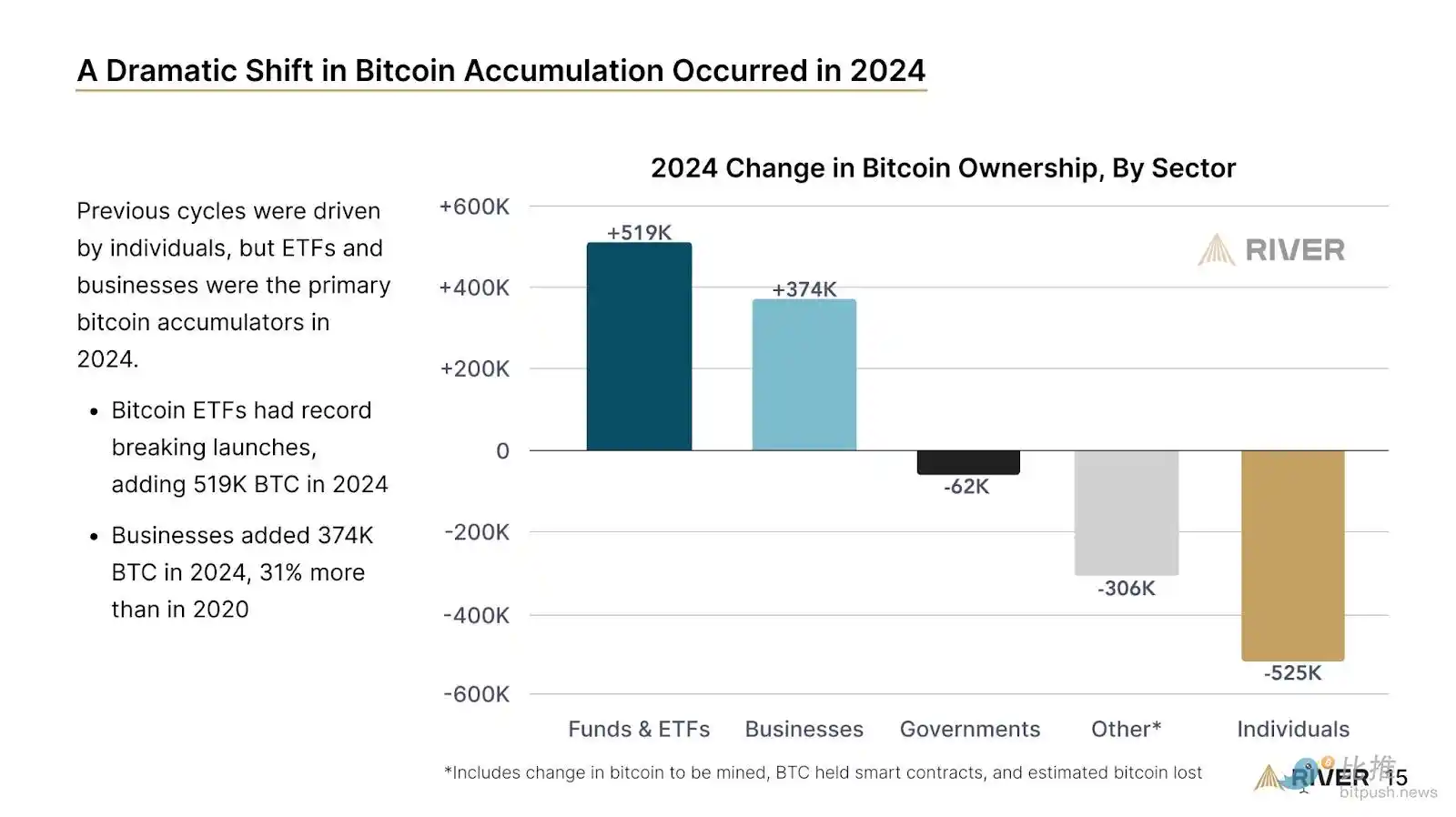
2024 Bitcoin Accumulation, river.com
For Bitcoin holders curious about doing more with their assets (earning yield, participating in on-chain governance, or trying DeFi), the onboarding process remains fragmented, non-intuitive, and often daunting. While the infrastructure has matured, the user experience still lags behind, with competitors not only being other blockchains but also TradFi.
This friction has created a significant entry barrier. Most users do not want to become power users of DeFi—they seek to simply and securely increase their net worth and BTC holdings without venturing into the maze of applications, bridges, and protocols like recent Bitcoin buyers who made large off-chain purchases through brokers, ETFs, and products like Michael Saylor's Strategy.
In order to transition the next wave of users from simple off-chain holders to on-chain users, tools need to eliminate this complexity while not sacrificing control, self-custody, or transparency. This is where emerging protocols and modern wallet experiences truly come into play—providing user-friendly DeFi foundational access while maintaining Bitcoin's core principles.
A better user experience is not just icing on the cake; it is key infrastructure for Bitcoin adoption's next stage.
A New Approach to On-Chain BTC Yield and Productivity
Many emerging solutions aim to make Bitcoin more user-friendly in DeFi—each with its own trade-offs:
1. Staking, Re-Staking, and Point-based Yield Programs
Platforms like Babylon and Lombard now offer Bitcoin-related yield programs through points or reward tokens, usually achieved through staking/restaking, which can often be redeemed for perks or future airdrops. These systems appeal to early adopters and chase airdrops, as well as crypto-native users of platform-specific tokenomics. These products often involve converting BTC to wrapped BTC standards, then locking assets in various plans/products to earn variable yields. For savvy on-chain traders, high yields can be obtained, but this requires a deeper understanding of cryptocurrency usage, as well as manual bridging, wrapping, and depositing of funds.
Pros:
· Broad range of yield opportunities
· Usually self-custody
Cons:
· Rewards not paid in BTC
· Typically involves lockup periods
· Long-term value of rewards is uncertain
2. Bitcoin Layer 2 and Meta protocols
Developments like the Lightning Network, Rootstock (RSK), Alkanes, and emerging Layer 2 innovations like Botanix and Starknet are bringing new features, programmability, and speed to Bitcoin. These innovations enable use cases like fast payments, NFTs, and smart contract-like behaviors. As a result, users can now use their BTC to access a wide range of DeFi opportunities—such as securing networks through asset locking, participating in liquidity provision, borrowing, or asset conversion to support various protocols' wrapped BTC standards. As more teams build out these networks, the ecosystem of Bitcoin-based yield opportunities will continue to expand.
Pros:
· Expands Bitcoin's use cases
· Maintains consistency with Bitcoin's architecture
· Wide range of on-chain earning opportunities
Cons:
· Still relatively early and decentralized
· Requires intermediate to advanced understanding to leverage
· Requires significant developer resources to build out much of what already exists on other smart contract chains
3. Smart Wallet Integration and Native BTC Earnings
Wallets like Braavos provide features that allow users to earn native BTC rewards without manually wrapping their Bitcoin or giving up custody. Users can directly invest BTC through their wallet without dealing with the typical bridging or usage of external applications. Complex steps such as depositing, wrapping, and bridging are seamlessly handled in the background, with BTC being deployed into specific DeFi strategies. This user-friendly approach aims to make BTC earnings accessible to everyone, regardless of their technical background or cryptocurrency experience.
Pros:
· Earnings paid in BTC (not in points or proxy tokens)
· No need for manual bridging or third-party custody
· Self-custody by default
· Beginner-friendly
Cons:
· Relies on converting to wrapped BTC
· Requires some trust in the bridging mechanism and earnings protocol infrastructure
· Larger picture: Bitcoin's evolving role on-chain
The narrative around Bitcoin has long revolved around "store of value"—a role it has reliably fulfilled. However, as the on-chain economy develops, the pressure on Bitcoin to integrate into this emerging financial stack and fulfill its promise as a reliable payment infrastructure is increasing.
In order to achieve this without compromising decentralization or user trust, new infrastructure must make these opportunities easily accessible without requiring technical expertise or compromising Bitcoin's core principles.
This means:
· Earnings should prioritize being paid in BTC rather than derivative assets
· Custody must be reserved for the user
· Complexity must be abstracted, not transferred to the user
Products like Braavos, Lombard, Babylon, and others mentioned in this article are examples of how these ideas are implemented. Whether through staking to earn user rewards or by directly embedding Bitcoin backing into self-custody options and automating the complexity behind it, they make it easier for Bitcoin holders to access DeFi without having to fully exit the Bitcoin ecosystem.
Bridging the Gap Thoughtfully
The transition of Bitcoin to an on-chain economy will not happen overnight—and it shouldn't. Prudence, simplicity, and self-sovereignty are the cornerstone of Bitcoin's core principles. However, as more tools that respect these values and provide new functionalities emerge, BTC's role in the broader cryptocurrency economy is evolving.
The current challenge is to build an open, secure, and most importantly—an accessible system. If the next billion users are to come on board through Bitcoin, they will need to meet their existing needs and be part of an experience that is acceptable to a wider user base.
You may also like

Wall Street Shorts ETH: Vitalik is aware and has front-run, while Tom Lee remains oblivious

Social Capital CEO: How Equity Tokenization is Reshaping Capital Markets from US Stocks to SpaceX?

CoinGecko Report: Surge of 346% vs Dip of 20.8%, The Wild Rise of DEX

a16z: The Real Opportunity of Stablecoins Lies Not in Disruption but in Filling Gaps

Mining Exodus: Someone Holds $12.8 Billion AI Order

March 6 Market Key Intelligence, How Much Did You Miss?

a16z: The True Opportunity of Stablecoins is in Complementing, Not Disrupting

Predict LALIGA Matches, Shoot Daily & Win BTC, USDT and WXT on WEEX
The WEEX × LALIGA campaign brought together football excitement and crypto participation through a dynamic interactive experience. During the event, users predicted matches, completed trading tasks, and took daily shots to compete for rewards including BTC, USDT, WXT, and exclusive prizes.

Ray Dalio Dialogue: Why I'm Betting on Gold and Not Bitcoin

Who Took the Money in the AI Era? A Must-See Investment Checklist for HALO Asset Trading
Wall Street Bears Target Ethereum: Vitalik In the Know Takes Flight, Tom Lee Remains Bullish
Pump.fun Hacker Steals $2 Million, Receives 6-Year Prison Sentence, Opts for 'Self-Detonation'

6% Annual Percentage Yield as Musk Declares War on Traditional Banks
36 years, 4 wars, 1 script: How does capital price the world in conflict?

Mining Companies' Great Migration: Some Have Already Secured $12.8 Billion in AI Orders
What Is Vibe Coding? How AI Is Changing Web3 & Crypto Development
What is vibe coding? Learn how AI coding tools are lowering the barrier to Web3 development and enabling anyone to build crypto applications.
The parent company of the New York Stock Exchange strategically invests in OKX: The intentions behind the $25 billion valuation

WEEX P2P update: Country/region restrictions for ad posting
To improve ad security and matching accuracy, WEEX P2P now allows advertisers to restrict who can trade with their ads based on country or region. Advertisers can select preferred counterparty locations for a safer, smoother trading experience.
I. Overview
When publishing P2P ads, advertisers can now set the following:
Allow only counterparties from selected countries or regions to trade with your ads.
With this feature, you can:
Target specific user groups more precisely.Reduce cross-region trading risks.Improve order matching quality.
II. Applicable scenarios
The following are some common scenarios:
Restrict payment methods: Limit orders to users in your country using supported local banks or wallets.Risk control: Avoid trading with users from high-risk regions.Operational strategy: Tailor ads to specific markets.
III. How to get started
On the ad posting page, find "Trading requirements":
Select "Trade with users from selected countries or regions only".Then select the countries or regions to add to the allowlist.Use the search box to quickly find a country or region.Once your settings are complete, submit the ad to apply the restrictions.
When an advertiser enables the "Country/Region Restriction" feature, users who do not meet the criteria will be blocked when placing an order and will see the following prompt:
If you encounter this issue when placing an order as a regular user, try the following solutions.
Choose another ad: Select ads that do not restrict your country/region, or ads that allow users from your location.Show local ads only: Prioritize ads available in the same country as your identity verification.
IV. Benefits
Compared with ads without country/region restrictions, this feature provides the following improvements.
Aspect
Improvement
Trading security
Reduces abnormal orders and fraud risk
Conversion efficiency
Matches ads with more relevant users
Order completion rate
Reduces failures caused by incompatible payment methods
V. FAQ
Q1: Why are some users not able to place orders on my ad?
A1: Their country or region may not be included in your allowlist.
Q2: Can I select multiple countries or regions when setting the restriction?
A2: Yes, multiple selections are supported.
Q3: Can I edit my published ads?
A3: Yes. You can edit your ad in the "My Ads" list. Changes will take effect immediately after saving.


 App
App