
Besides Resolv Hack, This DeFi Vulnerability Type Has Occurred Four Times

 Prefer us on Google


Original Title: DeFi Has Seen Resolv's $25M USR Exploit Many Times Before
Original Author: Camila Russo, The Defiant
Original Translation: DeepFlow Tech
On a quiet Sunday morning, someone turned $100,000 into $25 million in about 17 minutes.
The target was the yield-bearing stablecoin protocol Resolv. Before Resolv paused the contract, its USD-pegged stablecoin USR had plummeted to a few cents. As of the time of writing, USR remains severely off-peg, trading around $0.25, with a drop of over 70% this week.
The impact wave goes far beyond Resolv itself. Fluid/Instadapp absorbed over $10 million in bad debt in a single day, experiencing over $300 million in net outflows on the same day, marking its largest daily outflow in history. 15 Morpho vaults were affected. Euler, Venus, Lista DAO, and Inverse Finance all successively paused USR-related markets.
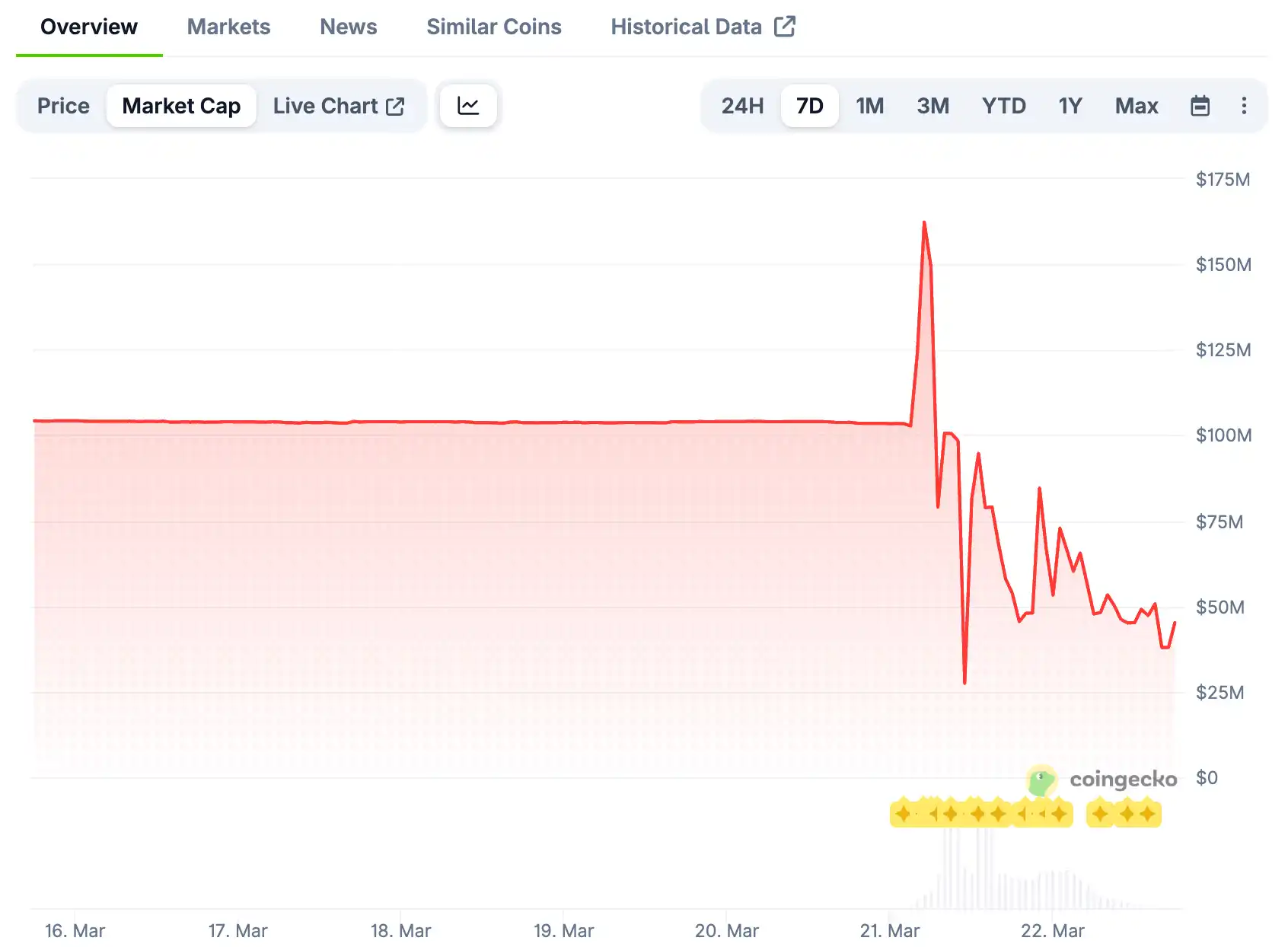
The mechanism that led to the spread of losses from this vulnerability—pricing the off-peg stablecoin at $1 in the lending market—is not a novelty. Over the past 14 months, this situation has occurred at least four times.
How the Exploit Worked
The minting of USR follows a two-step off-chain process: Users deposit USDC through the `requestSwap` function, and a privileged off-chain signing key `SERVICE_ROLE` finalizes the issuance of the USR amount through `completeSwap`.
The contract has a minimum output restriction but no upper limit. Whatever the key holder signs, the contract executes.
The attacker gained access to this key through Resolv's AWS Key Management Service. They submitted two USDC deposits totaling around $100,000 to $200,000 and then utilized the stolen key to mint 80 million USR as a reward. On-chain data shows two transactions of 50 million USR and 30 million USR, both minted within minutes.
「The Resolv USR vulnerability is not a bug - it's a feature working as intended. That's the problem.」 On-chain analyst Vadim (@zacodil) stated.
The SERVICE_ROLE is a regular external account address, not a multisig. The admin key has multisig protection, but the minting key does not.
「Resolv went through 18 audits,」 Vadim said, 「and one of the findings was directly named 'missing cap.'」
The attacker methodically exited: first converting minted USR to wstUSR (a wrapped staking version) to soften the market impact, then swapping it for ETH through Curve, Uniswap, and KyberSwap. The attacker's wallet holds around 11,400 ETH (about $24 million). The system's ETH and BTC collateral pools remain intact amid the stablecoin crash.
How the Contagion Spread
The Resolv vulnerability is actually the overlap of two events. The first being the minting bug and the second the failure of the cascade lending market.
When USR and wstUSR collapsed, every lending market that accepted them as collateral faced the same issue: their oracle still priced wstUSR near $1.
Risk analysis firm Chaos Labs founder Omer Goldberg documented this mechanism. His key finding was: 「The oracle is hardcoded, so it was never repriced. wstUSR was marked at $1.13, while its secondary market trading price was around $0.63.」
Traders bought wstUSR at a low price on the open market, then used the oracle's $1.13 price on Morpho or Fluid to collateralize it and borrowed USDC before exiting.
At Fluid, the team raised short-term loans to cover 100% of the default and pledged to compensate every user in full. At Morpho, co-founder Paul Frambot stated approximately 15 treasuries hold significant exposure, all part of a high-risk, long-tail collateral strategy.
Renowned curator Gauntlet has stated, "Several high-yield vaults have limited exposure."
However, D2 Finance directly refuted this claim, releasing on-chain data showing that Gauntlet's flagship "USDC Core Vault" allocated $4.95 million to the wstUSR/USDC market. Goldberg then stated that Gauntlet's vault holds 98% of the lending-side liquidity in that market.
Responding in writing to The Defiant, Frambot stated, "We've been researching how to present various risks more comprehensively. However, we don't believe the core issue here is a lack of labeling."
Frambot added, "Morpho is oracle agnostic, meaning it allows curators to choose any oracle they deem most suitable for a specific market. Morpho is an open, permissionless infrastructure designed to outsource risk management to curators."
"It is difficult to enforce an objectively 'correct' threshold in all scenarios," Frambot said. "Imposing constraints at the protocol level also carries the risk of hindering the implementation of legitimate strategies."
While the underlying protocol leaves risk management to the curator, some industry insiders believe that curators have not fulfilled their duties.
"I believe there is a flaw in the curator industry's design, as there is no genuine curation taking place," Marc Zeller stated on X.
As of the time of writing, Resolv, Gauntlet, and Fluid have not responded to The Defiant's request for comment.
A Recurring Pattern of Failure
This is not a new type of attack. In January 2025, Usual Protocol's USD0++ was hard-coded to $1 by curator MEV Capital in the Morpho Vault.
Usual then suddenly adjusted the redemption floor to $0.87 without any warning, leaving lenders locked in the MEV Capital Vault, which saw its utilization surge to 100%.
In November 2025, Stream Finance's xUSD collapsed, as the curator had routed USDC deposits into a leverage loop backed by that synthetic stablecoin. When its oracle refused to update, assets worth an estimated $2.85 billion to $7 billion on Morpho, Euler, and Silo faced risk.
In October and November 2025, Moonwell experienced two consecutive oracle failures, resulting in over $5 million in defaults.
-- Price
What Does This Mean for the Curator Model
Morpho's architecture outsources all risk decisions to a third-party "curator," who builds the vault, selects collateral, sets loan-to-value ratios, and chooses oracles. This theoretical framework posits that professional entities possess deeper expertise, competition leads to better risk management, and the protocol is responsible for rule execution.
However, curators rely on generated yields to earn fees, creating an incentive for higher-risk, higher-yield collateral (such as yield-bearing stablecoins). The issue arises when these stablecoins lose their peg, with depositors bearing the brunt of the loss instead of the curator.
In the Resolv incident, some curators' automated bots continued to deposit funds into the affected vault hours after the exploit, exacerbating the loss.
The reason for using hard-coded oracles for yield-bearing stablecoins is to prevent unnecessary liquidations triggered by short-term fluctuations. However, this protection is only effective when the stablecoin remains stable.
Chainalysis, a blockchain analysis firm, stated in a post-mortem analysis that real-time on-chain monitoring capabilities are essential.
"The on-chain smart contract execution worked perfectly fine. The issue clearly stemmed from broader system design and off-chain infrastructure." The analysis firm stated.
This content is provided for general informational purposes only and doesn't constitute financial, investment, legal, or tax advice. Any events, rewards, online promotions, or related information mentioned herein should not be considered a recommendation, solicitation, or invitation to purchase, sell, trade, or otherwise deal in any crypto assets. Crypto assets are highly volatile and may result in loss. The availability of WEEX services, products, and related events may vary by region. You are responsible for ensuring that your participation is in accordance with applicable local laws and regulations.
You may also like

The Lista DAO has launched the Dow Protocol E-Commerce Financing RWA Vault, with an APY currently reported at 10%

Lista DAO initiates a new proposal: to introduce the LISTA token economic model 2.0 and gradually phase out the veLISTA mechanism

The Lista DAO has updated the progress of the USR event, having repaid a loan of 8.4 million dollars, with risks nearly fully mitigated

Exchanging 200,000 for nearly 100 million, DeFi stablecoins face another attack

RootData: LISTA will unlock tokens worth approximately $3.43 million in one week

CMC20 Index Token Launches on BNB Chain

MEV Capital and Re7 Labs have reached a fund utilization rate of 99% in the Lista DAO platform, triggering a forced liquidation.

Korea's Largest Pension Fund Suffers Over $130 Billion Loss Due to Heavy Investment in Samsung and SK Hynix

Ripple to Address XRP Ledger Security at Swell 2026

Hatem Douidar Joins Tactful AI Investors to Support Its Expansion in AI Solutions

Cardano Project Catalyst selects 12 projects for 2 million ADA pilot fund
From Zero to Financial Freedom: A Trader's HYPE Airdrop Review and Trading Philosophy

BingX, YouHodler and Santander’s Openbank join EU MiCA register

Slow Fog Releases DarkSword Trojan Analysis Report: Public Code Weaponized, iOS Crypto Wallets Face Threats

Emirati Nabta Health Secures Investment from PVP in $3 Million Round
XRP holders can now earn fees from Kraken’s DeFi customers, but there is a catch

Can Celestia Turn the Tide with AI Payments After a 97% Drop?

Why is it difficult for meme coins to break the $50,000 market cap? This market is draining retail investors' funds
QCP: AI Credit Risk Heats Up, Bitcoin May Face Range Breakthrough

BlackRock wants tokenized funds to back traditional Wall Street trades
The New PayPal Mafia: 10 Interns, $100 Billion
Variant Investment Partner: In the Second Half of the Bull Market, Which Two Camps Are Marginal Dollars Flowing To?

BNB Chain claims 42.6% of tokenized stock market, beating Ethereum and Solana
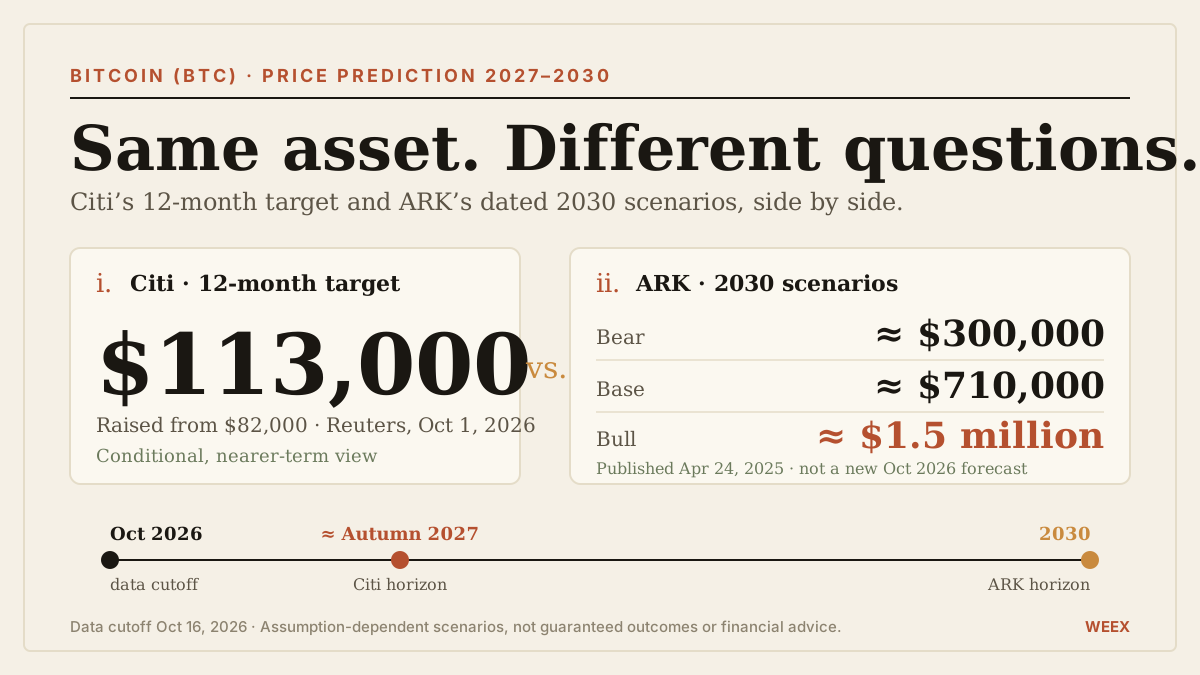
Bitcoin (BTC) Price Prediction 2027–2030: Citi’s $113,000 Target vs. Cathie Wood’s ARK Scenarios
Bitcoin price prediction for 2027–2030: compare Citi’s $113,000 target with ARK’s dated scenarios, demand assumptions, valuation math and key risks.

XRP (XRP) Price Prediction: Can BarriC’s $750 Target Pass the Market-Cap Test?
XRP price prediction: examine BarriC’s $750 target, market-cap math, next-bull-run scenarios, token demand and what could support a recovery to $5.
Musk Says He Will Give “One of My SpaceX Shares to Every Kid in America”: What the Post Says and What Is Still Unclear
Elon Musk said on October 19, 2026 that he will give one of his SpaceX shares to every kid in America next year. The post gave no details on delivery, eligibility or which shares. Estimates put the cost near $10 billion at recent SPCX prices, and a link to Trump Accounts remains unconfirmed.
Perp DEX Generates $125 Million in Fees Monthly, Who Really Gets Rewarded?
Freezing and Confiscation of Cryptos: Europe Strengthens Cooperation Against Criminal Networks
Hedera vs Algorand: Which Network is More Suitable?

Saudi Vrtx Raises $3.6 Million to Develop Its Integrated Financial Technology Infrastructure
The Lista DAO has launched the Dow Protocol E-Commerce Financing RWA Vault, with an APY currently reported at 10%
Lista DAO initiates a new proposal: to introduce the LISTA token economic model 2.0 and gradually phase out the veLISTA mechanism
The Lista DAO has updated the progress of the USR event, having repaid a loan of 8.4 million dollars, with risks nearly fully mitigated
Exchanging 200,000 for nearly 100 million, DeFi stablecoins face another attack
RootData: LISTA will unlock tokens worth approximately $3.43 million in one week
CMC20 Index Token Launches on BNB Chain


