
Bitcoin: Google Takes a Step Towards Reliable Quantum Computers

 Prefer us on Google


Google has demonstrated on its Willow processor a method that significantly reduces errors when creating a crucial component for universal quantum computing. This advancement brings research closer to useful quantum computers, but it still does not allow for breaking the signatures that secure bitcoins.
In Brief
- Google has made a major breakthrough in quantum computing with Willow, achieving an error reduction of about 40 times.
- Bitcoin remains out of reach of current quantum computers, despite the progress made by Google.
- Q-Day represents a long-term threat to the cryptographic signatures securing bitcoins.
- Some bitcoins are more exposed than others, particularly those with publicly visible keys.
- Transitioning to post-quantum cryptography becomes essential to protect Bitcoin before sufficiently powerful machines arrive.
Google Reduces a Major Quantum Error by 40 Times
While quantum computing aims at Bitcoin, the Google Quantum AI team announced on October 15 that it successfully tested the << magic state distillation >> on real hardware. This technique aims to produce highly reliable quantum states necessary for executing certain complex operations on an error-corrected quantum computer.
The results present several precise advancements:
- The error rate has been reduced by about 40 times compared to unprocessed states;
- Researchers achieved a logical fidelity of 99.99%;
- The experiment was conducted on Willow, Google's quantum processor;
- Only 8% of trials were retained after error detection;
- The method still needs to work at a much larger scale.
Magic states allow for performing operations essential for universal quantum computing. However, their production represents a considerable cost. According to some estimates, it could consume up to 95% of a quantum machine's capabilities, to the detriment of the calculations themselves.
Google's technique acts as a filter. It first places an imperfect state in a small area of the processor, then performs several coordinated measurements to discard defective trials. The retained states are then transferred to a broader correction code.
Google presents this experiment as the first hardware demonstration of a practical solution to this bottleneck. The company, while acknowledging that many technical obstacles remain, explains:
This success transforms a major theoretical idea into an experimentally demonstrated reality.
BTC Remains Out of Reach of Current Machines
The announcement does not mean that Willow can retrieve the private keys of Bitcoin wallets. It improves the quality of a resource necessary for future quantum calculations, but does not provide the number of qubits or the stability required to execute a full cryptographic attack.
Bitcoin notably uses the ECDSA signature algorithm on the secp256k1 curve. A sufficiently powerful quantum computer could apply Shor's algorithm to calculate a private key from a public key. It could then produce a valid signature and transfer funds without the owner's authorization.
In a study published in 2026, researchers from Google estimated that an attack against this cryptography could require at most 1450 logical qubits and about 70 million Toffoli-type operations. With certain assumptions about the hardware and error correction, fewer than 500,000 physical qubits might suffice to perform the calculation in a few minutes.
These estimates remain far from current capabilities. Corrected logical qubits require many physical qubits, as quantum systems remain sensitive to noise and quickly lose the information they manipulate. Google's demonstration pertains to an element of this future architecture, not to a cryptographically operational machine.
A fidelity of 99.99% does not correspond to the overall accuracy of the processor either. It measures the quality of a magic state produced during the experiment. Presenting this figure as proof that a quantum computer would be almost ready to attack Bitcoin would therefore be misleading.
-- Price
Q-Day Necessitates Bitcoin Preparation
The << Q-Day >> refers to the moment when a quantum computer can compromise current cryptographic systems. No reliable date can predict this event, but a migration of Bitcoin would require several years of research, development, and coordination.
Not all bitcoins have exactly the same exposure. Funds placed at addresses whose public key has never been revealed benefit from additional protection due to hashing. Old reused addresses, pay-to-public-key outputs, and transactions broadcasted in the mempool expose their public key more.
A sufficiently fast machine could theoretically calculate a private key between the broadcasting of a transaction and its confirmation. The old bitcoins attributed to Satoshi Nakamoto or lost for a long time raise another issue: their owners may no longer be able to migrate their funds to a post-quantum system.
The answer lies in new signatures resistant to quantum computation. However, their integration would require an upgrade of the protocol, new address formats, and a method for transferring existing funds. The community would also need to decide the fate of coins that would never migrate.
Google's advancement does not trigger Q-Day. It rather confirms that several previously theoretical obstacles are beginning to receive experimental solutions. For Bitcoin, the urgency is not to succumb to fear but to prepare for a transition before the threat becomes concrete.
This content is provided for general informational purposes only and doesn't constitute financial, investment, legal, or tax advice. Any events, rewards, online promotions, or related information mentioned herein should not be considered a recommendation, solicitation, or invitation to purchase, sell, trade, or otherwise deal in any crypto assets. Crypto assets are highly volatile and may result in loss. The availability of WEEX services, products, and related events may vary by region. You are responsible for ensuring that your participation is in accordance with applicable local laws and regulations.
You may also like

Bitcoin Recovery Faces Challenges as Exchange Reserves Rise and Spot Demand Turns Negative
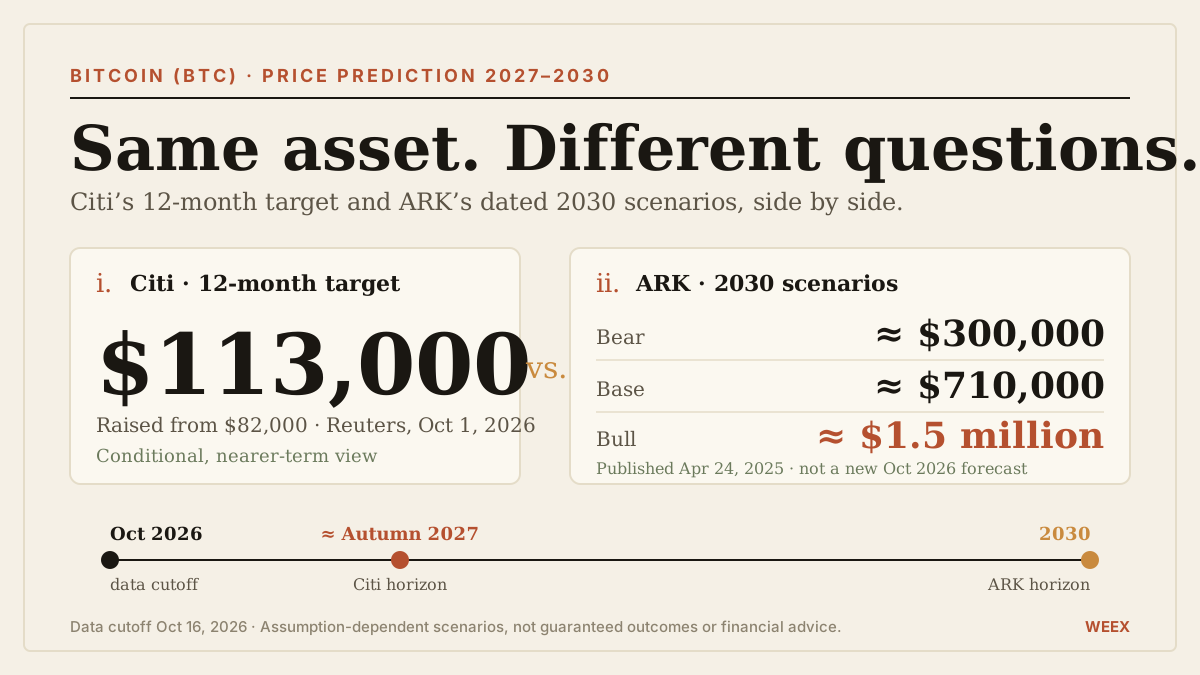
Bitcoin (BTC) Price Prediction 2027–2030: Citi’s $113,000 Target vs. Cathie Wood’s ARK Scenarios
Bitcoin price prediction for 2027–2030: compare Citi’s $113,000 target with ARK’s dated scenarios, demand assumptions, valuation math and key risks.

Mr&强 Analyzes BTC and ETH Short-Term Strategies

Bitcoin futures open interest declines, signaling weaker demand

Cathie Wood Predicts Long-Term Growth for Bitcoin Despite Dollar Strength
Peter Schiff Predicts Bitcoin Crash Over 99%
Liquidity in Cryptocurrency Market Approaches a Turning Point! Circle Aims to Enter 40 Emerging Markets

One dead, Qonto in flames, Nuñez resigns: why the streets worry crypto investors

Security Vulnerability Detected in ILITY Network, Cross-Chain Bridge Suspended

Bitcoin Spot ETF Sees Net Outflow of $229 Million Last Week, BlackRock's IBIT Leads with $165 Million Outflow

Morgan Stanley Recommends Up to 4% in Cryptocurrencies for Aggressive Portfolios

Deutsche Bank to Start Bitcoin and Ethereum Custody Within Weeks — Expansion to Asia by 2027

Bitcoin Ranges After Weekly Low Sweep| WEEX TradFi Daily(October 19, 2026)
Early on October 19, equity futures rebounded from last week’s chip selloff. Major indexes closed lower last week, the Nasdaq posted its worst week since June, the semiconductor ETF fell about 10%, and CoreWeave lost about 25%, while energy stocks were relatively resilient. Bitcoin traded near $82,000 after sweeping lows around $80,000, with markets watching the $79,800 and $83,600 zones.
WEEX Exclusive:Bitcoin Ranges After Weekly Low Sweep| WEEX TradFi Daily(October 19, 2026)

ECB: Lagarde defends rate hikes before the IMF and urges Brussels on digital euro

Sam Price Discusses Bitcoin Market Divergence

唐华斑竹 Analyzes Bitcoin Trends, Suggests Monitoring Support Levels

Saylor Envisions Bitcoin-Backed Stablecoin with Annual Yield of 6% to 8%

Strive CEO Emphasizes Going Long on Bitcoin and Short on USD, Claims Currency Depreciation is Irreversible

Bloomberg analyst warns BTC 50-week average decline may signal stock and metal downturns

Sam Price Focuses on Strategy Stock Price Drop and MSCI Index Adjustment

US Institutions See Net Inflows in Bitcoin as Demand for Dollar-Based Stablecoins Grows
Sam Price Focuses on the Hormuz Strait Tanker Incident, Crude Oil Prices Fluctuate
$4.8 Million Bitcoin Stolen from Scammer with Manipulated Ledger Wallet

Sazmining Offers Proto Hashboards at 4187 Dollars Each
Bitcoin or Dollar Returns: Same Strategy, Opposite Results
Bitcoin: AI Crash or Superabundance, Bitwise Sees Only One Winner

Bitcoin Mining Stocks Can Decline More Sharply Than Bitcoin

Crypto doesn’t need your party to win, just its candidates

Bitcoin’s Quantum Transition Won’t Stop at Bitcoin
Bitcoin Recovery Faces Challenges as Exchange Reserves Rise and Spot Demand Turns Negative
Bitcoin (BTC) Price Prediction 2027–2030: Citi’s $113,000 Target vs. Cathie Wood’s ARK Scenarios
Bitcoin price prediction for 2027–2030: compare Citi’s $113,000 target with ARK’s dated scenarios, demand assumptions, valuation math and key risks.
Mr&强 Analyzes BTC and ETH Short-Term Strategies
Bitcoin futures open interest declines, signaling weaker demand
Cathie Wood Predicts Long-Term Growth for Bitcoin Despite Dollar Strength
Peter Schiff Predicts Bitcoin Crash Over 99%
Contents
Latest articles




Latest coin listings on WEEX


