Bitcoin survived 5% yields but crypto’s cheap-money era did not

 Prefer us on Google


The US 10-year Treasury yield touched 5.34% on Oct. 1, its highest since 2002, capping a third quarter in which it climbed almost 90 basis points, the largest quarterly rise this century. Bitcoin gained about 43% over the same three months and Ethereum about 71%.
Bitcoin trades in the mid-$80,000s, and the clearest evidence of the yield shock sits in the financing built around it.
A 5% yield raises the bar, and Q3 buyers cleared it
The Federal Reserve's H.15 release for Oct. 1 put the 10-year at 5.29%, the 30-year at 5.64% and the 10-year real yield at 2.93%. Inflation-adjusted returns on government debt now compete with a coupon-free asset.
Bond yields climbed to new highs across the US, France, Germany, Japan and the UK, where 30-year borrowing costs reached 6% for the first time since 1998. Brent crude also moved back above $100 a barrel.
Against that backdrop, US-traded spot Bitcoin ETFs drew about $6.3 billion in the third quarter and Ethereum ETFs about $3 billion.
Citi raised its 12-month Bitcoin forecast to $113,000 from $82,000, citing stronger crypto activity, ETF inflows, and gradual adviser and brokerage allocations. Higher yields stayed a headwind, and other sources of demand outweighed it in the third quarter.
One quarter leaves the long-run relationship open, and ETF demand and adviser allocation shaped the outcome alongside yields.
On Sept. 23, a stronger PMI pushed yields higher, and Bitcoin slipped below $85,000, with $135.8 million of long liquidations in a single hour and $510 million over 24 hours.
A separate energy shock involving oil, bond yields, and Fed expectations triggered about $568 million in forced liquidations. The quarter's direction survived both events, and leveraged traders took the damage.
Bitcoin leverage gets repriced
On Sept. 25, open interest on selected exchanges fell 14.3% as Bitcoin held near $84,000 with the 10-year at 5.22%. Higher benchmark rates raise the cost of capital for explicit borrowing and implicit leverage such as perpetual futures, basis trades, options structures, and collateralized loans.
Macro shocks also lift volatility enough to force deleveraging inside a bull run.
Bitcoin treasury companies fund purchases through common equity, preferred stock, and convertible debt, according to Skadden. The model works when shares trade at a premium to net asset value, since selling stock for more than the crypto behind it buys more crypto per share.
Goodwin describes the sector's compression from premium valuations to NAV or below, with business models that depend on premium-priced equity and debt facing strain, and many treasury companies now trade at or below NAV.
Higher yields lift the return investors demand on preferred shares and convertibles, widen the risk premium on equity, and offer a higher risk-free alternative. Each of those raises the hurdle for a financing model that already depended on NAV premiums and cheap hybrid capital.
Individual discounts also reflect crypto-specific and company-specific factors, and yields shape the backdrop.
Treasury yields reach DeFi
A 2026 Finance Research Letters study using Aave data found stablecoin borrowing and deposit rates linked to US Treasury yields, with the 10-year showing the most consistent added explanatory power across maturities.
An ECB working paper on Aave found restrictive monetary shocks reduce both stablecoin borrowing demand and liquidity supply, with transmission depending on the balance between arbitrage and leverage channels.
Those links vary by market and period, and individual DeFi rates follow their own supply and demand. Bitcoin's spot price can move through a Treasury shock for weeks, and crypto's dollar funding markets feel it through borrowing costs.
In the zero-rate era, a 4% or 5% crypto yield looked attractive against cash that paid close to zero. At a 5% Treasury, DeFi yields must cover smart contract, liquidity, counterparty, stablecoin, oracle, and governance risk, and products need higher returns, leverage, token incentives, or different liquidity to compete.
RWA.xyz lists 108 tokenized US Treasury fund products, including USYC, USDY, BUIDL and iBENJI. The San Francisco Fed estimates stablecoin issuers' Treasury holdings could roughly double to about $400 billion by 2030 if recent growth continues.
-- Price
Where Bitcoin and its plumbing go from here
If the 10-year falls back below 5% as oil and inflation cool and adviser and brokerage allocations continue, Citi's $113,000 forecast becomes the reference for institutional demand.
Treasury-company premiums could reopen, basis trades would improve, and tokenized collateral adoption would broaden, which fits Citi's tokenization range of $5.5 trillion to $8.2 trillion by 2030.
If yields hold near 5% and real yields stay close to 3%, Bitcoin can keep rallying in bursts, with each data shock raising the odds of a liquidation flush.
Treasury-company discounts would persist, preferred and debt financing would cost more, DeFi borrowing rates would climb, and low-risk DeFi yields would lose appeal against tokenized Treasuries.
A disorderly bond or oil move would put the most weight on leveraged perpetuals, crypto-backed loans, and treasury-company debt and preferred stacks.
Bitcoin's price absorbed the third quarter's bond shock, and the financing around it took the repricing.
This content is provided for general informational purposes only and doesn't constitute financial, investment, legal, or tax advice. Any events, rewards, online promotions, or related information mentioned herein should not be considered a recommendation, solicitation, or invitation to purchase, sell, trade, or otherwise deal in any crypto assets. Crypto assets are highly volatile and may result in loss. The availability of WEEX services, products, and related events may vary by region. You are responsible for ensuring that your participation is in accordance with applicable local laws and regulations.
You may also like

QCP: AI Credit Risk Heats Up, Bitcoin May Face Range Breakthrough

French National Assembly Passes Tax Amendment on Stablecoin Transactions, Effective 2027

Bitcoin miner stocks driven by AI sentiment, not BTC prices

Black Monday Posts Break Records
Bitcoin Recovery Faces Challenges as Exchange Reserves Rise and Spot Demand Turns Negative
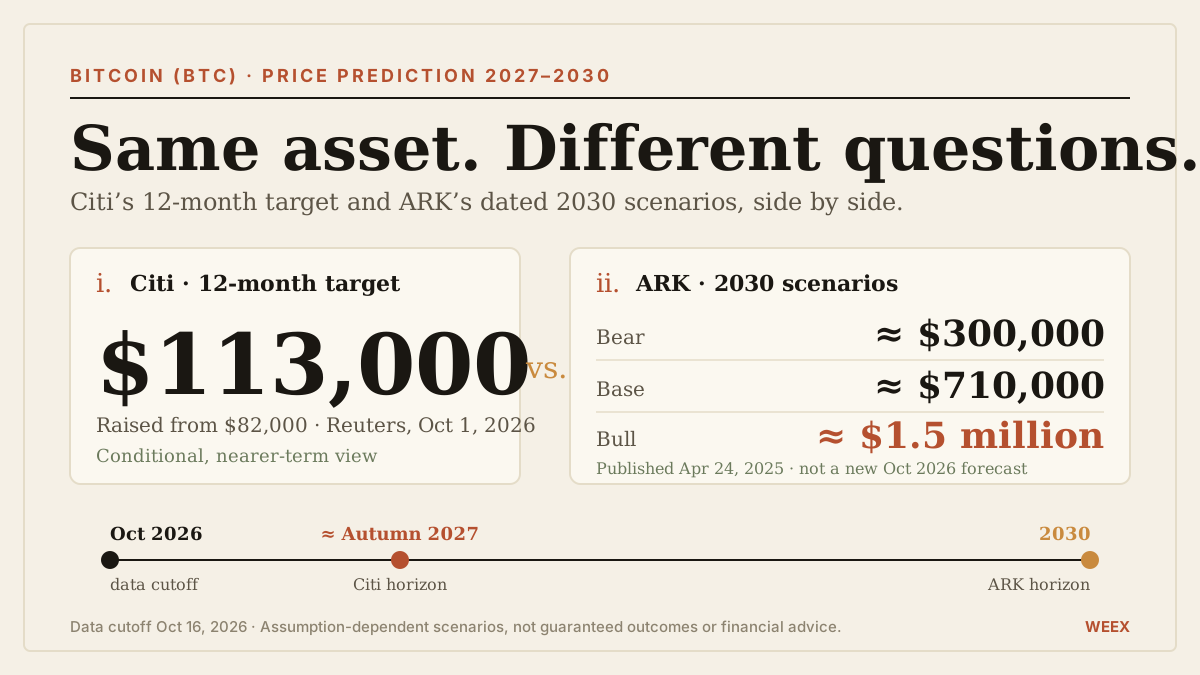
Bitcoin (BTC) Price Prediction 2027–2030: Citi’s $113,000 Target vs. Cathie Wood’s ARK Scenarios
Bitcoin price prediction for 2027–2030: compare Citi’s $113,000 target with ARK’s dated scenarios, demand assumptions, valuation math and key risks.

Mr&强 Analyzes BTC and ETH Short-Term Strategies

Bitcoin futures open interest declines, signaling weaker demand

Cathie Wood Predicts Long-Term Growth for Bitcoin Despite Dollar Strength

Peter Schiff Predicts Bitcoin Crash Over 99%
Liquidity in Cryptocurrency Market Approaches a Turning Point! Circle Aims to Enter 40 Emerging Markets

One dead, Qonto in flames, Nuñez resigns: why the streets worry crypto investors

Security Vulnerability Detected in ILITY Network, Cross-Chain Bridge Suspended

Bitcoin Spot ETF Sees Net Outflow of $229 Million Last Week, BlackRock's IBIT Leads with $165 Million Outflow

Morgan Stanley Recommends Up to 4% in Cryptocurrencies for Aggressive Portfolios

Deutsche Bank to Start Bitcoin and Ethereum Custody Within Weeks — Expansion to Asia by 2027

Bitcoin Ranges After Weekly Low Sweep| WEEX TradFi Daily(October 19, 2026)
Early on October 19, equity futures rebounded from last week’s chip selloff. Major indexes closed lower last week, the Nasdaq posted its worst week since June, the semiconductor ETF fell about 10%, and CoreWeave lost about 25%, while energy stocks were relatively resilient. Bitcoin traded near $82,000 after sweeping lows around $80,000, with markets watching the $79,800 and $83,600 zones.
WEEX Exclusive:Bitcoin Ranges After Weekly Low Sweep| WEEX TradFi Daily(October 19, 2026)

ECB: Lagarde defends rate hikes before the IMF and urges Brussels on digital euro

Sam Price Discusses Bitcoin Market Divergence

唐华斑竹 Analyzes Bitcoin Trends, Suggests Monitoring Support Levels

Saylor Envisions Bitcoin-Backed Stablecoin with Annual Yield of 6% to 8%

Strive CEO Emphasizes Going Long on Bitcoin and Short on USD, Claims Currency Depreciation is Irreversible

Bloomberg analyst warns BTC 50-week average decline may signal stock and metal downturns

Sam Price Focuses on Strategy Stock Price Drop and MSCI Index Adjustment

US Institutions See Net Inflows in Bitcoin as Demand for Dollar-Based Stablecoins Grows
Sam Price Focuses on the Hormuz Strait Tanker Incident, Crude Oil Prices Fluctuate
$4.8 Million Bitcoin Stolen from Scammer with Manipulated Ledger Wallet

Sazmining Offers Proto Hashboards at 4187 Dollars Each
Bitcoin or Dollar Returns: Same Strategy, Opposite Results
QCP: AI Credit Risk Heats Up, Bitcoin May Face Range Breakthrough
French National Assembly Passes Tax Amendment on Stablecoin Transactions, Effective 2027
Bitcoin miner stocks driven by AI sentiment, not BTC prices
Black Monday Posts Break Records
Bitcoin Recovery Faces Challenges as Exchange Reserves Rise and Spot Demand Turns Negative
Bitcoin (BTC) Price Prediction 2027–2030: Citi’s $113,000 Target vs. Cathie Wood’s ARK Scenarios
Bitcoin price prediction for 2027–2030: compare Citi’s $113,000 target with ARK’s dated scenarios, demand assumptions, valuation math and key risks.