Bitcoin's quantum-safe protection gets 82% cheaper as researchers race to secure 6 million exposed BTC

 Prefer us on Google


Researchers have cut the estimated computing cost of a specialized quantum-safe Bitcoin transaction by 82% to $59.
Data from the Quantum-Safe Bitcoin Optimization Challenge showed that improvements in graphics processing software reduced the projected expense from approximately $320 during StarkWare's first mainnet demonstration in August to $67 in September and $59 as of Oct. 13.
The breakthrough could make a specialized Bitcoin protection method more affordable as developers seek ways to safeguard cryptocurrency holdings against future quantum computers without waiting for changes to the network's underlying protocol.
The public competition, organized by StarkWare, Yukon Research, and Eigen Labs, used AI-assisted coding tools to accelerate the computational searches required for the transactions.
Its latest benchmark recorded more than 1 billion verified candidates per second on an Nvidia RTX 4090 GPU, up from an initial rate of approximately 146 million.
However, the $59 figure remains a hardware-dependent estimate based on simulated GPU workloads rather than a completed production transaction. Bitcoin network fees are separate, while some computing stages still rely on provisional assumptions.
StarkWare said the improvements make its proposed emergency protection method considerably cheaper to prepare, with researchers now targeting a computing cost below $10.
Quantum computing advances intensify Bitcoin security race
The development builds on research by StarkWare's Avihu Levy, who demonstrated in August that Bitcoin could support a quantum-resistant spending arrangement under its existing consensus rules.
Known as Quantum-Safe Bitcoin (QSB), the method uses hash-based cryptography and a computational puzzle to secure specially prepared Bitcoin holdings against attacks on conventional digital signatures.
The approach lets holders do the required calculations off-chain before spending their coins, potentially offering protection while developers work on broader changes to Bitcoin's cryptographic infrastructure.
That research has gained urgency as advances in quantum computing challenge previous estimates of how much computing power attackers would need to compromise cryptocurrency security.
In March, Google Quantum AI reported that future quantum computers could break the elliptic-curve cryptography used by Bitcoin with substantially fewer resources than previously estimated.
Its researchers calculated that certain attacks could theoretically complete in minutes using fewer than 500,000 physical qubits under specified hardware assumptions, a roughly 20-fold reduction from earlier estimates.
Although such machines remain beyond publicly demonstrated capabilities, the findings have increased pressure on blockchain developers to prepare before quantum attacks become practical.
The potential exposure is substantial.
According to a study by Glassnode, approximately 6.04 million BTC, representing 30.2% of Bitcoin's issued supply at the time, had public keys already visible on-chain.
The figure included 1.92 million BTC exposed through their underlying address structures and another 4.12 million BTC exposed through practices such as address reuse and previous spending activity.
A sufficiently powerful quantum attacker could theoretically derive private keys from those exposed public keys and gain control of the associated coins.
The threat has fueled debate over how quickly Bitcoin should adopt quantum-resistant cryptography, particularly given the complexity of introducing changes across a decentralized network.
QSB could offer an interim option, but it protects only eligible coins whose conventional public keys remain hidden until they are moved into specially constructed outputs.
That requirement leaves already-exposed holdings vulnerable if a capable quantum attacker emerges before owners can complete a secure migration.
The method also faces practical deployment restrictions. Although QSB transactions comply with Bitcoin's consensus rules, ordinary network relay policies reject them, requiring direct submission to miners willing to process them.
MARA's Slipstream service provided that route during the August demonstration.
Still, StarkWare continues to favor a broader Bitcoin protocol upgrade for long-term protection. Researchers must now demonstrate the latest computing savings in complete transactions and establish dependable miner access before QSB can become a practical fallback for holders.
-- Price
This content is provided for general informational purposes only and doesn't constitute financial, investment, legal, or tax advice. Any events, rewards, online promotions, or related information mentioned herein should not be considered a recommendation, solicitation, or invitation to purchase, sell, trade, or otherwise deal in any crypto assets. Crypto assets are highly volatile and may result in loss. The availability of WEEX services, products, and related events may vary by region. You are responsible for ensuring that your participation is in accordance with applicable local laws and regulations.
You may also like

Bitcoin Recovery Faces Challenges as Exchange Reserves Rise and Spot Demand Turns Negative
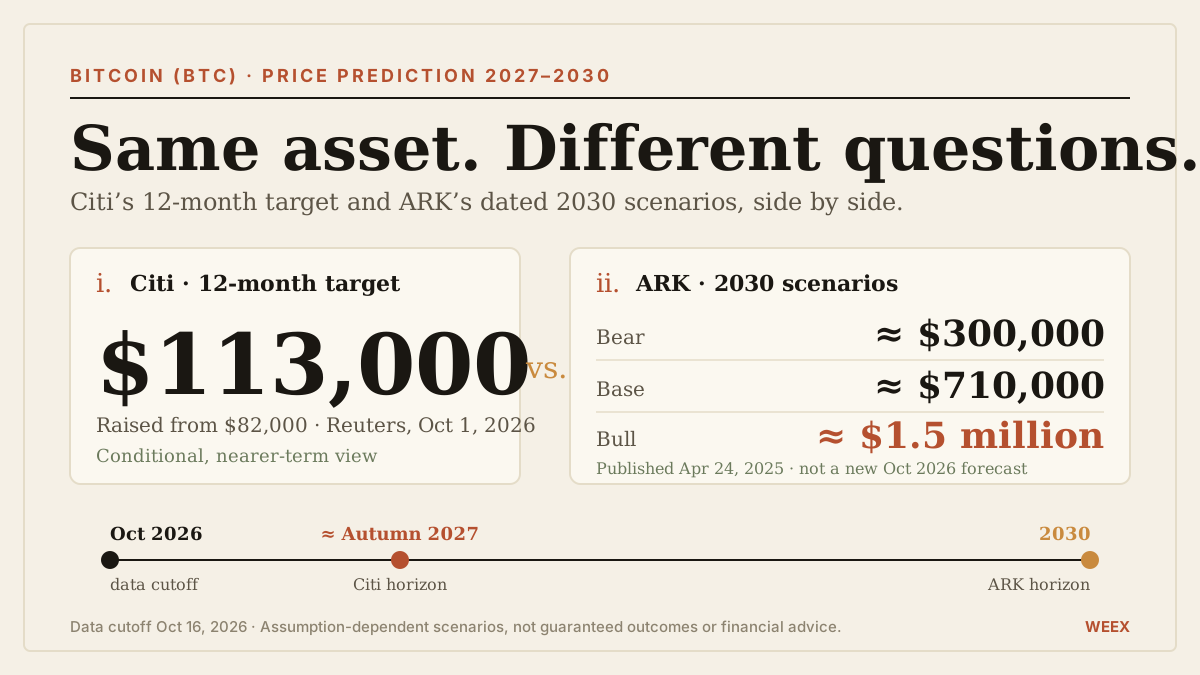
Bitcoin (BTC) Price Prediction 2027–2030: Citi’s $113,000 Target vs. Cathie Wood’s ARK Scenarios
Bitcoin price prediction for 2027–2030: compare Citi’s $113,000 target with ARK’s dated scenarios, demand assumptions, valuation math and key risks.

Mr&强 Analyzes BTC and ETH Short-Term Strategies

Bitcoin futures open interest declines, signaling weaker demand

Cathie Wood Predicts Long-Term Growth for Bitcoin Despite Dollar Strength
Peter Schiff Predicts Bitcoin Crash Over 99%
Liquidity in Cryptocurrency Market Approaches a Turning Point! Circle Aims to Enter 40 Emerging Markets

One dead, Qonto in flames, Nuñez resigns: why the streets worry crypto investors

Security Vulnerability Detected in ILITY Network, Cross-Chain Bridge Suspended

Bitcoin Spot ETF Sees Net Outflow of $229 Million Last Week, BlackRock's IBIT Leads with $165 Million Outflow

Morgan Stanley Recommends Up to 4% in Cryptocurrencies for Aggressive Portfolios

Deutsche Bank to Start Bitcoin and Ethereum Custody Within Weeks — Expansion to Asia by 2027

Bitcoin Ranges After Weekly Low Sweep| WEEX TradFi Daily(October 19, 2026)
Early on October 19, equity futures rebounded from last week’s chip selloff. Major indexes closed lower last week, the Nasdaq posted its worst week since June, the semiconductor ETF fell about 10%, and CoreWeave lost about 25%, while energy stocks were relatively resilient. Bitcoin traded near $82,000 after sweeping lows around $80,000, with markets watching the $79,800 and $83,600 zones.
WEEX Exclusive:Bitcoin Ranges After Weekly Low Sweep| WEEX TradFi Daily(October 19, 2026)

ECB: Lagarde defends rate hikes before the IMF and urges Brussels on digital euro

Sam Price Discusses Bitcoin Market Divergence

唐华斑竹 Analyzes Bitcoin Trends, Suggests Monitoring Support Levels

Saylor Envisions Bitcoin-Backed Stablecoin with Annual Yield of 6% to 8%

Strive CEO Emphasizes Going Long on Bitcoin and Short on USD, Claims Currency Depreciation is Irreversible

Bloomberg analyst warns BTC 50-week average decline may signal stock and metal downturns

Sam Price Focuses on Strategy Stock Price Drop and MSCI Index Adjustment

US Institutions See Net Inflows in Bitcoin as Demand for Dollar-Based Stablecoins Grows
Sam Price Focuses on the Hormuz Strait Tanker Incident, Crude Oil Prices Fluctuate
$4.8 Million Bitcoin Stolen from Scammer with Manipulated Ledger Wallet

Sazmining Offers Proto Hashboards at 4187 Dollars Each
Bitcoin or Dollar Returns: Same Strategy, Opposite Results
Bitcoin: AI Crash or Superabundance, Bitwise Sees Only One Winner

Bitcoin Mining Stocks Can Decline More Sharply Than Bitcoin

Crypto doesn’t need your party to win, just its candidates

Bitcoin’s Quantum Transition Won’t Stop at Bitcoin
Bitcoin Recovery Faces Challenges as Exchange Reserves Rise and Spot Demand Turns Negative
Bitcoin (BTC) Price Prediction 2027–2030: Citi’s $113,000 Target vs. Cathie Wood’s ARK Scenarios
Bitcoin price prediction for 2027–2030: compare Citi’s $113,000 target with ARK’s dated scenarios, demand assumptions, valuation math and key risks.
Mr&强 Analyzes BTC and ETH Short-Term Strategies
Bitcoin futures open interest declines, signaling weaker demand
Cathie Wood Predicts Long-Term Growth for Bitcoin Despite Dollar Strength
Peter Schiff Predicts Bitcoin Crash Over 99%