
- Buy Crypto
- Markets
 Futures
- Spot
- Copy Trade
- Earn
- More
Coinbase: What Is the Crypto Market Watching?

Original Title: Weekly: Business as Usual?
Original Source: Coinbase
Original Translation: Tao Zhu, Golden Finance
Summary
· Last week, both the cryptocurrency and traditional risk markets remained subdued as participants focused on the upcoming tariffs effective on April 2.
· Regulatory tailwinds for U.S. cryptocurrency remained strong. President Trump emphasized a focus on U.S. dominance at a digital asset summit, and the U.S. Securities and Exchange Commission hosted the first of five cryptocurrency special working group roundtable meetings on March 21.
· This week was significant for stablecoins. The House released a draft of the Stablecoin Act, World Liberty Financial plans to launch a stablecoin backed by U.S. Treasuries, Fidelity Investments is testing a USD-linked stablecoin, and Wyoming's multi-chain WYST entered the testnet.
Last week, trading in both cryptocurrency and traditional risk markets was subdued as participants awaited the tariffs effective on April 2. Nonetheless, on March 27, President Trump announced a 25% tariff on all imported cars, escalating market anxiety further by imposing reciprocal tariffs on trading partners. Despite this, the market performed relatively well, but we believe this was largely due to short-covering rather than fundamental trading. The spot and futures trading volume for BTC, ETH, and SOL on global centralized exchanges remained lackluster, although this is typically a time when we see month-end portfolio rebalancing adding liquidity.
Another technical factor driving broader market activity was GameStop's announcement of issuing $1.3 billion in zero-coupon convertible senior notes maturing in 2030, to be used for future purchases of Bitcoin for its treasury. Over the past few months, several publicly traded companies (apart from Strategy, formerly MicroStrategy) have announced Bitcoin acquisitions, including Metaplanet, Solidion Technology, and Semler Scientific.
Meanwhile, regulatory tailwinds for cryptocurrency remained strong – especially in the U.S., as symbolized by President Trump's speech at a digital asset summit last week, where he emphasized the focus on U.S. dominance in the field and drew attention to ongoing work on stablecoin and market structure legislation.
Related to this, the U.S. Securities and Exchange Commission (SEC) hosted the first of five roundtable discussions on March 21, focusing on the conditions under which certain digital assets would be classified as securities. These discussions may form the framework of a crypto market structure bill, with further discussions on custody, tokenization, DeFi, and other topics set to take place before June 2025. The Senate recently passed a resolution (70 votes in favor) to repeal the IRS's DeFi reporting rule, awaiting approval from President Trump.
Stablecoins and Multi-Chain
Regarding stablecoins, the House of Representatives released the full text of the Stablecoin Transparency and Accountability to Build Better Ledger Economic (STABLE) Act on March 26, outlining the preliminary direction of the forthcoming legislation. It is noteworthy that the act prohibits paying interest or returns to stablecoin holders and prohibits the creation of new algorithmic stablecoins (i.e., collateralized stablecoins) for two years. The act also outlines reserve and transparency requirements for issuers and establishes an approval process for entities seeking to issue new tokens.
Meanwhile, many other new stablecoins have made progress. World Liberty Financial announced plans to launch its own treasury-backed stablecoin. Fidelity Investments is testing a stablecoin (though its launch plans have not been confirmed yet), and Wyoming is entering the testing phase of its Wyoming Stable Token (WYST). We believe Wyoming's stablecoin launch strategy is particularly interesting as it underscores that while the focus is currently on Ethereum, tokenization may evolve into a multi-chain phenomenon in the long run.
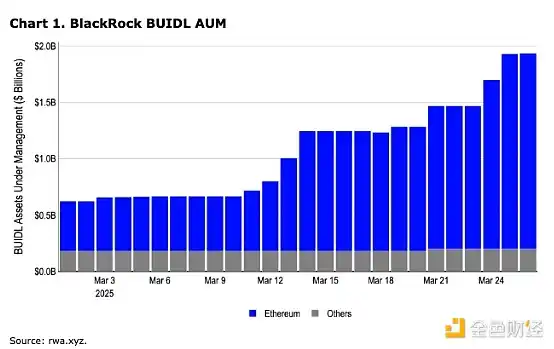
Wyoming has partnered with LayerZero as its token issuance partner to launch WYST contracts on the Avalanche, Solana, Ethereum, Arbitrum, Optimism, Polygon, and Base testnets. Likewise, BlackRock has extended its on-chain treasury fund BUIDL to the Solana blockchain—joining Aptos, Arbitrum, Avalanche, Ethereum, Optimism, and Polygon, expanding the networks where investors can access its products.
Interest in tokenized treasury funds has been rapidly increasing, with $1.3 billion in additional AUM flowing into BUIDL this month (totaling $1.9 billion). While most of the current interest and liquidity are concentrated on Ethereum (90% of BUIDL's total supply is on Ethereum), branching out preemptively to different blockchain networks suggests that issuers may be willing to follow users and liquidity if the adoption pattern shifts.
Cryptocurrency and Traditional Asset Overview
Coinbase Exchange and CES Insights
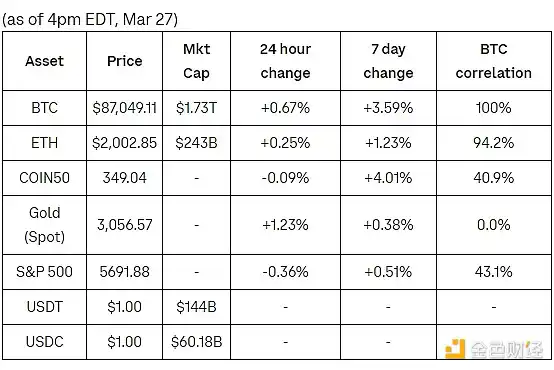
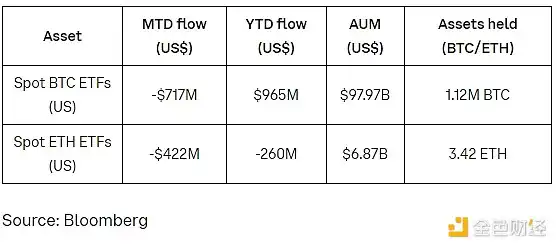
The cryptocurrency market witnessed a rebound. It has continued to correlate with the US stock market, with BTC reclaiming the key 200-day moving average. The Coin 50 Index also saw an uptick but remains in a downtrend, reflecting relative weakness in other cryptocurrencies. Unless there is unexpected economic data released, we expect range-bound volatility to persist at least until April 2, the deadline for President Trump's tariff imposition.
Single-digit perpetual funding, recent highs in stablecoin AUM, and short-term futures basis screening have highlighted low positions as traders patiently await further data before adding meaningful risk. Historically, April, May, and June have been challenging months for cryptocurrency assets, so maintaining a lower position may prove to be a prudent strategy.
Coinbase Platform Trading Volume (USD)
Trading Volume Segmented by Asset on the Coinbase Platform
Funding Rate
Week Ahead Preview
You may also like

Social Capital CEO: How Equity Tokenization is Reshaping Capital Markets from US Stocks to SpaceX?

CoinGecko Report: Surge of 346% vs Dip of 20.8%, The Wild Rise of DEX

a16z: The Real Opportunity of Stablecoins Lies Not in Disruption but in Filling Gaps

Mining Exodus: Someone Holds $12.8 Billion AI Order

March 6 Market Key Intelligence, How Much Did You Miss?

a16z: The True Opportunity of Stablecoins is in Complementing, Not Disrupting

Predict LALIGA Matches, Shoot Daily & Win BTC, USDT and WXT on WEEX
The WEEX × LALIGA campaign brought together football excitement and crypto participation through a dynamic interactive experience. During the event, users predicted matches, completed trading tasks, and took daily shots to compete for rewards including BTC, USDT, WXT, and exclusive prizes.

Ray Dalio Dialogue: Why I'm Betting on Gold and Not Bitcoin

Who Took the Money in the AI Era? A Must-See Investment Checklist for HALO Asset Trading
Wall Street Bears Target Ethereum: Vitalik In the Know Takes Flight, Tom Lee Remains Bullish
Pump.fun Hacker Steals $2 Million, Receives 6-Year Prison Sentence, Opts for 'Self-Detonation'

6% Annual Percentage Yield as Musk Declares War on Traditional Banks
36 years, 4 wars, 1 script: How does capital price the world in conflict?

Mining Companies' Great Migration: Some Have Already Secured $12.8 Billion in AI Orders
What Is Vibe Coding? How AI Is Changing Web3 & Crypto Development
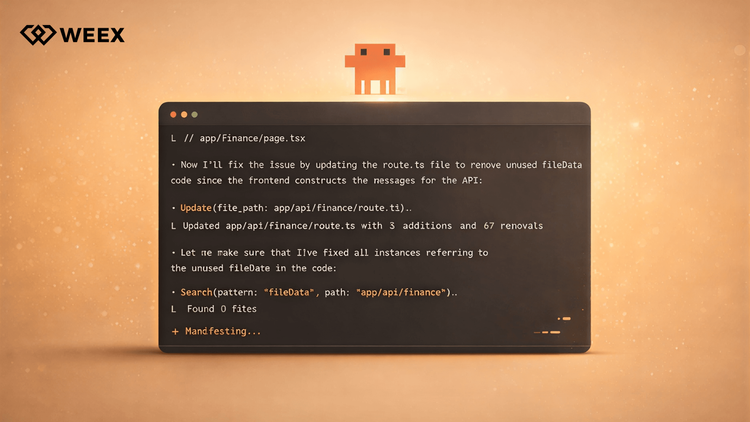
What is vibe coding? Learn how AI coding tools are lowering the barrier to Web3 development and enabling anyone to build crypto applications.
The parent company of the New York Stock Exchange strategically invests in OKX: The intentions behind the $25 billion valuation

WEEX P2P update: Country/region restrictions for ad posting
To improve ad security and matching accuracy, WEEX P2P now allows advertisers to restrict who can trade with their ads based on country or region. Advertisers can select preferred counterparty locations for a safer, smoother trading experience.
I. Overview
When publishing P2P ads, advertisers can now set the following:
Allow only counterparties from selected countries or regions to trade with your ads.
With this feature, you can:
Target specific user groups more precisely.Reduce cross-region trading risks.Improve order matching quality.
II. Applicable scenarios
The following are some common scenarios:
Restrict payment methods: Limit orders to users in your country using supported local banks or wallets.Risk control: Avoid trading with users from high-risk regions.Operational strategy: Tailor ads to specific markets.
III. How to get started
On the ad posting page, find "Trading requirements":
Select "Trade with users from selected countries or regions only".Then select the countries or regions to add to the allowlist.Use the search box to quickly find a country or region.Once your settings are complete, submit the ad to apply the restrictions.
When an advertiser enables the "Country/Region Restriction" feature, users who do not meet the criteria will be blocked when placing an order and will see the following prompt:
If you encounter this issue when placing an order as a regular user, try the following solutions.
Choose another ad: Select ads that do not restrict your country/region, or ads that allow users from your location.Show local ads only: Prioritize ads available in the same country as your identity verification.
IV. Benefits
Compared with ads without country/region restrictions, this feature provides the following improvements.
Aspect
Improvement
Trading security
Reduces abnormal orders and fraud risk
Conversion efficiency
Matches ads with more relevant users
Order completion rate
Reduces failures caused by incompatible payment methods
V. FAQ
Q1: Why are some users not able to place orders on my ad?
A1: Their country or region may not be included in your allowlist.
Q2: Can I select multiple countries or regions when setting the restriction?
A2: Yes, multiple selections are supported.
Q3: Can I edit my published ads?
A3: Yes. You can edit your ad in the "My Ads" list. Changes will take effect immediately after saving.



 App
App